
Mini-Split or AC in the Garage? Which Garage Door and R-Value Pay Off
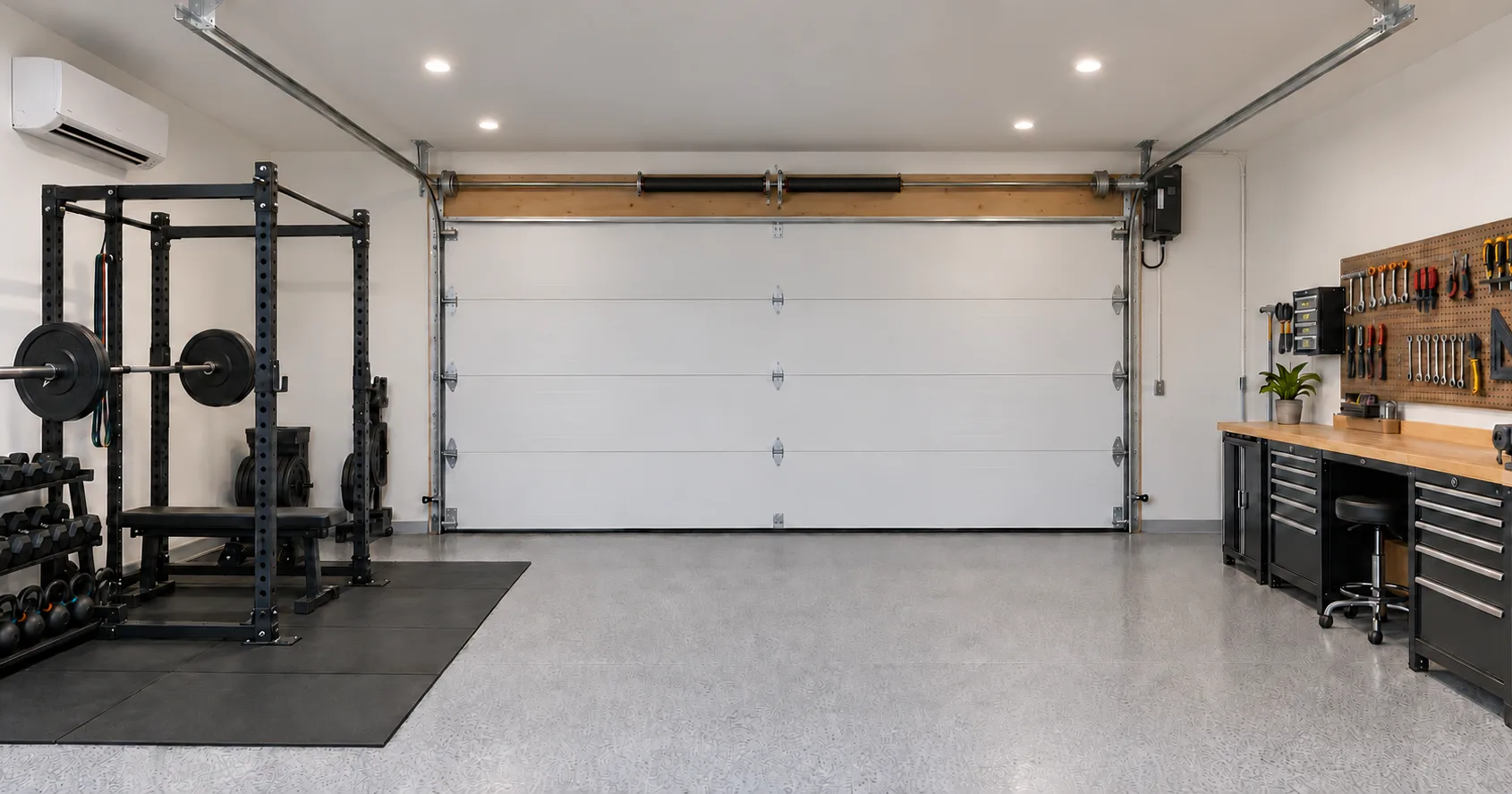
If you're adding a mini-split or any air conditioning to your garage, the garage door is the biggest weak spot in the room. Four things decide whether the AC wins:
- Get the door insulated at all. A bare steel door lets in many times more heat than any insulated door. That first step is the big one.
- For a garage you'll cool most days, pick polyurethane, R-12 to R-18. If the budget allows, we recommend R-18: the door will be on the house for 20 years or more. R-9 is a sensible budget floor. R-6 is built for garages nobody cools.
- Seal the gaps. Daylight at the bottom, sides or top lets hot air straight in, whatever the R-value on the sticker.
- Decide the door before the AC is sized, and keep the indoor unit clear of the springs, tracks and opener.
Below: what each R-value step actually buys in Arizona heat, how to seal the door you have, whether a retrofit kit is worth it, and where the mini-split can and can't go around the door hardware.
"The space is going to be conditioned, so which R-value should we get?" We hear some version of that every few weeks, usually from someone turning the garage into a home gym, a workshop, an office or a place to keep the car and the freezer out of 115° heat. It's a better question than most people realize. In a garage nobody cools, door insulation is a comfort upgrade. Once you're paying to run an air conditioner in there, the door decides how hard that air conditioner has to work every afternoon from May to October.
This guide is only about that situation. If you're still deciding whether an insulated door is worth it at all, start with insulated vs. non-insulated garage doors. If you want the background on what the number means, our garage door R-value guide covers it.
- Why the door is the biggest leak in a cooled garage
- What each R-value step actually buys
- Which R-value for your cooled garage
- Seal the door before the AC is sized
- Can you insulate the door you already have?
- Where the mini-split can go around the door
- The rest of the room matters too
- Is your door ready for a mini-split? Four quick questions
- FAQs
Why the Door Is the Biggest Leak in a Cooled Garage
Stand inside your garage and look at the door. A standard two-car door is 16 feet wide and 7 feet tall, about 112 square feet. That makes it the largest single surface in the room that isn't a solid wall, and it has four things working against an air conditioner:
- It's thin. Even a thick insulated door is about two inches of foam between two steel skins. A builder-grade door is a single sheet of steel with nothing behind it, and steel passes heat almost as if it weren't there.
- It takes the sun. On a lot of East Valley homes the garage faces the street, and when the street side faces west or south, the door takes the full afternoon sun. A dark door in that spot gets hot enough to burn your hand.
- It has edges on all four sides. A wall is sealed into the house. A door has to move, so it relies on rubber and vinyl seals at the bottom, both sides and the top, plus joints between every section.
- It opens. Every time the door goes up, the cooled air rolls out and the hot air rolls in. You can't insulate that away, but a door that seals tight when it closes recovers faster.
A ductless mini-split is the usual way to cool a garage, and it's a good one. But the unit only moves heat out. Every bit of heat the door lets in is heat the unit has to pull back out, and that's what decides how big a unit you need, how long it runs and what it costs you each summer. Fix the door side first and every other choice gets easier.
What Each R-Value Step Actually Buys
R-value measures how strongly something resists heat flow. The math behind it is simple enough to show here, and it explains why the first step matters so much more than the last one. The table below compares the heat that moves through the panels of a 16x7 door when it's 115° outside and you're holding the garage at 80°. It uses the R-value printed on the sticker, which is a best case; the real installed door comes after the table.
| Door | Panel R-value | Heat through the panels (best case) | Compared with bare steel |
|---|---|---|---|
| Single-layer steel, no insulation | About R-1 (the thin air layers on each side do most of the work) | About 3,900 BTU per hour | Baseline |
| Two-layer polystyrene | R-6.5 | About 600 BTU per hour | About 85% less |
| Polystyrene with a steel back | R-9.1 | About 430 BTU per hour | About 89% less |
| Three-layer polyurethane | R-12.9 | About 300 BTU per hour | About 92% less |
| Thick three-layer polyurethane | R-18.4 | About 210 BTU per hour | About 95% less |
For a sense of scale, a small 1-ton mini-split moves about 12,000 BTU per hour. A bare steel door on a 115° afternoon can eat up roughly a third of that by itself, before you count the walls, the ceiling or a single air leak. A good insulated door cuts that to a few percent, even after the real-world caveats below.
The R-values are the steps on the Clopay steel doors we install most; other brands land close to the same numbers. Three honest caveats about the table:
- It's the panels only, at their best. The rating describes the middle of one door section. Joints, hinges, windows and the edges all pass more heat, and a whole installed door does noticeably worse than the sticker. More on that just below.
- The sun makes it worse. A west-facing door in full afternoon sun gets far hotter than the air around it, so on that door the real numbers can be double these, for every row. That's where getting off bare steel matters most.
- It leaves out air leaks. A gap under the door can let in more heat than the panels do. That's the next section.
What a whole door actually does. The garage door industry is clear that a section's R-value doesn't describe the complete door, and that you can't convert one into the other. Some manufacturers have whole doors tested instead, and those results tell the real story. In one independent listing, a manufacturer's steel doors with about 2 inches of polyurethane tested at a U-factor of 0.12, roughly R-8 for the whole installed door. The same line with about 1 inch of polyurethane tested at 0.13. Twice the foam, nearly the same whole-door result, because the joints and edges leak about the same either way.
So the big win is getting off bare steel. Don't buy the top R-value expecting it to cut your cooling in half compared with the middle one; on a real door the top tiers land close together. We still recommend R-18 for a garage you'll cool most days, for two reasons. Polyurethane foam bonds to both steel skins, so the whole door is stiffer, quieter and harder to dent, and it stays flat and closes tighter after years of sun. And you buy a garage door once in 20 or more years, while you pay to cool the garage every summer.
Which R-Value for Your Cooled Garage
Here's how we'd match the door to the way the garage will be cooled. This is the same conversation we have on the phone and in driveways from Mesa to Queen Creek:
| How you'll cool the garage | What we'd pick | Why |
|---|---|---|
| Now and then: a portable or window unit on weekend projects | R-9 at least | You get most of the benefit; polystyrene is fine when the AC runs a few hours at a time |
| A mini-split running most days: gym, workshop, office, hobby space | R-12.9 to R-18.4 polyurethane | The door is part of the room's envelope now, and it should be built like it |
| The door faces west or south, or it's a dark color | R-18.4 | Sun load is the multiplier; a stiff polyurethane door also stays flatter and keeps sealing in full sun |
| A bedroom or living space above the garage, or a full garage conversion | R-18.4 | You're cooling the garage and protecting the room above it at the same time |
| Budget is tight | R-9 with good seals and a good install | A well-installed R-9 door that seals tight beats a high-R door with a gap under it |
R-6.5 doors are a real step up from bare steel and a fine choice for a garage you don't cool. For one you do, we'd start at R-9.
Windows and color. Glass is a fraction of the R-value of foam, and a west-facing window section lets the sun in directly. If you want windows in a cooled garage, keep them in the top section and ask for insulated glass. Color matters too: a dark door absorbs a lot more sun than a light one, which our guide to black garage doors in Arizona gets into. For door materials beyond steel, see the best garage doors for Arizona heat.
One more thing to plan for: an insulated door weighs more than a bare steel one, and the springs have to be sized to the new door's exact weight. On any new door we install, the springs are matched to that door; they aren't carried over from the old one.
Seal the Door Before the AC Is Sized
R-value only covers heat moving through the door. Air moving around it is a separate leak, and in a cooled garage it can be the bigger one, because the hot air comes straight in and the cold air spills straight out. Here's how to find the gaps:
- Do the daylight test. Close the door on a sunny afternoon, turn off the garage lights and let your eyes adjust. Look along the bottom, up both sides and across the top. Every line of light is a place where air gets in.
- Check the bottom seal. It should press flat against the floor across the full width of the door. Cracked, flattened or missing rubber is the most common gap we find, and Arizona sun wears it out faster than anywhere else.
- Check the side and top seals. These are the vinyl strips on the frame around the door, with a soft flap that presses against the door's face. Sun-baked flaps go stiff, shrink and pull away.
- Look at the corners. The bottom corners are where the bottom seal and side seals meet, and they leak first.
- Watch the door close. If it stops a little short of the floor, the seal never gets a chance to touch. On most openers that's a travel limit adjustment; our opener reset guide shows how on LiftMaster and Chamberlain models.
Replacing a bottom seal is a reasonable weekend job if the door sits level. Our guide to garage door weather seals in Arizona covers the types and how they wear.
Can You Insulate the Door You Already Have?
Retrofit kits, either foam boards or a foil-faced blanket that fit into the panels of a single-layer door, are sold for exactly this. They help some. But before you buy one for a garage you plan to cool, know what you're getting:
- The coverage is partial. The kit fits between the door's ribs and stiles, so the steel frame of the door is still bare and still passes heat. The result is well short of a factory-insulated door with the same number on the box.
- It adds weight the springs weren't set for. Your springs are balanced for the door you have now. Add a few pounds to every section and the door gets heavier to lift, the opener works harder, and the door may no longer stay put halfway up. Rebalancing the springs is a job for a pro, not a step in the kit's instructions.
- It does nothing for the seals. A kit on a door with daylight under it is still a leaky door.
A kit is a fair low-cost improvement for a garage you cool now and then. For a garage you'll cool most days, an older single-layer door is usually better replaced with a factory-insulated one, which comes with new seals and springs sized to its weight. If you've already added a kit and the door now feels heavy or drifts down on its own, that's a spring adjustment. In the East Valley? Call or text (602) 935-9766 and we'll rebalance it.
Where the Mini-Split Can Go Around the Door
Your HVAC installer decides where the unit goes for airflow and drainage. What they may not know is where your garage door goes when it opens, and a mini-split head or line set in the wrong spot gets hit by the door, or blocks a future repair. Before anyone drills, here are the zones to keep clear:
- The wall right above the door opening. On most doors this is where the torsion springs, the spring bar and its center bracket live, and the top section of the door swings up through that space as it opens. People search for "mini-split above garage door" a lot; in most garages, it's the one wall spot we'd rule out.
- The side walls up high, near the front. The door's horizontal tracks run back along each side wall, near the ceiling, for roughly the door's height plus about 18 inches on a standard setup. That's about 8½ feet back on a 7-foot door. A unit mounted inside that zone sits in the door's path.
- The middle of the ceiling. The opener rail and the open door itself fill that space. If you want a ceiling cassette, or just more room up there, a wall-mount opener that sits beside the door frees the ceiling. Wall-mount openers need torsion springs; see our opener installation page.
- The hardware itself. Never fasten a line set, bracket or drain line to the tracks, the track brackets or the spring anchor plate. Those parts carry the door's weight and spring tension.
- The floor near the door. Keep the condensate drain line and the line set away from the safety sensors (the little "eyes" a few inches off the floor on each side) and out of the path of the bottom seal.
Good spots are usually on a side wall behind the end of the tracks, on the back wall, or on a side wall below track height. In the East Valley? Text us a photo of the wall before anyone drills and we'll tell you where the door hardware runs.
The Rest of the Room Matters Too
We're garage door people, not HVAC contractors, so we'll keep this short. The door is the biggest single leak, but it isn't the only one:
- The ceiling and attic. Many garages have little or no insulation overhead, and the attic above a Phoenix garage gets far hotter than the outdoor air. Ask your HVAC contractor or an insulation company to look at it.
- The outside walls. Builders insulate the wall between the garage and the house, but the garage's outside walls often get less.
- The door into the house. Its weatherstrip matters more once both sides are cooled.
- A gas water heater or furnace in the garage. These may need vent openings for combustion air. Don't block or seal them while you tighten up the garage; ask the contractor who installs your AC.
- Tying into the house's ducts. Building codes limit mixing garage air into the house's heating and cooling system, which is one reason a separate mini-split is the usual route. Your HVAC contractor will know the local rules.
For the full list of ways to bring a garage's temperature down, with or without AC, see why your garage is so hot in Phoenix. Charging an EV in there too? Our EV charging and garage heat guide covers where the charger goes around the door.
Is Your Door Ready for a Mini-Split? Four Quick Questions
Answer these from inside the garage with the door closed. Look, but don't touch the springs or cables.
A single-layer steel door, or a door that feels heavy, sits crooked or has a loose or frayed cable, will fight your mini-split, and a heavy or crooked door or a damaged cable should be looked at right away whether you add AC or not. Daylight around the edges or full afternoon sun on the door means you should fix the seals and plan for a higher R-value.
Sort out the door before the AC goes in.
As it is, this door will fight your mini-split all summer, and you'd be sizing the unit around a problem. If the door is heavy or crooked, or a cable is loose or frayed, that needs a repair right away, AC or not; don't keep running the opener on it. In the Phoenix area, book a door visit or call (602) 935-9766. We'll check the springs and balance and quote an insulated door at two R-values side by side, in writing. Somewhere else? Ask a local garage door company for the same thing before your HVAC contractor sizes the unit.
Close. One fix first.
If you saw daylight, start with the seals; that's the cheapest improvement you can make. If the door takes the afternoon sun, plan on the higher end of the R-value range when the door is replaced, and keep that side in mind when the unit is sized. In the East Valley, text us a photo of the door from inside and we'll tell you what we'd do first.
Your door is ready.
Tell your HVAC contractor the door's R-value so they can size the unit around it. It's usually on the manufacturer's label on the inside of the door, often on the top section or an end stile, or in your purchase paperwork. Then check where the unit can go before anyone drills.
Why East Valley Homeowners Call Farnsworth Before They Cool the Garage
Farnsworth Garage Door Service was founded by brothers Brigham and Riley Farnsworth, and we run it the way our family has always run businesses in the East Valley: tell the truth, put the price in writing, and do the work right the first time.
- Two R-values, side by side. Ask, and we'll quote the same door at two insulation levels, so you can see exactly what the step up costs.
- We install insulated Clopay, Amarr and CHI doors with new perimeter and bottom seals, and springs sized to the new door's weight.
- Start with a photo. In the East Valley and planning a mini-split? Text us a photo of the door from inside and we'll tell you what we see.
- Licensed and insured in Arizona (ROC #351810), residential garage doors only.
See our garage door installation page, our weather seal replacement service, or where we work across the East Valley.
Frequently Asked Questions
What R-value garage door do I need for a garage with a mini-split?
For a garage you'll cool most days, choose a polyurethane door rated about R-12 to R-18. If the budget allows, R-18 is our pick, especially for a door that faces west or south. R-9 is a sensible budget floor. R-6 doors are built for garages nobody cools. Whatever you choose, seal the gaps around the door; a high R-value door with daylight under it still lets hot air in.
Can I put a mini-split in a garage without insulating the door?
You can, but the unit will work much harder. On a 115° afternoon, a bare single-layer steel door can let in roughly a third of what a small 1-ton mini-split removes, before counting walls, ceiling or air leaks. Expect the unit to run longer, and to need more capacity, than it would with an insulated door.
Is an R-18 garage door worth it over R-9 if I'm air conditioning the garage?
Usually, yes, when you cool the garage most days. Not because it halves the heat. On the sticker R-18 looks like half the heat of R-9, but tested whole doors land much closer together, because the joints and edges leak about the same either way. The bigger difference is construction: R-18 doors are polyurethane, so they're also stiffer, quieter, more dent-resistant and stay flatter in the sun. And the door will be there 20 years or more. On a tight budget, a well-sealed R-9 door is a reasonable choice.
Can I add an insulation kit to my existing garage door instead of replacing it?
You can, and it helps some, but a kit only covers the panels between the door's steel ribs and stiles, so it falls well short of a factory-insulated door. It also adds weight the springs weren't balanced for, so the door can get heavy and wear out the opener. If you add a kit, have the springs rebalanced by a pro. For a garage you'll cool most days, a factory-insulated door with new seals is usually the better buy.
Can a mini-split go on the wall above the garage door?
In most garages, no. The wall right above the door is where the torsion springs and their bracket sit, and the top section of the door swings up through that space when it opens. Also keep units out of the strip along each side wall near the ceiling where the horizontal tracks run, about the door's height plus 18 inches back from the door. A side wall behind the end of the tracks, the back wall, or a side wall below track height usually works.
Do windows in the garage door matter if I'm cooling the garage?
Yes. Glass has a fraction of the R-value of foam, and windows on a door that faces the afternoon sun let the heat straight in. If you want windows in a cooled garage, put them in the top section and choose insulated glass.
Will an insulated garage door make my opener or springs work harder?
Not if it's installed right. An insulated door weighs more than a single-layer steel door, but the springs should be sized to the new door's exact weight, so the door stays balanced and the opener only guides it. Problems come when springs are carried over from an old, lighter door, or when insulation is added to an existing door without rebalancing the springs.

Make Your Garage Worth Cooling
Licensed, insured, locally owned in Mesa, serving Gilbert, Chandler, Queen Creek and the Phoenix area. We'll quote an insulated door at two R-values side by side, install it with new seals and springs sized to its weight, and put every option in writing before any work. Planning a mini-split? Text us a photo of the door first.