
Garage Door R-Value Explained: What Insulation Number Actually Matters in Arizona
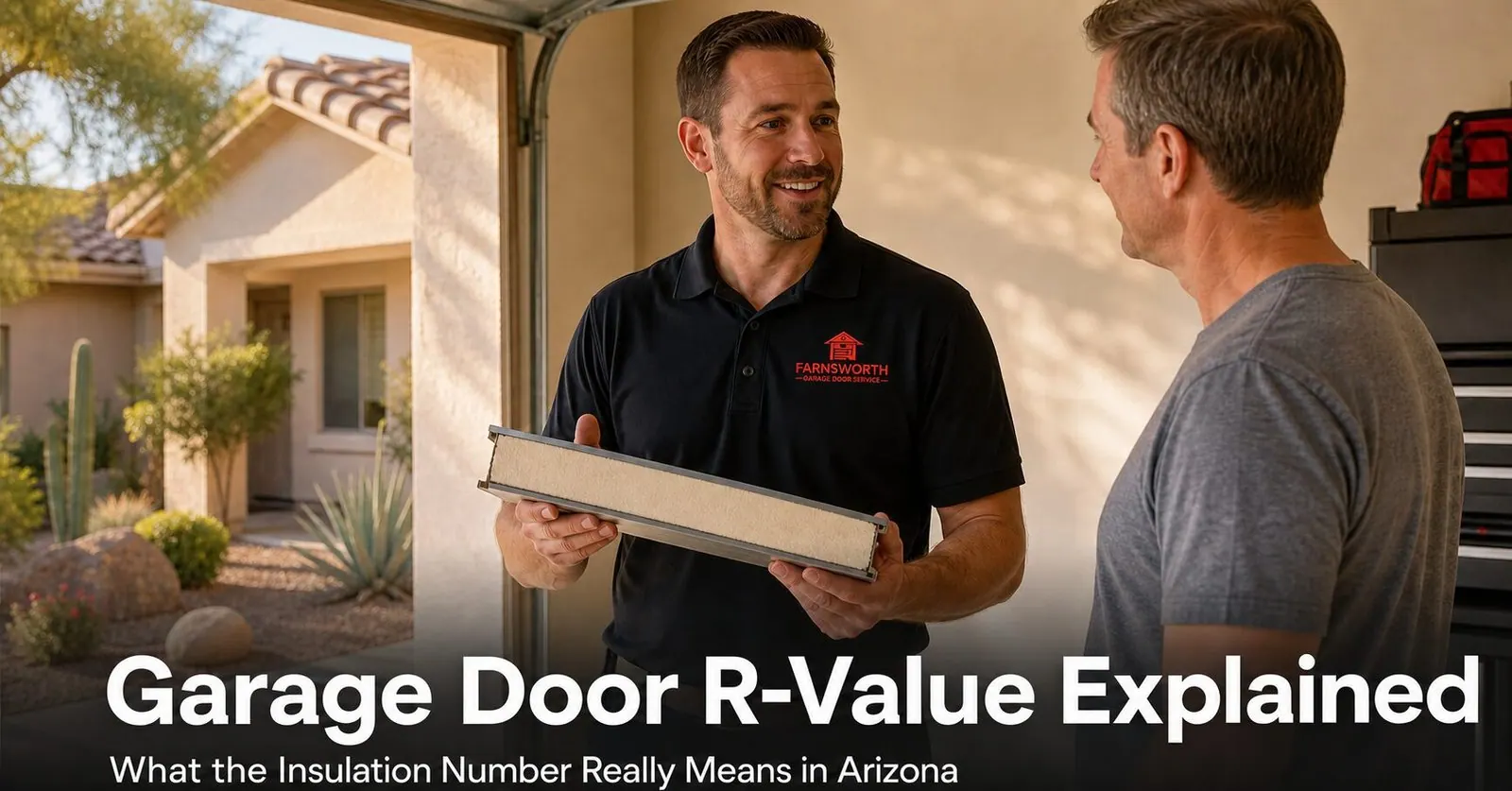
R-value measures how well a garage door resists heat flow — the higher the number, the slower Arizona's summer heat pushes through the panels. For most Phoenix-area homes:
- Attached garage (most Mesa and Gilbert homes): a three-layer polyurethane door around R-12 to R-18 is the sweet spot
- Detached garage, parking and storage only: a lower rating — or none — is a reasonable choice
- Bedroom above the garage, or a workshop inside it: aim for the top of the range
Two pieces of fine print the brochures skip: the advertised number describes the center of a panel in a lab, not the installed door — and doubling the R-value doesn't double the real-world performance. Construction type and seals matter as much as the number.
Shop for a new garage door anywhere in the Phoenix area and you'll run into a wall of numbers: R-6.5, R-9.1, R-12.9, R-18.4. The salesperson says higher is better, the price climbs with each step, and nobody quite explains what the number means or where it stops being worth it. That's what this guide is for. We've already covered whether an insulated garage door is worth it in Phoenix heat — the short answer is usually yes for attached garages. This post digs into the number itself: what R-value measures, the honest fine print behind it, and how to pick a rating that fits the way your garage actually gets used.
What R-Value Actually Measures
R-value is a measure of thermal resistance — how strongly a material resists heat flowing through it. It's the same rating system used for the insulation in your attic and walls. The higher the R-value, the slower heat moves from the hot side to the cool side.
In an Arizona July, the physics are simple and a little brutal. The sun loads your door's steel skin with heat all day — a west-facing door in Mesa or Queen Creek can get almost too hot to touch by late afternoon. An uninsulated door is a single sheet of steel, and steel is an excellent heat conductor, so that surface heat radiates straight into the garage. It's a big part of why Phoenix garages run so hot in the first place: the door is usually the largest single opening in the room, and on many homes it's the wall the afternoon sun hits hardest.
An insulated door puts a layer of foam between the outside skin and your garage. Heat still gets through eventually — nothing stops it entirely — but an R-13 or R-18 door slows it dramatically compared to bare steel. The garage still warms up on a 115° day; it just does so later, less, and more slowly, which also takes load off the house walls and any bedroom sitting above the garage.
The Fine Print: Lab Numbers and Diminishing Returns
Here's the part the brochures don't lead with. Two things about R-value are worth knowing before you pay for a bigger number:
1. The advertised R-value is a panel-center lab measurement
When a manufacturer says a door is R-18.4, that describes the insulated center of a panel measured under lab conditions. Your installed door also has panel joints, hinges and hardware that pass through the insulation, optional windows (glass is a fraction of foam's R-value), and a full perimeter where the door meets the opening. The door as a whole performs somewhat below the headline number — every brand, every model. That's not a scandal; it's just why the number should be read as a comparison tool between doors, not a promise about your garage's temperature.
2. Doubling the R-value doesn't double the benefit
Thermal resistance has diminishing returns. The jump from an uninsulated R-0 door to roughly R-9 blocks the large majority of the heat flow through the panels — that's the step you feel most. Going from R-9 to R-18 helps again, meaningfully, but it's a smaller real-world gain than the first step. And past the door itself, the rest of the room takes over: attic insulation above the garage, sun orientation, and how well the door seals at its edges and bottom. A high-R door with daylight showing under the bottom seal is losing the battle at the perimeter.
Single, Double, or Triple Layer: Why Construction Beats the Number
Behind every R-value is one of three ways a steel door is built — and the construction tells you more about how the door will live in your garage than the number does:
| Construction | Typical R-value | How it's built | What that means day to day |
|---|---|---|---|
| Single layer (non-insulated) | R-0 | One steel skin, open framework behind it | Lightest and most affordable; radiates summer heat straight into the garage, flexes and rattles more, dents show through |
| Double layer (polystyrene) | ~R-6 to R-9 | Steel skin + rigid foam board + inner backing | The affordable middle ground — a real step up in heat resistance and quietness over bare steel |
| Triple layer (polyurethane) | ~R-12 to R-18 | Foam injected between two bonded steel skins | The foam bonds to both skins, so the door is stiffer, quieter, and more dent-resistant — plus the best heat performance |
Notice what the third row is really telling you: polyurethane doors aren't just “more insulation.” Because the foam is expanded in place and bonds to both steel skins, the whole panel becomes a rigid sandwich. That stiffness is why a triple-layer door closes with a solid thunk instead of a tinny bang, shrugs off the stray basketball, and stays flatter over years of Arizona sun than a single skin that bakes and flexes daily. Every major manufacturer builds this way at the top of their residential lines — you'll see it across the Clopay, Amarr, and CHI doors we install. If you're weighing steel against other materials entirely, our guide to the best garage doors for Arizona heat covers that decision.
Comparing doors and drowning in spec sheets? Call or text (602) 935-9766 — we'll give you a straight answer for your exact garage.What R-Value Your Arizona Garage Actually Needs
There's no single right number — there's a right number for how the garage gets used. Here's how we walk homeowners through it on driveways from Mesa to Scottsdale:
| Your situation | Sensible target | Why |
|---|---|---|
| Detached garage, parking & storage only | R-0 to ~R-6 | No shared wall with the house; insulation is a comfort-and-durability upgrade, not a necessity |
| Attached garage, typical use | ~R-9 to R-13 | The garage shares walls (and often a ceiling) with cooled living space — slowing heat here eases the load on the whole house |
| Bedroom or living space above the garage | R-13 to R-18 | That room sits on top of your hottest space; a well-insulated door is one of the biggest levers you have for it |
| Workshop, home gym, or heat-sensitive storage | R-13 to R-18 | You're spending real time in there — and if you ever cool the space, insulation is what makes that worth doing |
| West- or south-facing door, full afternoon sun | Add a step up | Sun orientation is the multiplier — the doors that take the full Arizona afternoon benefit most from every point of R-value |
One more Arizona-specific note: R-value is a year-round worker here. The same foam that slows heat coming in during July keeps the garage from going cold on those 35° desert winter mornings — a small thing, until it's your gym or your workbench at 6 a.m. in January. When you're ready to compare actual doors, our garage door installation team can show you panel cross-sections side by side so you can see exactly what each rating buys.
What Insulation Changes Beyond Temperature
The R-value conversation is usually framed around heat, but the construction behind the number changes three other things you'll live with daily:
- Noise. Insulated panels are stiffer and damped — they don't drum and rattle the way a single steel skin does. If the garage sits under a bedroom, this alone can justify the upgrade.
- Durability. Bonded polyurethane construction resists dents and panel flex, and stays truer over years of daily sun-baking — a real factor on unshaded Arizona driveways.
- Weight. Insulation adds real weight to the door. That's fine — expected, even — as long as the torsion springs are sized to the door's exact weight, which is part of any professional install. It matters because an under-sprung heavy door forces the opener to lift weight it was never designed to carry, wearing out both. If you're upgrading an older door, the spring system gets matched to the new weight, not carried over.
Why Neighbors Ask Farnsworth Before Buying an Insulated Door
Farnsworth Garage Door Service was founded by brothers Brigham and Riley Farnsworth. The Farnsworth name carries 60+ years of family business across Mesa and the East Valley — R&K, Farnsworth Wholesale, Farnsworth Realty — and we run this company the same way: tell the truth, put it in writing, fix it right the first time.
- We match the rating to the garage, not the invoice. If your detached storage garage doesn't need R-18, we'll say so — and tell you where that money does more good.
- We install the whole system for the door's weight. Springs sized to the new door, opener checked against it, seals fitted tight — the details that decide whether the spec sheet shows up in real life.
- We carry the major lines. Clopay, Amarr, and CHI insulated doors across every construction tier, so the comparison happens in your driveway, not a showroom.
- 5.0 stars on Google from homeowners across Mesa, Gilbert, Chandler, and Queen Creek who got a straight answer first and a clean install second.
Frequently Asked Questions
What is a good R-value for a garage door in Arizona?
For an attached garage in the Phoenix area, a three-layer polyurethane door in the R-12 to R-18 range is the sweet spot — enough insulation to take the edge off summer heat and quiet the door, without paying for performance the space can't use. A detached garage used only for parking can be comfortable at a lower rating or even uninsulated, while a garage with a bedroom above it or a workshop inside benefits from the top of the range.
What does garage door R-value actually measure?
R-value measures resistance to heat flow — how slowly heat passes through the door's panels. The higher the number, the longer it takes Arizona's summer heat to work its way through the steel and into your garage. It's the same rating system used for attic and wall insulation, applied to the door's sandwich of steel and foam.
Does a higher R-value garage door really keep the garage cooler?
Yes, but with diminishing returns. The jump from an uninsulated door to roughly R-9 makes the biggest real-world difference; going from R-9 to R-18 helps again, but doubling the R-value does not double the performance. The door is also only one surface of the garage — attic insulation above it, sun exposure, and how well the door seals around its edges all shape the temperature you actually feel.
What's the difference between polystyrene and polyurethane garage door insulation?
Polystyrene is a rigid foam board fitted between the door's steel skins — think of a firmer version of cooler foam — and typically delivers roughly R-6 to R-9. Polyurethane is foamed in place, expanding to bond directly to both steel skins, which delivers roughly R-12 to R-18 in the same panel thickness plus a stiffer, quieter, more dent-resistant door. That bonded construction is why polyurethane doors feel noticeably more solid.
Is the advertised R-value true for the whole garage door?
Not exactly. Advertised R-values describe the insulated center of a panel measured in a lab. The installed door — with its panel joints, hardware, windows if you add them, and the perimeter where the door meets the opening — performs somewhat below that headline number. That's normal across every brand, and it's why the construction type and the quality of the seals matter as much as the number on the brochure.
Do I need an insulated garage door if my garage is detached?
If a detached garage is just parking and storage, insulation is optional — there's no shared wall with the house to protect. It still buys you a quieter, stiffer, more durable door, and it matters more if you store anything heat-sensitive or use the space as a shop. For attached garages, which most Mesa and Gilbert homes have, insulation earns its keep because the garage shares walls, and often a ceiling, with living space.
Does an insulated garage door weigh more, and do my springs need to handle that?
Yes — insulation adds real weight, especially polyurethane three-layer construction. That's not a problem when the door is installed correctly, because the torsion springs are sized to the exact weight of the door so it feels nearly weightless to lift. It is a problem if someone swaps in a heavier door without re-spring-ing it, which strains the opener and wears parts fast. Any professional installation includes springs matched to the new door's weight.

Ready to See What Each R-Value Actually Buys?
Licensed, insured, locally owned. We'll look at your garage, your sun exposure, and how you use the space — then recommend the insulation level that earns its cost, with a written quote and no upsell theater. Same-day service is our standard, often within hours of your call.