
Insulated vs Non-Insulated Garage Doors: Worth It in Phoenix Heat?
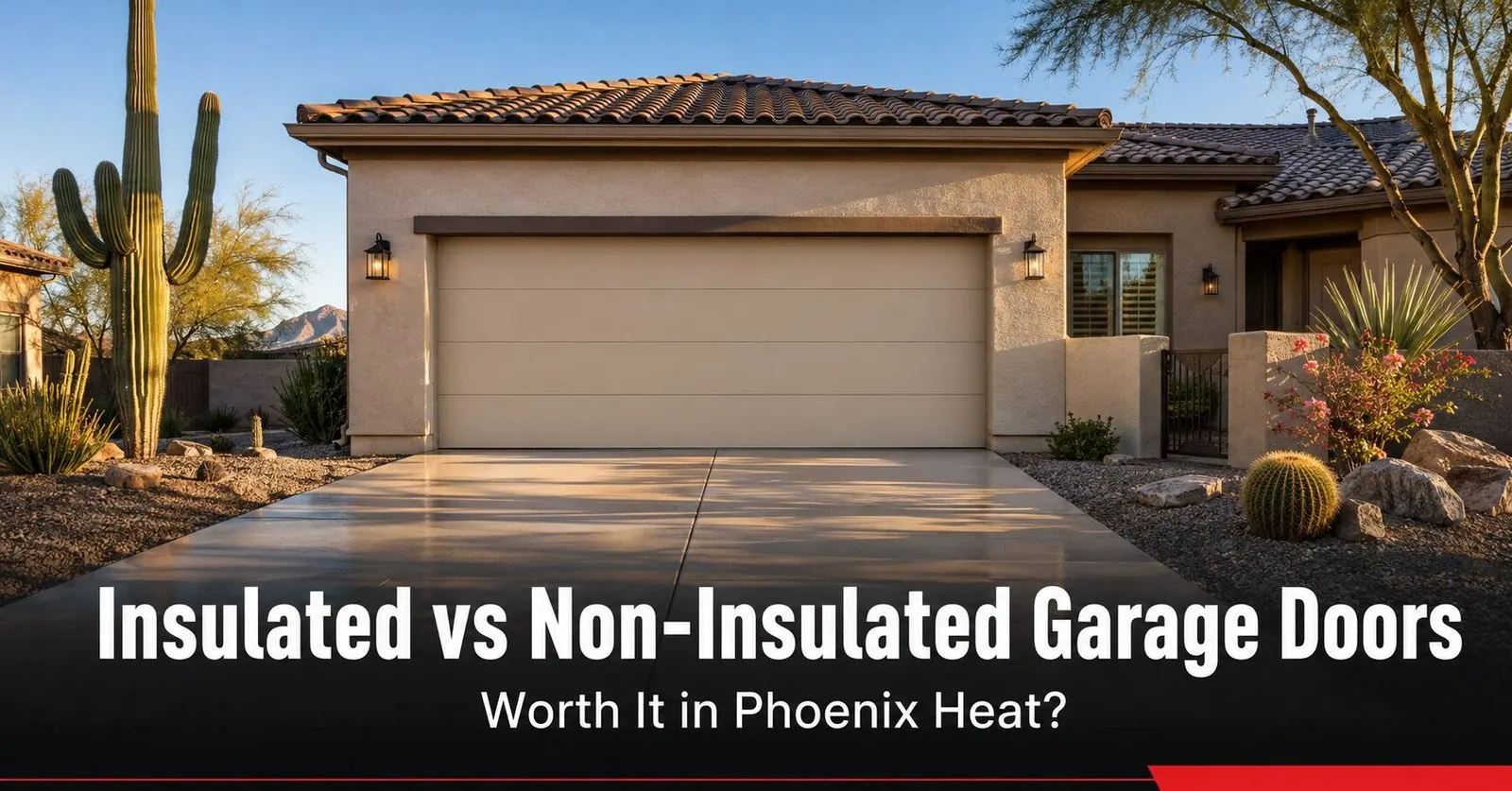
For most attached-garage homes in the Phoenix area, an insulated garage door is worth the upgrade — not because it makes the garage cool on a 115° day, but because it slows the heat soak into the house, takes load off your air conditioner, dramatically reduces noise, and lasts noticeably longer than a single-skin uninsulated door. Here's how the math breaks down:
- Uninsulated (R-0): Fine for detached garages and shops. Loud, prone to denting, runs the hottest. Cheapest sticker price.
- Entry insulated polystyrene (R-6 to R-9): A real improvement, foam board sandwiched between steel skins. Good budget upgrade.
- Polyurethane (R-12 to R-18): The sweet spot for Arizona. Injected foam bonds to both steel skins — quietest, most durable, biggest heat-soak reduction.
- Above R-18: Diminishing returns on a residential door. Fix the side seals, top seal, and bottom sweep first.
If your garage is attached, shares a wall with a bedroom or living room, gets used as a workshop or gym, or sits on the west side of the house catching afternoon sun — an insulated polyurethane door pays you back in comfort, a quieter, less-stressed HVAC system, and resale value. If the garage is fully detached and used only for parking, the upgrade is mostly about door durability and noise, not energy.
The "is an insulated garage door worth it in Phoenix?" question comes up on almost every new-door quote we write. It's a fair question, and a lot of the answers floating around the internet are written by people who've never spent a July afternoon in a Mesa garage. So this guide is the honest version: how insulation actually behaves in Arizona heat, the real differences between the insulation types, when the upgrade is a no-brainer, and when we'll tell you to skip it.
- How garage door insulation actually works in Arizona
- The three insulation tiers, in plain English
- Side-by-side comparison
- Five scenarios where insulation is worth every penny
- Three scenarios where you can probably skip it
- The HVAC and comfort math
- The noise difference most homeowners underestimate
- Why the seals matter as much as the R-value
- FAQs
How Garage Door Insulation Actually Works in Arizona
Most homeowners assume insulation is about keeping things cool. In Arizona, it's the opposite — it's about slowing the heat coming in. Your garage door is the single biggest piece of metal facing the sun on the front of most East Valley homes. On a 110° July afternoon, that uninsulated steel skin can hit 150°F+ on the outside surface. All of that heat radiates inward.
An uninsulated single-skin door is essentially a frying pan you've bolted to your house. There's nothing between the hot steel and the interior of the garage but a thin layer of paint. Within an hour or two of midday sun, an attached garage with an uninsulated door routinely runs 125–140°F inside — and that heat then conducts through the shared wall into a bedroom, an office, or a living room, forcing your air conditioner to fight a losing battle on that side of the house.
An insulated door doesn't stop the heat. It slows it down. Polyurethane foam is a poor conductor of heat, so instead of the door reaching peak garage temperature quickly, the heat soak takes most of the day. By the time the foam core has fully warmed through, the sun has moved off the west-facing door and things are starting to cool down. That delay is the whole game.
The cooler garage also makes everything inside the garage last longer — the opener's logic board, paint cans, tools, the rubber compound on car tires, the chemicals in fertilizer and pool supplies. None of those are designed for the 140° environment an uninsulated garage creates in July.
The Three Insulation Tiers, in Plain English
Walk into any showroom and the salesperson will throw R-values at you. R-value is a number that measures resistance to heat flow — higher is better. But the R-value alone doesn't tell you everything. The construction method matters as much as the number on the sticker.
Uninsulated (R-0): Single-skin steel
One thin layer of painted steel. That's it. You can see the ribs and stiles from inside the garage because there's no inner skin. Common on builder-grade entry-level doors and on detached-garage installs where insulation doesn't matter. Clopay's Gallery base tier and Amarr's Heritage line both have R-0 options at the bottom.
- R-value: R-0
- Construction: Single layer of 25–27 gauge steel
- Heat performance in AZ summer: Worst — garage can hit 125–140°F by mid-afternoon
- Sound damping: None — door operates like a drum
- Durability: Lowest — prone to denting, oil-canning, and panel flex
- Best for: Detached garages, shops, budget builds, garages used only for parking
Polystyrene (R-6 to R-9): Entry-level insulated
A pre-cut foam board sandwiched between the outer steel skin and a thin inner steel or vinyl skin. The foam isn't bonded chemically — it's just placed between the two surfaces, with air gaps at the edges and at the section joints. Real improvement over R-0, but the structural and sound-damping benefits are modest because the layers aren't unified into a single rigid panel. Clopay's Classic Collection and Amarr's Olympus line live in this tier.
- R-value: R-6 to R-9
- Construction: Outer steel + foam board + thin inner skin
- Heat performance in AZ summer: Noticeable improvement over R-0, but not the big jump
- Sound damping: Light — the door is quieter, but the layers still rattle independently
- Durability: Better than uninsulated; foam can separate from the steel skin after many years of extreme heat cycling
- Best for: Budget-conscious upgrades, secondary garages, rental properties
Polyurethane (R-12 to R-18): The Arizona sweet spot
Liquid polyurethane foam is injected into the panel during manufacturing. It expands to fill every cavity, chemically bonds to both the outer and inner steel skins, and creates a single rigid sandwich with zero air gaps. The difference in real-world performance versus a polystyrene door is bigger than the R-value numbers would suggest, because the bonded panel acts as a unified insulator and as structural reinforcement. Clopay's Premium and Bridgeport lines, Amarr's Lincoln and Classica, and CHI's 3283/3285 series all live here.
- R-value: R-12 to R-18
- Construction: Outer steel + injected polyurethane foam bonded to both skins + inner steel skin
- Heat performance in AZ summer: Best — biggest reduction in heat soak into the garage and shared walls
- Sound damping: Substantial — door operates quietly, no rattle or drum effect
- Durability: Highest — rigid bonded panel resists denting, flexing, and panel separation
- Best for: Attached garages, homes with living space sharing a wall with the garage, west-facing doors, garages used as workshops/gyms
Side-by-Side Comparison
Here's how the three tiers stack up on the things that actually matter to an East Valley homeowner.
| Feature | Uninsulated (R-0) | Polystyrene (R-6 to R-9) | Polyurethane (R-12 to R-18) |
|---|---|---|---|
| Construction | Single steel skin | Foam board sandwiched between two skins | Injected bonded foam between two skins |
| Typical AZ garage temp on a 110° day | 125–140°F by mid-afternoon | 115–128°F | 105–120°F |
| Heat soak into shared wall | Significant | Reduced | Substantially reduced |
| Noise level when operating | Loud, drum-like | Quieter, some rattle | Quietest |
| Structural rigidity | Low — prone to denting | Moderate | Highest |
| Long-term durability in AZ heat | Steel paint UV-fades; oil-cans | Foam can loosen from skin over decades | Bonded panel stays intact |
| Inner appearance | Exposed ribs and stiles | Clean inner skin | Clean inner skin |
| Installed price tier (relative) | Lowest | Modest upgrade over R-0 | Mid-range upgrade over R-0 |
| Best fit | Detached garages, shops, parking only | Budget upgrade, rentals, secondary doors | Attached garages, AZ heat, shared walls |
Five Scenarios Where Insulation Is Worth Every Penny
1. Your garage shares a wall (or floor) with a living space
If a bedroom, office, kitchen, or living room shares a wall with the garage — or if there's a bonus room or master bedroom directly above the garage — insulation pays for itself the fastest. That shared wall is the path of least resistance for heat from a 130° garage into your air-conditioned house, and your HVAC system fights it 24/7 from June through September. A polyurethane door noticeably reduces the load on that zone of the house.
2. The garage faces west or south
A west-facing garage door catches direct afternoon sun for hours during the worst part of the Arizona day. By the time the door's outer skin starts to cool, it's already late evening. An insulated polyurethane door delays the heat soak long enough that the door surface never fully transfers peak heat into the garage interior. South-facing doors are nearly as bad in summer because the sun stays high. East- and north-facing doors get a partial pass — they take less direct heat — but they're not immune.
3. You actually use the garage
If the garage doubles as a workshop, a home gym, a hobby space, or a workout-bike corner, you're spending real time in there. A 105–115° garage with a polyurethane door and a small fan is bearable; a 135° garage with a single-skin door is not. We've seen homeowners abandon entire workshop setups in July because the heat made the space unusable.
4. You have a smart garage and an attached opener
Garage door openers are designed for the 130–140° range, but logic boards and capacitors hold up better the cooler the environment. The same goes for everything else stored in the garage: paint, automotive fluids, lithium-ion batteries on yard equipment, fertilizer, pool chemicals. A cooler garage means less degradation and longer service life across the board.
5. You're planning to sell within 5–10 years
Insulated polyurethane doors are a documented resale lever in Arizona. Buyers in the East Valley have been burned by hot-garage homes enough that "insulated garage door" reads as a real feature, not a checkbox. The remodel-cost-vs-resale studies on garage doors consistently show one of the highest ROI percentages of any home improvement, and the gap widens when the home is in a climate where the upgrade is genuinely useful.
Three Scenarios Where You Can Probably Skip It
1. The garage is detached
A detached garage doesn't share a wall with the living space, so the heat soak argument disappears. If you don't care about the temperature inside the detached garage (which most homeowners don't, for parking and storage), an uninsulated door is fine. The exception is if the detached garage is a workshop or guest space — then the calculus is the same as an attached garage.
2. The garage is rarely used and budget is tight
If the door's only job is to open in the morning and close at night, the garage doesn't connect to anything climate-controlled, and budget is the deciding factor — we'll quote you an uninsulated door without hesitation. We'd rather see you upgrade your hardware (rollers, opener, springs) than stretch into an insulated door you don't strictly need.
3. Your walls and ceiling aren't insulated either
An insulated garage door fighting alone against uninsulated stucco walls and an uninsulated ceiling makes a smaller dent than the same door does in a garage with insulated walls. If you're planning a serious garage conversion to conditioned space, the door is the easy part — budget the wall and ceiling insulation alongside it for the full effect. If you're not, the door alone is still helpful but the gains are limited.
The HVAC and Comfort Math
The clearest signal that your garage is hurting your air conditioner is what happens to your AC during a July evening. If your master bedroom (or any room sharing a wall with the garage) stays 3–6° warmer than the rest of the house at night, that's the garage heat soak leaking through the shared wall hours after sundown. The air conditioner short-cycles trying to catch up. Energy use climbs. The thermostat reads fine; the room reads hot.
An insulated polyurethane door cuts the peak garage temperature, but the more important effect is how quickly the garage cools off in the evening. An uninsulated garage holds heat well past midnight in mid-July because the bare steel and concrete have been absorbing it all day. An insulated garage starts shedding heat as soon as the sun's off the door, which means the shared wall stops radiating heat into the bedroom much earlier in the evening.
The energy savings vary by home. We've seen homeowners report 5–10% reductions on summer cooling bills after a door swap when the garage shares a wall with a living space. We've also seen homeowners report no measurable change in cost — but a real change in how comfortable that side of the house feels. Both can be true. The comfort piece is usually the one that makes the upgrade feel worth it long after the install.
The Noise Difference Most Homeowners Underestimate
An uninsulated steel door isn't just hot — it's loud. Without the foam core and inner skin, the door has nothing to absorb vibration. Every roller bump, every gust of wind hitting the panel, every chain pull from an opener overhead reverberates through the metal and into the house. If the master bedroom shares a wall with the garage, a 5:30 a.m. departure is going to wake people up.
The polyurethane foam core acts as sound damping in three directions: outside noise coming in, opener noise echoing through the door, and door noise transmitting to the shared wall. Pair an insulated door with a quiet belt-drive opener and 13-ball nylon rollers, and the difference inside the house is bigger than any single one of those upgrades would deliver on its own. (For a deeper dive on which opener to pair with an insulated door, see our opener cost guide.)
Why the Seals Matter as Much as the R-Value
Spending on R-18 polyurethane and ignoring the seals around the door is like buying a premium window and leaving it cracked open all summer. The bottom seal (sweep), the side jamb seals, and the top header seal are the gaskets that determine whether the door's insulation actually works in practice. A door rated R-18 with a half-inch gap at the bottom corner is functionally an R-6 door — the air just goes around the insulation.
Arizona conditions are especially hard on bottom seals: heat cycles the rubber, monsoon dust abrades it, and the constant up-down opens hairline cracks within a few years. We always recommend inspecting and (if needed) replacing the bottom seal, side seals, and threshold as part of any door upgrade. It's a small cost relative to a new door, and it's the difference between an insulated door that performs and one that just looks like it should. Our weather stripping and bottom seal page walks through what we typically replace.
Why East Valley Homeowners Call Farnsworth for Insulation Upgrades
Farnsworth Garage Door Service was founded by brothers Brigham and Riley Farnsworth. The Farnsworth name has 60+ years of family business across the East Valley behind it — R&K, Farnsworth Wholesale, Farnsworth Realty — and we run this company the same way our family has always run a business: tell the truth, put the price in writing, do the work right the first time.
- Written quotes on insulated and uninsulated options side by side. You see exactly what each step up costs before you decide.
- Clopay, Amarr, CHI, and Wayne Dalton insulated doors across polyurethane R-12, R-16, and R-18 lines — not locked into a single brand.
- Seals replaced as part of the install when needed. We don't bolt a premium door onto worn weather stripping and call it done.
- We measure your specific opening, sun exposure, and shared-wall layout before recommending a tier — not a one-size pitch.
- Same-day service is our standard, often within hours of your call.
- 5.0 stars on Google. Our neighbors keep us busy by telling theirs.
Ready to compare options for your home? See our full garage door services, or check where we work across the East Valley.
Frequently Asked Questions
Is an insulated garage door worth it in Phoenix?
For most attached-garage homes in the Phoenix area, yes — but the reason isn't always what people think. Insulation doesn't make a garage cool on a 115-degree day. What it does is slow the heat soak into the garage and into the living space on the other side of the wall. If your garage is attached, if there's a bedroom or living room sharing a wall with it, if the garage is finished as a workshop or gym, or if your air conditioner short-cycles trying to keep the master bedroom comfortable, an insulated door pays you back in comfort and a quieter, less-stressed HVAC system. If the garage is detached, used purely as a parking spot, and there's no living space nearby, the upgrade is mostly about door durability and noise, not energy savings.
What R-value do I actually need for a garage door in Arizona?
For most East Valley homes, R-12 to R-18 polyurethane is the sweet spot. R-0 is uninsulated — fine for detached or shop garages where you don't care about temperature. R-6 to R-9 polystyrene (the white foam board you see between two steel skins) is the entry-level insulated tier and a real improvement over nothing. R-12 to R-18 polyurethane (foam injected and bonded between the steel skins, with no air gaps) is where the meaningful comfort gains live, and it's also dramatically more durable than the foam-board doors. Going above R-18 on a residential door rarely makes a measurable difference in Arizona because the door isn't usually the weakest link — the framing around it, the side and top seals, and the floor sweep are. Fix those first, and R-18 is plenty.
How much hotter does an uninsulated garage get in Phoenix summer?
On a 110-degree afternoon, an attached garage with a single-skin uninsulated steel door and no other shading routinely runs 125 to 140 degrees inside — and that heat then radiates into the living space on the other side of the wall for hours after the sun goes down. With an R-12 to R-18 polyurethane door, the same garage typically runs 10 to 25 degrees cooler in peak afternoon, depending on direction of sun exposure, how well the door is sealed, and whether the garage has other insulation in the walls or ceiling. The door alone won't make the garage comfortable in July, but it changes how hard the rest of the house has to work.
Will an insulated garage door lower my electric bill?
It can — but it depends on your home's specific layout. The biggest savings show up in homes where a bedroom, office, kitchen, or living room shares a wall (or a floor, if there's a room over the garage) with the garage. In those homes, the HVAC system is constantly fighting heat soak from the garage in summer, and insulating the door noticeably reduces how often the air conditioner runs in that zone. If the garage is well-separated from the living space and the door between house and garage is well-sealed, the energy savings are smaller and the comfort benefit is the main reason to upgrade.
Do insulated garage doors hold up to Arizona heat?
Polyurethane-insulated doors hold up dramatically better than uninsulated single-skin steel. The foam core makes the panel rigid, which means it doesn't bow, dent, or oil-can in the heat the way a thin uninsulated door does. UV from the sun is hard on any door's paint finish — that's a paint-quality question, not an insulation question — but the structural integrity of an insulated polyurethane door is in a different league. The one warning: the older polystyrene foam-board sandwich design (the cheap insulated doors at the big-box stores) can have the foam come loose from the steel skin over many years of extreme heat cycling. The injected polyurethane bond doesn't separate the same way. If you're going to spend on insulation, spend on polyurethane.
Are insulated garage doors quieter than non-insulated?
Yes, and the difference is bigger than most homeowners expect. An uninsulated single-skin steel door is essentially a giant drum head — every roller bump, every gust of wind, every chain pull echoes through the metal and into the house. An insulated polyurethane door has the foam core and an inner steel skin acting as sound damping, so the door operates with a duller, quieter sound. Combine an insulated door with a belt-drive opener and most homeowners stop hearing the door open from inside the house. Pair it with new nylon rollers and you've eliminated three of the main noise sources at once.
What's the difference between polystyrene and polyurethane insulation in a garage door?
Polystyrene is a pre-cut foam board sandwiched between the door's outer and inner steel skins. There are usually air gaps around the edges and at the section joints, so the insulation isn't continuous. Polyurethane is a liquid foam injected into the panel during manufacturing — it expands to fill every cavity, bonds chemically to both steel skins, and creates a single rigid panel with no air gaps. Polyurethane delivers a higher R-value at the same thickness, better structural rigidity, better sound damping, and a longer service life. Polystyrene is cheaper. For Arizona conditions, polyurethane is almost always the better long-term value.
If I'm replacing my garage door anyway, is the insulation upgrade always worth it?
Almost always, yes — because the marginal cost of stepping up from uninsulated to insulated on a brand-new door is much smaller than buying an insulated door later. You're already paying for the installation, the hardware, and the delivery. The upgrade from a single-skin steel R-0 door to an R-12 polyurethane door typically adds a modest amount to the total, and you get the heat performance, the noise reduction, the durability, and the resale value all at once. The only time we'll tell a homeowner to stay with uninsulated is when the garage is detached, used only for parking, and budget is the deciding factor.

Ready to Cool the Hottest Wall of Your House?
Licensed, insured, locally owned. We quote insulated and non-insulated options side by side, in writing — so you can see exactly what each tier costs for your specific door size and home layout. Same-day service is our standard, often within hours of your call.