
Best Garage Doors for Arizona Heat (And Two Materials to Avoid)
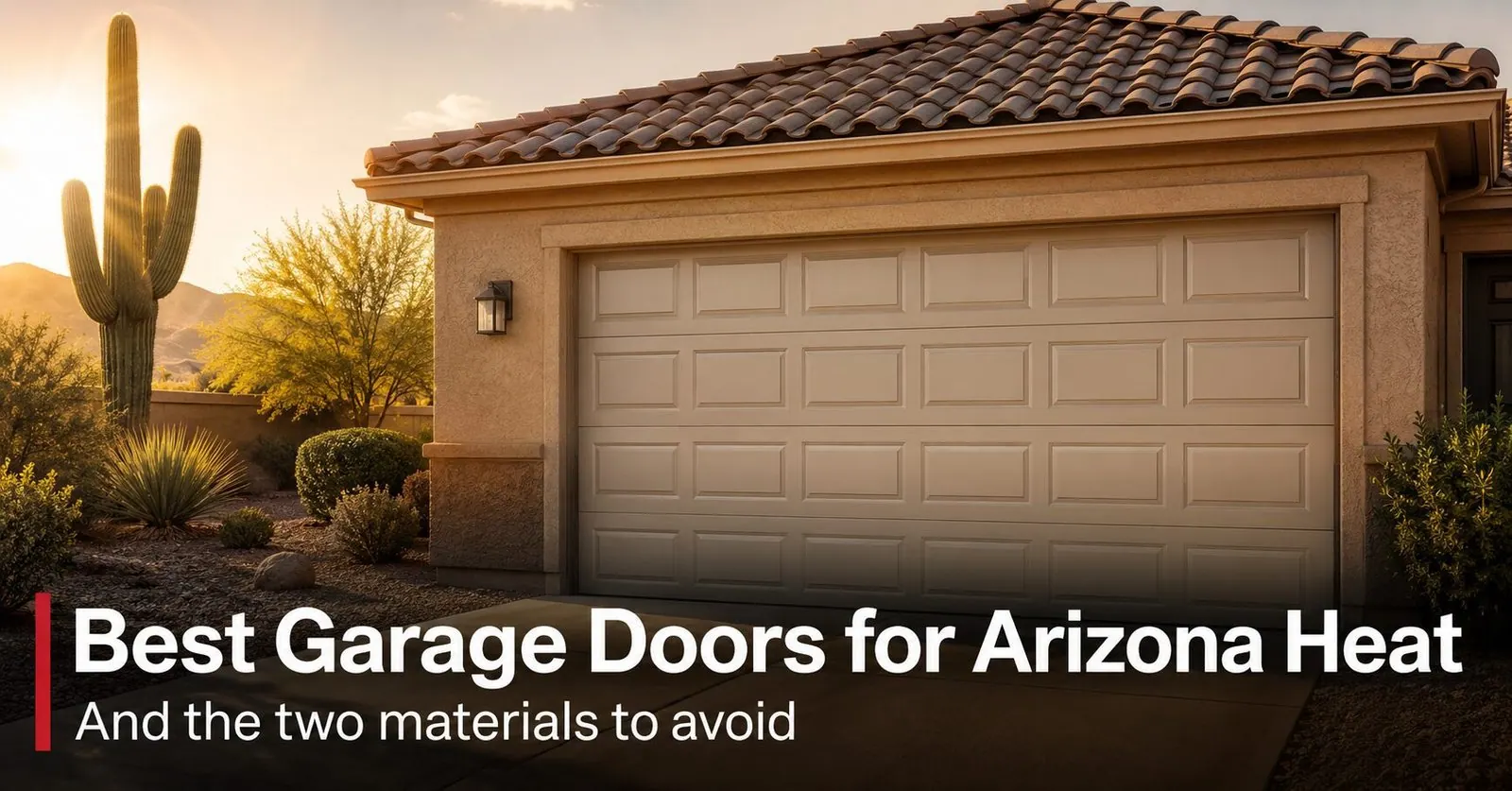
For Arizona heat, the best garage door for most East Valley homes is a 24- or 25-gauge steel door with a polyurethane-insulated core (R-12 to R-18.4). It blocks heat better than anything else, won't warp in 150-degree surface temperatures, and holds its finish under desert UV. Here's the short list:
- Best overall — polyurethane-insulated steel: Top thermal performance, lowest maintenance, best value. The Arizona default.
- Best for curb appeal — faux-wood steel composite: The wood look with identical heat performance and no refinishing.
- Best for modern homes — insulated aluminum-and-glass: Striking on the right house and detached garages, but insulates poorly — not ideal for an attached, west-facing garage.
The two materials to avoid in our climate: fiberglass and vinyl. Both struggle under relentless desert UV and the sustained surface heat a sun-exposed AZ door takes every summer afternoon. The rest of this guide explains why — and how to match the right door to your specific garage.
In the East Valley, "best garage door" and "best garage door for heat" are basically the same question. Our sun is relentless from April through September, our UV index is among the highest in the country, and a west-facing door surface can climb past 150 degrees on a July afternoon. A door that performs fine in a mild climate can underperform badly here — warping, fading, heat-soaking the garage, and aging years faster than the brochure promised. So when a homeowner in Mesa, Gilbert, or Queen Creek asks what to buy, the honest answer starts with heat and works outward from there. This guide ranks the doors that actually hold up to our summers, shows where a few popular options fit (and where they don't), and names the two materials we steer people away from — written from what we see in driveways every week, not from a spec sheet.
- Why heat is the deciding factor in Arizona
- The one spec that matters most: insulation
- Best overall — polyurethane-insulated steel
- Best for curb appeal — faux-wood composite
- Best for modern homes — insulated aluminum-and-glass
- A word on dark colors and finishes
- Two materials to avoid in Arizona heat
- Side-by-side: best doors for heat
- Matching the right door to your garage
- FAQs
Why Heat Is the Deciding Factor in Arizona
Most "best garage door" articles online are written for a national audience, where the big variables are curb appeal and price. In the desert, heat quietly outranks both. Here's what our climate does to a garage door:
It heat-soaks the garage — and the room behind it. Your garage door is one of the largest uninsulated or poorly-insulated surfaces on the whole house. On an attached garage, the heat that passes through the door warms the garage air, then the shared wall, then the bedroom or living room on the other side. The right door slows that chain; the wrong one feeds it all afternoon.
It punishes thin, rigid panels with thermal cycling. A west-facing surface that hits 150 degrees at 3 p.m. and cools to the 60s overnight expands and contracts every single day. Thin uninsulated steel "oil-cans" — visibly flexes and ripples — under that cycling, and brittle materials can crack at stress points.
It breaks down finishes with UV. The same sun that fades patio furniture and cracks dashboards hits your garage door ten or eleven hours a day all summer. Factory-baked finishes and engineered overlays hold up; field-applied finishes and UV-sensitive materials don't.
Get the heat answer right and the rest — durability, comfort, finish life, even how quietly the door runs — tends to fall into place. That's why this list is ranked by Arizona summers first, looks second.
The One Spec That Matters Most: Insulation
If you remember one thing from this guide, make it this: for Arizona heat, how a door is insulated matters more than what it's made of. Two steel doors that look identical from the curb can perform worlds apart depending on what's inside the panel.
The three insulation tiers, ranked for AZ
Polyurethane-injected core (R-12 to R-18.4) — the Arizona sweet spot. The foam is injected as a liquid that expands and bonds to both steel skins, forming one rigid panel with no air gaps. It's both the best insulator and the most structurally rigid, which is exactly what our heat demands.
Polystyrene foam board (about R-6 to R-9) — a real mid-tier step up. Pre-cut foam panels slid into the door. Better than nothing by a wide margin, but it doesn't bond to the skins, so it insulates less and stiffens the panel less than polyurethane.
Single-skin, uninsulated (R-0) — the builder-grade trap. One layer of steel and nothing behind it. Essentially a frying pan bolted to your house. Fine for a detached storage garage; the wrong call for anything attached or sun-exposed.
- For an attached or sun-exposed AZ garage, target R-12 to R-18.4 polyurethane
- Polystyrene (R-6 to R-9) is an acceptable mid-tier for less-exposed openings
- Skip uninsulated single-skin unless the garage is detached storage
- Insulation also makes the panel quieter and more dent-resistant
With that lens, here are the three doors we recommend most often for East Valley homes — in order.
Best Overall: Polyurethane-Insulated Steel
A 24- or 25-gauge steel door with a polyurethane-injected core is the door we put on more East Valley homes than any other, and it's the default we'd recommend to our own family. It hits the top insulation tier, the bonded foam keeps the panel rigid so it won't oil-can in the heat, and the factory baked-on paint finish shrugs off desert UV for years before it shows meaningful fade. It also comes in every panel style — contemporary flush, traditional raised-panel, carriage — so you're not trading looks for performance.
Gauge note: lower number means thicker steel. For an AZ door, 24- or 25-gauge is the target, and 24-gauge specifically if the door faces west or south. The 26- and 27-gauge builder-grade tier is thinner, dents more easily, and oil-cans sooner in the heat.
- Best thermal performance available (R-12 to R-18.4)
- Rigid bonded panel resists oil-canning and warping in extreme heat
- Factory finish holds up to desert UV; repaintable down the road
- Lowest maintenance of any door — rinse with a hose, lubricate hardware seasonally
- Every panel style and color; strongest value for the performance
- Typical AZ lifespan: 20–30 years
If you have no specific reason to choose something else, this is the door. The only common reason to look elsewhere is curb appeal — which the next pick handles without giving up an ounce of heat performance.
Best for Curb Appeal: Faux-Wood Steel Composite
Faux-wood doors — wood-look, composite carriage, or overlay carriage — are polyurethane-insulated steel doors with a wood-grain texture molded into the skin or a wood-look cladding bonded to the front. From the curb they read as a stained wood carriage door; underneath, they're the same high-performance steel panel as our #1 pick. That means you get the warm, high-end look that wood delivers with none of the desert maintenance penalty.
This is the smart answer for homeowners who love the wood aesthetic but don't want to be on a ladder with a sander and a can of finish every year or two — which is what a real wood door demands in our sun. Clopay's Canyon Ridge and Coachman, Amarr's Carriage Court, and CHI's Accents lines all deliver convincing wood looks with R-12 to R-18.4 insulation.
- Wood look, steel performance — best of both
- Top insulation tier (R-12 to R-18.4), equal to premium steel
- Overlay finishes are engineered for sun; far more UV-stable than a real wood finish
- No refinishing cycle, ever — rinse and go
- Strong selection of carriage and traditional styles
- Typical AZ lifespan: 20–30 years
For nine out of ten East Valley homeowners who want the wood look, faux-wood is the right call. Real wood is gorgeous, but in Arizona it's the highest-maintenance door you can buy — refinish it on schedule or watch it gray, crack, and warp. We cover that trade-off in depth in our steel vs aluminum vs wood comparison.
Best for Modern Homes: Insulated Aluminum-and-Glass
Full-view aluminum-and-glass doors are the contemporary look you see on remodeled Scottsdale homes and showcase Gilbert builds — clean lines, frosted or clear glass, an architectural statement. On the right house they're stunning, and we install plenty of them. But they earn the #3 spot for a reason: aluminum is a strong heat conductor and glass conducts heat too, so even with insulating glass panels this door lets more heat into the garage than a polyurethane steel door.
That makes it a great fit for a detached garage, a modern home where the look is the priority, or any door that doesn't sit between cooled living space and the afternoon sun. It's a poor fit for an attached, west-facing garage that shares a wall with a bedroom — the heat soak there is real. Aluminum also dents more easily than steel, so it's not ideal on a busy family driveway.
- Best for contemporary architecture and detached garages
- Choose insulating glass panels to soften the heat soak (it won't eliminate it)
- Lightweight — eases load on springs and opener
- Won't rust; anodized finishes are very UV-stable
- Lower insulation and easier denting are the trade-offs
- Not the best pick for an attached west/south-facing garage
A Word on Dark Colors and Finishes
Modern black and deep-bronze doors are one of the most popular looks in the East Valley right now, and they can absolutely work here — but color matters more in our sun than in most places. A dark finish absorbs more solar heat than a light one, so a black door surface can run roughly 20 to 30 degrees hotter than a cream or white door in the same exposure.
That doesn't mean skip the dark door. It means build it to handle the heat: pair the color you love with a polyurethane-insulated steel panel, a quality factory finish engineered for UV, and good seals around the opening. The combination to avoid is a dark, uninsulated door on a west-facing attached garage. We break down the specifics in our guide to modern black garage doors in Arizona.
Two Materials to Avoid in Arizona Heat
Plenty of door materials work fine in a mild climate but struggle in the desert. Two come up often enough — usually pitched as "low-maintenance" or "dent-proof" — that they're worth naming directly.
Fiberglass
Fiberglass is marketed elsewhere as rust-proof and dent-resistant, and in a moderate climate that holds up. In Arizona, the relentless UV is the problem: over a few years of Phoenix sun, fiberglass resin tends to yellow, chalk, and grow brittle. A brittle panel doesn't flex the way steel does — it cracks at stress points and on impact. The same desert sun that's hard on a wood finish is even harder on fiberglass. There's almost always a better choice here.
Vinyl
Vinyl doors get sold on being low-maintenance and dent-friendly, which sounds great until you put one in front of an Arizona afternoon. In the sustained 140-to-150-degree surface temperatures a west- or south-facing door reaches all summer, vinyl can fade, soften, and warp, and the color and style options are limited compared with steel. For a shaded or detached opening it's less of an issue — but for the sun-exposed doors most homes have, it's not the material we'd choose.
Side-by-Side: Best Doors for Arizona Heat
Here's how the recommended doors — and the ones to avoid — stack up on what matters most in our climate.
| Door type | Best insulation | Heat performance | UV / finish | Best fit in AZ |
|---|---|---|---|---|
| Polyurethane-insulated steel | R-12 to R-18.4 | Best available | Excellent (factory baked) | Almost every East Valley home |
| Faux-wood steel composite | R-12 to R-18.4 | Best available | Excellent (engineered overlay) | Curb appeal with steel performance |
| Insulated aluminum-and-glass | R-0 to R-7 | Fair (heat soak) | Good (anodized); fair if painted | Modern homes, detached garages |
| Fiberglass | Low to moderate | Poor (brittle, cracks) | Poor (yellows, chalks) | Avoid for sun-exposed doors |
| Vinyl | Low to moderate | Poor (softens, warps) | Fair (fades; limited colors) | Avoid for sun-exposed doors |
Matching the Right Door to Your Garage
Attached garage sharing a wall with living space
Polyurethane-insulated steel or faux-wood steel, every time. The heat-soak into your cooled rooms is the single biggest performance variable, and only steel-based doors reach the R-12 to R-18.4 range that actually moves the needle.
Door faces west or south
Same answer, plus watch the finish color. A dark door on a hot elevation needs every advantage from polyurethane insulation and quality seals to perform well. 24-gauge steel is worth it here.
You want a modern, contemporary look
Insulated aluminum-and-glass is built for this. Choose insulating glass to ease the heat soak, and lean this way most comfortably on a detached garage or a non-west elevation.
Detached garage or storage
The heat-into-living-space math disappears. Uninsulated single-skin steel is fine for parking and storage. If the space doubles as a workshop, gym, or office, treat it like an attached garage and insulate.
One last thing: the door is only part of the system. A premium insulated door with cracked, sun-baked seals leaks much of its advantage, so when we install a new door we look at the bottom seal, weatherstripping, and hardware together — our weather-stripping and bottom seal service covers the gaskets that make or break real-world heat performance.
Why East Valley Homeowners Call Farnsworth for New Door Installs
Farnsworth Garage Door Service was founded by brothers Brigham and Riley Farnsworth. The Farnsworth name has 60+ years of family business across the East Valley behind it — R&K, Farnsworth Wholesale, Farnsworth Realty — and we run this company the way our family has always run a business: tell the truth, put the price in writing, do the work right the first time.
- We quote heat-rated options side by side, in writing. You see exactly what each door costs for your specific size, elevation, and sun exposure before you decide.
- Clopay, Amarr, CHI, and Wayne Dalton across steel, faux-wood, and aluminum-and-glass lines — not locked into one brand.
- We measure your opening, sun exposure, and shared-wall layout before recommending a door. No one-size pitch.
- Seals and hardware addressed as part of the install when needed — so your insulation actually performs.
- Same-day service is our standard, often within hours of your call.
- 5.0 stars on Google. Our neighbors keep us busy by telling theirs.
Ready to find the right door for your home? See our garage door installation page, browse Clopay options we offer, or check where we work across the East Valley.
Frequently Asked Questions
What is the best garage door for Arizona heat?
For most East Valley homes, the best garage door for Arizona heat is a 24- or 25-gauge steel door with a polyurethane-injected insulated core in the R-12 to R-18.4 range. Polyurethane bonds to both steel skins to form one rigid panel with no air gaps, so it delivers the best thermal performance, resists warping in extreme surface temperatures, and takes a factory baked-on paint finish that holds up to desert UV far better than a field-applied finish. If curb appeal matters, a faux-wood version of that same polyurethane steel door (Clopay Canyon Ridge or Coachman, Amarr Carriage Court, CHI Accents) gives you the wood look with identical heat performance. Insulated aluminum-and-glass doors are a good fit for modern homes and detached garages, but they insulate poorly and aren't the best pick for an attached, west-facing garage.
Does garage door insulation actually make a difference in Phoenix?
Yes — more in Phoenix than in almost any other U.S. climate. A west-facing garage door surface can reach 150 degrees in mid-afternoon. An uninsulated single-skin door passes that heat straight through into the garage, and on an attached garage, into the wall it shares with your living space. A polyurethane-insulated door in the R-12 to R-18.4 range slows that heat transfer dramatically. Homeowners who upgrade from a bare builder-grade door to an insulated polyurethane door routinely notice a cooler garage, a more comfortable adjoining room, and a quieter door. Insulation also makes the panel more rigid, so it resists the oil-canning (visible flexing) that thin uninsulated doors show in the heat.
Are fiberglass garage doors good for Arizona?
Fiberglass is one of the two materials we steer Arizona homeowners away from. Fiberglass is sold elsewhere as a dent-resistant, rust-proof option, but the relentless desert UV is hard on it: over a few years of Phoenix sun the resin tends to yellow, chalk, and grow brittle, and a brittle fiberglass panel can crack on impact or along stress points where a steel panel would simply flex. The same sun exposure that makes Arizona a tough place for a wood finish is even tougher on fiberglass. There are far better choices here — polyurethane-insulated steel or a faux-wood steel composite will outlast and outperform fiberglass in our climate.
What garage door material should I avoid in Arizona?
The two materials we generally steer East Valley homeowners away from for sun-exposed doors are fiberglass and vinyl. Fiberglass yellows, chalks, and becomes brittle under sustained desert UV, and brittle panels crack instead of flexing. Vinyl is marketed as low-maintenance and dent-resistant, but in the sustained 140-to-150-degree surface temperatures a west- or south-facing Arizona door reaches, vinyl can fade, soften, and warp, and the color options are limited. Beyond those two materials, the single most common heat mistake we see is a spec choice rather than a material: a thin, uninsulated single-skin steel door. The steel itself is fine — it's the lack of insulation that turns it into a heat conductor. Choose polyurethane-insulated steel or a faux-wood steel composite and you avoid all three traps.
Do dark or black garage doors get too hot in Arizona?
A dark finish absorbs more solar heat than a light one — a black or deep-bronze door surface can run roughly 20 to 30 degrees hotter than a cream or white door in the same sun. That doesn't mean you can't have a dark door in Arizona; modern black doors are one of the most popular looks in the East Valley right now. It means a dark door on a west- or south-facing elevation should be built to handle it: a polyurethane-insulated steel panel, a quality factory finish engineered for UV, and good weather seals around the opening. A dark uninsulated door on a west-facing attached garage is the combination to avoid. Pair the color you love with the right construction and you get the look without the heat penalty.
Is an insulated aluminum-and-glass door a good choice for a hot climate?
It depends on the garage. Aluminum-and-glass full-view doors are designed for a clean, modern look, and on the right home they're striking. But aluminum is a strong heat conductor and glass conducts heat too, so even with insulating glass panels a full-view door lets more heat into the garage than a polyurethane steel door. That's fine for a detached garage, a contemporary home where the look is the priority, or a door that doesn't sit between conditioned living space and the afternoon sun. For an attached garage on a west or south elevation that shares a wall with a bedroom or living room, an insulated polyurethane steel door (or a faux-wood version of it) is the better heat choice.
What R-value garage door do I need in Arizona?
For an attached East Valley garage, aim for a polyurethane-insulated door in the R-12 to R-18.4 range. That tier is where the insulation is dense enough and the panel rigid enough to make a real difference against 150-degree surface temperatures. A polystyrene foam-board door (roughly R-6 to R-9) is a meaningful step up from an uninsulated door and a reasonable mid-tier choice for a less sun-exposed opening. An uninsulated R-0 single-skin door is fine only for a detached storage garage that doesn't touch living space. The higher R-value matters most on attached garages, west- and south-facing doors, and any garage you use as a workshop, gym, or home office.
Will a better garage door actually lower my electric bill in summer?
An insulated door won't single-handedly transform your power bill, but on an attached garage it can meaningfully reduce how much heat soaks into the shared wall and, from there, into the conditioned rooms beyond it — which eases the load on your AC during the worst part of an Arizona afternoon. The effect is biggest when the garage is attached, the door faces west or south, and the room on the other side of that wall is living space you cool. It's also biggest when the rest of the system is tight: a great insulated door with cracked, sun-baked bottom and side seals leaks much of its advantage. We look at the door and the seals together so the insulation you pay for actually does its job.

Ready to Pick a Door Built for Arizona Heat?
Licensed, insured, locally owned. We quote heat-rated steel, faux-wood, and aluminum-and-glass options side by side, in writing — so you can see exactly what each one costs for your specific door size, elevation, and sun exposure. Same-day service is our standard, often within hours of your call.