
Steel vs Aluminum vs Wood Garage Doors: Which Holds Up Best in AZ?
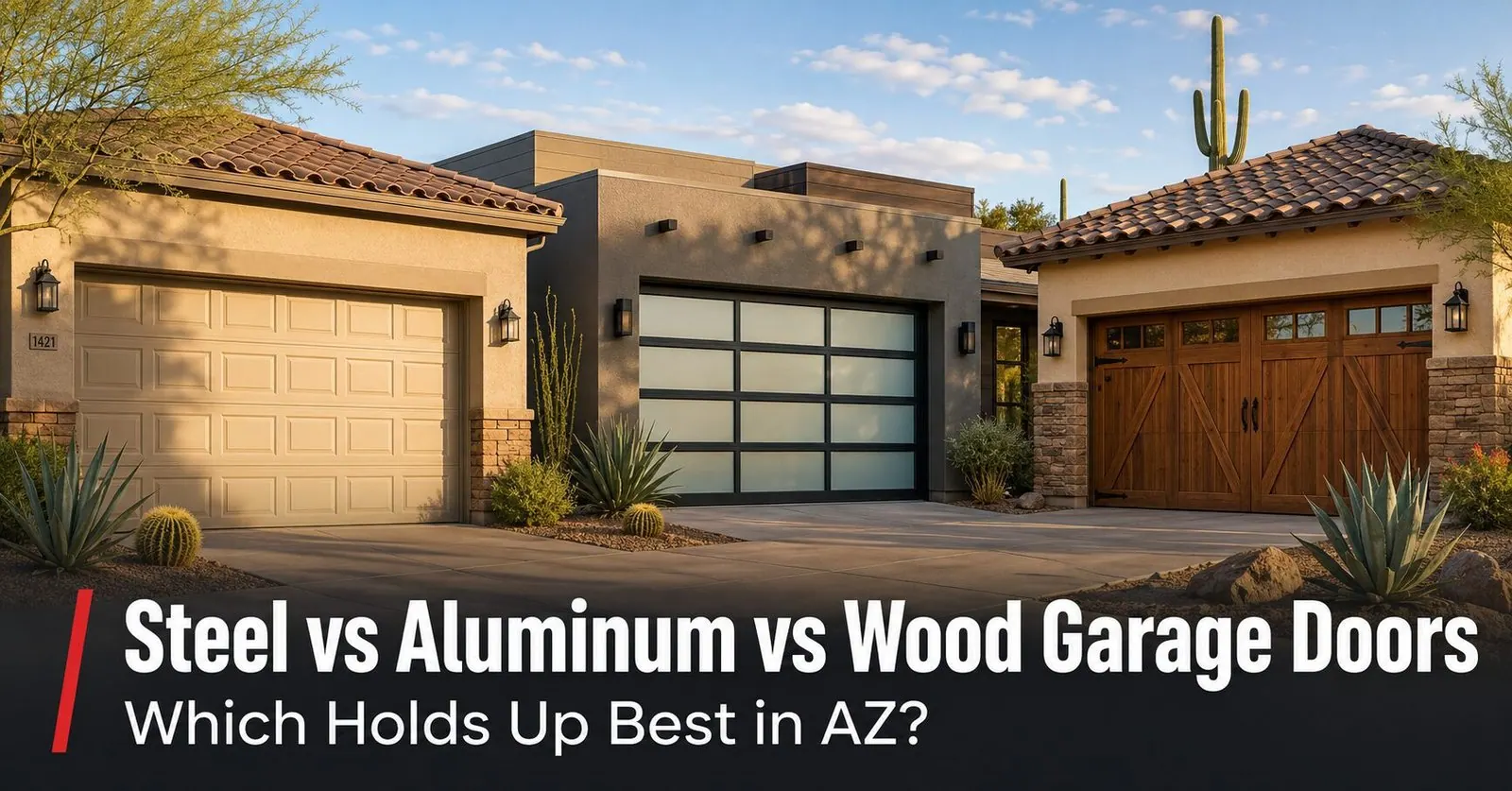
For most East Valley homes, a 24- or 25-gauge polyurethane-insulated steel door is the best all-around material — durable, the easiest to insulate well, the lowest maintenance, and the most affordable for the performance you get. Here's the short version of each material:
- Steel (24–25 gauge, polyurethane): The Arizona default. Handles heat, takes a UV-resistant factory paint finish, lowest lifetime cost. Pick this unless you have a specific reason not to.
- Aluminum: Best for contemporary full-view glass doors and modern Scottsdale aesthetics. Lightweight, won't rust, dents easily, insulates poorly. Right for the look, not the everyday family garage.
- Real wood: Stunning aesthetic, premium pricing, the highest maintenance burden in Arizona. Plan on refinishing every 1–3 years or watch the door deteriorate.
- Faux-wood (steel with wood-look overlay): The smart compromise. Wood curb appeal, steel performance, full insulation tiers. Often the best long-term value when looks matter.
If your garage is attached, faces west or south, or shares a wall with a living space, the right answer is almost always polyurethane-insulated steel (or a faux-wood version of it). The rest of this guide walks through why — and the situations where aluminum or real wood actually does win.
Choosing a garage door material in Arizona is a different problem than choosing one in Ohio. Our heat is brutal, our UV exposure is some of the highest in the country, our dust is constant, and our monsoon storms move serious water and wind across the East Valley a few times a summer. Materials that perform well in milder climates can fail noticeably faster here. Materials nobody recommends elsewhere can be the smart choice in Arizona for specific reasons. This guide is the honest breakdown of how steel, aluminum, real wood, and faux-wood composite doors actually behave on East Valley homes — not a generic "which material is best" article copy-pasted from somewhere with milder weather.
- How Arizona tests every garage door material
- Steel doors — the Arizona default
- Aluminum doors — modern, light, dent-prone
- Real wood doors — beautiful, demanding
- Faux-wood composite — the smart compromise
- Side-by-side comparison
- Choosing the right material for your AZ home
- The maintenance reality nobody talks about
- FAQs
How Arizona Tests Every Garage Door Material
Before we get into the four materials, it's worth understanding what they're actually up against. Four Arizona conditions matter most:
Direct UV exposure. Phoenix-area sun delivers some of the highest UV index readings in the U.S. from April through September. UV is what breaks down paint finishes, oxidizes wood, fades plastic trim, and chalks faux-wood overlays. A door that looks fine after ten years in Portland can look ten years older after five years on a west-facing Mesa house.
Extreme thermal cycling. A west-facing garage door surface can hit 150°F at three in the afternoon and drop to the 60s overnight in October. That's a daily expansion-and-contraction cycle that puts stress on seams, joints, finishes, and any glued or bonded assemblies. Materials that don't expand and contract uniformly — like a steel skin bonded to a foam core — have to be engineered for it.
Dust and grit. Our valley sits in a basin that traps dust, and monsoon storms haul fine grit across the East Valley several times a season. That grit works into seals, hinges, and tracks, and abrades any finish that isn't well-protected. Wood is especially vulnerable here — small cracks in the finish let dust grind in and accelerate breakdown.
Low humidity, then sudden monsoon. Most of the year Arizona sits at single-digit humidity, which dries out wood and rubber faster than almost any other U.S. climate. Then monsoon hits and the same materials swell with moisture. Wood handles this poorly without sealer; rubber bottom seals lose their flexibility; thin steel skins can oil-can as panels expand and contract.
With those stressors in mind, here's how each material actually performs.
Steel Doors — The Arizona Default
Steel is the material on roughly four out of five East Valley garages, and for good reason. It's the most versatile of the four: it comes in every insulation tier from uninsulated single-skin to R-18.4 polyurethane, in every panel style from flush contemporary to traditional raised panel, and at every price point. When we recommend a steel door to a homeowner, the conversation usually centers on two specs: gauge and insulation.
The steel-door spec breakdown
Gauge measures thickness — lower number means thicker steel. Builder-grade doors are usually 26 or 27 gauge. Mid- and premium-tier residential doors are 24 or 25 gauge. The thinner the steel, the more easily it oil-cans (visibly flexes) in heat, dents from impacts, and shows wear. The cost difference between 26-gauge and 24-gauge is meaningful but rarely huge once you're already replacing the door.
Insulation determines how the door performs against AZ heat. A single-skin R-0 steel door is essentially a frying pan bolted to your house. A polystyrene foam-board sandwich (R-6 to R-9) is a real step up. A polyurethane-injected core (R-12 to R-18.4) is the Arizona sweet spot — the foam bonds to both steel skins and creates a single rigid panel with no air gaps. It's both the best insulator and the most structurally rigid.
- Available gauges: 24–27 (24 or 25 recommended for AZ)
- Insulation range: R-0 to R-18.4
- UV behavior: Factory baked-on paint finish handles AZ sun for 10–15 years before showing meaningful fade; can be repainted
- Heat behavior: With polyurethane core, the best thermal performance of any material
- Dent resistance: Best in 24-gauge; mediocre in 26–27 gauge
- Maintenance: Lowest of any material — rinse with a hose, lubricate hardware seasonally
- Style options: Every panel style, from contemporary flush to raised traditional to carriage
- Typical lifespan in AZ: 20–30 years
- Best for: Almost every East Valley home, unless you have a specific reason for another material
The one steel-door trap to avoid: a builder-grade 26-gauge uninsulated door that looks acceptable on day one and visibly deteriorates over five years. If you're choosing a steel door, spend the modest extra on at least a 25-gauge polystyrene-insulated door — or, better, a 24-gauge polyurethane door. The lifespan and performance jump is significant.
Aluminum Doors — Modern, Light, Dent-Prone
Aluminum's biggest residential role is as the frame around full-view glass doors — the contemporary, modern look you see on remodeled Scottsdale homes, new-build Arcadia properties, and showcase Gilbert garages where the door itself is part of the architecture. Think Clopay Avante, Amarr Vista, Martin Athena. Aluminum on its own as a solid panel material is uncommon in residential because it dents easily and doesn't insulate well; aluminum with glass panels is a different conversation.
What aluminum is actually good for
Aluminum is lightweight, which is genuinely helpful: a lighter door means less stress on springs, cables, and your opener, and a longer life for the moving parts. Aluminum is also corrosion-resistant in a way steel isn't — not a major Arizona concern but useful near pools or in coastal climates. Anodized aluminum finishes hold up well in AZ UV; powder-coated finishes hold up reasonably well; painted aluminum can chalk over time.
Where aluminum struggles is impact resistance and insulation. The same softness that makes aluminum easy to manufacture into contemporary designs also makes the panels vulnerable to dents from basketballs, car doors, ladders, or anything wind-driven during a monsoon. And aluminum is a strong heat conductor with very low intrinsic R-value, so a full-view aluminum-and-glass door on an attached west-facing garage will heat-soak the garage far more than a polyurethane steel door would.
- Available formats: Mostly full-view glass-and-aluminum contemporary designs
- Insulation range: Limited — typically R-0 to R-7 with insulating glass panels
- UV behavior: Anodized finishes excellent; painted finishes can chalk over years
- Heat behavior: Poor insulator; significant heat soak on attached garages
- Dent resistance: Lowest of the four materials
- Maintenance: Low for the frame, moderate for glass panel seals
- Style options: Strong for contemporary/modern; limited for traditional/carriage
- Typical lifespan in AZ: 25–35 years on the frame, sooner on seals and glass panels
- Best for: Modern architecture, detached garages, low-impact driveways, homeowners prioritizing aesthetic over thermal performance
If you love the modern full-view look, aluminum-and-glass can be a great choice — just go in with eyes open about the heat soak (insulating glass panels help; they don't eliminate it) and the dent risk. If you have a busy family driveway, kids playing in the front yard, or a west-facing attached garage you want to keep cooler, aluminum is probably not the right answer.
Real Wood Doors — Beautiful, Demanding
A real wood garage door — cedar, redwood, mahogany, or hemlock, often in a carriage-house style — is the most striking material on this list. There's a depth and warmth to actual wood grain that no overlay or print can fully replicate, and on the right home (custom Gold Canyon hillside, Spanish-tile Fountain Hills, Cave Creek architectural) a wood door is part of the curb-appeal story in a way no other material can match. We install these, and on the right house we love them.
The honest part: wood is the most maintenance-heavy garage door material you can buy in Arizona, by a wide margin. Our dry air pulls moisture out of wood, our sun bleaches and breaks down finishes, and our thermal cycling stresses joints. A wood door that gets refinished on schedule with a quality exterior-grade sealer (often marine-grade varnish for the harshest exposures) can look spectacular for thirty years. A wood door that skips refinish cycles will show graying, cracking, and finish chalking within five years and structural warping inside ten.
What "on schedule" actually means in Arizona
For a north- or east-facing wood door, plan on refinishing every two to three years. For a south- or west-facing door, every one to two years — we've seen west-facing custom doors in Gold Canyon and Mesa need annual attention. That's coat the door down to the bare grain after light sanding, then two or three coats of high-quality UV-blocking exterior sealer or varnish.
You can hire a refinisher or do it yourself on a weekend, but it's not optional. Skipping a year on a west-facing door is the difference between thirty years and twelve.
- Common species: Cedar, redwood, mahogany, hemlock
- Insulation range: R-0 to R-10 depending on construction (wood is a moderate natural insulator)
- UV behavior: Worst of the four materials — finish degrades fastest in AZ sun
- Heat behavior: Decent natural insulation, but joints can stress in extreme cycling
- Dent resistance: Excellent — wood absorbs impact instead of denting
- Maintenance: Highest — refinish every 1–3 years to preserve the finish and prevent warping
- Style options: Best for traditional, carriage, custom-architectural
- Typical lifespan in AZ: 30+ years with maintenance; 10–15 years without
- Best for: Custom homes, traditional or carriage architecture, homeowners committed to the maintenance schedule
Our practical advice: if you love the wood look, ask yourself honestly whether you'll be on a ladder with a sander and a quart of finish every year or two for the next thirty years. If yes, a real wood door is a wonderful choice. If you're not sure, the faux-wood option in the next section gives you 90% of the look with none of the maintenance.
Faux-Wood Composite — The Smart Compromise
Faux-wood doors — sometimes called wood-look, composite carriage, or overlay carriage — are steel doors with a wood-grain texture molded into the steel skin or a wood-look cladding bonded to the front face. From the curb at twenty feet, a good one is indistinguishable from a stained wood carriage door. Underneath the overlay, it's a polyurethane-insulated steel sandwich panel with all the performance benefits we covered in the steel section.
This category has gotten dramatically better over the last decade. Clopay's Canyon Ridge and Coachman collections, Amarr's Carriage Court, CHI's Accents Planks, and Wayne Dalton's 8000 series all deliver convincing wood aesthetics with R-12 to R-18.4 insulation and the maintenance profile of a steel door. For homeowners who want the curb appeal of wood without the every-year refinish cycle, this is almost always the smart answer in Arizona.
What faux-wood gives you in Arizona
- Construction: Polyurethane-insulated steel with wood-look texture or overlay
- Insulation range: R-12 to R-18.4 (the best tiers)
- UV behavior: Strong — the overlay finishes are engineered for sun exposure and hold up much better than real wood finish
- Heat behavior: Equal to premium polyurethane steel — the Arizona sweet spot
- Dent resistance: Excellent (steel substrate)
- Maintenance: Low — rinse with a hose, occasional touch-up if scratched
- Style options: Carriage, traditional, custom-look — strong selection
- Typical lifespan in AZ: 20–30 years
- Best for: Homeowners who want the wood look with steel performance — usually the best long-term value when curb appeal matters
The honest tradeoff: real wood costs more upfront and costs more in maintenance, but to a wood-loving eye it has more soul than even the best faux. Faux-wood costs less upfront, costs almost nothing in maintenance, and looks nearly identical from the street — especially on the carriage-house and barn-style designs where the overlay is doing what overlays do best. For nine out of ten East Valley homeowners considering a wood look, we recommend faux.
Side-by-Side Comparison
Here's how the four materials stack up on the things that actually matter to an Arizona homeowner.
| Feature | Steel (24-25 ga, polyurethane) | Aluminum (full-view glass) | Real wood | Faux-wood composite |
|---|---|---|---|---|
| Best insulation tier | R-12 to R-18.4 | R-0 to R-7 | R-0 to R-10 | R-12 to R-18.4 |
| UV / paint fade in AZ | Excellent (factory baked finish) | Good if anodized; fair if painted | Poor without regular refinish | Excellent (engineered for sun) |
| Dent resistance | Strong at 24 ga | Weakest | Strong (absorbs impact) | Strong (steel substrate) |
| Maintenance burden | Lowest | Low | Highest (refinish 1–3 yrs) | Lowest |
| AZ lifespan | 20–30 years | 25–35 years on frame | 30+ with care; 10–15 without | 20–30 years |
| Style range | Every style | Contemporary / modern | Traditional / carriage / custom | Traditional / carriage / custom |
| Relative installed cost | Lowest to mid | High | Highest | Mid to high |
| Best fit | Most East Valley homes | Modern Scottsdale / contemporary | Custom homes, committed owner | Curb appeal with steel performance |
Choosing the Right Material for Your AZ Home
If the garage is attached and shares a wall with a living space
Polyurethane-insulated steel or faux-wood steel, every time. The heat-soak math is the single biggest performance variable on attached garages in Phoenix, and only steel-based doors hit the R-12 to R-18.4 range that actually moves the needle. Aluminum-and-glass on an attached west-facing garage is almost always the wrong call no matter how good the look is.
If the door faces west or south
Same answer, plus pay attention to finish color. Dark and matte-black finishes can run 20–30 degrees hotter on the surface than light cream or white finishes. We cover this in detail when homeowners ask about modern black doors specifically, but the short version: dark colors look great, and they need every advantage from polyurethane insulation and quality seals to perform well on a west-facing AZ door.
If you love a contemporary or modern look
Aluminum-and-glass full-view doors are designed for exactly this aesthetic, and on the right home they're spectacular. Just understand the tradeoffs: lower insulation, easier denting, higher upfront cost. We frequently install these on remodeled Scottsdale, Paradise Valley, and Arcadia-area homes where the look is the priority.
If you love a traditional or carriage-house look
Start with faux-wood composite (Clopay Canyon Ridge or Coachman, Amarr Carriage Court, CHI Accents). The look is excellent, the insulation is the best available, and you'll never refinish it. Step up to real wood only if you have a specific architectural reason and you're committed to the maintenance schedule.
If you have a detached garage or shop
The calculus changes because the heat soak into living space doesn't matter. Uninsulated single-skin steel is fine for parking and storage. If the detached space doubles as a workshop or gym, treat it like an attached garage and use polyurethane-insulated steel.
The Maintenance Reality Nobody Talks About
Whatever material you choose, the door itself is only part of the picture. The seals around the door, the springs and cables behind it, the rollers in the track, and the opener overhead all wear at their own pace — and in Arizona, they wear faster than they do in mild climates. A premium polyurethane steel door with worn bottom seals and tired springs performs noticeably worse than a basic steel door with fresh seals and properly-tensioned hardware.
When we quote a new door installation, we always look at the rest of the system: the bottom seal (Arizona dust and heat are brutal on rubber sweeps), the side and top weatherstripping, the rollers, the springs, the opener's age and condition. Replacing a door without addressing those at the same time leaves performance on the table. Our tune-up service covers the moving parts; our weather-stripping and bottom seal page covers the gaskets that determine whether your new door's insulation actually works in practice.
Why East Valley Homeowners Call Farnsworth for New Door Installs
Farnsworth Garage Door Service was founded by brothers Brigham and Riley Farnsworth. The Farnsworth name has 60+ years of family business across the East Valley behind it — R&K, Farnsworth Wholesale, Farnsworth Realty — and we run this company the way our family has always run a business: tell the truth, put the price in writing, do the work right the first time.
- Written quotes that compare materials side by side. You see exactly what steel, aluminum, and faux-wood options cost for your specific door size and elevation before you decide.
- Clopay, Amarr, CHI, and Wayne Dalton across steel, aluminum, and faux-wood lines — not locked into a single brand.
- We measure your specific opening, sun exposure, and shared-wall layout before recommending a material. No one-size pitch.
- Hardware and seals replaced as part of the install when needed. We don't bolt a new door onto worn weather stripping and call it done.
- Same-day service is our standard, often within hours of your call.
- 5.0 stars on Google. Our neighbors keep us busy by telling theirs.
Ready to compare materials for your home? See our garage door installation page, browse Clopay options we offer, or check where we work across the East Valley.
Frequently Asked Questions
What is the best garage door material for Arizona heat?
For the great majority of East Valley homes, a 24- or 25-gauge steel door with a polyurethane-insulated core is the best all-around material. It handles 115-degree summer heat without warping, takes a factory baked-on paint finish that resists UV fade better than field-applied finishes, accepts the highest insulation R-values, and is the most affordable for the performance you get. Aluminum is the right call for modern full-view glass doors and homeowners who want a contemporary look but it dents easily and insulates poorly. Real wood is gorgeous but is the most maintenance-heavy choice in Arizona — the dry desert air and intense sun will fade, crack, or warp an unprotected wood door faster than almost any other climate in the country. Faux-wood composite (steel with a wood-look overlay) gives you the wood aesthetic with steel performance and is usually the smartest choice when curb appeal matters.
Do wood garage doors hold up in Arizona?
They can — but only with consistent maintenance. The same intense UV that fades patio furniture and cracks dashboards is hitting your garage door for ten or eleven hours a day from May through September. A real wood door (cedar, redwood, mahogany, hemlock) needs a fresh exterior-grade sealer or marine-grade varnish roughly every one to three years in the East Valley to keep moisture out, prevent cracking, and stop the finish from chalking. South- and west-facing doors need it on the shorter end of that range. Skip a refinish cycle and you'll see the surface gray out, the joints start to open, and the panels begin to cup or warp. Homeowners who love wood and budget for the maintenance are happy; homeowners who buy wood expecting steel-like upkeep almost always regret it within five years.
Will an aluminum garage door dent easily?
Yes, more easily than a comparable-gauge steel door. Aluminum is significantly softer than steel, so a basketball, a teenager's car door, a wind-driven object, or a misplaced ladder can leave a permanent dent in an aluminum panel that would barely mark a 24-gauge steel one. That's why most aluminum doors in the residential market are designed as modern full-view glass doors — the glass panels carry the visual weight, and the aluminum is essentially a frame around them. If your garage faces a basketball hoop, a busy family driveway, or a high-traffic side yard, an aluminum door is usually a poor fit. Where aluminum shines is on a clean, contemporary front elevation where the look is the priority and the door doesn't take regular impact.
What gauge of steel garage door do I need in Arizona?
Lower gauge equals thicker steel. For an East Valley residential door we recommend 24- or 25-gauge for most homes, and 24-gauge specifically if the door will be on the west or south side of the house catching afternoon sun. 26- and 27-gauge doors are the builder-grade tier you'll see on a lot of new construction. They're not unsafe, but the thinner steel oil-cans (visibly flexes) in heat more easily, dents more easily, and shows wear sooner than 24- or 25-gauge. The cost difference between a thin builder-grade door and a real 24-gauge polyurethane door is usually smaller than people expect, and the durability gap is significant. When we quote a new door, we walk you through both tiers in writing so you can see exactly what the upgrade costs.
Is faux wood the same as real wood?
No. Faux wood — sometimes called wood-look, carriage-house overlay, or composite carriage — is a steel garage door with a wood-grain pattern molded into the steel skin or a textured cladding bonded to the steel. It looks like a stained wood carriage door from the curb, but underneath it's a polyurethane-insulated steel sandwich panel that performs like any other premium steel door. The advantage is enormous in Arizona: you get the curb appeal that wood delivers without the every-couple-years refinish cycle, without the warping risk, and with full insulation tiers (R-12 through R-18.4 on Clopay Canyon Ridge and Coachman, Amarr Carriage Court, CHI Accents). For most homeowners who love the wood look, faux wood is the smart compromise.
How long does each garage door material last in Arizona?
With normal use and the right hardware behind it: a 24-gauge polyurethane-insulated steel door typically delivers 20 to 30 years of service in Arizona, with the paint finish needing refreshing somewhere in years 15-25. A premium aluminum full-view door lasts 25 to 35 years on the frame itself, though the glass panels and seals will likely need attention sooner. A real wood door can last 30+ years if it's refinished on schedule — and 10 to 15 years if it isn't. Faux-wood steel composite doors track closely with premium steel: 20 to 30 years for the structure, with the overlay's appearance holding up better than most homeowners expect. The bigger lifespan variable for any door is the springs, rollers, and opener — those wear out long before the panels do.
Are aluminum garage doors good in hot weather?
Structurally yes, energy-wise no. Aluminum doesn't rust, warp, or rot in heat — that's the structural side. But aluminum is a much better heat conductor than steel and a poor insulator on its own. Standard aluminum panels carry a very low R-value, and most contemporary aluminum doors are full-view glass which conducts even more heat. If you're putting a full-view aluminum-and-glass door on an attached garage that shares a wall with a bedroom or living room, expect the heat soak to be noticeably worse than with an insulated polyurethane steel door. For detached garages, contemporary aesthetics, or doors that don't sit between conditioned space and the outside, aluminum is fine. For attached garages on west or south elevations, it's usually the wrong call.
Should I replace my garage door with the same material it currently is?
Not necessarily — and a replacement is often the best moment to upgrade the material. If your current door is a builder-grade 26-gauge uninsulated steel door that's faded and oil-canned in the heat, the natural upgrade is a 24-gauge polyurethane-insulated door (same material family, big jump in performance and durability). If you have a real wood door you love but can't keep up with the refinishing schedule, switching to a faux-wood steel carriage style preserves the look and ends the maintenance cycle. If you have an aging aluminum-and-glass contemporary door and you've enjoyed the look, replacing with a newer aluminum design with better seals and insulating glass usually makes more sense than switching to steel and losing the aesthetic. We talk through the actual condition of your existing setup and your goals before recommending a direction.
Ready to Pick the Right Door for Your AZ Home?
Licensed, insured, locally owned. We quote steel, aluminum, and faux-wood options side by side, in writing — so you can see exactly what each material costs for your specific door size, elevation, and sun exposure. Same-day service is our standard, often within hours of your call.