
What's Included in a New Garage Door Install (and How Long It Takes)
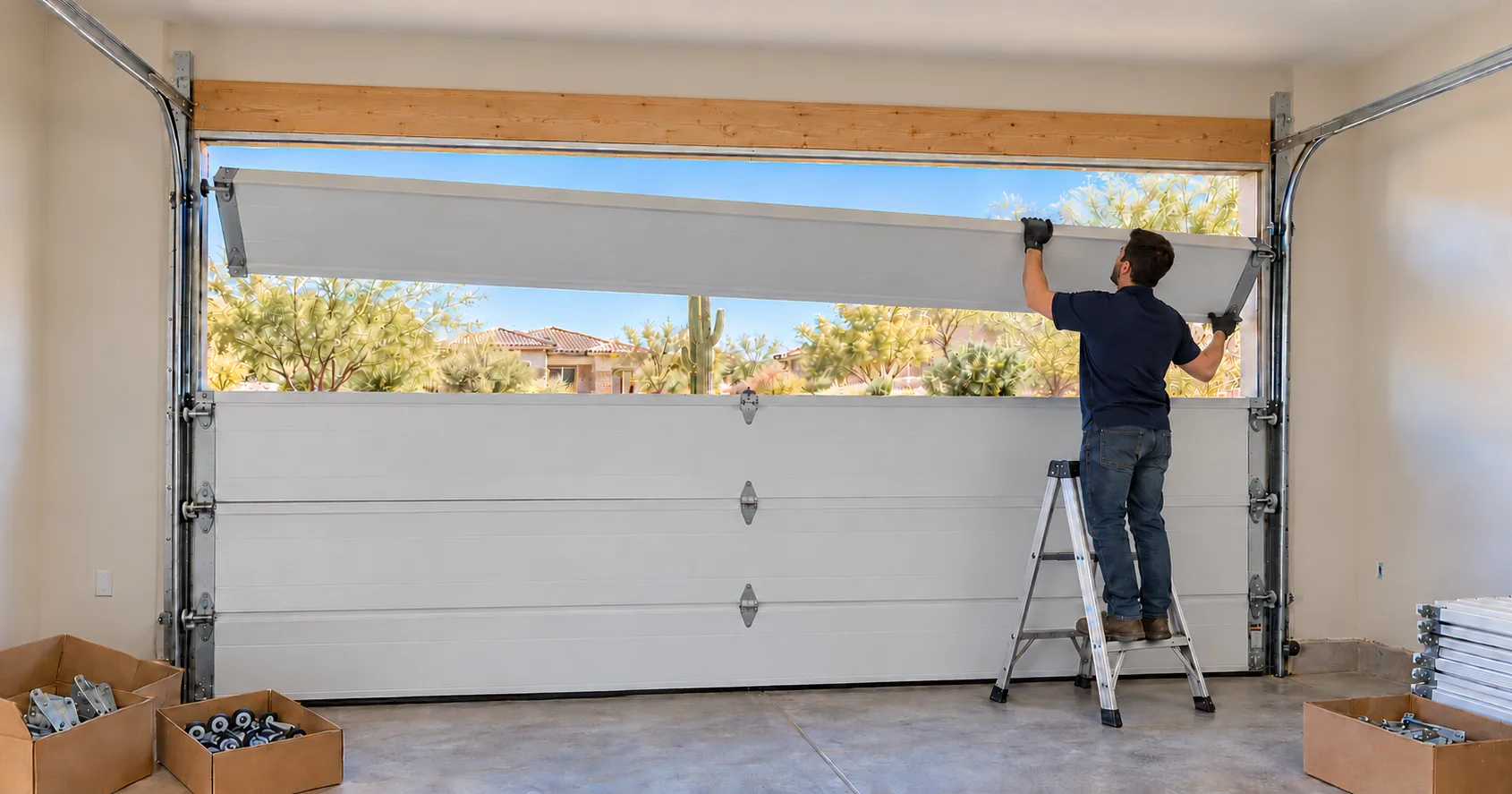
A complete garage door install replaces the whole system, not just the panels you see from the street:
- Included: the new door sections, new tracks, rollers, hinges and hardware, a new torsion spring system sized to the new door's weight, a new bottom seal and perimeter weather seal, and removal and haul-away of your old door.
- Your opener usually stays. It's reconnected and adjusted for the new door, then safety-tested. A new opener is a separate choice and a separate line on the quote.
- How long: a standard two-car door swap takes a few hours on install day. A door that has to be ordered adds lead time before that day, and extras like framing repairs or a new opener add time on the day.
- Get it itemized. Whoever you hire, ask for a written quote that lists tracks, springs, seals and haul-away, so you can compare quotes line for line.
Below: the full checklist, what's usually not included, whether your old tracks can be reused, what happens to your opener, and an hour-by-hour look at install day.
When people call us about a new garage door, the first questions are almost never about style. They're "Do I get new springs, or just the door?", "Can you use my old tracks?", "Will my opener still work?" and "How long will my garage be open?" Those are the right questions. Two quotes for "a new 16x7 door" can describe very different jobs, and the difference is usually in the parts you don't see: the tracks, the springs and what happens to your old door.
This guide walks through what a complete install includes, what's usually extra, and what install day actually looks like. If you're still deciding whether you need a new door at all, start with 8 signs your garage door is beyond repair. For styles, materials and brands, see our garage door buying guide.
The Checklist: What a Complete Install Includes
A garage door is a system: the door sections ride on rollers in a set of tracks, and a spring system does the actual lifting. A complete install replaces that whole system as a matched set. Here's what should be on the list:
| Part | In a complete install? | Why it matters |
|---|---|---|
| Door sections (panels) | Yes | The part you picked: size, style, color, insulation and any windows |
| Tracks (vertical, curved and horizontal) | Yes, new by default | Sized to the new door's height, thickness and hardware; see reusing old tracks |
| Rollers, hinges, brackets and fasteners | Yes | On our installs, quiet 11-ball nylon rollers are standard |
| Torsion spring system: springs, shaft, drums, cables and bearings | Yes | Sized to the new door's exact weight; old springs were sized for the old door |
| Struts (bracing on wide doors) | When the door calls for them | Keep wide doors from bowing, especially the top section, where a ceiling opener's arm pushes and pulls |
| Bottom seal and perimeter weather seal | Yes | Keeps out dust, heat and critters; Arizona sun wears out the old seals |
| Removal and haul-away of the old door | Yes | Including safely releasing the old springs, which is the dangerous part |
| Opener reconnected, adjusted and safety-tested | Yes, if you keep your opener | A new door is a different weight; travel limits and force have to be reset |
| Balance test and walkthrough | Yes | A balanced door stays put about halfway up with the opener released |
If a quote just says "new door, installed," ask which of these lines it covers. A cheaper quote that reuses old springs or skips the seals isn't the same job.
What's Usually Not Included
These are the things that most often come up as a separate line, or as a surprise if nobody mentions them on the measure visit:
- A new opener. Your existing opener is reconnected and adjusted. Replacing it is your call, and it's priced separately. More on that below.
- New exterior trim. The trim around the outside of the opening is often replaced as an option. Be aware that pulling old trim off a stucco house can chip or crack the stucco around it, and that patch can stay visible after the new trim goes on. Ask about it before the day, not on the day.
- Framing or jamb repairs. If the wood the tracks and trim attach to is rotted, split or out of plumb, it has to be fixed before the new door can hang right. A good installer checks this at the measure visit.
- Upgrades you choose. Windows, decorative handles and hinges, a higher insulation level, or higher-cycle springs are usually options on top of the base door.
- Paint and drywall. Touching up the garage walls or the outside of the house around the opening is generally not part of a door install.
Can You Reuse Your Old Tracks?
Sometimes, but it's the exception. New doors normally come with their own tracks, and there are good reasons to use them:
- The tracks have to match the door. The track width, the radius of the curve where the track turns toward the ceiling, and the hardware on the door all have to line up. A new door of the same size can still use different hardware than the old one.
- Old tracks wear. Years of rollers grind the track, brackets loosen, and a track that's been bumped by a car or bent by a door coming off its rollers rarely runs true again.
- A heavier door asks more of them. An insulated door weighs more than the single-layer steel door it often replaces.
Reusing the existing track can make sense when the new door is the same size and lift type, and the old track is straight, solidly mounted and in good shape. That's a judgment call made on the measure visit, not on install day, and it should be written on the quote either way so you know which you're getting.
In the East Valley? Text us a photo of your tracks and we'll tell you whether they look reusable.
Does a New Door Come With New Springs?
It should, every time. Springs do the lifting, and they're wound for a specific door weight. Your old springs were sized for your old door, they're partway through their life, and a new insulated door can weigh a good deal more. Reusing them leaves the door out of balance: heavy to lift, hard on the opener, and quick to wear out both.
Two things to ask about:
- The cycle rating. Springs are rated by how many open-and-close cycles they're built for. Standard springs are commonly rated around 10,000 cycles, and higher-cycle springs are an upgrade worth asking about if you use the garage door as your front door. Our spring lifespan guide compares the ratings.
- Extension or torsion. Some older East Valley homes still have extension springs running along the tracks. A new door is a good time to move to a torsion system; here's how to tell which you have.
Can You Keep Your Garage Door Opener?
Usually, yes. A healthy opener can run a new door. On install day it's disconnected, the new door is hung and balanced, and then the opener is reconnected and its travel limits and force are reset for the new door. The last step is a safety-reverse test.
It may be time for a new opener as well when:
- It's old. Openers made before 1993 don't have the safety sensors at the floor that are required now. Any opener that has needed several repairs is worth a second look.
- The new door is much heavier. A small-horsepower opener that was fine with a light, single-layer door may labor with an insulated two-car door, even when the door is properly balanced.
- You want something it can't do, like quieter belt drive, battery backup, smartphone control, or a wall-mount opener that frees up the ceiling (wall-mount openers need a torsion spring system).
Our guide to repairing or replacing a garage door opener goes through the decision. If you're replacing both, doing them on the same visit saves a second trip.
How Long a Garage Door Install Takes
There are two clocks: the time before install day, and install day itself.
Before install day. It starts with a measure visit, where the installer checks the opening, the headroom above it, the room beside it, the framing and your opener, and you pick the door. Then the door is ordered. Common sizes and styles can come quickly; custom colors, wood-look finishes, windows and non-standard sizes take longer. Ask for the expected lead time when you approve the quote. If you have an HOA, get its approval for the style and color before the order goes in.
Install day. For a standard two-car door replacing an old one, plan on a few hours. Here's roughly how the time goes:
- Old door out. The old springs are released safely, then the door, tracks and hardware come down and get loaded up for haul-away.
- Opening checked. The framing and jambs are checked for rot or damage before anything new goes up.
- Tracks up. The new tracks are mounted, leveled and set to the right pitch.
- Door stacked. The sections go in from the bottom up, with hinges and rollers attached as each one is set.
- Springs on. The torsion springs, drums and cables go on, and the springs are wound for the new door's weight.
- Balanced and sealed. The door is tested by hand for balance, and the bottom and perimeter seals are adjusted.
- Opener and safety. The opener is reconnected and adjusted, and the safety reverse is tested.
- Walkthrough. You get shown how it all works, including the manual release, and the old door leaves with the crew.
Add time for a new opener, new exterior trim, framing repairs, an extension-to-torsion conversion, or a second door. Your installer should tell you up front which of those apply to your job.
How to Get Ready for Install Day
- Move the cars out the night before, and clear the driveway in front of the door. The crew needs room to stage the new sections and stack the old ones.
- Clear a few feet inside the opening, plus the walls along both tracks up to the ceiling. Shelving, bikes and anything hanging near the tracks should come down.
- Check the outlet for the opener on the ceiling, and let the installer know if it's on a switch or a GFCI that trips.
- Plan to be home at the start and the end: at the start to confirm the details, and at the end for the walkthrough and remote programming.
- Keep pets and kids inside. The garage will be open, and springs and heavy sections are coming down.
- Have your HOA approval handy if your neighborhood requires one.
Seven Questions to Ask About Any Quote
Use these on every quote you get, ours included. The answers should be in writing:
- Are new tracks included, or are you reusing mine? If reusing, why?
- Are new springs included, sized to the new door, and what's their cycle rating?
- Are the bottom seal and perimeter seal new?
- Is removal and haul-away of my old door included?
- What happens with my opener: reconnected and adjusted, or replaced? If replaced, which model?
- What's not included that might come up on the day: trim, framing, drywall, permits or HOA paperwork?
- Who warranties what, and for how long: the door and parts, and the installation labor?
Also ask who warranties what, because there are usually two warranties. The door and its parts are covered by the manufacturer, and the length and terms differ by brand and by door model. The installation labor is covered by the installer. On our installs, Farnsworth covers the labor for 1 year. Our garage door warranty guide explains the difference. And if you're comparing financing, see financing a garage door installation.
Why East Valley Homeowners Call Farnsworth for a New Door
Farnsworth Garage Door Service was founded by brothers Brigham and Riley Farnsworth, and we run it the way our family has always run businesses in the East Valley: tell the truth, put the price in writing, and do the work right the first time.
- Itemized, in writing. Your quote lists the door, tracks, springs, seals, haul-away and opener work, so you can compare it with anyone's.
- Complete systems. Our door packages come with new tracks, hardware, nylon rollers, a torsion spring system and perimeter seal, and we take the old door away.
- 1-year labor warranty from us, on top of the manufacturer's warranty on the door and parts.
- We check before we order. Tracks, framing, headroom and your opener get checked on the measure visit, so install day has no surprises.
- Licensed and insured in Arizona (ROC #351810), residential garage doors only.
See our garage door installation page, our opener installation page, or where we work across the East Valley.
Frequently Asked Questions
Does a new garage door come with tracks?
A complete install normally includes new tracks, along with new rollers, hinges and hardware, because the tracks have to match the new door's size and hardware. Reusing the old tracks is sometimes possible when the new door is the same size and lift type and the old track is straight and in good shape. That should be decided on the measure visit and written on the quote.
Do new garage doors come with springs?
They should. Springs are wound for a specific door weight, so a new door needs a spring system sized to it. Reusing old springs leaves the door out of balance and wears out the opener. Ask what cycle rating the new springs have; standard springs are commonly rated around 10,000 cycles, and higher-cycle springs are an upgrade.
Can you install a new garage door on old tracks?
Sometimes. It can work when the new door is the same size, uses the same lift type and track radius, and the old track is straight, solidly mounted and not worn. If the track is bent, rusted or a different size, or the new door is much heavier, new tracks are the right call.
How long does it take to install a garage door?
Replacing a standard two-car door usually takes a few hours on install day. That covers removing the old door and springs, installing new tracks, sections and springs, balancing and sealing the door, and reconnecting the opener. A new opener, new trim, framing repairs or a second door add time. Before install day, allow lead time for the door to arrive; custom colors, windows and non-standard sizes take longer.
Can I keep my garage door opener with a new door?
Usually, yes. A healthy opener is reconnected and its travel limits and force are reset for the new door, then the safety reverse is tested. Consider replacing it if it was made before 1993, has needed repeated repairs, or is a small-horsepower unit and the new door is a much heavier insulated door.
Do I need to be home during a garage door installation?
It helps to be there at the start, to confirm the details, and at the end, for the walkthrough and remote programming. Move the cars out and clear the driveway and the area inside the opening beforehand.
What happens to my old garage door?
On a complete install, the installer releases the old springs safely, takes down the door, tracks and hardware, and hauls them away. Confirm that removal and haul-away are listed on your quote.
What warranty comes with a new garage door install?
Usually two. The door and its parts carry the manufacturer's warranty, and the length and terms vary by brand and door model. The installer covers the installation labor separately. On Farnsworth installs, that labor warranty is 1 year. Ask any installer to put both in writing.

Want to See Exactly What's Included?
Licensed, insured, locally owned in Mesa, serving Gilbert, Chandler, Queen Creek and the Phoenix area. We'll measure your opening, check your tracks and opener, and give you an itemized written quote for a complete install, with the old door hauled away. Not sure where to start? Text us a photo of your door.