
Garage Door Spring Lifespan: How 10,000-Cycle, 25,000-Cycle, and 50,000-Cycle Springs Compare
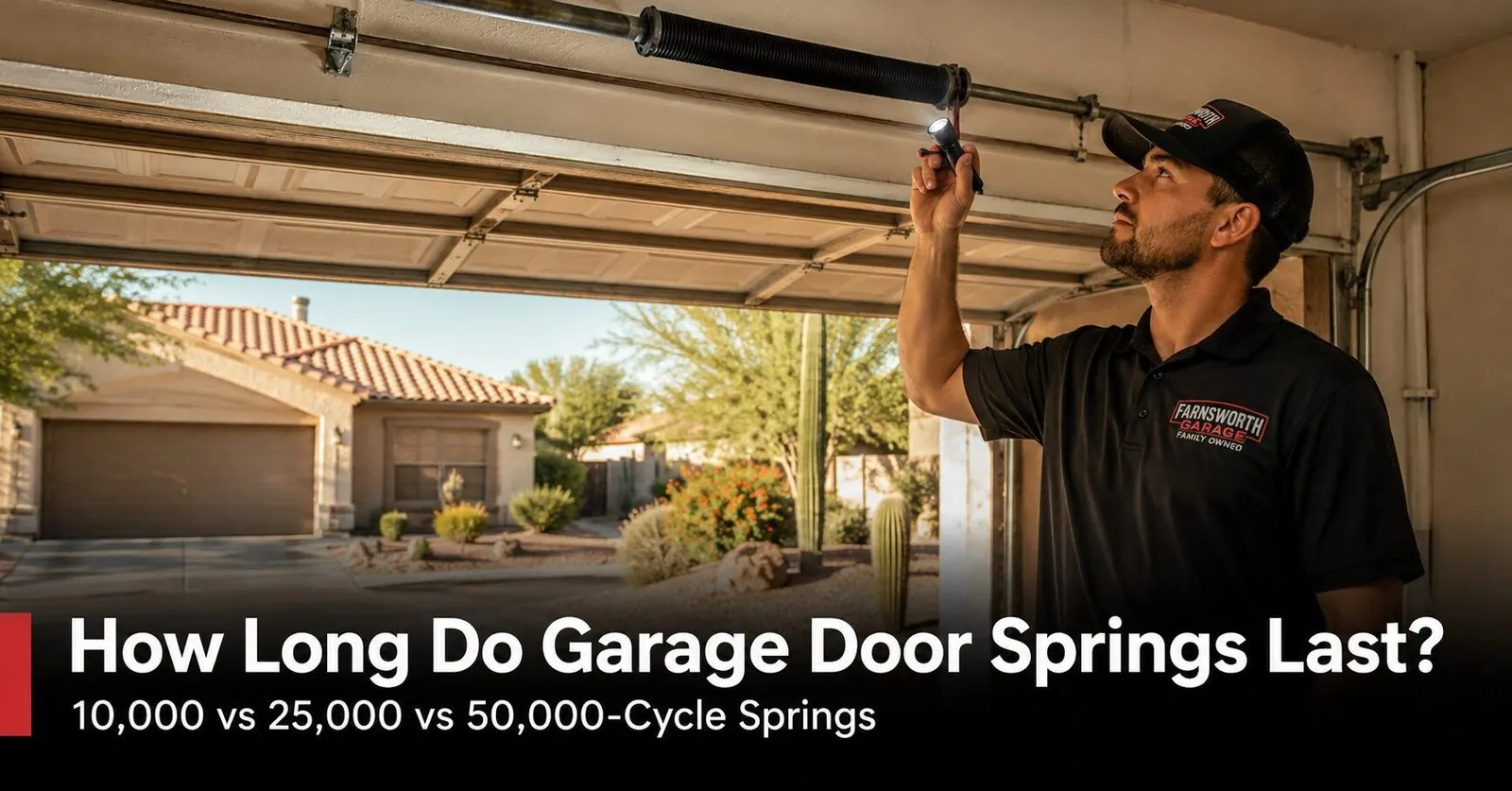
Garage door spring life is measured in cycles — one cycle is a single open plus a single close — not in years. Here's roughly how the three common ratings translate for a typical Mesa-area home that runs the door three to four times a day:
- 10,000-cycle (standard builder-grade): about 6 to 9 years. Fewer if the garage is your main entrance.
- 25,000-cycle (the common upgrade): about 15 to 20 years. The sweet spot for most families.
- 50,000-cycle (high-use): often 25+ years — frequently outlasts the door itself.
The single biggest factor isn't the desert heat — it's how many times your door moves each day. Below is the year-by-year math, plus how to pick the right rating for your home.
When a spring snaps, almost everyone asks the same two questions: "Why now?" and "How long should the next one last?" The honest answer to both comes down to one number most homeowners have never heard of — the spring's cycle rating. It's the closest thing the garage door world has to a lifespan, and once you understand it, replacing a spring stops feeling like a gamble and starts feeling like a choice you control. This guide breaks down what a cycle really is, how long 10,000-, 25,000-, and 50,000-cycle springs actually last, why so many Phoenix-area homes burn through the standard spring faster than expected, and how to make whatever spring you choose reach the end of its rated life.
What a "Cycle" Actually Means
A torsion spring is a tightly wound steel coil mounted on a shaft above your door. Every time the door closes, the spring winds up and stores energy — like twisting a giant rubber band. Every time the door opens, it releases that energy to counterbalance the door's weight, which is what makes a 150-pound door feel almost weightless to lift.
Each full wind-and-release is one cycle: one open plus one close. Steel can only be stressed and relaxed so many thousands of times before it fatigues and breaks, so manufacturers rate springs by how many cycles they're built to survive. That rating — 10,000, 25,000, 50,000 — is the real expiration date on your spring. Years are just a rough translation of it.
Here's why that matters: two identical springs on two identical doors can have completely different lifespans. The family that uses the garage as their front door, in and out six or eight times a day, will reach 10,000 cycles years sooner than the neighbor who parks in the driveway and only runs the door once a day. Same spring, same quality — very different number of years.
10,000 vs 25,000 vs 50,000-Cycle Springs, Side by Side
All three ratings do the same job — counterbalance your door — and from the floor they look nearly identical. The difference is in the steel. A higher-cycle spring uses thicker wire and more coils to support the same door weight, so it works less hard on every cycle and fatigues more slowly. Here's how they compare.
| Cycle rating | Typical lifespan* | What it is | Best fit |
|---|---|---|---|
| 10,000-cycle | ~6–9 years | Standard builder-grade spring on most new doors | Low-use doors; driveway parkers; rentals on a budget |
| 25,000-cycle | ~15–20 years | Thicker wire, more coils; the common upgrade | Most families — the door used several times a day |
| 50,000-cycle | ~25+ years | Heaviest-duty residential spring available | High-use homes; the garage that's your main entrance |
*Based on a typical home running the door three to four times a day. Heavy-use homes land at the lower end; light-use homes exceed the high end.
How Many Years Each Spring Really Lasts
Lifespan ranges are useful, but the real picture comes from your own daily use. The table below converts each cycle rating into years at four common usage levels. Find the row that sounds like your household and read across.
| Daily use (open + close) | 10,000-cycle | 25,000-cycle | 50,000-cycle |
|---|---|---|---|
| 2 cycles/day (light — driveway parker) | ~13–14 years | ~34 years | ~50+ years |
| 4 cycles/day (typical family) | ~7 years | ~17 years | ~34 years |
| 6 cycles/day (garage is main entry) | ~4–5 years | ~11 years | ~23 years |
| 8 cycles/day (multiple drivers, busy home) | ~3–4 years | ~9 years | ~17 years |
The pattern jumps out fast: at the busy end of the table, a standard 10,000-cycle spring is gone in three or four years, while a 50,000-cycle spring on the same door is still going strong two decades later. That gap — not the brand of the spring or the heat outside — is what most homeowners are really feeling when a spring "didn't last."
Why Your Home Likely Uses More Cycles Than You Think
Most people underestimate their own door. It's easy to picture two trips a day — leave in the morning, come home at night — but a normal day in a Gilbert or Queen Creek household tends to look more like this:
- Out for work or school drop-off, and back
- A midday errand or two — groceries, appointments, the gym
- A second driver coming and going on their own schedule
- Letting the dog out, taking out the trash, grabbing something from the garage
- Kids and teens in and out through the afternoon and evening
It adds up quickly. Plenty of Phoenix-area homes run their door six, eight, even ten cycles a day without realizing it — especially the many households that use the garage as their primary entrance and never touch the front door. On a 10,000-cycle spring, that's a replacement every three to five years. On a 50,000-cycle spring, it's barely a dent. This is exactly why we ask about daily use before recommending a spring, instead of just matching whatever the builder originally installed.
Does Arizona Heat Shorten Spring Life?
It's a fair question in a place where summer surface temperatures climb past 150 degrees — but the surprising answer is that heat is not the main villain here, and in one important way our climate is actually kind to springs.
The good news: dry desert air means less rust
Torsion springs fail two ways — metal fatigue from cycling, and corrosion that weakens the steel. In humid and coastal climates, rust is a major lifespan killer. Our dry desert air produces far less of it, so an Arizona spring is more likely to live out its full cycle rating than one in a damp Gulf Coast garage. The spring also sits inside the garage, above the door, shielded from direct UV, so the relentless sun that fades door finishes doesn't reach the coils.
The local factors that do matter: usage and dust
Two desert realities work against you. First, usage — many homeowners park inside to keep their vehicles out of the brutal summer sun, which means the door runs more often and racks up cycles faster. Second, dust. Fine Arizona dust and monsoon grit settle into dry spring coils, and a spring that's never lubricated grinds against that grit on every cycle. A light coat of garage door lubricant a few times a year keeps the coils clean and gliding, and it's the highest-value thing you can do for spring life in our climate.
So the desert doesn't so much shorten the rated life of a spring as it nudges you toward burning through cycles faster — another reason a higher cycle rating tends to pay off here.
Signs Your Spring Is Near the End of Its Life
A spring rarely gives much warning before it snaps — but there are a few tells in the weeks before that a tech, or an attentive homeowner, can catch:
- The door feels heavier than it used to when you lift it by hand with the opener disconnected.
- The opener strains, hesitates, or struggles to lift a door that used to glide up.
- The door won't stay put at waist height — it drifts down or jumps up when you let go (a failed balance test).
- You see gaps, stretching, or rust in the coils, or the coils look uneven end to end.
- Grinding, popping, or louder operation than the door used to make.
If you spot these, it's worth a look before the spring lets go — a planned replacement is always easier than an emergency one. When a spring does snap, you'll usually hear a loud bang from the garage and find the door suddenly too heavy to lift or the opener running without moving it. For a full walkthrough of the warning signs and what to do, see our guide to spotting a broken garage door spring in Arizona.
Which Cycle Rating Should You Choose?
When a spring needs replacing, you're rarely stuck with the rating the builder picked. In most cases you can step up, and the decision comes down to how hard your door works.
Step up to 25,000-cycle
For the average family that runs the door several times a day, the 25,000-cycle spring is the value pick. It gives you roughly two-and-a-half times the lifespan of the standard spring, which often turns a replacement-every-five-years situation into replace-every-fifteen-plus. For a door you use as a daily entrance, that math is hard to argue with.
Consider 50,000-cycle
If your garage is the main way everyone gets in and out, you have multiple drivers, or you simply want to install springs once and forget them, the 50,000-cycle spring is worth a look. On many homes it will outlast the door, the opener, and your time in the house. Because it carries the most steel, correct sizing to your true door weight matters most here.
Stick with 10,000-cycle
The standard spring isn't a bad spring — it's just sized for lighter use. For a low-traffic door, a detached garage, or a rental where the budget is the priority, it does the job. Just go in knowing it's the shortest-lived option, especially if usage is higher than expected.
A note on two-spring doors
Many wider doors use two springs, and here's a detail worth knowing: both springs ride on the same torsion shaft. A common myth is that if one of the two breaks, the door hangs crooked — it usually doesn't, because the springs share one shaft. What you'll feel instead is that the door suddenly got very heavy or won't open, because you've lost roughly half your lifting force. Since both springs are the same age and have done the same number of cycles, when one fails the other is close behind — so we almost always recommend replacing the pair together. It restores balanced lift, avoids a second service call within months, and is the natural moment to step both springs up to a higher cycle rating.
How to Make Any Spring Last Longer
You can't raise a spring's cycle rating after it's installed, but you can make sure it reaches the rating it has. Three habits do most of the work:
- Lubricate the coils a few times a year. A light spray of garage door lubricant or white lithium grease along the spring body (skip the cones at each end) keeps desert dust from grinding the steel. This is the single biggest favor you can do a spring here.
- Keep the door balanced. An unbalanced door forces the spring and opener to fight extra load on every cycle. A quick balance test — lift the door halfway by hand and see if it holds — tells you whether tension is still right.
- Skip unnecessary cycles. If a side door works for a quick trip to the garage, use it. Every full open-and-close you avoid is a cycle banked.
It also pays to have the whole system looked at periodically, because the spring shares its life with the cables, drums, bearings, and rollers around it. A worn cable or a dry bearing can cut a good spring's life short. A seasonal garage door tune-up catches those before they become a roadside-style breakdown in your driveway, and it's the cheapest insurance there is on a door you rely on every day.
Why Mesa-Area Homeowners Call Farnsworth for Spring Replacement
Farnsworth Garage Door Service was founded by brothers Brigham and Riley Farnsworth. The Farnsworth name has 60+ years of family business across Mesa and the East Valley behind it — R&K, Farnsworth Wholesale, Farnsworth Realty — and we run this company the way our family always has: tell the truth, put the price in writing, do the work right the first time.
- We size the spring to your actual door — measuring weight and use, not just matching the builder's part — so the lifespan you pay for is the lifespan you get.
- We walk you through 10k, 25k, and 50k options in writing and tell you which makes sense for how your household uses the door.
- We replace springs in pairs on two-spring doors when it's the right call, so you're not back in a few months.
- We check the cables, drums, and bearings while we're in there, because they share the spring's workload.
- Same-day service is our standard, often within hours of your call.
- 5.0 stars on Google. Our neighbors keep us busy by telling theirs.
Learn more on our garage door spring repair page, or see where we work across Mesa and the Phoenix area.
Frequently Asked Questions
How long does a garage door spring last?
Garage door spring life is measured in cycles, not years, and one cycle is a single open plus a single close. A standard 10,000-cycle torsion spring lasts roughly 6 to 9 years in a typical home that opens the door three or four times a day. A 25,000-cycle spring lasts about 15 to 20 years at that same pace, and a 50,000-cycle spring often outlasts the door it's installed on. The real number for your home depends almost entirely on how many times the door moves each day, so a busy family that uses the garage as the main entrance will reach the end of a 10,000-cycle spring much faster than a household that parks in the driveway.
What is a cycle on a garage door spring?
One cycle is the door going up once and coming back down once. So if you leave for work, come home, run an errand, and come home again, that's four cycles on the spring in a single day. Springs are engineered and rated by how many of these cycles they can perform before the steel fatigues and breaks, which is why a spring's lifespan is given as a cycle count, such as 10,000 or 25,000, rather than a number of years. Two households can buy the identical spring and one replaces it in four years while the other gets twelve, purely because of how often the door runs.
Are 25,000-cycle springs worth the upgrade?
For most homes, yes. Upgrading from a standard 10,000-cycle spring to a 25,000-cycle spring gives you roughly two-and-a-half times the spring life, and in a busy household that's often the difference between replacing springs every five years and every twelve or more. The upgrade is achieved by using thicker wire and more coils to support the same door weight, so the spring works less hard per cycle. We talk through the trade-off with every spring replacement and put the options in writing, because for a family that uses the garage door as the front door, the longer-life spring frequently makes the most sense.
How long does a 50,000-cycle spring last?
A 50,000-cycle spring lasts roughly 22 to 34 years for a household using the door four to six times a day, and even longer for lighter use. In practical terms, a 50,000-cycle spring frequently outlasts the garage door, the opener, and sometimes the homeowner's time in the house. It's the right choice for high-use households, multi-driver families, and anyone who wants to install springs once and not think about them again. Because it carries the most steel for a given door, correct sizing matters more than ever, so it should be matched to your actual door weight rather than guessed.
Does Arizona heat shorten garage door spring life?
Heat itself is not the main driver of spring failure, and Arizona's dry desert air is actually kinder to springs than humid or coastal climates because there's far less rust and corrosion to weaken the steel. The two local factors that do matter are usage and dust. Many Phoenix-area homes use the garage as the primary entrance and park inside to keep vehicles out of the sun, which pushes daily cycle counts up and shortens spring life. And fine desert dust works into dry coils, so a spring that's never lubricated wears faster than one that gets a light coat of garage door lubricant a couple of times a year. Keep the door cycle count and the lubrication in mind and your springs will reach their rated life.
Why did my garage door spring break after only a few years?
The most common reason is that a standard builder-grade 10,000-cycle spring was paired with a high-use door. If your household opens the door eight times a day, a 10,000-cycle spring can reach the end of its rated life in three to four years, even though nothing was defective. Other causes include an undersized spring that was never matched to the true door weight, missing lubrication that let dust accelerate wear, rust from a damp garage, or a single broken spring on a two-spring door that put extra strain on its partner. A balance test and a look at the wire size tell us which of these is in play, and the fix is usually a correctly sized, higher-cycle spring.
If I have two springs and one breaks, do I replace both?
We almost always recommend replacing both. On a two-spring door, both springs ride on the same torsion shaft and have done the same number of cycles, so when one reaches the end of its life the second one is right behind it. Replacing only the broken spring usually means a second service call within months, plus the new spring and the worn one won't be balanced to each other. Replacing the pair at once restores even, balanced lift, costs less than two separate visits, and resets the lifespan of the whole system. It's also the moment to consider stepping up to a higher cycle rating so you're not back in the same spot in a few years.
How can I make my garage door springs last longer?
You can't change a spring's cycle rating, but you can make sure it reaches it. Lubricate the spring coils lightly with a garage door lubricant or white lithium grease two or three times a year, avoiding the cones at each end. Keep the door balanced so the opener and springs aren't fighting an unbalanced load. Avoid unnecessary cycles, such as opening the full door when a side entry would do. And have the system tuned periodically so a tech can catch a fraying cable, a worn bearing, or an undersized spring before it cuts the life short. In our dry, dusty climate, lubrication and balance are the two highest-value habits.

Spring Worn Out — or Want One That Lasts?
Licensed, insured, locally owned. We size the spring to your actual door and walk you through 10k, 25k, and 50k options in writing, so the lifespan you pay for is the lifespan you get. Same-day service is our standard, often within hours of your call.