
Repair or Replace Your Garage Door Opener? How Arizona Homeowners Should Decide
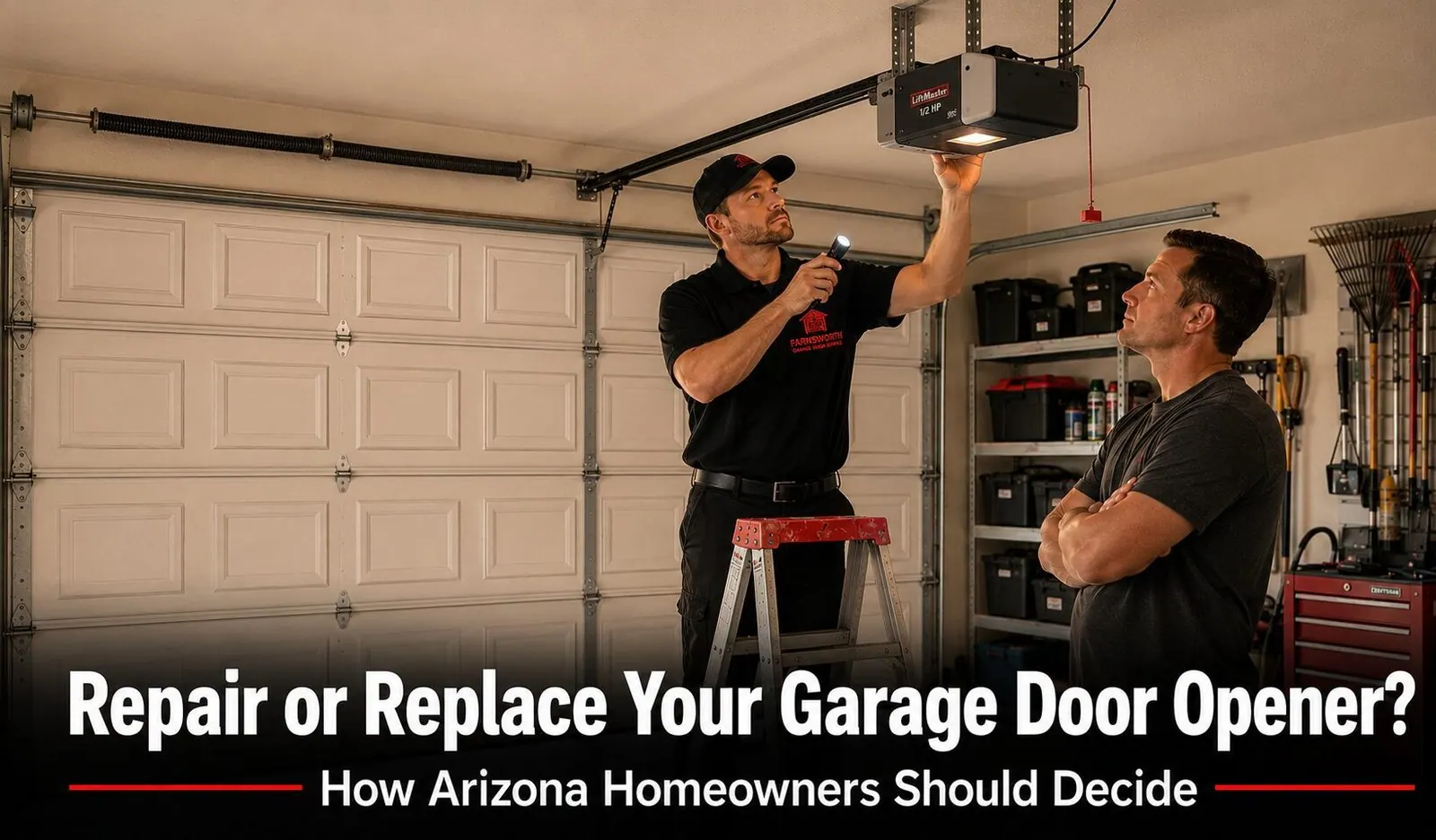
Four questions settle most repair-or-replace decisions:
- How old is it? Under 10 years usually favors repair; past 12–15 years — and Arizona heat pushes openers toward the early end — usually favors replacement.
- What failed? Remotes, sensors, adjustments, and worn drive parts are repair territory. A failed motor or logic board on an older unit is a replacement signal.
- Is it still safe and secure? No photo-eye safety sensors, or old DIP-switch remotes, means replace — no exceptions worth making.
- What would you gain? Battery backup for monsoon outages, quieter operation, phone control, and modern rolling-code security often tip a close call.
Rule of thumb: when a repair bill approaches half the cost of a new opener installed, put the money toward the new unit.
Every week, homeowners across Mesa, Gilbert, and Queen Creek ask us the same question from the driveway: “Is this opener worth fixing, or am I throwing good money after bad?” It's the right question — and the honest answer depends on a handful of specifics, not a sales pitch. An opener is a motor, a drive system, and a small computer bolted to the ceiling of the hottest room in an Arizona house. Some failures are cheap, quick fixes. Others are the machine telling you it's done. This guide walks through how we'd help you decide if we were standing in your garage — so you can make the call with clear eyes either way.
How Long Openers Really Last in Arizona
Most manufacturers build openers to last roughly 10 to 15 years. In the Phoenix area, plan on the low end of that range. A closed garage in Mesa or San Tan Valley can sit above 120°F for hours a day, all summer long — and heat is the enemy of exactly the parts an opener depends on. Capacitors dry out and weaken. Circuit boards age faster. Plastic gears and trolleys get brittle. Then monsoon season arrives with power surges that can damage a logic board in a single evening, and fine desert dust works into the chain or belt drive year-round.
A quick way to date your unit without digging up paperwork: look at the color of the LEARN button on the back of the motor. On LiftMaster, Chamberlain, and Craftsman openers, a yellow button means 2011 or newer; a purple, red, or orange button means the opener predates 2011 — which puts it at 15+ years old today. And if your remote has a row of tiny switches inside the battery cover, you're looking at 1990s-era technology.
When Repair Is the Smart Call
Plenty of “dead opener” calls end with a modest fix and a working door the same visit. Repair usually makes sense when the opener is on the younger side — roughly under 10 years — and the failure is one of the common, contained ones:
Accessories and adjustments. Dead remotes, a keypad that lost its code, safety sensors knocked out of alignment by a trash can, or travel limits that drifted — these are quick, inexpensive service items, not opener failures.
Worn drive components. A stripped main drive gear, a worn trolley or carriage, or a stretched chain are classic mid-life repairs. On a healthy opener, replacing them restores years of service.
One-off electrical items. A weakened capacitor that makes the motor hum without lifting is a known, fixable fault — and a common one in our summer heat.
- The opener is under ~10 years old
- This is its first real problem, not its third this year
- The failed part is a component, not the motor or the brain
When Replacement Is the Smart Call
Some situations point clearly toward a new unit — not because repair is impossible, but because it's poor value or leaves you with something unsafe:
The brain or the muscle failed on an old unit. When a logic board or motor gives out on an opener past the 10-to-12-year mark, the math rarely favors fixing it. Every other component on that machine has the same years of Arizona heat cycles behind it, so a major repair often buys you a season or two before the next failure. This is where the half-the-cost rule earns its keep: if the repair approaches half of what a new opener installed would run, replace.
No safety sensors. Photo-eye sensors have been required on every new opener sold in the U.S. since 1993. If your opener has no little lenses near the floor on either side of the door, it cannot reverse when a child or pet crosses under a closing door. We don't repair these; we replace them, and we'd tell family the same thing.
Fixed-code remotes. Old DIP-switch systems broadcast the same code every time — technology from an era when that seemed fine. Modern rolling-code openers change the code with every press. If your opener predates rolling code, replacement is a security upgrade, not just a convenience.
Parts are drying up. Discontinued models from the 1990s and early 2000s can be slow or impossible to source parts for. When a repair means hunting for obsolete components, the repair itself becomes the expensive path.
It's become a frequent flyer. If you're on your second or third service call in a couple of years, the opener is telling you something. Repeated repairs on an aging unit almost always cost more over three years than replacing it once.
Repair vs Replace, by Symptom
| What's happening | Likely culprit | Usual verdict |
|---|---|---|
| Remote or keypad stopped working | Battery, programming, or worn remote | Repair — quick fix at any age |
| Door reverses for no reason | Sensor alignment or force settings | Repair — adjustment or sensor service |
| Motor hums but door doesn't move | Capacitor or stripped drive gear | Repair if under ~10 years; weigh replacement past that |
| Grinding, then nothing | Stripped main gear or worn trolley | Repair on a younger unit; replace an old one |
| Completely dead after a storm | Surge-damaged logic board | Repair if newer; replace if 10+ years old |
| No photo-eye sensors at all | Pre-1993 opener | Replace — safety isn't negotiable |
| DIP-switch remotes, parts hard to find | Obsolete 1990s-era system | Replace — security and parts have moved on |
If your opener's symptom isn't on this list — it clicks, blinks a code, or works only sometimes — a diagnostic visit sorts it out fast. Our opener repair and replacement service covers every major brand: LiftMaster, Chamberlain, Genie, Craftsman, and more.
What a Modern Opener Gets You in Arizona
When the decision is close, it helps to know what's on the other side of it — because openers have changed more in the last decade than in the thirty years before it.
Battery backup. When a monsoon outage hits, a battery-equipped opener keeps working for a couple of days of normal use — no fumbling for the red release cord in a dark garage. For anyone who's been stuck outside during an August storm, this feature alone can justify the upgrade.
Quieter operation. Belt-drive and DC-motor openers run dramatically quieter than the chain units most Valley homes came with — a real quality-of-life change if a bedroom sits above or beside the garage.
Phone control and alerts. Wi-Fi openers let you check whether the door is closed from anywhere and get an alert if it opens — the end of the “did I close the garage?” U-turn.
Modern security. Rolling-code encryption, vacation lock modes, and motion-activated lighting come standard on current units.
And because a new installation includes fresh force and travel settings, sensor alignment, and a door balance check, the whole system leaves in better shape than an old opener limping along ever could. Pairing the install with a garage door tune-up is the cleanest reset a door can get.
Not sure which way your opener leans? Call or text (602) 935-9766 — describe what it's doing and we'll give you an honest read.Why Neighbors Trust Farnsworth With the Call
Farnsworth Garage Door Service was founded by brothers Brigham and Riley Farnsworth. The Farnsworth name carries 60+ years of family business across Mesa and the East Valley — R&K, Farnsworth Wholesale, Farnsworth Realty — and we run this company the same way: tell the truth, put it in writing, fix it right the first time.
- Repair-first honesty. If a capacitor or gear kit will give your opener years more life, that's what we'll recommend — we'd rather earn the replacement job whenever it's actually time.
- Every major brand. LiftMaster, Chamberlain, Genie, Craftsman, Overhead Door — we diagnose and service them all, and we'll explain what your unit's blink codes are telling us in plain English.
- Same-day service is our standard, often within hours of your call — a dead opener shouldn't hold your car hostage.
- 5.0 stars on Google from homeowners across Mesa, Gilbert, Chandler, Queen Creek, and the greater Phoenix area.
Frequently Asked Questions
How long do garage door openers last in Arizona?
Most garage door openers are built to last roughly 10 to 15 years, but Arizona garages run hotter than almost anywhere in the country — often well above 120°F inside during summer — and that heat is hard on capacitors, circuit boards, and plastic drive components. Add monsoon power surges and fine desert dust working into the drive system, and many Valley openers reach the end of their useful life closer to the 10-year mark than the 15.
Is it worth repairing a 15-year-old garage door opener?
Usually not, unless the fix is very minor. A 15-year-old opener predates modern security encryption and often battery backup and smart features too, and its other components have the same 15 years of heat cycles on them — so fixing one part frequently buys you a short reprieve before the next failure. Once a repair on an opener that age is anything more than a remote, sensor alignment, or small adjustment, putting that money toward a new unit is generally the better value.
What is a logic board, and why did mine fail?
The logic board is the opener's brain — the circuit board that reads your remotes, runs the motor, and monitors the safety sensors. In Arizona, the two most common killers are summer heat, which slowly degrades the board's components in a garage that bakes all day, and monsoon-season power surges, which can damage a board in one strike. On a newer opener a board replacement can make sense; on an older one, it's often the tipping point toward replacement.
Can I still get parts for my old opener?
It depends on the brand and era. Major brands like LiftMaster, Chamberlain, Genie, and Craftsman keep parts available for many older models, and a good technician can often cross-reference compatible components. But some discontinued models — especially units from the 1990s and early 2000s, and openers that use old fixed-code DIP-switch remotes — have limited or no parts support. When parts are scarce, repairs get slower and less economical, which weighs toward replacement.
My opener doesn't have safety sensors. Should I replace it?
Yes. Photo-eye safety sensors — the small lenses near the floor on each side of the door — have been required on new openers nationwide since 1993. If your opener has none, it's more than three decades old and lacks the reversing protection that stops a closing door when a child, pet, or object is in its path. That's not a repair conversation; it's a replacement conversation, and it's one of the clearest-cut cases we see.
Will a new opener work with my existing garage door?
In almost every case, yes. Openers are largely universal — a new unit can be installed on nearly any sectional garage door in good working order. The important caveat is door condition: an opener only moves the door, while the springs do the lifting. If the door is heavy, unbalanced, or has worn springs, a new opener will strain just like the old one did, which is why we check door balance before recommending any opener installation.
Do I have to replace my remotes and keypad with a new opener?
New openers come with new remotes, and your existing keypad and old remotes usually won't carry over because security technology has changed generations. The good news: reprogramming is part of a professional installation. Your cars' built-in HomeLink buttons can be reprogrammed to the new unit, new keypads take minutes to set up, and modern openers add phone control through Wi-Fi apps — so most homeowners end up with more ways to open the door than they had before.

Get an Honest Answer on Your Opener
Licensed, insured, locally owned. We'll diagnose what's actually wrong, lay out repair and replacement options side by side with everything in writing, and let you make the call — no pressure either way. Same-day service is our standard, often within hours of your call.