
Extension vs Torsion Springs: Which Does Your Arizona Garage Door Have?
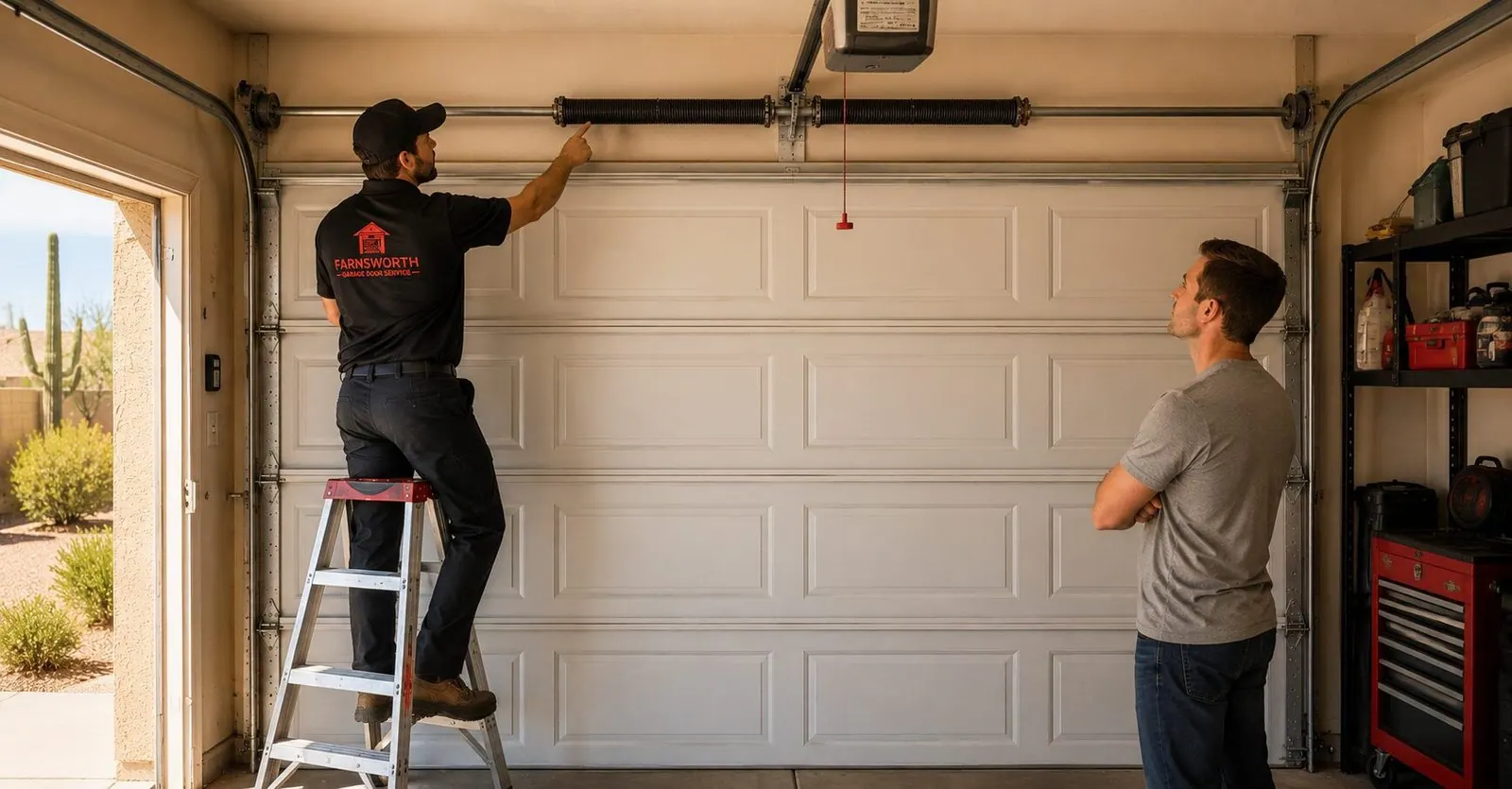
You can tell in about ten seconds. Stand inside the garage with the door closed and look up:
- Torsion springs: one or two tightly wound steel coils on a horizontal shaft directly above the door opening. This is the modern standard.
- Extension springs: two long, stretchy springs running alongside the horizontal tracks, one over each side, hooked to cables and pulleys. Common on older and budget builds.
- No visible coils, just a metal tube? That's likely a Torquemaster-style system — torsion springs hidden inside the tube.
Torsion springs lift more evenly, last roughly twice as long, and fail more safely. Either way, spring adjustment and replacement is professional work — these parts store serious force.
When a homeowner in Mesa or Gilbert calls about a spring, the first thing we ask is what they see above the door — because the two spring systems behave differently, wear differently, and break differently. Knowing which one you have tells you a lot: how long your springs are likely to last in Arizona's heat, what a failure will look like when it comes, and whether an upgrade is worth discussing at your next service. Here's the plain-English version of what we explain in driveways across the Phoenix area every week.
The 10-Second Visual ID
Close the door, step inside the garage, and look up at the wall above the opening and along the tracks.
You'll see a horizontal metal shaft mounted on the wall just above the door opening, with one or two tightly wound steel coils on it. At each end of the shaft sits a grooved wheel called a cable drum, and cables run from those drums down to the bottom corners of the door. The coils don't stretch — they twist. Nothing hangs over the tracks.
- Coiled spring(s) centered above the opening, parallel to the door
- Cable drums at each end of a single shared shaft
- Clean look — no pulleys or long springs over the tracks
You'll see two long springs stretched horizontally above the tracks — one on the left, one on the right — roughly parallel to the ceiling. Each connects to a system of cables and pulleys. When the door closes, the springs stretch out like giant screen-door springs; when it opens, they contract and pull the door up from the sides.
- Long, skinny springs running alongside each horizontal track
- Pulleys and visible cable runs at several points
- Should have a safety cable threaded through the middle of each spring
How Torsion Springs Work
A torsion spring is a coiled steel spring mounted on a metal shaft above the door. When the door closes, the spring winds up and stores energy — like twisting a rubber band. When the door opens, that stored energy releases through the shaft, turning the cable drums at each end, which reel in the cables attached to the bottom corners of the door. The result is a door that feels nearly weightless even though a typical double door weighs 130 pounds or more.
Because the force comes from a single shared shaft turning both drums together, the lift is symmetrical — both sides of the door rise in unison, with almost no friction in the system beyond a few bearings. That evenness is why torsion doors run quieter, bind less, and put far less strain on the opener. One important detail homeowners often get wrong: on a two-spring torsion door, both springs sit on that one shaft. If one spring breaks, the door doesn't tilt or hang crooked — it simply gets very heavy, because the shaft still turns both drums evenly.
Standard residential torsion springs are rated around 10,000 open-close cycles, and high-cycle versions go well beyond that. If your springs seem to need replacing too often, our garage door spring repair team can size a longer-life spring set for your exact door weight.
How Extension Springs Work
Extension springs take the opposite approach: instead of twisting, they stretch. One spring runs above each horizontal track, connected through pulleys and cables to the door. Closing the door stretches both springs; opening it lets them contract and pull the door up from the sides.
The system works, and millions of doors still use it — especially homes built before the 2000s and garages with very low ceiling clearance, where there isn't room for a torsion shaft above the opening. But it has built-in disadvantages. Each side lifts independently, so if the springs age unevenly or a cable stretches, the door can lift lopsided, rack in the tracks, and grind on its hinges. The pulleys add four or more friction points that the opener has to fight. And extension springs typically wear out sooner — roughly 5,000 to 7,000 cycles versus 10,000 for standard torsion.
The bigger issue is what happens at failure. A stretched extension spring stores its energy in the open coil itself, with nothing containing it. When one snaps without a safety cable installed, it can whip sideways or fly across the garage. That's why every extension spring should have a safety cable threaded through the coil and anchored at both ends — if yours don't, that's a quick fix worth making before anything else.
Extension vs Torsion: Side by Side
| Feature | Torsion Springs | Extension Springs |
|---|---|---|
| Where you see them | On a shaft directly above the door opening | Stretched along both horizontal tracks |
| How they lift | Twist and release through a shared shaft — even, centered lift | Stretch and contract on each side independently via pulleys |
| Typical cycle life | ~10,000 cycles standard; high-cycle options available | ~5,000–7,000 cycles |
| When one breaks | Energy stays contained on the shaft; door gets heavy but doesn't tilt | Spring can whip or fly if no safety cable; one side of door can sag |
| Noise & smoothness | Quieter, smoother, less opener strain | More friction, more bounce, more wear on hinges and rollers |
| Best fit | Nearly all modern doors; the current standard | Older homes and very low-headroom garages |
What a Broken Spring Looks Like on Each System
Broken torsion spring: the classic sign is a loud bang from the garage — neighbors sometimes hear it. Afterward, you'll see a visible gap of an inch or two in the coil above the door, the opener may run without moving the door, and the door will feel extremely heavy if you try to lift it by hand. It will not hang crooked; both cables still wind evenly on the shared shaft.
Broken extension spring: the failure is often quieter but messier. Because each side works alone, the door frequently sags or tilts toward the broken side, and you may find the spring dangling on its safety cable — or, if there was no safety cable, pieces of it somewhere they shouldn't be.
Either way, the right move is the same: stop using the door and don't disconnect the opener to lift it manually — without spring counterbalance, the door's full weight is in your hands. If it just happened, here is what to do in the first 10 minutes after a spring snaps. Schedule a spring repair, and if the door is stuck with a car trapped inside, our 24/7 emergency service exists for exactly that morning.
Why Arizona Is Hard on Both Types
Spring life is rated in cycles, but our climate stacks the deck. A Mesa or Queen Creek garage can swing from the 60s at dawn to well over 130°F inside by late afternoon in July — and steel expands and contracts with every swing, working the metal beyond its normal cycle wear. Fine desert dust settles into the coils and acts like a mild abrasive, and monsoon humidity spikes invite surface corrosion that seeds micro-cracks. None of this breaks a spring overnight; it just moves the failure date up.
Extension systems feel the desert even more, because dust and grit also collect in the pulleys and along the longer cable runs, adding friction and accelerating cable fray. That's a big part of why an annual garage door tune-up — inspection, lubrication, balance test, cable check — pays for itself here in a way it might not in a milder climate.
Should You Switch From Extension to Torsion?
If your door already has torsion springs, there's nothing to switch — you're on the modern standard. If you have extension springs, you don't need to panic-replace a healthy system, but there are two natural decision points. The first is when a spring breaks anyway: since you're paying for spring work regardless, converting to torsion at that moment often makes sense — you get the safer failure mode, the smoother lift, and roughly double the cycle life for one service visit. The second is when the door lifts unevenly, bounces, or chews through cables and pulleys — signs the extension system is fighting itself.
The main exception is very low headroom: a torsion shaft needs a few inches of clearance above the opening, and a handful of garages simply don't have it. A technician can measure yours in minutes and give you a straight answer on whether a conversion fits — and if it doesn't, a fresh set of extension springs with new safety cables is still a perfectly sound repair. Either path starts with the same visit: our spring repair service covers both systems and conversions.
Not sure which springs you have? Text a photo of the area above your door to (602) 935-9766 and we'll tell you.Why Neighbors Trust Farnsworth With Spring Work
Farnsworth Garage Door Service was founded by brothers Brigham and Riley Farnsworth. The Farnsworth name carries 60+ years of family business across Mesa and the East Valley — R&K, Farnsworth Wholesale, Farnsworth Realty — and we run this company the same way: tell the truth, put it in writing, fix it right the first time.
- Springs sized to your door, not off a shelf. We measure wire diameter, length, and inside diameter and match spring strength to your door's actual weight — the difference between a door that floats and one that fails early.
- Both systems, compared straight. If a torsion conversion makes sense for your garage we'll show you why; if fresh extension springs and safety cables are the right call, that's what we'll recommend.
- Same-day service is our standard, often within hours of your call — a broken spring shouldn't strand your car overnight.
- 5.0 stars on Google from homeowners across Mesa, Gilbert, Chandler, Queen Creek, and the greater Phoenix area.
Frequently Asked Questions
How do I tell which type of springs my garage door has?
Stand inside the garage with the door closed and look up. If you see one or two tightly wound steel springs on a horizontal metal shaft directly above the door opening, you have torsion springs. If you instead see two long, stretched-out springs running alongside the horizontal tracks — one above each track, connected to cables and pulleys — you have extension springs. If you see a plain metal tube above the door with no visible coils, you likely have a Torquemaster-style system, which hides torsion springs inside the tube.
Which is better, extension or torsion springs?
Torsion springs are the modern standard for good reason. They lift the door evenly from the center shaft, last roughly twice as long as extension springs, put less strain on the opener, and contain their energy on the shaft if they break. Extension springs still work — millions of doors use them — but they rely on pulleys and stretched cables, wear faster, lift less evenly, and release their energy violently when they snap, which is why safety cables are essential on every extension spring.
Do extension springs need safety cables?
Yes, every extension spring should have a safety cable running through the middle of the coil and anchored at both ends. When an extension spring breaks, it can whip sideways or fly across the garage with real force — the safety cable keeps the broken pieces contained on the cable instead of airborne. If you look at your extension springs and don't see a cable threaded through each one, that's worth fixing right away; it's a quick, inexpensive safeguard a technician can add during any service visit.
Why did one side of my garage door drop lower than the other?
A crooked or tilted door usually points to the lift system on one side — and the diagnosis differs by spring type. On an extension-spring door, each side has its own independent spring, so if one breaks or loses tension, that side sags. On a torsion-spring door, both springs sit on one shared shaft that turns both cable drums together, so a broken torsion spring doesn't tilt the door — the whole door just gets very heavy. If a torsion door hangs crooked, suspect a frayed or jumped cable or a drum problem, not the spring itself.
How long do garage door springs last in Arizona?
Springs are rated in open-close cycles rather than years. Standard torsion springs are typically rated around 10,000 cycles, while extension springs often fail earlier, in the 5,000-to-7,000-cycle range. At a typical three to five uses per day, that's roughly five to nine years for torsion and four to six for extension — and Arizona's extreme garage heat, dust, and daily expansion-contraction swings tend to push both toward the early end. High-cycle torsion springs are available if you want to replace springs less often.
Can I replace garage door springs myself?
We don't recommend it for either type. Torsion springs store enormous twisting force and require winding bars, correct sizing, and a precise number of turns — mistakes can cause serious injury. Extension springs seem simpler, but they're under tension too, and getting the spring stretch, cable routing, and safety cables right matters just as much. Spring work is the one garage door job where the honest advice is always the same: leave it to a trained technician with the right tools.
My garage door has no visible springs at all. What do I have?
You most likely have a Torquemaster or similar enclosed system, common on Wayne Dalton doors and some builder-grade installs. The torsion springs are hidden inside the metal tube above the door, which looks cleaner but makes wear impossible to inspect visually. These systems work fine until a spring breaks — then many homeowners choose to convert to a standard exposed torsion setup, which is easier to service and offers more spring options. A technician can identify your exact system in seconds.

Spring Trouble? We'll Sort It Out Today.
Licensed, insured, locally owned. Whether it's torsion, extension, or a hidden Torquemaster tube, we'll identify your system, explain your options in plain English, and put everything in writing before any work starts. Same-day service is our standard, often within hours of your call.