
How Long Do Garage Door Openers Last in Arizona Heat?
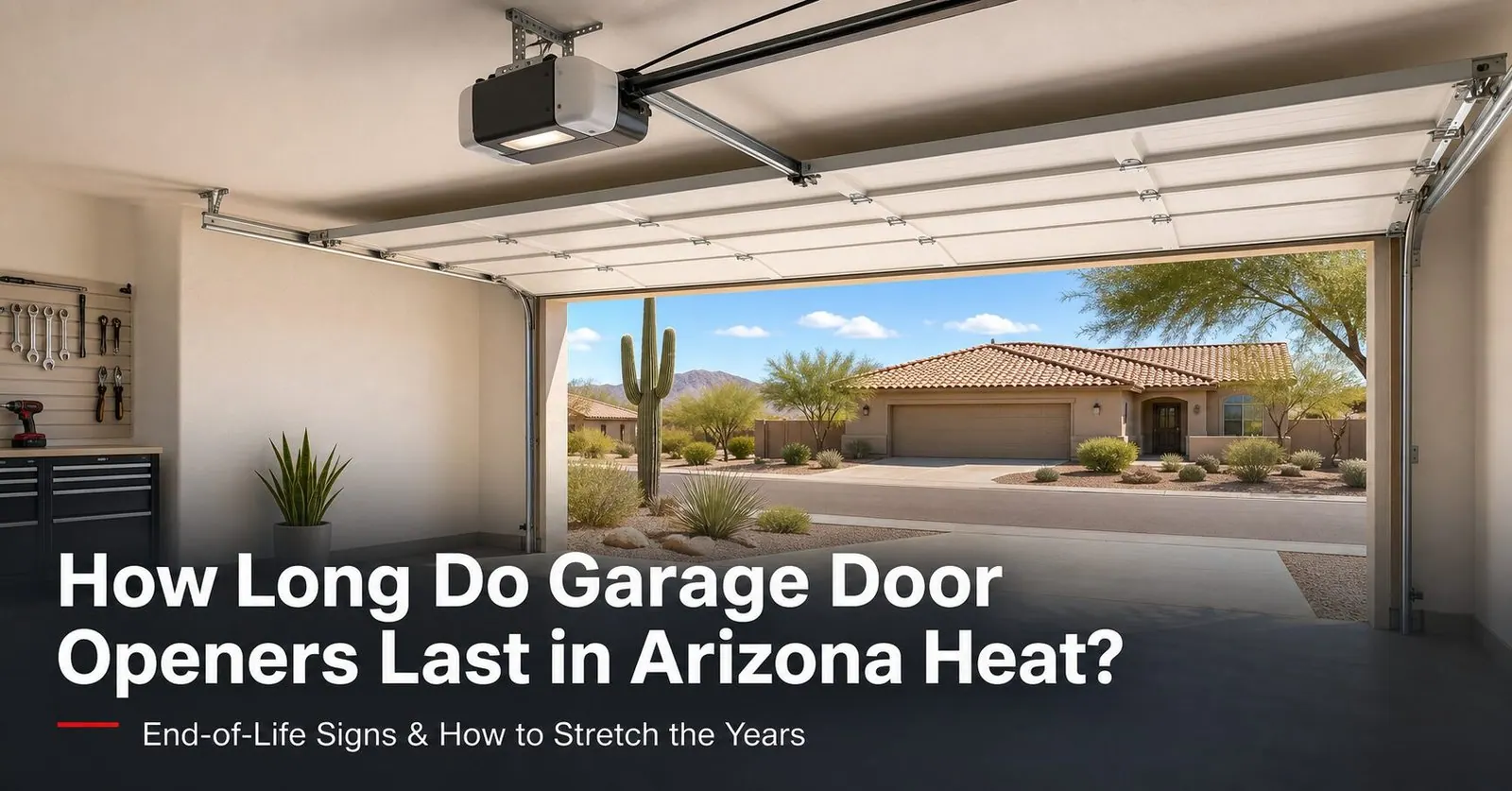
Most garage door openers are built to serve 10–15 years — in Arizona, plan on the earlier end of that range. A garage in Mesa, Gilbert, or Chandler routinely bakes past 130 degrees in summer, and that heat works on the opener every single day: it dries out the capacitor, stresses the logic board, wears the plastic drive gears, and thins the grease that keeps everything moving. Two things decide which end of the range yours reaches:
- Door balance — springs are supposed to carry the door's weight; an opener forced to muscle a heavy, out-of-balance door wears out years early
- Basic care — an annual tune-up, clean tracks, and a surge protector before monsoon season all buy real years
Below: what the heat actually does, the end-of-life warning signs, and how to stretch the years you have left.
Here's a question we hear in driveways from Mesa to Queen Creek, usually right after an opener starts acting up: "Shouldn't this thing have lasted longer?" Sometimes the answer is yes — and something specific killed it early. More often, the opener did exactly what it was built to do; it just did it in one of the hardest climates in the country for garage equipment. The motor head hanging from your ceiling spends every June through September in air hot enough to bake cookies, then gets hit with monsoon power surges and a year-round film of desert dust. This guide covers what that environment really does to an opener's lifespan, the signals one gives before it dies, and the habits that keep yours running toward the long end of the range.
The Honest Lifespan Number
Nationally, a garage door opener is expected to serve somewhere between 10 and 15 years. That number assumes average use — a few cycles a day — and an average climate. Arizona is not an average climate, and most Valley households use the garage as the front door, which means more daily cycles than the national assumption too. Put those together and the realistic expectation here is the earlier half of the range: an opener crossing its tenth birthday in a Phoenix-area garage has earned it.
Two clarifications worth making. First, the opener and the door age on different clocks — a quality steel door can serve for decades, and it's normal for one door to outlive two openers. If you're wondering about the door side of that equation, our guide to how long a garage door lasts in Arizona covers it. Second, lifespan isn't purely about the calendar. The single biggest variable is how hard the opener has to work — which brings us to what our climate actually does to it.
What Arizona Heat Actually Does to an Opener
The opener head unit hangs from the ceiling — the hottest air in the hottest room of the house. While you're inside enjoying the A/C, the opener spends the whole summer in an oven. Here's how that shows up, component by component:
| Component | What heat & desert conditions do | What you eventually notice |
|---|---|---|
| Start capacitor | Sustained heat dries out the capacitor — the part that gives the motor its starting jolt. It's one of the most common heat casualties we find, often bulging or leaking on inspection. | The opener hums but the door doesn't move, or it takes several button presses to get going |
| Logic board | Heat stresses the electronics year-round, and monsoon lightning and grid surges deliver the knockout blow — a surge-weakened board may limp along for months before failing. | Erratic behavior: ignoring remotes, random reversing, flashing error lights, or no response at all |
| Drive gears & trolley | Many openers use nylon or plastic drive gears. Heat cycles make them brittle, and a heavy or unbalanced door strips them outright. | Grinding from the head unit while the door barely moves — the classic stripped-gear sound |
| Rail, chain & lubricant | Summer heat thins and dries the factory grease; desert dust then sticks to what's left and turns it into grinding paste on the rail and moving parts. | A louder, rougher-sounding opener each year, and extra strain on the motor with every cycle |
| Remotes & keypads | Heat is brutal on the batteries in visor remotes and wireless keypads — a car parked outside all summer cooks them. | Shrinking remote range and dead keypads — annoying, but the cheapest fix on this list |
7 Signs Your Opener Is Near the End
Openers rarely die without warning. In roughly the order we tend to see them:
- 1. Intermittent response. Sometimes the remote works, sometimes it doesn't — and fresh batteries don't fix it. Aging logic boards and receivers get moody before they quit.
- 2. Humming without movement. The motor makes an effort sound but nothing happens. Often the capacitor, sometimes a stripped gear — our guide to an opener that hums but won't move breaks down which is which.
- 3. Slower, straining operation. The door crawls up like it's tired. That's the motor working harder than it should — against worn internals, a heavy door, or both.
- 4. New noises from the head unit. Grinding, clattering, or a rattle that wasn't there last year. Noise from the rail can be lubrication; noise from the motor housing is usually wear.
- 5. Random reversing or phantom behavior. The door reverses without an obstruction, or behaves differently after every storm. Surge-damaged boards fail in strange, intermittent ways.
- 6. The light stops cooperating. Flickering or dead opener lights are minor on their own, but on an old unit they're often the board's early warning.
- 7. It's simply outdated. No photo-eye safety sensors near the floor (required on openers made since 1993) or no rolling-code security means the opener is a generation behind on safety, whatever its mechanical condition.
One symptom, once, is a repair question. Several symptoms on a 10-plus-year-old unit is a lifespan conversation.
Not sure which conversation yours needs? Call or text (602) 935-9766How to Stretch Your Opener's Life in the Desert
Keep the door balanced — this is 80% of it
Close the door, pull the red release cord, and lift the door by hand to waist height. It should rise smoothly and stay put. If it's heavy or slams down, the springs aren't doing their job and the opener is paying for it daily. Spring tension is professional work — but catching the imbalance early is something any homeowner can do in thirty seconds.
Get an annual tune-up
A proper garage door tune-up covers the things that quietly kill openers: door balance, spring condition, roller and hinge wear, rail lubrication with the right high-temperature product (not WD-40, which strips grease), and safety-sensor alignment. In our climate, once a year is the floor — heavy-use households do well with a check before and after summer.
Add a surge protector before monsoon season
A quality surge protector on the opener's outlet is some of the cheapest protection you can buy for a logic board. If a storm has already scrambled yours, our guide to what to check after a monsoon power surge walks through the diagnosis.
Fight the dust
A few times a year, wipe down the photo-eye sensor lenses and clear dust and debris from the tracks with a dry cloth. Skip liquid lubricants inside the tracks themselves — in the desert, wet tracks just collect grit.
When Replacing Beats Repairing
Age changes the math. A remote, a sensor, or a capacitor on a younger opener is a simple repair that buys years. But when a major component fails — logic board, motor, gearbox — on a unit past its tenth Arizona summer, putting a new organ in an old machine rarely pays. The rest of the unit has the same miles on it, and today's openers offer things a repair can't: DC motors that run dramatically quieter, battery backup for storm-season outages, rolling-code security, and built-in Wi-Fi. We wrote a full decision framework in repair or replace your garage door opener, and if you get to the replacement side, belt vs. chain vs. direct drive explains the motor choice in plain English.
Either way, the process with us is the same: we diagnose what actually failed, then put both paths in writing — repair and replacement — so you're choosing between real options, not guessing. Our opener repair and replacement service handles everything from a capacitor swap to a full modern install.
Why Neighbors Ask Farnsworth First
Farnsworth Garage Door Service was founded by brothers Brigham and Riley Farnsworth. The Farnsworth name carries 60+ years of family business across Mesa and the East Valley — R&K, Farnsworth Wholesale, Farnsworth Realty — and we run this company the same way: tell the truth, put it in writing, fix it right the first time.
- Diagnosis before prescription. We test the door manually first — if the real problem is springs or balance, we'll say so instead of selling you an opener.
- We know what fails here. Cooked capacitors, surge-struck boards, stripped gears — our recommendations come from Phoenix-area garages, not a national script.
- Both options in writing. Repair and replacement, side by side, before any work starts. You decide.
- 5.0 stars on Google from homeowners across Mesa, Gilbert, Chandler, and the wider Phoenix area.
Frequently Asked Questions
How long do garage door openers last in Arizona?
Most garage door openers are built to serve well over a decade — 10 to 15 years is the range you'll hear nationally. In Arizona, plan on the earlier end of that range. Garages here routinely bake past 130 degrees in summer, and that heat is hard on the opener's capacitor, logic board, and plastic drive components. An opener lifting a smooth, well-balanced door can still reach the far end of the range; one dragging a stiff, out-of-balance door usually won't.
Why does Arizona heat shorten a garage door opener's life?
The opener hangs from the ceiling, right where garage heat is worst. Sustained high temperatures dry out capacitors, stress the logic board's electronic components, soften and wear plastic drive gears, and thin out the grease on the rail and in the gearbox. Add monsoon power surges and a full year's coating of desert dust, and an Arizona opener simply works harder and ages faster than the same unit in a milder climate.
What are the warning signs my garage door opener is wearing out?
Watch for intermittent response to remotes or the wall button, the motor humming without the door moving, slower or straining operation, grinding from the head unit, the light flickering or dying, and the door reversing for no clear reason. One glitch after a storm can be a simple fix — a pattern of these symptoms on an opener past its tenth birthday usually means it's approaching the end.
Should I repair or replace an older garage door opener?
It comes down to age, what failed, and what the opener is missing. Small parts on a younger unit — a remote, a sensor, a capacitor — are usually worth repairing. A failed logic board or motor on a unit past 10 years usually isn't, because you'd be putting a major part into a machine that's near the end anyway, and today's openers are quieter and more secure. We put both options in writing so you can decide.
Does the garage door itself last longer than the opener?
Usually, yes. A well-maintained steel door can serve decades in Arizona, while springs, rollers, and the opener are the wear items that get replaced along the way. It's common for a door to outlive two openers. That's also why a failing opener doesn't automatically mean you need a new door — they're separate decisions.
How can I make my garage door opener last longer in Arizona?
The single biggest factor is door balance — the springs should carry the door's weight so the opener only guides it. Keep the door professionally tuned and lubricated, put a surge protector on the opener's outlet before monsoon season, keep the tracks and rail free of desert dust, and don't ignore new noises. An opener that's never forced to muscle a heavy door is the one that reaches the long end of its lifespan.
Are very old garage door openers safe to keep using?
Openers made before 1993 predate the federal requirement for photo-eye safety sensors, and many older units also lack rolling-code security, which means their remote signal can be copied. If your opener has no sensors near the floor of the door opening, replacement is a safety upgrade, not just a convenience — modern units auto-reverse when anything crosses the beam.

Get an Honest Read on Your Opener
Licensed, insured, locally owned. Whether your opener needs a simple part, a tune-up to take the strain off, or it's time for a quieter modern replacement, we'll diagnose what actually failed and put your options in writing before any work starts. Same-day service is our standard, often within hours of your call.