
Belt vs Chain vs Direct Drive Garage Door Openers: Which Is Right for Your Arizona Home?
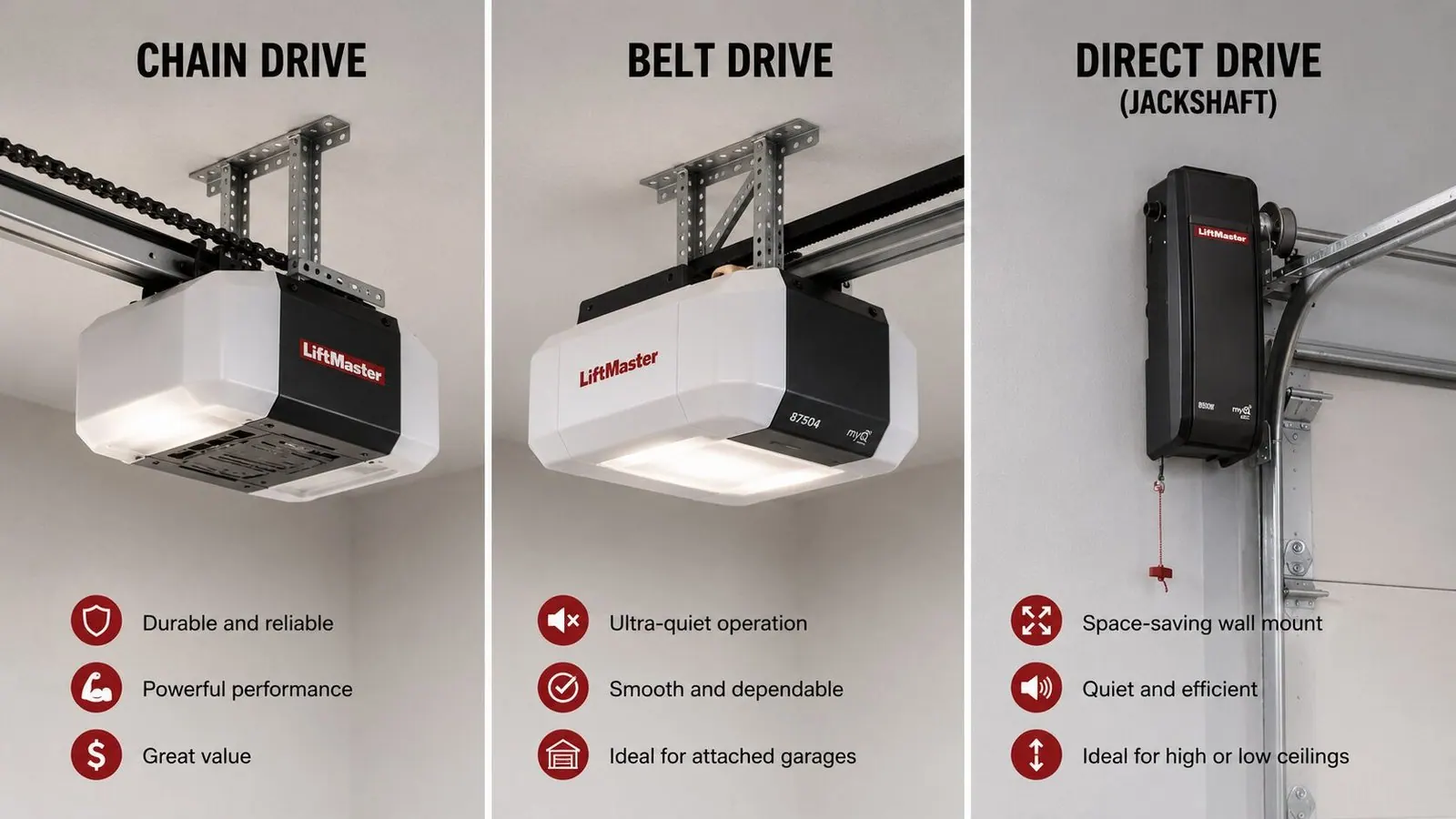
The three opener types do the same job in different ways. The differences come down to how quiet they are, what's bundled with them, and how long they tend to last. The short version:
- Chain drive (the workhorse): loudest, simplest, easiest to service. Great for detached garages, shops, and budget-conscious replacements.
- Belt drive (the quiet upgrade): dramatically quieter than chain. Wi-Fi, battery backup, and bright LEDs are usually bundled in at this tier — the sweet spot for most attached-garage East Valley homes.
- Direct drive & wall-mount jackshaft (the premium pick): the quietest options on the market. The jackshaft mounts to the wall instead of the ceiling and frees up overhead garage space.
For most attached-garage homes in Mesa, Gilbert, Chandler, Queen Creek, and Scottsdale, a belt drive with battery backup is the sweet spot. For detached or shop-style garages, chain is tough to beat. Below we walk through where each one shines, what factors into the install, and how to know if your old opener is worth repairing or replacing. For the actual numbers on your specific door, give us a call — we quote in writing after we see it.
Garage door openers are one of those purchases where the spec sheet is only part of the story. The way an opener sounds at 6 a.m. when you leave for work usually matters more than the model number, and the same opener can be a great fit in one home and a poor fit in another. This guide walks through how the three drive types compare on the things that actually matter — noise, lifespan, features, and which kind of garage they suit — so you walk into a quote conversation already knowing what you want. We don't publish opener prices online because each install depends on door size, drive type, hardware condition, and what gets bundled in, but we'll give you a written quote with everything itemized after we look at your door.
- The three drive types, in plain English
- Chain drive: the workhorse
- Belt drive: the quiet upgrade
- Direct drive & wall-mount jackshaft: the premium pick
- A note on screw drive
- Side-by-side comparison
- What goes into the quote
- The Arizona angle: heat, monsoon, attached garages
- Repair the old opener or replace it?
- FAQs
The Three Drive Types, in Plain English
Every garage door opener does the same job: it pulls a trolley (or shaft) that lifts the door. The differences are in how it pulls.
- Chain drive: a metal chain, basically a heavy bike chain, runs along the rail and pulls the trolley. Strong, simple, cheap, loud.
- Belt drive: a steel-reinforced rubber or polyurethane belt replaces the chain. Same idea, almost no vibration, much quieter.
- Direct drive: a Sommer-style opener where the motor itself rides along a stationary toothed chain attached to the rail. One moving part. Very quiet.
- Wall-mount jackshaft: bolts to the wall beside the door and turns the torsion shaft directly — no overhead rail. Often grouped with direct drive because it's quiet, DC-motor, and premium. (LiftMaster 8500W is the classic example.)
You may also see screw drive openers in older Arizona homes (Genie Excelerator, PowerMax) — a long threaded rod the trolley rides along. Less common in new installs now; we'll cover them briefly below.
Chain Drive: The Workhorse
What it is
The opener you grew up with. A 1/2 to 3/4 HP motor on the ceiling pulls a steel chain along a metal rail. The chain pulls a trolley, the trolley pulls the door arm, the door goes up. Common models in this category: LiftMaster 8164W and 8355W, Genie Chain Glide 2024, and equivalent Chamberlain/Craftsman units. All current chain drives use rolling-code security (Security+ 2.0 or Intellicode II), so security is current even at the entry tier.
- Noise level: loudest of the three (you'll hear it through the wall)
- Lifespan with annual maintenance: 12–18 years
- Bundled features: Security+ 2.0 rolling code, safety photo-eyes, basic wall control
- Best for: detached garages, shops, budget-conscious replacements
- Not great for: attached garages with bedrooms next to or above the garage
Where it shines — and what you give up
For detached garages, workshops, and homes where the bedrooms are nowhere near the door, a quality chain drive is hard to beat. It's the simplest opener to service, which is why so many of them are still running in Arizona homes 20 years after install. 1/2 HP handles a 7-ft single door; for a heavier insulated 16-ft door we step up to 3/4 HP. The downside is noise and vibration — chain drives shake the rail and transmit sound through anything bolted to the ceiling joists. If your master bedroom shares a wall with the garage, you'll hear it.
Belt Drive: The Quiet Upgrade
What it is
Same trolley-and-rail design as a chain drive, but the chain is replaced with a steel-cord reinforced rubber or polyurethane belt. The motor pulls the belt, the belt pulls the trolley, no metal-on-metal vibration. Dramatically quieter operation and almost no rail shake. This is also the tier where smart-home and convenience features start coming standard — the LiftMaster 8557W and 8587W belt drives, the LiftMaster 87802 with built-in camera, and the Genie SilentMax 1000 all bundle Wi-Fi, battery backup, bright LED lighting, and Security+ 2.0 rolling code as part of the package.
- Noise level: very quiet (you'll know it's running, but the house won't shake)
- Lifespan with annual maintenance: 12–18 years
- Bundled features: Wi-Fi for phone control, battery backup, bright LED lighting, rolling-code security; camera module on higher-end models
- Best for: attached garages, homes with bedrooms near the door, anyone tired of waking the dog up at 5 a.m.
- Not great for: extreme high-cycle commercial use (we'd spec different equipment there anyway)
Where it shines
For roughly 80% of attached-garage homes in the East Valley, belt drive is the sweet spot. You're getting current safety tech, a quiet ride, smart-home integration, and battery backup for monsoon outages. If you might sell the home in the next five years, the buyer-appeal upgrade is real too. The trade-off is added electronic complexity (Wi-Fi modules, battery packs, camera units), but the features — especially battery backup — tend to feel worth it the first time the monsoon takes out the grid for two hours.
Direct Drive & Wall-Mount Jackshaft: The Premium Pick
What these openers are
True direct drive (the Sommer design) flips the geometry of a chain-drive opener inside out. The chain is stationary, attached to the rail, and the motor itself rides along it. Only one moving part. Near-silent ride. A wall-mount or jackshaft opener (LiftMaster 8500W is the most common in our service area) bolts to the wall right beside the door and turns the torsion shaft directly — no overhead rail at all. DC-motor, quiet, almost always includes battery backup. Homeowners group them with direct drive because they share the same premium, quiet, low-maintenance feel.
- Noise level: the quietest options available
- Lifespan with annual maintenance: often 15–20 years
- Bundled features: battery backup standard, DC motor, smart-home integration, frees up the ceiling on jackshaft installs
- Best for: bedrooms above the garage, low-headroom garages, car lifts, finished ceilings
- Not great for: doors with weak or unbalanced spring systems (the jackshaft needs a balanced door)
Where they shine
Two homes in particular. First, the home with a master bedroom directly above the garage — the jackshaft removes ceiling vibration entirely because there's no overhead rail. Second, the garage with low headroom: high-ceiling storage racks, a car lift, a finished tongue-and-groove ceiling, or a tandem garage with awkward overhead space. A wall-mount jackshaft pulls the entire opener off the ceiling and frees up that vertical real estate. For most other homes, a quality belt drive will get you most of the quietness — and we'll tell you that during a quote rather than upselling.
A Quick Note on Screw Drive
You may have a screw-drive opener already — Genie's Excelerator 1500 and PowerMax 1500 are the common ones around here. Instead of a chain or belt, they use a long threaded steel rod the trolley rides along. They're fast and they last when lubricated correctly. The catch: screw drives need Genie GLU-3 white lithium grease on the rail annually. WD-40 or motor oil will eat the carriage in weeks. For new installs we don't usually lead with screw drive anymore — belt and direct-drive options have caught up on speed, beat them on noise, and don't have the lubrication trap.
Side-by-Side Comparison
Here's how the three main types stack up on the things that actually matter to a homeowner. For an apples-to-apples comparison on your specific door, give us a call and we'll quote all three in writing.
| Feature | Chain Drive | Belt Drive | Direct Drive / Jackshaft |
|---|---|---|---|
| Noise level | Loud — mechanical clatter | Quiet — light motor hum | Near silent |
| Vibration through ceiling | High | Low | Minimal (jackshaft has none) |
| Typical lifespan | 12–18 years | 12–18 years | 15–20 years |
| Maintenance touch points | Chain tension, lube annually | Belt tension check, lube hinges | Lowest — few moving parts |
| Battery backup | Add-on, not standard | Usually standard at mid/upper tier | Almost always standard |
| Wi-Fi / smart features | Available on newer chain models | Standard at this tier | Standard |
| Frees up ceiling space | No | No | Yes (jackshaft only) |
| Best for | Detached garages, shops, budget builds | Attached garages — the typical AZ home | Bedrooms over garage, low headroom, car lifts |
What Goes Into the Quote
Every opener quote we write is built from the same set of variables. Knowing what they are makes the written quote a lot easier to read.
Door size, weight, and what's included
A single 7-ft door weighs 80–120 lbs; a two-car 16-ft insulated door weighs 200–280 lbs. Heavier doors need more horsepower (3/4 HP and up) and a heavier-duty motor. Our standard install always includes the opener, new rail, two remotes, a wireless keypad, wall control, two new photo-eye sensors, mounting hardware, professional installation, haul-away of the old unit, and a workmanship warranty. If a quote from another company looks light, check what's missing — some shops quote the opener bare and add for everything else.
Springs, cables, and smart-home add-ons
A new opener is only as smooth as the door it lifts. We check spring tension, cable condition, and roller wear during the install — replacing tired hardware while we're on-site beats calling us back in six months when the new opener strips a drive gear on an out-of-balance door. For more on this, see our guide on spotting a broken garage door spring. Add-ons that change what's on the quote: a Wi-Fi camera module (the LiftMaster 87802 has one built in), a smart deadbolt, extra remotes, a HomeKit bridge for Apple Home. We'll walk through which are worth it for your home rather than handing you a checklist of upsells. For full details, see our opener and full-replacement installation page.
The Arizona Angle: Heat, Monsoon, and Attached Garages
Three local realities change what we recommend versus what a generic national guide would tell you.
Heat doesn't kill openers — surges do
Garage door openers sit in attached garages that hit 130°F+ in July. The motor and logic board are designed for that range. What kills openers in Arizona, in waves every monsoon season, is logic boards fried by power surges when the grid comes back online after an outage. A quality surge protector on the opener's outlet is one of the simplest ways to protect against this, and we'll recommend one during any install.
Monsoon outages favor battery backup
If you've had to do the manual-release routine more than once this year, your next opener should include battery backup. Most LiftMaster Elite-series belt drives include it standard, and the wall-mount 8500W includes it on every install — good for roughly 20 cycles after power cuts out, enough for a typical monsoon outage.
Attached garages mean noise matters more here
The East Valley building pattern leans heavily on attached garages with bedrooms either next to the garage wall or directly above. Belt drive and jackshaft openers noticeably change how the house feels in the morning — the single biggest reason we lean toward belt drive for typical East Valley homes even when budget would allow a chain. For homes in storm-heavy parts of the service area — Apache Junction, Gold Canyon, Fountain Hills, the outer ring of San Tan Valley — battery backup plus a surge protector is the combo that prevents most of the calls we get in late July and August.
Repair the Old Opener or Replace It?
You don't always need a new opener. Rules of thumb we use when we walk up to a job:
- Under 7 years old: almost always worth repairing. A drive gear, logic board, snapped chain, or worn trolley is a routine fix on a unit with plenty of life left.
- 7–12 years old: depends on the part. A small repair is a yes; a logic board on a chain drive that also has a worn trolley is a coin flip — we'll quote both.
- 12+ years old: math tilts toward replacement, especially without rolling-code security (anything with a purple LEARN button is pre-2011, using older 315 MHz fixed-frequency technology that's much easier to hack).
- Any age: if the safety sensors don't reverse, the wall button is dead, remotes can't pair to current Security+ 2.0 standard, or you have monsoon outages and no battery backup — replacement is the safer call.
For service on an existing opener, see our opener motor service and repair page. For a brand-new install, see opener and full-replacement installation.
Why East Valley Homeowners Call Farnsworth for Opener Replacements
Farnsworth Garage Door Service was founded by brothers Brigham and Riley Farnsworth. The Farnsworth name has 60+ years of family business across the East Valley behind it — R&K, Farnsworth Wholesale, Farnsworth Realty — and we run this company the same way our family has always run a business: tell the truth, put the price in writing, do the work right the first time.
- Written quotes before any work starts. No mid-job surprises.
- Popular openers and parts on the truck. Most replacements happen in a single visit.
- Belt, chain, direct-drive, and wall-mount jackshaft installs from LiftMaster, Chamberlain, Genie, and Sommer — not just whichever brand the company is locked into.
- We balance the door as part of every install. A new opener on an out-of-balance door is a new opener on borrowed time.
- Same-day service is our standard, often within hours of your call.
- 5.0 stars on Google. Our neighbors keep us busy by telling theirs.
Ready to compare options for your specific door? See our full garage door services, or where we work across the East Valley.
Frequently Asked Questions
What goes into the price of a new garage door opener in Arizona?
Every opener install is a little different, so we quote in writing after looking at your door rather than publishing a price online. The biggest factors are the drive type (chain, belt, direct drive, or wall-mount jackshaft), the door size and weight (a single 7-ft door is lighter than a two-car 16-ft insulated door and needs a less powerful motor), what's bundled with the opener (remotes, keypad, photo-eye sensors, battery backup, Wi-Fi, camera module), and the condition of the rest of the door (springs, cables, rollers — replacing tired hardware while the technician is on-site avoids a follow-up visit). Smart-home add-ons and any wiring or code issues we find at the outlet can also move the total. Call or text us and we'll give you a written quote with everything itemized — no surprises after the work starts.
What's the difference between belt drive, chain drive, and direct drive openers?
All three lift your garage door — they just use different mechanical methods to do it. A chain-drive opener uses a metal chain (like a bike chain) to pull a trolley along the rail. It's the loudest of the three but also the simplest, the easiest to service, and the entry-tier option. A belt-drive opener uses a reinforced rubber or polyurethane belt instead of a chain — same idea, dramatically quieter, and almost no vibration. A true direct-drive opener (the Sommer-style design) has only one moving part: the motor itself rides along a stationary toothed rail. There's no chain, no belt, no trolley. Jackshaft or wall-mount openers (mounted on the wall beside the door rather than the ceiling) are often grouped in with direct drive because they're DC-motor, low-noise, and a premium-tier option, even though they technically use a torsion-shaft mechanism instead.
Is a belt drive opener worth the extra money in Arizona?
For most attached-garage homes in the East Valley, yes. Belt-drive openers are dramatically quieter — you'll feel the difference the first morning you open the door without waking everyone in the house. Modern reinforced belts hold up well in Arizona heat as long as the door is balanced and the trolley isn't dragging. The bigger reasons to spend up are usually the extras that come bundled at the belt-drive tier: built-in battery backup (huge during monsoon outages), Wi-Fi for phone control, brighter LED lights, and a camera module on the higher-end LiftMaster and Chamberlain models. If the garage is detached, or the bedrooms are nowhere near the door, a chain drive will do the same job at the budget tier.
How long does a garage door opener last in the Arizona heat?
A properly installed opener on a well-balanced door should last 12 to 18 years in our climate, with 15 being a common average. Heat is rarely the thing that kills an opener directly. What usually kills openers in Arizona is one of three things: a logic board fried by a monsoon power surge, a worn drive gear from years of pulling a door that's slightly out of balance, or a worn-out trolley assembly. A chain stretches over the years and needs periodic tensioning; a belt loosens but doesn't really wear out; a direct-drive motor has the fewest moving parts and tends to be the most patient over the long haul. Annual maintenance — checking door balance, tightening the chain or belt, lubing the right parts — adds years to any of them.
Do I need a battery backup on my garage door opener in Arizona?
If monsoon storms knock your power out more than once a year, a battery backup is one of the smartest upgrades you can make. Most LiftMaster Elite-series and several newer Chamberlain belt-drive openers come with a built-in battery backup that runs the opener for roughly 20 cycles after the power cuts out. The pack is a sealed lead-acid battery inside the opener head and lasts 3 to 5 years before replacement. Parts of Apache Junction, Gold Canyon, the outer ring of San Tan Valley, and Fountain Hills get hit harder than central Mesa by summer storms, so homeowners in those areas tend to feel the value the fastest.
Are direct-drive and wall-mount jackshaft openers really worth the price?
They're worth it in two specific cases. First, if the bedrooms sit right above or next to the garage and you have a household that's sensitive to noise — direct drive and wall-mount jackshaft are the quietest options on the market, period. Second, if your garage has low headroom (high storage shelves, a car lift, or a finished ceiling) a wall-mount jackshaft frees up all the overhead space because the motor moves off the ceiling and onto the wall beside the door. For everyone else, a quality belt drive will get you most of the quietness without stepping up to the premium tier. When we quote your job, we'll lay both options out side by side so you can decide.
Can I just replace my opener and keep the existing rail and remotes?
Sometimes, but usually not. Rails are model-specific — a new LiftMaster 8557W ships with its own belt rail that's not interchangeable with an old chain rail. The new opener's logic board also uses current Security+ 2.0 rolling-code technology, so old remotes that ran on 315 MHz purple-LEARN systems generally won't pair. The good news is that a standard install includes a new rail, the new motor, two new remotes, a wall-mounted keypad, and new safety sensors — so you're getting a fully matched system. Reusing parts to save a little upfront usually creates a maintenance headache a few years down the line.
Should I repair my old opener or replace it?
Depends on what's broken and how old the unit is. A worn drive gear, a fried logic board, or a snapped chain on a 5-year-old opener is usually worth fixing. A failed logic board on a 14-year-old chain-drive unit that already needs a new trolley and is missing Wi-Fi, battery backup, and rolling-code security — that's a replacement conversation. When you call, we'll quote both repair and replacement in writing so you can compare them on the same job. A good rule of thumb: if the opener is past 10 years old and the same visit would also need a trolley or chain, you'll typically get more value out of a new unit. Newer than that and a single-part repair is usually the better answer.

Ready for a Quieter, More Reliable Opener?
Licensed, insured, locally owned. We'll quote belt, chain, and direct-drive options side by side in writing, with no upsell pressure. Same-day service is our standard, often within hours of your call.