
Garage Door Opener Hums But Door Won't Move: What's Actually Broken
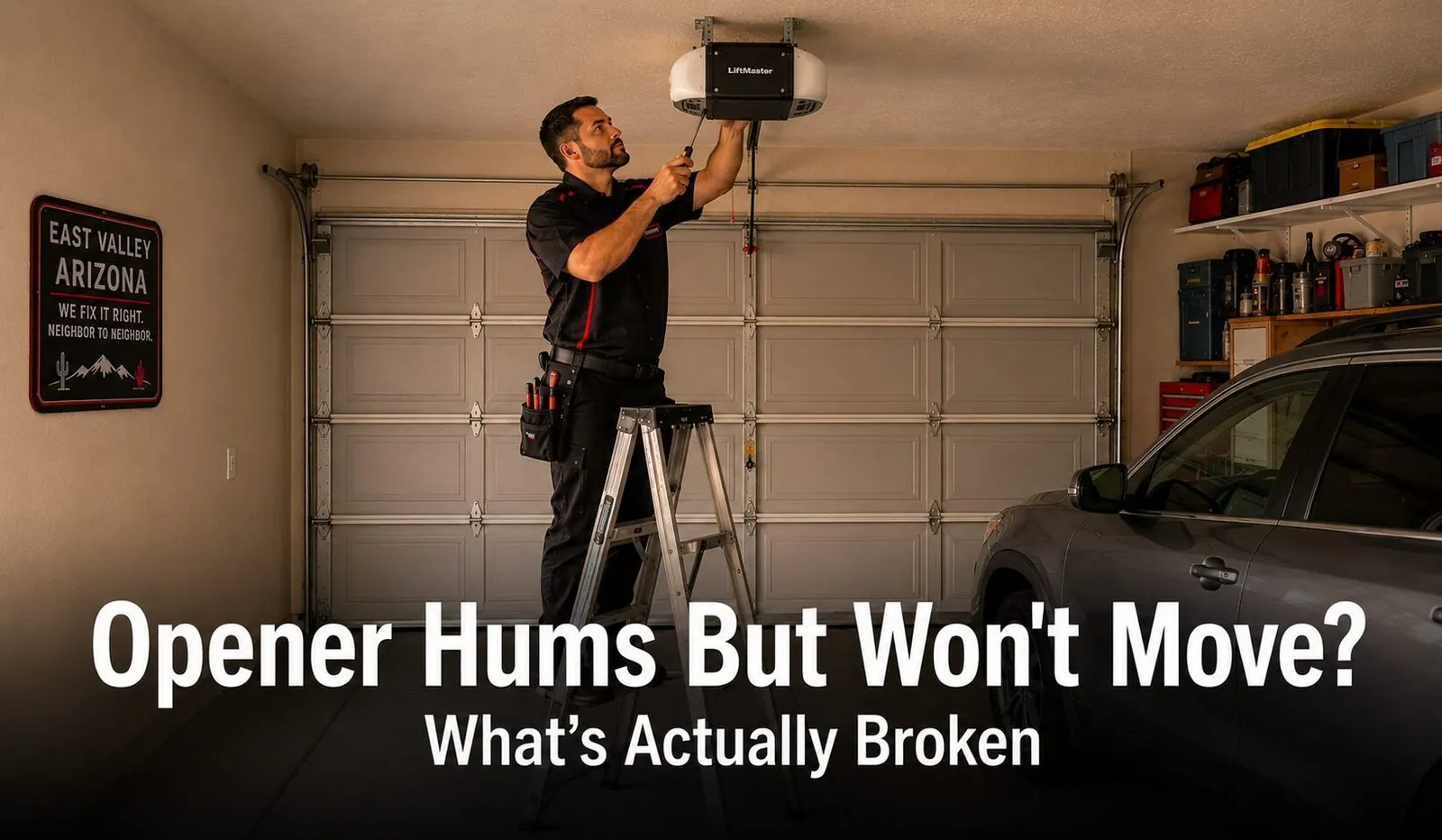
You press the wall button or the remote, the opener overhead lets out a low hum or a buzz, the light might flicker — and the door just sits there. No movement. Maybe a strain, maybe a click, then silence. It's one of the more confusing garage door problems because the opener is clearly doing something; it's just not doing the one thing you need.
Here's the reassuring part: a hum is actually good news compared to total silence. It means power is reaching the motor and the motor is trying to run. That narrows the problem considerably. The bad news is that "trying but failing" can mean a thirty-second re-engagement fix, or it can mean a broken spring you should not be anywhere near. This guide walks through the seven causes we run across the East Valley, the order to check them in, and the one quick test that tells you whether to keep troubleshooting or step back and call us.
Start Here: The 30-Second Test That Splits the Problem in Half
Before you guess at parts, do this one thing. It's the same test our technicians run first on every "won't move" call, because it instantly tells you whether you're chasing an opener problem or a door problem.
- Open the door fully, or get it as far open as it will go. Never disconnect the opener with the door partway up — if a spring is broken, the door can drop.
- Pull the red emergency release cord hanging from the opener rail. This disconnects the door from the motor so you can move it by hand.
- Lift the door by hand. A healthy, balanced door glides up with one hand and roughly holds its position when you let go around the halfway point.
Now you know which way to go. If the door is heavy, won't budge, or feels like it's fighting you, the door is the problem — almost always a broken spring or a door that's off track, and the opener was only humming because it was straining against a load it was never built to lift. If the door lifts easily by hand but the opener still just hums when reconnected, the opener itself is the problem, and the cause is one of the mechanical or electrical failures below.
The 7 Causes We See Most Often
These are listed in roughly the order we check them on a service call across Mesa, Gilbert, Chandler, Queen Creek, and the rest of the East Valley — the quick, free things first, the bigger repairs last.
1. The trolley is disconnected from the door
The trolley (or carriage) is the part that rides along the rail and pulls the door open and closed. When someone pulls the red release cord — to get the car out during a power outage, say — the trolley disengages from the door. Press the button after that and the motor runs, the chain or belt may even move, but the door stays put because nothing is connected to it. It's the single most common "why won't it move" call, and the cheapest fix there is.
2. A failed start/run capacitor
This is the textbook "hums but won't move" failure. The capacitor is a small canister inside the motor housing that stores energy and gives the motor the jolt it needs to start spinning. When it fails, the motor gets power but can't kick over — so it buzzes or hums for a second or two, the light may dim, and the door doesn't move. Disconnect the opener and the door lifts by hand just fine, which confirms it's the opener, not the door. Capacitors take a beating in hot Arizona garages, where summer attic-level heat is hard on every electrical component, so we see these fail earlier here than in milder climates.
3. A stripped main drive gear
Chain-drive openers (and many older units) use a plastic drive gear inside the motor head that the motor turns to move the chain. After enough years and cycles — and heat accelerates the wear — the teeth on that gear strip out. The motor spins freely and hums happily, but with nothing to grab, the chain never moves. A tell-tale sign is fine plastic shavings on top of the door or on the garage floor beneath the motor.
4. The drive sprocket is slipping
On a chain or belt opener, the motor turns a sprocket, and the sprocket drives the chain or belt that pulls the trolley. If the sprocket's set screw loosens or the sprocket wears, the motor can spin without driving the chain — same hum, same stationary door. The clue here is that the chain itself doesn't move even though the motor is clearly running.
5. The chain or belt has come off (or broken)
Less common, but it happens: the chain jumps off the sprocket or the belt slips its track, and now there's no link between the motor and the trolley. The motor runs and hums, nothing moves, and you'll often see the chain hanging slack or pooled near the motor head.
6. The trolley is binding on a bent rail
If the trolley is connected and the chain is moving but the door still won't go, the trolley may be jammed against a bent or obstructed section of rail. The motor strains and hums trying to push the trolley past the bind. Rails get bent by a ladder leaning against them, something stored too close overhead, or a prior forced-door incident.
7. A broken spring or off-track door (the door, not the opener)
This is the one to take seriously. If your 30-second test showed the door is heavy or stuck, the opener was only humming because it was straining against a door it can't lift. The usual culprit is a broken torsion spring. The springs carry the door's full weight; when one breaks, the door instantly becomes far too heavy for the motor. On a two-spring door, both springs share a single shaft above the door, so even one break leaves the entire door too heavy to lift — the door does not tilt to one side. A door that's jumped its track will also bind and stop the opener cold.
Quick-Reference: The Sound & Behavior Decoder
Match what you're seeing and hearing to the most likely culprit so you know where to start.
| What you notice | Most likely cause | First thing to check |
|---|---|---|
| Motor runs, chain moves, door doesn't | Trolley disengaged from the door | Re-engage the red release cord and let the trolley re-latch |
| Short hum/buzz, light dims, no movement at all | Failed start/run capacitor | Confirm the door lifts by hand — then call a tech (capacitors hold a charge) |
| Motor spins freely, chain doesn't move, plastic shavings | Stripped main drive gear | Look for plastic shavings under the motor head |
| Motor runs, chain stays still, no shavings | Slipping or worn drive sprocket | Check the sprocket set screw on the motor shaft |
| Chain hanging slack or pooled near the motor | Chain/belt off the sprocket or broken | Inspect the chain path and tension |
| Door is heavy or stuck when lifted by hand | Broken spring or door off track | Stop — don't use the opener; call a technician |
| One click, no hum, nothing moves | Logic board relay or capacitor | Note it for the tech — points to the control board |
A Safe Homeowner Checklist Before You Call
These steps catch the easy, no-cost causes safely. Stop at any point you're not comfortable — and especially if the door turns out to be heavy by hand.
- Press the button just once or twice to confirm the hum, then stop. Repeated tries can overheat the motor and turn a small repair into a replacement.
- Run the 30-second test above: open the door, pull the red release cord, and lift by hand. Heavy or stuck means the door is the problem — leave it and call us.
- If the door lifts easily, look at the rail while a helper presses the button. Does the chain or belt move? Is the trolley connected? Is the chain slack or are there plastic shavings below the motor? Note what you see.
- Try to re-engage the trolley if the release cord was pulled — pull it back toward the motor and let the carriage re-latch. If that solves it, great. If not, you've gathered exactly what a technician needs to arrive with the right part.
When to Stop and Call a Tech
A few signs mean it's time to set the remote down and let us take it from here.
- The door is heavy or won't lift by hand. That's a spring or balance issue, and torsion springs are the part most likely to injure a homeowner.
- You see a gap or separation in a spring coil above the door, or the door sits crooked. Stop using the opener entirely.
- The motor keeps humming but nothing moves after you've ruled out a disconnected trolley. That points to a capacitor, gear, or sprocket — internal opener repairs.
- Plastic shavings under the motor head. The drive gear is stripping, and continuing to run it finishes the job.
- The opener is well over a decade old. A new opener replacement may make more sense than chasing repairs on worn-out parts — we'll show you the honest comparison.
And please don't keep mashing the button hoping it catches. An opener that only hums is telling you a specific part has failed; forcing it just spreads the damage.
Why East Valley Homeowners Call Farnsworth When the Opener Just Hums
Farnsworth Garage Door Service was founded by brothers Brigham and Riley Farnsworth. The Farnsworth name carries 60+ years of business behind it across the East Valley — R&K, Farnsworth Wholesale, Farnsworth Realty — and we run this company the same way our family always has: real diagnosis first, written quote second, work third.
- We diagnose before we sell. A humming opener can be a free re-engagement or a worn-out motor — we find out which before we quote a dollar.
- Trucks stocked for first-visit fixes. Capacitors, gear kits, common springs, rollers, and cables ride with us, so most repairs finish on the first visit.
- Same-day service is our standard, often within hours of your call.
- Written, itemized quote before any work begins. The price you agree to is the price on the invoice.
- 5.0 stars on Google. Our neighbors trust us — and tell their neighbors.
Need a humming opener diagnosed? Book a repair visit, learn about opener repair & replacement, or see where we work across the East Valley.
Frequently Asked Questions
Why does my garage door opener hum but the door won't move?
A hum means the opener is getting power and trying to work, but something is stopping the door from moving. There are two families of causes. Either the opener can't generate the force to move (a failed start/run capacitor, a stripped drive gear, a slipping sprocket, or a chain or belt that's come off), or the door itself is stuck and too heavy for the opener to budge (a broken spring, a door off its track, or the manual lock thrown). The fastest way to tell which family you're in is to pull the red release cord and try lifting the door by hand. If it's heavy or won't lift, the door is the problem. If it lifts easily by hand but the opener still only hums, the opener is the problem.
How do I know if my garage door opener capacitor is bad?
A failed capacitor is the classic "hums but won't move" symptom. The motor buzzes for a couple of seconds, sometimes the light flickers, and the door doesn't move at all — and when you disconnect the opener the door lifts by hand normally, which rules out the door itself. The capacitor is the small canister inside the motor housing that gives the motor its starting kick. They wear out faster in hot Arizona garages, and they can hold a dangerous electrical charge even when unplugged, so this is a test-and-replace job for a technician, not a DIY part swap.
Why does my opener motor run but the door doesn't move?
If the motor clearly spins or runs but the door stays put, the connection between the motor and the door has failed. The most common reasons are a trolley that's been disengaged by the red release cord, a stripped main drive gear (the plastic gear inside chain-drive units that wears out after years of cycles), a drive sprocket slipping on the motor shaft, or a chain or belt that has jumped off or broken. Watch the rail while someone presses the button: if the chain or belt moves but the trolley doesn't, the trolley or its connection is the issue; if nothing on the rail moves, the gear or sprocket is.
Can a broken spring make my garage door opener just hum?
Yes, and it's one of the most common causes we find. The springs — not the opener — carry the actual weight of the door. The opener motor is only strong enough to guide a balanced door, not to lift a 150-plus-pound door on its own. When a spring breaks, the door instantly becomes far too heavy, so the opener strains, hums, and gives up without moving it. On a two-spring door both springs share one shaft, so a single break still leaves the whole door too heavy to lift — the door doesn't tilt to one side. If your door is suddenly heavy by hand and you see a gap or separation in a spring coil above the door, stop using the opener and call a technician.
Is it safe to keep pressing the button if my opener just hums?
No — stop pressing it. Repeatedly forcing an opener that only hums can overheat and burn out the motor, finish off a capacitor that's already failing, or strip what's left of a worn drive gear, turning a smaller repair into a full opener replacement. It can also damage the door if the opener is straining against a broken spring or an off-track door. Press the button once or twice to confirm the symptom, then leave it alone and diagnose the cause.
What's the difference between an opener that hums and one that clicks?
A hum or buzz means the motor is energized and trying to turn — that points to a capacitor, a stripped gear, a slipping sprocket, or a door too heavy to move. A single click with no hum usually means the logic board relay is firing but the motor never engages, which points to a control-board or capacitor problem. No sound at all when you press the button is a different track entirely — that points to lost power, a tripped GFCI outlet, or a dead board. Noting exactly what you hear helps a technician arrive with the right part on the truck.
How much does it cost to fix a garage door opener that hums but won't move?
It depends entirely on which part failed. Re-engaging a trolley that was simply disconnected is the least expensive — sometimes nothing at all. Replacing a capacitor or a stripped drive gear is a mid-range repair. A broken spring is its own repair, separate from the opener. And if the opener is old enough that parts are scarce, a full replacement may cost less over time than chasing repairs on a worn-out unit. We diagnose the actual cause first, then give you a written, itemized quote before any work begins — the price you agree to is the price on the invoice. Call or text us at (602) 935-9766.

Opener Humming but the Door Won't Budge? We'll Diagnose It Today.
Licensed, insured, locally owned. Written, itemized quote before any work starts. Same-day service across the East Valley.