
The Quietest Garage Door Opener for Bedroom-Above-Garage Homes
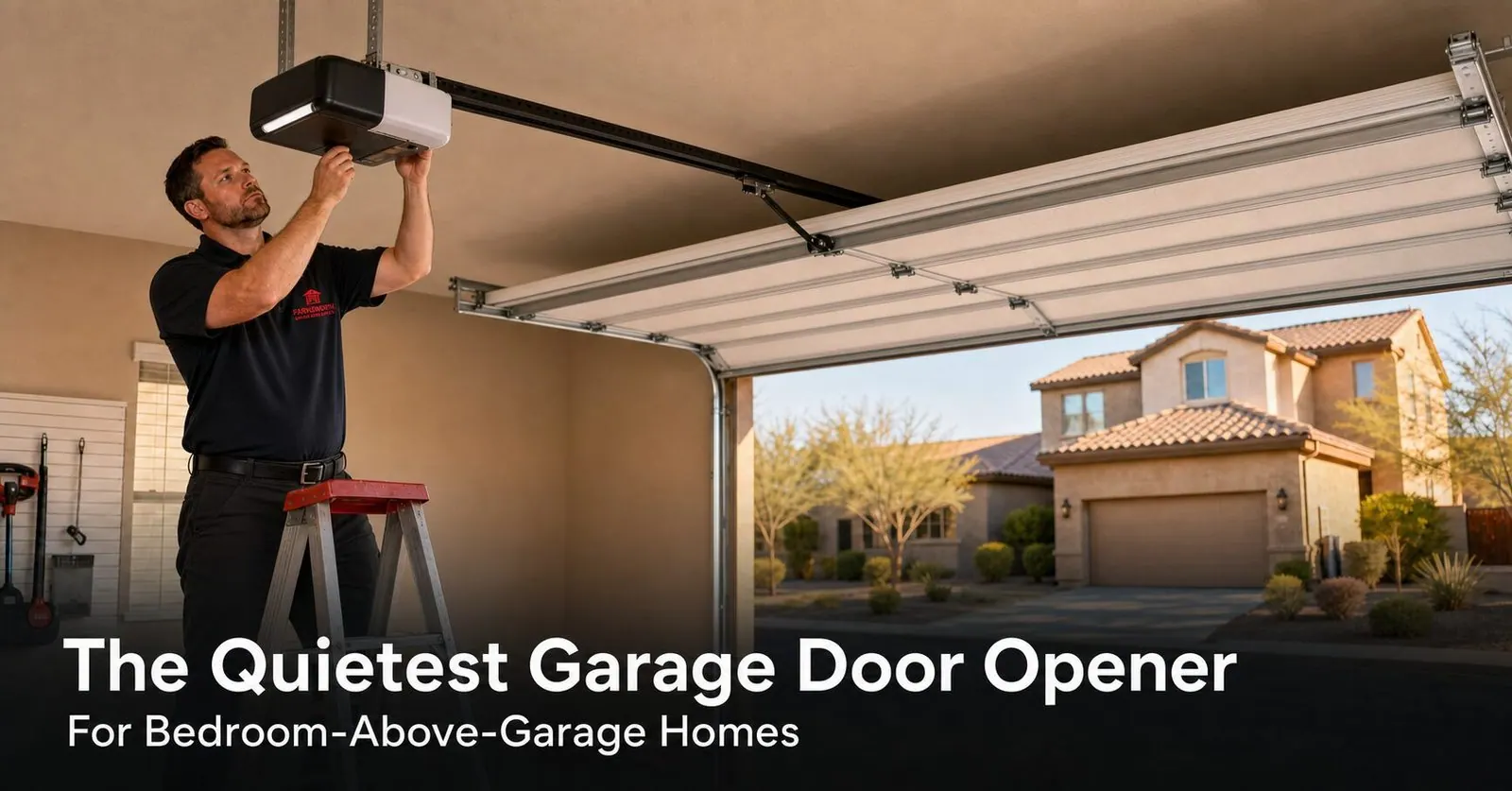
The quietest garage door opener for a bedroom-above-garage home is a wall-mount (jackshaft) opener, with a belt-drive DC opener a very close second. Why:
- Wall-mount openers remove the motor and rail from the ceiling entirely — nothing vibrates under the bedroom floor
- Belt drives with DC motors glide on a rubber belt and ramp up softly instead of jolting the framing
- Chain drives and old AC motors are the loud ones — metal-on-metal clatter plus a hard start-stop jolt
One honest catch: the opener is only half the noise. Worn steel rollers, dry hinges, and an out-of-balance door will keep waking the room no matter what motor you hang. The quietest homes fix both.
Two-story homes with a bedroom over the garage are everywhere in the Phoenix area — they're the standard floor plan across newer Mesa, Gilbert, and Queen Creek neighborhoods, and plenty of older Chandler two-stories share the layout. They're also where we hear the same complaint again and again: every early-morning departure and late-night arrival rumbles straight up into the room above. Sometimes it's a spouse leaving for a 4 a.m. shift; sometimes it's a teenager's bedroom sitting directly over the door; sometimes it's a nursery, and the stakes of a smooth, silent close suddenly feel very high. The good news is that garage door noise is one of the most fixable problems in the trade — if you attack the right sources. Here's what's actually making the racket, which opener types run quietest, and the door-side upgrades that finish the job.
Why the Bedroom Above Hears Everything
Here's the piece most homeowners miss: the noise that wakes the room upstairs is mostly not sound traveling through the air. It's vibration traveling through the structure. A traditional garage door opener hangs from the ceiling — which means it bolts to the very joists that hold up the bedroom floor. Every motor rumble, every trolley clatter along the rail, and every jolt when the door starts and stops gets transmitted directly into the framing, and the floor above behaves like a big speaker cone.
That's why simply buying a "quieter motor" often disappoints. If the machine is still hanging from the bedroom's floor joists, still yanking a chain across a steel rail, and still moving a door with dry hinges and worn steel rollers, the room upstairs will hear it. Getting real silence means attacking three things in order: what drives the door (the opener type), how the motion starts and stops (the motor type), and what the door itself contributes (rollers, hinges, balance). Let's take them in turn.
Opener Types Ranked: Quietest to Loudest
Wall-mount (jackshaft) opener
A wall-mount opener doesn't hang from the ceiling at all. It mounts on the wall beside the door and turns the torsion spring shaft directly — no rail running overhead, no trolley dragging across it, no motor bolted to the joists under the bedroom floor. For a bedroom-above-garage home, that's the whole ballgame: the biggest vibration source is simply gone from the ceiling. Most models pair a DC motor with a battery backup option, and you get your overhead storage space back as a bonus. The catches: they cost more than a belt drive, and they require a torsion-spring door in good working condition — which is why we check your spring setup and door balance before recommending one. If your door still runs on extension springs, a spring conversion comes first.
Belt drive with a DC motor
The belt drive is the workhorse quiet opener — and for most families, it's the sweet spot of price and silence. Instead of a metal chain clattering along the rail, a steel-reinforced rubber belt glides the trolley almost silently. Pair that with a DC motor's soft start and soft stop, and the two loudest events in every cycle — the jolt when the door starts moving and the clunk when it stops — all but disappear. Modern belt drives also commonly include battery backup and built-in Wi-Fi. If you're comparing drive systems in more depth, our full belt vs. chain vs. direct drive guide breaks down the mechanics; the short version for light sleepers is: belt, every time.
Direct drive
Direct-drive openers take a different route to silence: the motor itself travels along a stationary chain, so there's only one moving part and very little to rattle. They're impressively quiet and extremely durable. They're less common in Arizona homes than belt drives, so parts and service familiarity vary more, but as a noise solution they absolutely belong in the conversation.
Chain drives and older AC-motor openers
The classic chain drive is rugged, affordable… and the source of that industrial rattle most people picture when they think "noisy garage door." Metal chain on metal rail, hanging from the bedroom's floor joists, driven by an AC motor that slams to full speed instantly — it's the worst-case combination for the room above. If your home still has one (very common in Mesa and Chandler homes built in the '90s and 2000s), the nightly noise isn't a defect. It's just an opener generation doing what it was built to do — and it's the single most impactful thing to replace. Our team handles opener replacement and installation across the Phoenix area, and a chain-to-belt swap is one of the most satisfying upgrades we do.
| Opener type | Noise level above the garage | Best for |
|---|---|---|
| Wall-mount (jackshaft) | Quietest — nothing mounted to the ceiling at all | Bedroom directly over the door; torsion-spring doors in good shape |
| Belt drive + DC motor | Near-silent glide with soft start/stop | Most bedroom-above-garage homes — best value for the silence |
| Direct drive | Very quiet — single moving part | Homeowners prioritizing durability with quiet operation |
| Screw drive | Middle of the pack — quieter than chain, not belt-quiet | Speed priority; less ideal when sleep is the goal |
| Chain drive / older AC motor | Loudest — rattle plus start-stop jolt through the joists | Detached garages where nobody's sleeping overhead |
The Features That Matter (and Quiet Lines by Brand)
Once you're shopping in the quiet tier, a handful of features separate "quieter" from "did the door even open?":
- DC motor with soft start/stop. The non-negotiable. Ramping speed up and down eliminates the jolt that shakes the framing at the start and end of every cycle.
- Battery backup. Standard on most premium quiet models — and truly useful here, where monsoon-season outages love to strike right when you need to leave.
- Built-in Wi-Fi. Close the door from your phone without a rumbling second trip — and get an alert if it was left open at midnight.
- Vibration isolation. Rubber-isolated mounting between the opener and the ceiling keeps residual motor hum out of the joists on rail-style openers.
Every major brand builds a quiet line worth considering: LiftMaster's belt-drive models with DC motors and battery backup (and its wall-mount 8500 series), Chamberlain's B-series belt drives, and Genie's aptly named SilentMax and StealthDrive belt models. We'll recommend the specific model that fits your door's weight, height, and your budget during the visit — a heavier insulated double door and a light single door shouldn't get the same opener.
Sleeper over the garage? Call or text (602) 935-9766 — same-day service is our standard, often within hours of your call.The Other Half: Quieting the Door Itself
We've swapped beautiful new belt drives onto doors that stayed loud — because the door, not the opener, was the noisemaker. Before or alongside any opener upgrade, these four door-side fixes deliver a shocking share of the silence:
| Upgrade | What it silences |
|---|---|
| Sealed nylon rollers | The grinding of worn steel wheels in the tracks — the #1 door-side noise in dusty Arizona garages. Details in our roller replacement service. |
| Garage-door-rated lubrication | Squeaking hinges, dry bearings, and spring chatter — desert dust strips lubricant faster here than almost anywhere. |
| Balance and spring-tension check | The straining and shuddering of an opener forced to lift weight the springs should carry — quieter cycle, longer opener life. |
| Hardware snug-up | Panel rattle and track vibration from bolts that thousands of cycles have worked loose. |
All four are part of a standard professional tune-up — which is why we often suggest starting there. If a tune-up gets the door itself running smooth and the remaining noise is clearly the opener, you'll know exactly where the next dollar should go.
Why Neighbors Call Farnsworth for Quiet-Opener Upgrades
Farnsworth Garage Door Service was founded by brothers Brigham and Riley Farnsworth. The Farnsworth name carries 60+ years of family business across Mesa and the East Valley — R&K, Farnsworth Wholesale, Farnsworth Realty — and we run this company the same way: tell the truth, put it in writing, fix it right the first time.
- We diagnose the noise before selling the opener. If half your racket is worn rollers and a door out of balance, you'll hear that first — sometimes a tune-up is the honest answer.
- Matched to your door, not a one-size-fits-all box. Door weight, height, spring system, and headroom decide which quiet opener actually fits your garage.
- Clean installs that stay quiet. Proper rail alignment, isolated mounting, and a balance test before we leave — a sloppy install can make even a belt drive hum through the ceiling.
- 5.0 stars on Google from homeowners across Mesa, Gilbert, Chandler, and Queen Creek — including plenty who just wanted to stop waking the baby.
Frequently Asked Questions
What is the quietest type of garage door opener?
Wall-mount (jackshaft) openers are generally the quietest, because they eliminate the overhead rail and trolley entirely — nothing runs across the ceiling above the bedroom. Belt-drive openers with DC motors are a very close second and cost less; the rubber belt glides instead of clattering, and the DC motor ramps up and down softly. Chain drives are the loudest common type, and older AC motors add a hard jolt at start and stop that travels straight into the framing.
Why can I hear the garage door so clearly in the bedroom above the garage?
Most of what you hear isn't airborne sound — it's vibration traveling through the structure. A ceiling-rail opener bolts to the same joists that hold up the bedroom floor, so every motor rumble and trolley clatter transmits directly into the room. That's why fixing bedroom-over-garage noise means reducing vibration at the source (drive type, motor type, isolation) and not just making the motor a little quieter.
Will a new opener alone make my garage door quiet?
Only partly. The opener is usually the loudest single component, but worn steel rollers grinding in the tracks, dry hinges and bearings, and an out-of-balance door all make noise the new opener can't fix. The quietest results come from pairing a belt-drive or wall-mount opener with nylon rollers, fresh lubrication, and a balance check — that combination addresses both the machine and the door it moves.
What is soft start and soft stop on a garage door opener?
Soft start/stop means the DC motor ramps its speed up gradually when the door begins moving and eases off before it stops, instead of jerking to full speed instantly. That jolt is one of the biggest noise events in each cycle — it shakes the door, the rail, and the framing it's mounted to. Nearly all modern belt-drive and wall-mount openers with DC motors include it, and it's one of the main reasons they feel so much quieter than openers from 15 or 20 years ago.
Are wall-mount (jackshaft) openers worth it for a bedroom-above-garage home?
If the bedroom noise truly bothers you, yes — they're the most complete fix, because they remove the noise source from the ceiling altogether. The opener mounts on the wall beside the door and turns the torsion shaft directly, so there's no rail, no trolley, and no motor hanging from the joists under the bedroom floor. They cost more than a belt drive and require a torsion-spring door in good condition, which is why a technician checks your setup before recommending one.
Do belt-drive openers hold up in Arizona heat?
Yes. Modern belts are steel-reinforced rubber designed for wide temperature swings, and belt drives have been standard in Phoenix-area homes for years. Arizona's real opener killers are heat-stressed electronics and hard use — which affect every drive type equally — so the belt itself isn't the weak point. Like any opener, a belt drive lasts longest when the door is properly balanced so the motor isn't lifting weight the springs should carry.
Can my existing garage door opener be made quieter?
Often, meaningfully so. Swapping steel rollers for sealed nylon ones, lubricating hinges, bearings, and springs with garage-door-rated lubricant, snugging loose hardware, and correcting door balance can take a surprising amount of racket out of an existing setup. If the opener itself is an older chain drive with an AC motor, there's a floor to how quiet it can get — but a tune-up is the right first step before deciding whether a new opener is worth it.
Does the garage door itself affect how loud the system is?
Definitely. A well-sealed, insulated door runs quieter because the panels are stiffer and rattle less, and the insulation damps vibration instead of letting the door act like a drum. Loose panel hardware, worn hinges, and dry rollers all add noise no opener can silence. If you're replacing an older door anyway, choosing an insulated model is one of the easiest quiet upgrades an Arizona home can make — it helps with garage heat, too.

Ready for a Garage Door That Doesn't Wake the House?
Licensed, insured, locally owned. We'll diagnose where your noise is really coming from, recommend the quiet opener that fits your door, and leave the whole system gliding. Same-day service is our standard, often within hours of your call.