
Sagging Garage Door? Why Struts and Reinforcement Matter in Arizona Heat
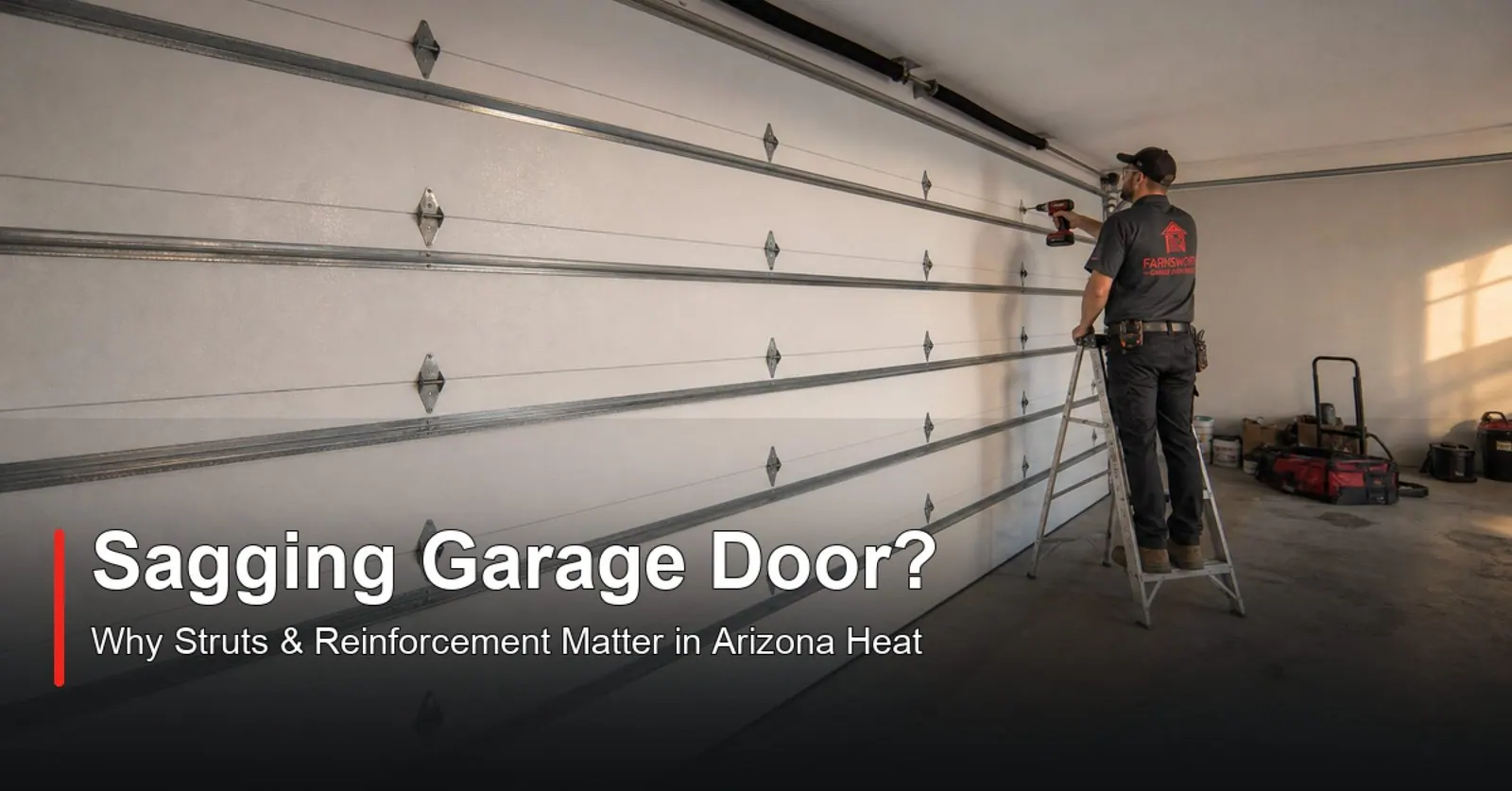
A garage door that bows or sags across the top is missing reinforcement. The fix is usually a strut — a horizontal steel bar that stiffens the section — not a whole new door:
- Sags while moving, straight at rest — the panel is flexing; a strut restores stiffness
- 16-foot double doors need struts on the top two sections at minimum — many builder-grade doors shipped without enough
- Already creased or buckled? That section has permanently deformed and needs panel replacement, with a strut on the new section
- Hangs crooked at rest? Different problem — likely a cable or spring, and worth a prompt inspection
Arizona's heat cycling makes all of this show up sooner, which is why sagging doors are one of the most common calls we get across Mesa, Gilbert, and Queen Creek every summer.
Stand inside your garage and watch the door open. Does the top section bow toward you as the opener pulls it? Do you hear a flexing pop as it bends around the curve of the track? Maybe you've noticed a slight smile-shaped dip across the top panel even when the door is closed. That's sag — and it's one of the most common things homeowners describe when they call us. The good news: caught early, a sagging door is one of the cheapest problems in the garage door world to fix. Caught late, it becomes a creased panel, a strained opener, and a much bigger ticket. Here's how to tell the difference and what reinforcement actually does.
What a Sagging Garage Door Actually Is (and Isn't)
A sectional garage door is a stack of wide, thin panels hinged together. Each panel is strongest at its edges, where the hinges and rollers carry it, and weakest in the middle of its span. When a panel flexes downward or bows outward in that middle zone, that's sag.
The top section takes the worst of it, for one simple reason: the opener pulls from its center. Every open and close, the trolley yanks on a bracket in the middle of that panel while the rollers hold the ends back. On a narrow door, the panel shrugs it off. On a wide door — especially a 16-foot double — that's a lot of unsupported steel bending around a concentrated pulling point, thousands of cycles a year.
It's worth separating sag from two look-alikes, because they're treated differently:
- Sag — the panel itself bows or flexes across its width, most visibly while the door is moving. This is a reinforcement problem.
- Crooked or tilted — the whole door hangs higher on one side, even at rest. That points to a cable or drum issue, not the panels, and it deserves a prompt professional look before a cable lets go.
- Suddenly heavy — the door sags and the opener strains or the door won't stay up. That's spring tension, and our spring repair team should check the balance before anything else is adjusted.
Why Arizona Heat Makes Doors Sag Sooner
Sag happens everywhere eventually. In the Phoenix area, it happens on fast-forward, and the reason is the daily temperature swing your door lives through.
Heat cycling fatigues the steel. A west- or south-facing door in Mesa or Apache Junction bakes all afternoon, then cools 30 or 40 degrees overnight. Steel expands when hot and contracts when cool, and that daily flex works the metal the way bending a paperclip back and forth does — slowly, then noticeably. Thin builder-grade panels feel it first.
Fasteners work loose. The same expansion-and-contraction cycle gradually loosens the screws and bolts holding hinges, brackets, and any existing struts. A strut that's lost its grip on the panel isn't reinforcing much of anything.
Summer is high season for door cycles. Between school pickup, evening errands, and everyone avoiding the front door in 110-degree weather, garage doors in Gilbert and Queen Creek work hardest exactly when the material is most stressed.
Builder-grade doors often shipped light. A lot of homes across the Valley — especially in fast-built subdivisions — got the thinnest door that met spec, sometimes with fewer struts than the width really calls for. Those doors behave fine for the first few years. Then a few Arizona summers catch up with them, and the top panel starts to bow.
What Struts Do — and How Many Your Door Needs
A strut is a long, U-shaped galvanized steel bar bolted horizontally across the inside face of a door section. It's not decorative and it's not optional on wide doors — it's structural. The strut turns a flexible panel into a stiff one by carrying load across the full width of the section, so the opener's center pull and the panel's own weight can't bend it.
Struts do three jobs at once: they stop panel flex (the sag itself), they quiet the door by killing vibration, and they protect the opener by spreading the pulling force so the trolley isn't fighting a bending panel on every cycle.
How many struts a door needs comes down to width and weight:
| Door width | Strut needed? | Where |
|---|---|---|
| Up to 12 ft (typical single) | Optional | Worth adding on heavy or wood doors |
| 12–14 ft | Recommended | Top section at minimum |
| 14–16 ft | Yes — required | Top section, to prevent panel sag |
| 16 ft (standard double) | Yes — required | Top two sections at minimum |
| 16–18 ft and wider | Yes — multiple | Top 2–3 sections; often 3+ struts on insulated doors |
One more thing struts affect that surprises people: balance. Struts add real weight to the door, and the springs are sized to the door's weight. Add reinforcement without rebalancing and the opener ends up lifting the difference — which is why a proper strut install ends with a balance check, and sometimes a spring adjustment, in the same visit.
4 Signs Your Door Needs Reinforcement Now
The top section bows while the door moves
Watch from inside as the door opens. If the middle of the top panel visibly flexes toward the opener as the trolley pulls, the section is bending on every single cycle. Each flex is small; ten cycles a day across an Arizona summer is not. This is the classic early-stage symptom, and it's exactly what a strut fixes.
Popping or flexing sounds during operation
A healthy door rolls; it doesn't creak like a ship. Popping, oil-canning, or flexing sounds as the door bends around the track radius are the sound of unreinforced steel working. If the noise has been getting louder over the past few months, the panel is telling you it's losing the fight.
A visible dip or "smile" across a closed section
Step back at the end of the driveway and sight across the door's horizontal lines. They should be dead straight. A shallow curve across the top section — even one you can only see in raking afternoon light — means the panel has started to take a set. At this stage reinforcement can still stop the progression, but the window is closing.
The opener is straining or the bracket area is wrinkling
A bowing top section loads the opener's trolley unevenly, so the motor labors, the rail shudders, or the door hesitates at the start of travel. Look closely at the metal around the opener bracket in the center of the top panel — wrinkles or hairline creases forming there mean the concentrated pull is deforming the section. That's the last exit before panel replacement, and it's also hard on the opener itself.
Reinforce, Replace the Panel, or Replace the Door?
The honest answer depends on one question: has the panel creased?
Flexing but not creased → reinforce. If the section still returns to straight when the door is at rest, the steel hasn't permanently deformed. Adding a strut (or replacing a bent one) stiffens the section, stops the sag, quiets the door, and takes the strain off the opener — a quick visit, and one of the best value-for-money repairs in the trade. If your door is due for its regular service anyway, strut checks are part of a proper garage door tune-up, along with the balance test that should follow any added weight.
Creased or buckled → replace that section. Once steel folds, no bar will un-fold it. A creased top panel is permanently weakened at the fold line and will keep failing there. The fix is panel replacement — swapping the damaged section while keeping the rest of the door — with a strut installed on the new section so the same failure doesn't repeat. Matching panels are usually available for doors from the major manufacturers, and it costs a fraction of a full door.
Multiple damaged sections, or an old tired door → run the numbers on both. When two or more sections are creased, or the door is already decades old with rusted hardware and faded panels, section-by-section repair can quietly add up past the point of sense. A straight-shooting technician will price the repair and the replacement side by side and let you decide — that's how we handle it.
Top panel bowing? Call or text (602) 935-9766 — same-day service is our standard, often within hours of your call.A word on DIY: the strut itself looks like a simple bolt-on, but getting the right gauge and length, positioning it correctly, and — critically — rebalancing the door afterward is where DIY installs go wrong. Spring adjustments are never a homeowner job; the springs are under enormous tension and the injury stories are real. Have the bar and the balance done in one professional visit and the whole problem is closed out properly.
Why Neighbors Call Farnsworth for Sagging Doors
Farnsworth Garage Door Service was founded by brothers Brigham and Riley Farnsworth. The Farnsworth name carries 60+ years of family business across Mesa and the East Valley — R&K, Farnsworth Wholesale, Farnsworth Realty — and we run this company the same way: tell the truth, put it in writing, fix it right the first time.
- Reinforce before replace. If a strut solves it, that's what we'll tell you — we're not in the business of selling a new door to fix a bendable panel.
- The whole fix in one visit. Strut, hardware tightening, and the balance check that added weight requires — done together, so your opener isn't left carrying the difference.
- We know Arizona doors. Heat-fatigued builder-grade panels are a pattern we see weekly across Mesa, Gilbert, Queen Creek, and the Phoenix area — we can usually tell you what we'll find before we open the truck.
- 5.0 stars on Google from homeowners who got a straight answer and a door that runs quiet and true again.
Frequently Asked Questions
What is a garage door strut?
A garage door strut is a horizontal reinforcement bar — usually U-shaped galvanized steel — that attaches across the inside face of a door section. It stiffens the panel so it can't flex or bow under its own weight or under the pull of the opener. Struts are standard equipment on wider doors: a 16-foot double door should have struts on at least its top two sections, and heavier insulated doors often carry three or more. On narrower single doors they're optional but still worthwhile on heavier doors.
Why is my garage door sagging in the middle?
The most common causes are a missing or bent strut, a wide door span with no reinforcement, thin builder-grade panels flexing under their own weight, or the opener pulling at the center of an unreinforced top section. In Arizona, years of extreme heat cycling also fatigue the steel and loosen the fasteners that hold the door's hardware, which makes flex show up sooner. A door that sags only while moving usually needs reinforcement; a door that hangs crooked at rest is more likely a cable or spring issue and should be inspected promptly.
Can a sagging garage door be fixed, or does it need to be replaced?
Very often it can be fixed. If the panel is flexing but hasn't creased, adding or replacing a strut restores stiffness and stops the sag — a quick, inexpensive repair compared to panel work. If the top section has already buckled or creased at the fold line, the metal has permanently deformed and that section usually needs to be replaced, with a strut installed on the new panel so it doesn't happen again. Whole-door replacement only enters the conversation when multiple sections are damaged or the door is near the end of its life anyway.
How many struts does a garage door need?
It depends on width and weight. Doors up to about 12 feet wide can usually go without struts, though heavier doors benefit from one. From 12 to 14 feet, a strut on the top section is recommended. At 14 to 16 feet, a top-section strut is required to prevent sag. A standard 16-foot double door should have struts on the top two sections at minimum, and insulated or extra-wide doors often need three or more. A technician can check your door's specs and tell you exactly what it calls for.
Does Arizona heat really make garage doors sag?
Heat doesn't melt the door, but it accelerates everything that leads to sag. A sun-facing steel door in Mesa or Gilbert can get extremely hot in summer, and the daily expansion-contraction cycle fatigues the metal and works fasteners loose over the years. Panels that flex slightly when new flex more every season, and builder-grade doors with thin steel and no struts show it first. That's why a door that behaved fine for years can start bowing, popping, and straining the opener after a few Arizona summers.
Can I install a garage door strut myself?
Installing a strut is more involved than it looks. The strut must be the right gauge and length for the door, positioned correctly on the section, and bolted without over-stressing the panel — and adding weight to the door changes its balance, which can require a spring adjustment afterward. Spring adjustments are not a DIY job; the springs are under enormous tension. Handy homeowners sometimes handle the bar itself, but we recommend having a technician do the install and rebalance the door in the same visit so the opener isn't left lifting a heavier door with the old spring setting.
Will a sagging garage door damage my opener?
Yes, over time. The opener connects to the center of the top section, so when that panel bows, the load on the trolley and rail becomes uneven and the motor works harder on every cycle. You'll often hear flexing or popping sounds as the door moves. Left alone, the strain shortens the opener's life and can crack the top panel around the bracket. A strut spreads that pulling force across the full width of the section, which protects both the panel and the opener.

Door Bowing? Let's Straighten It Out.
Licensed, insured, locally owned. One visit covers the inspection, the right reinforcement for your door's width, and the balance check that keeps your opener happy — with repair and replacement priced side by side if a panel is past saving. Same-day service is our standard, often within hours of your call.