
Is It Safe to Use My Garage Door If a Spring Is Broken?
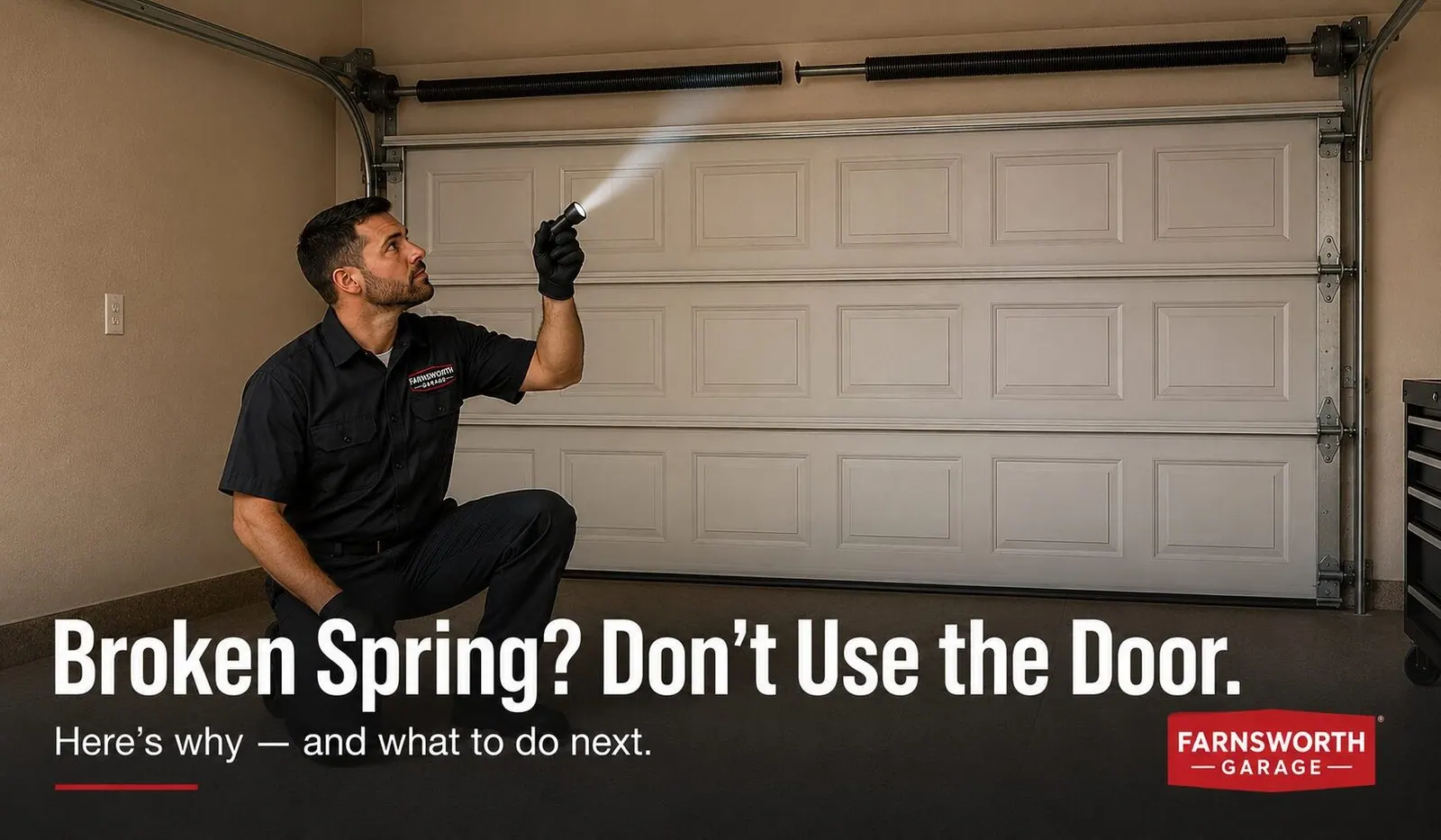
No — it is not safe to use a garage door with a broken spring. The spring is what carries the door's weight. A typical East Valley door weighs 150 to 220 pounds, and the spring makes it feel light enough for the opener to glide and for you to lift with two fingers. Break that spring and all of that weight comes back. Run the opener and you can burn it out and damage cables, panels, and track. Lift the door by hand and it can come crashing down with enough force to break bones or crush whatever is underneath.
If you suspect a broken spring, leave the door where it is, keep people and pets away from the opening, and call for spring repair. Below is exactly why it's unsafe, the one question everyone asks (getting a car out), and what to do right now.
It's one of the most common questions we get after a spring snaps: the door still looks fine, the opener still has power, so surely it's okay to use it once or twice to get the car out, right? We understand the instinct — nobody plans their day around a broken garage door. But a broken spring quietly changes the physics of the whole system, and "just this once" is how a single spring repair turns into a spring, cable, panel, and opener repair, or worse, an injury. Here's the honest, neighborly version of what's going on and how to handle it.
Why a Broken Spring Makes the Door Unsafe
A garage door isn't lifted by the opener. That surprises most people. The opener is a guide — a small motor that nudges an already-balanced door along its track. The thing actually doing the heavy lifting is the spring system, which stores energy to offset the door's full weight so that, in a properly tuned door, you could raise all 150-plus pounds with one hand.
When the spring breaks, that counterbalance disappears in an instant. The door doesn't get a little heavier — it becomes its entire dead weight with almost nothing holding it up. That's the whole safety problem in one sentence: a part designed to hold the door against gravity is gone, and gravity doesn't take a day off.
What the Spring Actually Does
Most modern East Valley doors use a torsion spring — the tightly wound steel coil mounted on a horizontal shaft above the opening. As the door lowers, the cables wind the shaft and load the spring with energy; as the door rises, that stored energy is released to help carry the weight back up. It's a beautifully simple system, right up until a spring reaches the end of its cycle life and snaps.
The two-spring question, answered correctly
Plenty of doors run two springs side by side on that same shaft. Here's a point we like to clear up, because it's widely misunderstood: when one of two springs breaks, the door does not tilt or hang crooked. Both springs sit on a single shared shaft and pull together, so a one-spring break doesn't twist the door — it just leaves the door badly under-sprung. The surviving spring is now doing a job sized for two, the opener strains on every cycle, and that second spring (same age, same cycle count as the one that just failed) is usually not far behind. So a "only one broke" door is still an unsafe-to-use door, and the right fix is to replace both springs together. Our deeper write-up on spotting and fixing a broken spring walks through that in detail.
What Goes Wrong If You Keep Using It
Here's what tends to happen when a homeowner tries to "baby it" through a few more cycles after a spring breaks — and why each action lands where it does.
| If you… | What can happen | Safe? |
|---|---|---|
| Run the opener | Motor burns out or strips its gear, a cable jumps the drum, the top panel bends where the arm attaches, rollers pop out of the track | No |
| Lift the door by hand | You're holding the full 150–220 lbs with no help; the door can drop fast and slam, injuring hands or feet and damaging panels | No |
| Leave it closed and stop using it | A closed door is resting at the bottom; left alone and unused, it stays put until a tech arrives | Yes |
| Try to re-seat the cable yourself | Cables, drums, and the shaft are precision, high-tension parts; handling them with a failed spring invites serious injury | No |
If the opener already took a beating before you realized the spring was the real problem, that's a separate fix — our opener repair and replacement page covers what that involves.
"But My Car Is Stuck Inside"
This is the real-world reason most people are tempted to use a broken door, so let's take it seriously. Yes, it's frustrating to have a car boxed in. But muscling a 200-pound unbalanced door up over your head — or propping it with whatever's handy — is exactly the scenario that puts homeowners in the ER every year. A door held up by a clamp, a ladder, or your own grip can come down without warning.
The safer path is almost always the faster one too: leave the door down, call a technician for emergency garage door service, and let them release and raise it under control with the proper hold. Because broken springs are an everyday call for us, most East Valley homeowners aren't waiting long — same-day service is our standard, often within hours of your call. If you truly can't wait, the right move is to have a pro open it, not to improvise.
And if the door happens to be stuck in the up position with the car free, resist the urge to close it with the opener to "secure the house." Lowering an unbalanced door can be just as rough on the system as raising one.
If the Door Is Already Open
Sometimes the spring lets go while the door is up, and now you've got a door sitting open with nothing properly counterbalancing it. A few honest pointers:
- Don't walk or park under it. The opener carriage may be holding the door for now, but that small mechanism wasn't built to hold a fully unbalanced door indefinitely.
- Don't trust a propped door. Ladders, boards, and clamps are not a safe substitute for a working spring, especially with kids or pets around.
- Get it handled promptly. Beyond the safety angle, a garage standing open is an open invitation in any neighborhood — tools, bikes, and the door into your home are all sitting right there.
The goal is a door that's been properly rebalanced and tested, not one that's "good enough for now." That's a quick fix for a tech and a genuine hazard for a homeowner to gamble on.
The Arizona Angle: Heat, Dust, and Snowbird Homes
Our climate adds a few wrinkles to the broken-spring story that homeowners in milder places never think about.
Heat cycling is hard on steel. An East Valley garage can swing from the 50s on a winter morning to well past 140 degrees on a summer afternoon. That daily expand-and-contract fatigues spring steel faster than a mild climate would, which is part of why springs here often give out right around their rated cycle life rather than beyond it.
Dust dries out the system. Fine desert dust and monsoon grit settle into coils and bearings and wick away lubrication, so an under-maintained door runs with more friction on every cycle. A little seasonal attention — the kind we cover in a garage door tune-up — goes a long way toward catching a tired spring before it strands you.
Snowbird homes are the sneaky one. If you head north for the summer and a spring fails while the house sits empty, the door can end up stuck — sometimes stuck open — for months with no one watching it. It's worth having a neighbor test the door now and then, or scheduling a check before you leave, so a broken spring doesn't become an open, unsecured garage in August.
What to Do Right Now
If you think a spring just broke, here's exactly what we'd tell a neighbor over the phone:
- Stop using the opener. Don't keep tapping the button hoping it catches — that's how the motor, cables, and panels get damaged.
- Don't lift the door by hand. With no spring, you're holding the whole weight. Leave it down.
- Keep kids and pets away from the opening until the door has been repaired and rebalanced.
- If a car is trapped, leave it. A technician can open the door safely — forcing it risks injury and a bigger repair.
- Engage any manual lock so no one operates the door from another remote or the wall button.
- Call a licensed local company (that's us — (602) 935-9766) and mention if you heard a bang or see a gap in the coils, so we bring the right parts.
Why Neighbors Call Farnsworth for Broken Spring Repair
Farnsworth Garage Door Service was founded by brothers Brigham and Riley Farnsworth. The Farnsworth name has 60+ years of family business across the East Valley behind it — R&K, Farnsworth Wholesale, Farnsworth Realty — and we run this company the way our family always has: tell the truth, put the price in writing, do the work right the first time.
- Spring repair is our most common call. Trucks are stocked with the most common East Valley spring sizes, so most jobs are handled same-day.
- We replace springs in pairs when it's warranted — and tell you when it isn't. No upsell, no scare tactics.
- Honest written quotes before any work begins, every time.
- We rebalance and safety-test the door after the repair, not just swap the part — so it's actually safe to use again.
- Same-day service is our standard, often within hours of your call.
- 5.0 stars on Google. Our neighbors keep us busy by telling theirs.
We cover the whole East Valley — see where we work across our service areas, or book online anytime.
Frequently Asked Questions
Is it safe to use my garage door if a spring is broken?
No. When a garage door spring is broken, the door has lost the counterbalance that carries its weight, so it is no longer safe to run with the opener or lift by hand. A typical East Valley door weighs 150 to 220 pounds, and the spring is what makes it feel light. With the spring broken, a door you raise can come crashing down with enough force to injure a person or crush whatever is underneath, and the opener can be damaged trying to lift a load it was never built to carry. Leave the door where it is and call for spring repair.
Can I open my garage door manually if the spring is broken?
We strongly advise against it. The springs are the only thing that offsets the full weight of the door. Pull the red emergency release on a door with a broken spring and you are holding the entire 150-to-220-pound panel with nothing helping you. It can drop fast and slam shut, taking fingers, a foot, or worse with it, and it can damage the cables, track, and panels on the way down. If your car is trapped inside, the safest move is to leave the door alone and have a technician open it under control.
What happens if I keep using the opener with a broken spring?
You usually turn a clean, single repair into several. A garage door opener is built to guide a counterbalanced door, not to lift a 150-pound-plus door on its own. Forcing it with a broken spring can burn out the motor or strip the drive gear, pull a cable off its drum, bend the top panel where the opener arm attaches, and knock rollers out of the track. What started as a spring replacement can become springs, cables, a panel, and an opener. The cheapest outcome is to stop pressing the button the moment you suspect a broken spring.
My garage door has two springs and only one broke — is it safe to use?
Still no. On a two-spring system both springs sit on the same shaft above the door and share the load together, so the door does not tilt or hang crooked when one breaks. What changes is that the remaining spring is now carrying a job sized for two. The door is under-sprung and too heavy, the opener strains on every cycle, and the surviving spring, which has the same age and cycle count as the one that just failed, is close behind. Treat a one-of-two break the same as a full failure: stop using the door and replace both springs together.
Is it safe to leave my garage door open with a broken spring?
A door that is already up and is being held by the opener carriage or is clamped in place is generally stable to leave for a short time, but it is not something to rely on. With no working spring, the only thing resisting gravity may be the opener's small holding mechanism, and that was never designed to hold a fully unbalanced door for long. Do not walk or park under it. The safer position for most homeowners is a closed, secured door, because a partly open door in an Arizona neighborhood is also an open invitation. Have the spring repaired promptly rather than leaving the door stuck open for days.
How long can I leave a broken garage door spring before fixing it?
From a damage standpoint, a broken spring sitting unused does not get worse on its own, so there is no countdown ticking on the spring itself. The real risks while you wait are practical: a car trapped inside, a side door left as the only entry, a closed door that someone forgets about and tries to open, and on an open door, security and the chance of an unbalanced drop. Because spring replacement is the most common call we run and most are handled the same day, there is rarely a reason to live with it for long. Get it on the schedule, and in the meantime keep everyone away from the door.
Can a garage door fall if the spring is broken?
Yes, and that is the core reason a broken spring is a safety issue rather than just an inconvenience. The spring counterbalances the door's weight; remove that and the door wants to obey gravity. A closed door with a broken spring will usually stay closed because it is already resting at the bottom. The danger comes when the door is raised, partway up, or being forced, because there is little or nothing holding it against a fast drop. Keep children and pets away from the opening until the spring is replaced and the door is rebalanced and tested.
Who do I call for a broken garage door spring in the East Valley?
Farnsworth Garage Door Service handles broken spring calls across Mesa, Gilbert, Chandler, Tempe, Scottsdale, Queen Creek, San Tan Valley, Apache Junction, Gold Canyon, Fountain Hills, Guadalupe, Maricopa, and Phoenix. Spring breaks are the single most common job we run, our trucks are stocked with the most common spring sizes, and same-day service is our standard, often within hours of your call. Call or text (602) 935-9766 and we will get your door safe and working again.

Broken Spring? Don't Risk the Door — Let Us Make It Safe.
Licensed, insured, locally owned. Spring repair is our most common East Valley call, and we rebalance and safety-test every door before we leave. Honest written quote before any work begins. Same-day service is our standard, often within hours of your call.