
Garage Door Safety Sensors: How They Work and Why They Save Lives
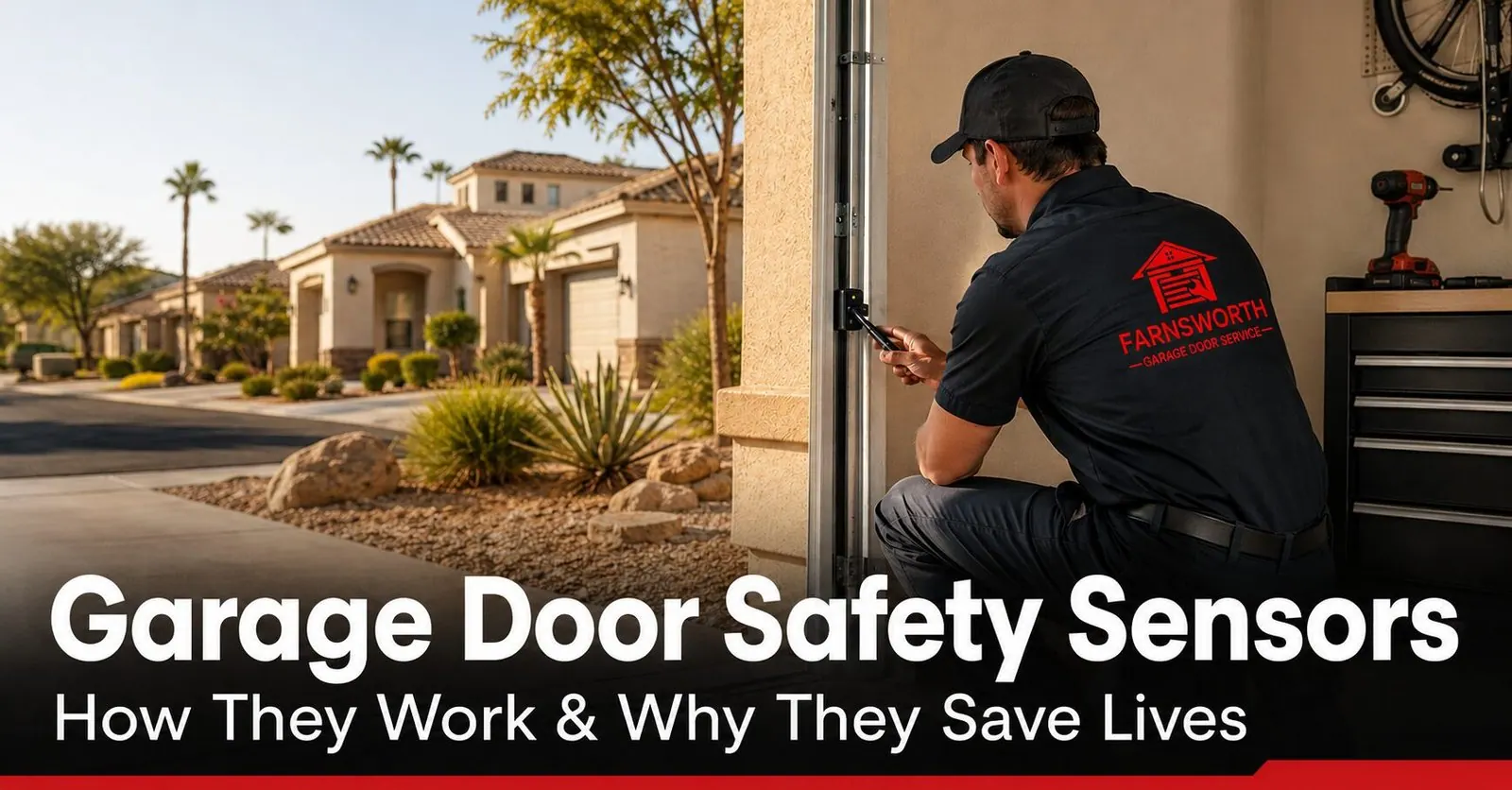
Your garage door's safety sensors are two small photo-eyes mounted a few inches off the floor on each side of the opening. One shoots an invisible infrared beam across to the other. While the door is closing, anything that breaks that beam — a toddler, a dog, a bike — tells the opener to stop and reverse before the door can come down on it. Quick facts:
- Required by federal law since 1993 on every residential opener sold in the U.S.
- A blinking sensor light almost always means a blocked, dirty, or misaligned beam.
- Door only closes if you hold the button? That's your sensors asking for help.
- Never bypass them. They're the one part of your door that protects people, not the door.
Here's how they work, how to test yours in 30 seconds, and why Arizona dust and sun make them act up more than you'd expect.
Most homeowners never think about their garage door's safety sensors until the door suddenly won't close — or closes only when they march over and hold the wall button down. Those two little eyes near the floor are easy to ignore, but they do one of the most important jobs of anything on your house: they make sure a closing garage door, one of the heaviest moving objects most families own, never comes down on a child, a pet, or anyone underneath it. At Farnsworth, sensor calls are some of the most common service visits we run across Mesa, Gilbert, Queen Creek, and the rest of the East Valley, and the good news is that a lot of sensor trouble is simple to understand and quick to fix. Here's the full picture in plain English.
What Garage Door Safety Sensors Are
If you crouch down and look at the bottom of your garage door tracks, you'll see a small plastic eye mounted on each side, usually about four to six inches above the floor. These are your safety sensors — also called photo-eyes or photoelectric sensors. They always come as a matched pair, one on the left track and one on the right, facing each other across the opening.
One eye is the sending unit. It projects a thin, invisible beam of infrared light straight across the door opening. The other eye is the receiving unit. Its only job is to "see" that beam. As long as the receiving eye can see the sending eye, the system knows the doorway is clear. Break that line of sight — with anything at all — and the system knows something is in the way.
Both eyes connect back to your opener motor with a pair of thin low-voltage wires. They don't run on the door itself, and they have nothing to do with your remote, your keypad, or your Wi-Fi. They are a dedicated, single-purpose safety system, and that's exactly why they're so reliable when they're working — and so noticeable when they're not.
How the Photo-Eye Beam Actually Works
The whole system comes down to one simple rule: the door is only allowed to close on its own if the beam between the two eyes is unbroken. Here's the sequence every time you tell the door to close:
- You press close. The opener checks in with the sensors before it moves the door down.
- The beam is clear. The receiving eye sees the sending eye's infrared light. The opener gets a green light and lowers the door.
- Something enters the doorway. A child runs through, the dog wanders out, a trash can is in the path. The object breaks the beam.
- The opener reverses instantly. The moment the beam is broken, the closing door stops and rolls back up to fully open — no contact required.
To tell you what it's "seeing," each sensor has a tiny indicator light. On most LiftMaster and Chamberlain units, the sending eye glows amber and the receiving eye glows green. Genie and other brands use their own colors, but the idea is the same:
Reading your sensor lights
Both lights steady and solid — the beam is aligned and clear. The door will close normally. This is what you want.
One light blinking, flickering, or dark — the beam is broken or weak. Something is in the path, a lens is dirty, the eyes are knocked out of alignment, or a wire has come loose. The door will refuse to close on its own until it's resolved.
- Steady light = good beam
- Blinking or off = blocked, dirty, misaligned, or wiring fault
- The sending (amber) eye usually stays lit even when there's a problem — it's the receiving (green) eye that flags trouble
Why They Save Lives (and Why They're the Law)
This isn't an exaggeration for effect. Before modern safety sensors, garage doors were responsible for serious injuries and a number of tragic deaths, often involving small children who darted under a closing door. A residential garage door and its hardware are heavy, and a door closing under power has enough force to badly hurt or trap a child or pet.
That history is why, since 1993, U.S. federal law has required every residential garage door opener sold in the country to include a secondary entrapment protection system — in practice, photo-eye sensors like yours. They are the backup that doesn't depend on anyone reacting in time. The door doesn't have to touch anything; the broken beam alone is enough to send it back up.
For families, the stakes are easy to picture. Kids treat the garage like a second front door. Pets follow people in and out. Bikes, scooters, and pool toys end up in the doorway. The sensors are watching that gap every single time the door comes down, so a split-second of bad timing doesn't turn into an emergency. When people ask us which repair is the least optional on the whole door, this is it — and it's a big part of why a full garage door repair visit always includes checking that the reverse actually works.
Signs Your Sensors Are Failing
Sensors rarely die without warning. They usually nag you for a while first. These are the classic symptoms we hear on the phone every week:
- The door starts down, then immediately reverses back to open without anything in the way.
- The door won't close at all from the remote or wall button — but the opener motor light may flash a set number of times.
- The door only closes if you hold the wall button down the entire way. (This is the opener's built-in override telling you the sensors aren't happy.)
- One of the small sensor lights is blinking, flickering, or completely dark.
- It works fine in the morning but reverses every afternoon at about the same time — a classic sun-glare tell in Arizona.
- It got intermittent right after a storm, a bumped track, or some garage reorganizing.
Any one of these points at the sensors. The fix is often quick, but the symptom shouldn't be ignored, because while the door is misbehaving its automatic safety reverse may not be doing its job.
How to Test Your Sensors in 30 Seconds
Every homeowner should run this test about once a month. It's the single best way to know your door's life-safety system is actually working. We call it the cardboard-box test, and the most important rule is simple: never use your hand, foot, or any part of your body to test it. Always use an object.
- Open the door fully with your remote or wall button.
- Set a sturdy object in the path, right where the beam crosses — a cardboard box, a roll of paper towels, or a small trash can works well. It should sit between the two sensors, breaking the beam.
- Press the close button. Watch what happens the instant the door starts down.
- A healthy door stops and reverses immediately, before it gets anywhere near the object. That's a pass.
While you're down there, do a second quick test for the force reverse: lay a flat board or a 2x4 on the floor where the door lands, then close the door. When the bottom of the door hits the wood, it should reverse back up. If it doesn't, the force setting needs adjusting too. Both tests together take about a minute and cover your door's two main safety systems.
Door failing the reverse test? Don't keep using it — call or text (602) 935-9766Why Arizona Dust and Sun Cause Sensor Trouble
Photo-eyes are sensitive by design, and our climate gives them a harder life than they'd have almost anywhere else. If your sensors act up, one of these East Valley culprits is usually behind it:
| Cause | What you'll notice | Typical fix |
|---|---|---|
| Dust & desert grit on the lens | Door reverses randomly; gets worse over weeks | Wipe both lenses gently with a soft, dry cloth |
| Low-angle sun glare | Works mornings, reverses the same time each afternoon | Add or reposition a sun shield over the receiving eye |
| Eyes knocked out of alignment | Light blinks; happened after a bump or reorganizing | Loosen the bracket, re-aim until the light goes steady |
| Monsoon water / corroded wiring | Intermittent after rain or humidity | Inspect and repair the wire connections at each eye |
| Heat-loosened brackets over time | Slow drift into misalignment with no obvious event | Re-secure brackets and realign the pair |
| Aged or failed sensor | Cleaning and realigning don't help; light won't stay solid | Replace the sensors as a matched pair |
The encouraging part: the top three causes on that list — dust, glare, and a bumped eye — are the most common, and none of them require new parts. A clean lens and a careful realignment solve a large share of the sensor calls we run. Working these checks into a seasonal preventative maintenance routine keeps them from turning into a "door won't close and I'm late for work" morning.
The One Thing You Should Never Do
When sensors get frustrating, the internet is full of advice on how to "jump out" or permanently bypass them so the door just closes. Please don't. Permanently defeating your safety sensors removes the only system standing between a closing door and whoever — or whatever — is underneath it. The door will happily come down on a child, a pet, or a car bumper, because you've told it to stop checking.
The hold-to-close button on your wall control is a temporary override, meant to get a misbehaving door shut once while you sort out the real problem. It's not a fix, and even then the door's protection is reduced while you hold it. If your sensors are acting up, the answer is always to clean, realign, or replace them — never to disable them. They were required by law because the alternative cost lives, and that math hasn't changed.
When to Call a Technician
Plenty of sensor issues are true do-it-yourself fixes, and we're happy when a homeowner solves it in five minutes with a paper towel. Handle these yourself with confidence:
- Wiping dust off both lenses
- Clearing an obvious obstruction out of the beam path
- Gently nudging an eye back into alignment until its light goes steady
Call a technician when the simple fixes don't hold or when the problem goes deeper:
- The light won't stay solid no matter how you clean or aim it
- The wiring is pinched, chewed, corroded, or damaged
- The door fails the reverse test (box test or force test)
- The sensors are old and need replacing as a pair
- You're just not sure the safety system is doing its job — and want it verified
Because this is a life-safety system, there's real value in having the repair finished and the final reverse test confirmed by a professional. When we come out, we diagnose the actual cause before touching parts, fix it, and put the price in writing first — so you never pay to replace sensors that only needed a wipe and a realignment.
Why East Valley Homeowners Call Farnsworth for Sensor Repairs
Farnsworth Garage Door Service was founded by brothers Brigham and Riley Farnsworth. The Farnsworth name has 60+ years of family business across the East Valley behind it — R&K, Farnsworth Wholesale, Farnsworth Realty — and we run this company the way our family has always run a business: tell the truth, put the price in writing, and do the work right the first time.
- We diagnose before we replace. If your sensors only need cleaning or realigning, that's what you'll pay for — not new parts you didn't need.
- We test the full safety system, sensors and force-reverse both, and confirm the door reverses the way it should before we leave.
- Price in writing, up front. You approve the cost before any work starts.
- Local technicians who know AZ doors — dust, monsoon, and sun-glare issues we see every week.
- Same-day service is our standard, often within hours of your call.
- 5.0 stars on Google. Our neighbors keep us busy by telling theirs.
Need a sensor checked or a door that won't close looked at? See our garage door repair page, learn about opener replacement, or check where we work across the East Valley.
Frequently Asked Questions
What do garage door safety sensors do?
Garage door safety sensors are two small photo-eyes mounted a few inches off the floor on each side of the door opening. One sends an invisible infrared beam straight across to the other. While the door is closing, anything that breaks that beam — a child, a pet, a backpack, a car bumper — tells the opener to stop and reverse the door back up immediately. They are a secondary entrapment protection system, and federal law has required them on every residential garage door opener sold in the United States since 1993. In short, they keep the door from closing on something, or someone, that's in the way.
Why won't my garage door close unless I hold the button?
If your door only closes when you hold the wall button down the whole way, your safety sensors are almost always the reason. The opener thinks the beam is blocked or broken, so it refuses to close on its own. Holding the button is the opener's built-in override for exactly this situation — but it is a warning light, not a fix. It means the sensors need attention: check for an obstruction in the beam path, wipe the lenses clean, make sure both eyes are aimed at each other, and look at the small indicator lights. A steady light usually means good; a blinking or dark light points to the problem. If it keeps happening, have the sensors inspected rather than relying on the hold-to-close workaround.
How do I test my garage door safety sensors?
Use the cardboard-box test. With the door fully open, press the close button, then set a sturdy object such as a cardboard box or a roll of paper towels in the door's path so it breaks the beam between the two sensors. A properly working door should stop and reverse the moment the object enters the beam. Do this once a month. Never use your foot, hand, or any body part to test it. If the door does not reverse, stop using the opener and have it serviced — the entrapment protection is not working, and that is the one part of a garage door you do not want to gamble on.
Why do garage door sensors fail more often in Arizona?
Our climate is hard on photo-eyes in a few specific ways. Blowing dust and fine desert grit settle on the lenses and weaken or block the beam. Low-angle afternoon and winter sun shines straight into a west- or east-facing receiving eye and washes out the infrared signal, so the door reverses for no apparent reason at the same time each day. Monsoon water and humidity can corrode the small wire connections at the back of each sensor. And the daily heat-and-cool cycle slowly loosens the mounting brackets, nudging the eyes out of alignment. None of these are dramatic, but together they make sensor trouble one of the most common service calls we run across the East Valley.
Is it safe to bypass or disable garage door safety sensors?
No. Permanently bypassing, jumping out, or disabling the safety sensors removes the only thing stopping the door from closing on a child, a pet, or anyone caught underneath it — and a closing garage door carries enough force to cause serious injury. The sensors are required by federal law for a reason. If yours are misbehaving, the right move is to fix or replace them, not defeat them. The hold-to-close button on the wall is a temporary override for getting the door shut once; it is not a substitute for working sensors, and the door's reverse protection is reduced while you use it.
How much does it cost to fix or replace garage door sensors?
It depends on what's actually wrong. Many sensor problems aren't a parts issue at all — a dirty lens, a bumped bracket, or sun glare can be corrected in a single visit with no new parts. When a sensor itself has failed or the wiring is damaged, the eyes are replaced as a matched pair so the beam stays calibrated. We diagnose the real cause first and give you the price in writing before any work starts, so you're never paying to replace parts that only needed cleaning or realigning. Call or text us and we'll walk through it.
Can I install garage door safety sensors myself?
You can handle the easy fixes yourself — wiping the lenses, clearing the beam path, and gently nudging an eye back into alignment until the indicator light goes steady are all reasonable homeowner tasks. Where we'd pump the brakes is anything involving the wiring or replacing the sensors. The low-voltage wires running back to the opener are easy to pinch, staple through, or wire with the wrong polarity, and a sensor that's installed but not properly calibrated can give you a false sense of safety. Because this is a life-safety system, it's worth having the install and the final reverse test verified by a technician.

Garage Door Won't Close? Let's Make Sure It's Safe.
Licensed, insured, locally owned. We diagnose the real cause, test your door's full safety system, and put the price in writing before any work starts — so you only pay for what your door actually needs. Same-day service is our standard, often within hours of your call.