
Garage Door Opens or Closes by Itself? Causes and Fixes for Arizona Homes
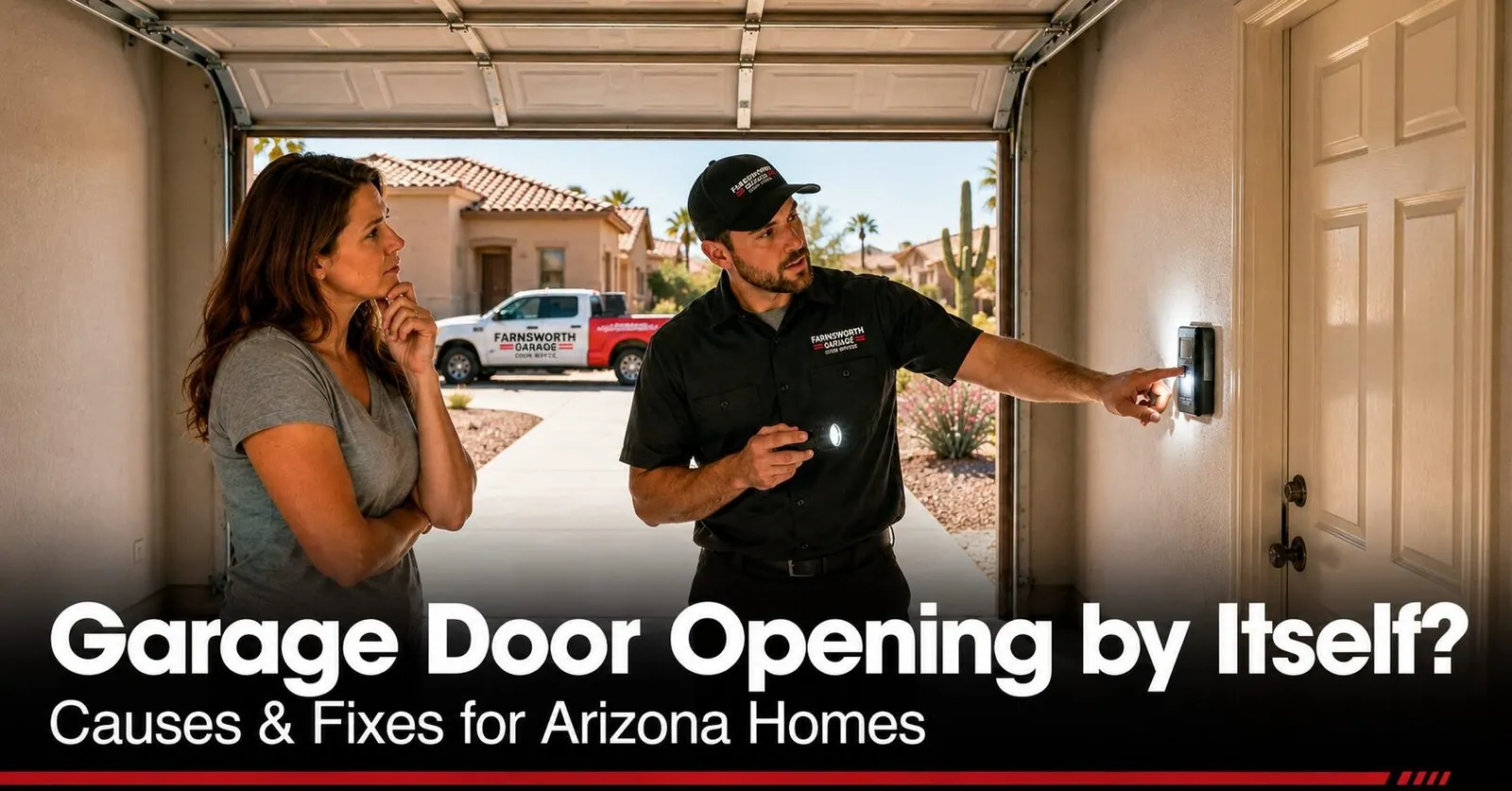
A garage door that opens or closes on its own isn't haunted — something is sending the opener a signal, or the opener is misreading one. The usual suspects, roughly in order:
- A stuck or shorted wall button (or the low-voltage wiring behind it)
- A remote with a stuck button or dying battery — often buried in a car console or junk drawer
- Radio interference from LED bulbs or nearby electronics
- An old fixed-code opener responding to a neighbor's remote
- A logic board damaged by a monsoon power surge
First move: unplug the opener. That stops the door instantly while you work through the checklist below — and in Arizona, where an open garage means heat, dust, and an unlocked path into your home, this one's worth solving quickly.
Few garage door problems rattle homeowners like this one. You come home to a wide-open garage you're certain you closed, or you hear the door rumble up at 2 a.m. for no reason at all. We take these calls every summer across Mesa, Gilbert, Chandler, and Queen Creek, and there's always a real, physical cause — usually electrical, occasionally a neighbor's remote, and more often than you'd think, a piece of Arizona weather. This guide walks through the causes we actually find in driveways, what's safe to check yourself, and when the smart move is a technician with a multimeter.
- First: is it really moving "by itself"?
- Cause #1 — a stuck or shorted wall button
- Cause #2 — a remote that's transmitting without you
- Cause #3 — radio interference
- Cause #4 — a neighbor's remote and old fixed-code openers
- Cause #5 — damaged low-voltage wiring
- Cause #6 — a surge-damaged logic board
- Match the pattern to the cause
- What to do tonight vs. what to leave to a pro
- FAQs
First: Is It Really Moving "By Itself"?
Two lookalike problems get mistaken for phantom operation, and they have different fixes:
The door starts closing, then reverses back up. That's not the door acting on its own — it's the safety system doing its job, usually because the photo-eye sensors near the floor are blocked, dirty, or knocked out of alignment. Common as ever in dusty Arizona garages.
The door drifts or sinks when the opener isn't even connected. If you pull the red release cord and the door slowly creeps down (or floats up) on its own, that's a balance problem in the springs, not an electrical one — a job for our spring repair team, since spring tension should never be a DIY project.
True phantom operation is different: the opener motor runs, unprompted, as if someone pressed a button. If that's what you have, one of the six causes below is almost certainly why.
A Stuck or Shorted Wall Button
The wall-mounted button by your door into the house is the most common culprit we find. It's a simple low-voltage switch, and when it sticks, warps, or corrodes, it can close its circuit intermittently — sending "open" commands nobody pressed. Arizona is hard on these: a garage that bakes at 120-plus degrees all summer can warp the plastic housing, and dust works its way into the contacts over the years.
The tell: phantom operation at random times of day or night with no other pattern. Press the button a few times and feel for sticking, look for a sun-yellowed or cracked housing, and check whether the door acts up more on hot afternoons.
A Remote That's Transmitting Without You
Every remote paired to your opener is a possible source — including the ones you forgot exist. A remote wedged under a car seat with something pressing its button, a visor clip with a cracked case, a spare in a junk drawer with a swollen battery, a keychain mini in a kid's backpack: any of them can fire off signals. A dying battery can also transmit weak, garbled codes that a receiver occasionally misreads.
The tell: the door moves when a particular car pulls in, when someone digs through a drawer, or at oddly "human" times of day. Round up every remote, pull the batteries, and see if the problem stops. If it does, replace batteries one at a time until you find the troublemaker — or erase and re-program the full set.
Radio Interference
Your opener listens for a radio signal, and it's not the only thing in your house making one. Certain LED bulbs — especially bargain no-name ones, and especially the bulb screwed into the opener itself, inches from the receiver antenna — emit radio-frequency noise in the same range remotes use. Baby monitors, wireless cameras, and other transmitters can add to the noise floor. Some openers will even tell you: on many LiftMaster and Chamberlain units, a diagnostic LED flashing five times signals RF interference or a remote problem.
The tell: the trouble started after new bulbs or new electronics went in, or your remotes also work only from close range. Swap the opener bulb for an incandescent or a garage-door-rated LED, and make sure the antenna wire hangs straight down from the motor head, at least six inches.
A Neighbor's Remote (Old Fixed-Code Openers)
Modern openers use rolling-code security — a new code with every press, billions of combinations — so a neighbor's remote effectively can't open your door. But openers from the early 1990s and before used fixed codes set by little DIP switches, with a limited number of combinations. In neighborhoods with original openers still hanging from the ceiling — and plenty of Mesa and Tempe homes from that era still have them — two houses really can end up on the same code.
The tell: the door opens around the same time a specific neighbor comes or goes. You can reshuffle DIP switches as a stopgap, but an opener that old predates modern safety standards, and the better answer is a rolling-code opener upgrade — it fixes the security hole and the phantom openings in one move.
Damaged Low-Voltage Wiring
Thin low-voltage wires run from the opener head to the wall button and safety sensors, usually stapled along the ceiling and walls. A staple that bit too deep years ago, insulation nicked during a garage shelving project, a wire pinched behind storage bins, pack rats or mice chewing insulation, or monsoon moisture creeping into an outdoor keypad — any of these can create an intermittent short that the opener reads as a button press.
The tell: phantom operation that comes and goes with temperature, humidity, or vibration — worse on hot afternoons or right after a storm. Look along the wire runs for staples, kinks, and chew marks. Confirming a short takes a multimeter and patience, which is where a technician earns their keep.
A Surge-Damaged Logic Board
The logic board is the opener's brain — every button press, remote signal, and sensor reading runs through it. Arizona's monsoon season is rough on them: a nearby lightning strike or a grid surge can partially damage the board without killing it outright, and a half-damaged board misbehaves in strange ways. It can misread electrical noise as commands, run the door on its own, forget remotes, or work one day and not the next. Age does the same thing more slowly.
The tell: the weirdness started right after a storm or outage, or it's paired with other gremlins — flickering opener lights, unresponsive remotes, random stops. This one isn't a DIY fix. A technician can test the board and tell you whether a board replacement or a new opener is the smarter money — on an older unit, a new opener with rolling-code security and battery backup often is.
Match the Pattern to the Cause
Phantom operation almost always has a pattern. Here's how the patterns map to the likely cause and your first move:
| What you notice | Most likely cause | First thing to try |
|---|---|---|
| Random times, day or night, worse on hot afternoons | Stuck/shorted wall button or wiring | Inspect the wall button; unplug opener to confirm it stops |
| Happens when a certain car or person is around | Stuck or misfiring remote | Pull batteries from every remote; re-test one at a time |
| Started after new LED bulbs or electronics | RF interference | Swap the opener bulb; check the antenna hangs free |
| Lines up with a neighbor coming or going | Fixed-code overlap (pre-mid-'90s opener) | Upgrade to a rolling-code opener |
| Started right after a monsoon storm or outage | Surge-damaged logic board | Professional board test; surge protector going forward |
| Smart-app history shows the door commands | Shared app access or a schedule | Audit app users, linked devices, and automation rules |
What to Do Tonight vs. What to Leave to a Pro
Safe to do yourself, tonight: unplug the opener (the door stays put and can be operated manually), slide the manual lock if you're leaving town, round up remotes and pull their batteries, swap the opener bulb, check the app history, and look over the wall button and visible wiring. If the garage is your main way in, the door still opens from inside by hand with the release cord.
Leave to a technician: anything involving a multimeter, the logic board, sensor or button wiring repairs, and — always — anything touching the springs. A good tech will also catch wear you can't see; it's the same inspection we run in a full garage door tune-up, which is worth doing yearly in our heat and dust anyway.
And if the door is opening on its own while you're away — or won't stay closed at all — treat it as urgent. An open garage in July is an invitation to heat, dust, critters, and worse. That's exactly what our 24/7 emergency service is for.
Why Neighbors Call Farnsworth for the Weird Ones
Farnsworth Garage Door Service was founded by brothers Brigham and Riley Farnsworth. The Farnsworth name carries 60+ years of family business across Mesa and the East Valley — R&K, Farnsworth Wholesale, Farnsworth Realty — and we run this company the same way: tell the truth, put it in writing, fix it right the first time.
- We diagnose, we don't guess. Phantom operation gets a real electrical diagnosis — wall button, wiring, receiver, board — not a shrug and a parts cannon.
- Repair-first honesty. If a battery or a bulb fixes it, that's what we'll tell you. If the opener is past its useful life, we'll show you why in writing.
- Same-day service is our standard, often within hours of your call — because a door that opens itself is a security problem, not a someday problem.
- 5.0 stars on Google from homeowners across Mesa, Gilbert, Chandler, Queen Creek, and the greater Phoenix area — see our Mesa service page for where we're based.
Frequently Asked Questions
Why does my garage door open by itself at night?
Nighttime phantom openings usually trace back to an electrical cause rather than a ghost: a wall button or its low-voltage wiring shorting intermittently, a remote with a stuck or pressure-triggered button sitting in a car or drawer, or a failing logic board sending its own signals. Cooler overnight temperatures can make marginal wiring connections expand and contract just enough to close a circuit, which is why some doors only act up after dark. Unplug the opener to stop it immediately, then work through the wall button, remotes, and keypad — and if it started after a storm, suspect the logic board.
Can a neighbor's remote open my garage door?
With a modern opener, effectively no. Openers made since the mid-1990s use rolling-code technology (like LiftMaster's Security+), which generates a new code with every press — billions of combinations, never reused. But older fixed-code openers set with small DIP switches inside the remote and motor head only have a limited number of switch combinations, so a neighbor's remote can indeed match yours. If your opener predates the mid-1990s and the door opens when a certain neighbor comes home, that's the likely cause — and the fix worth making is upgrading to a rolling-code opener rather than reshuffling DIP switches.
Can LED bulbs interfere with my garage door opener?
Yes. Some LED bulbs — especially bargain no-name ones — emit radio-frequency noise in the same range garage door remotes use. That interference usually shows up as remotes only working from very close range, but in combination with other marginal signals it can contribute to erratic behavior. The bulb inside the opener itself is the most common offender because it sits right next to the receiver antenna. A quick test: swap in an incandescent bulb or an LED specifically rated for garage door openers and see if the strange behavior stops.
What should I do first if my garage door opens on its own?
Unplug the opener from its ceiling outlet. That takes the motor out of the equation instantly, so the door can't move again while you investigate — and it tells you something: if a disconnected door still drifts open or closed on the tracks, the issue is spring balance, not electronics. With the opener unplugged, check the wall button for a stuck or warped housing, pull the batteries from every remote, and look over any keypad. Then plug back in and see if the behavior returns. If it does, or if it began after a monsoon storm, have a technician test the wiring and logic board.
Can monsoon storms damage a garage door opener?
They can, and every summer we see it across Mesa, Gilbert, and Queen Creek. A nearby lightning strike or a grid surge during a storm can partially damage the opener's logic board — the small circuit board that interprets every signal. A partially damaged board doesn't always die outright; it can misread noise as commands, which shows up as a door that opens or closes on its own, works one day and not the next, or forgets its remotes. If phantom operation started right after a storm, the logic board is the prime suspect, and a technician can test it and advise whether a board replacement or a new opener makes more sense.
Is a garage door that opens by itself dangerous?
It's more of a security problem than a physical safety one — the door still has its safety sensors and auto-reverse protection when it moves. The real risk is what an open door invites: an unlocked entry into your home, easy visibility of everything you store, and in Arizona, a garage full of summer heat, dust, and the occasional scorpion or pack rat. A door that opens while you're at work or out of town is a real exposure. Treat phantom operation as urgent: unplug the opener, use the manual lock if you need to leave, and get the cause diagnosed rather than hoping it stops.

Stop the Phantom Openings for Good
Licensed, insured, locally owned. We'll find the real cause — button, remote, wiring, interference, or logic board — explain it in plain English, and put the fix in writing before any work starts. Same-day service is our standard, often within hours of your call.