
New Construction Garage Doors: A Builder & Homeowner Guide for Arizona
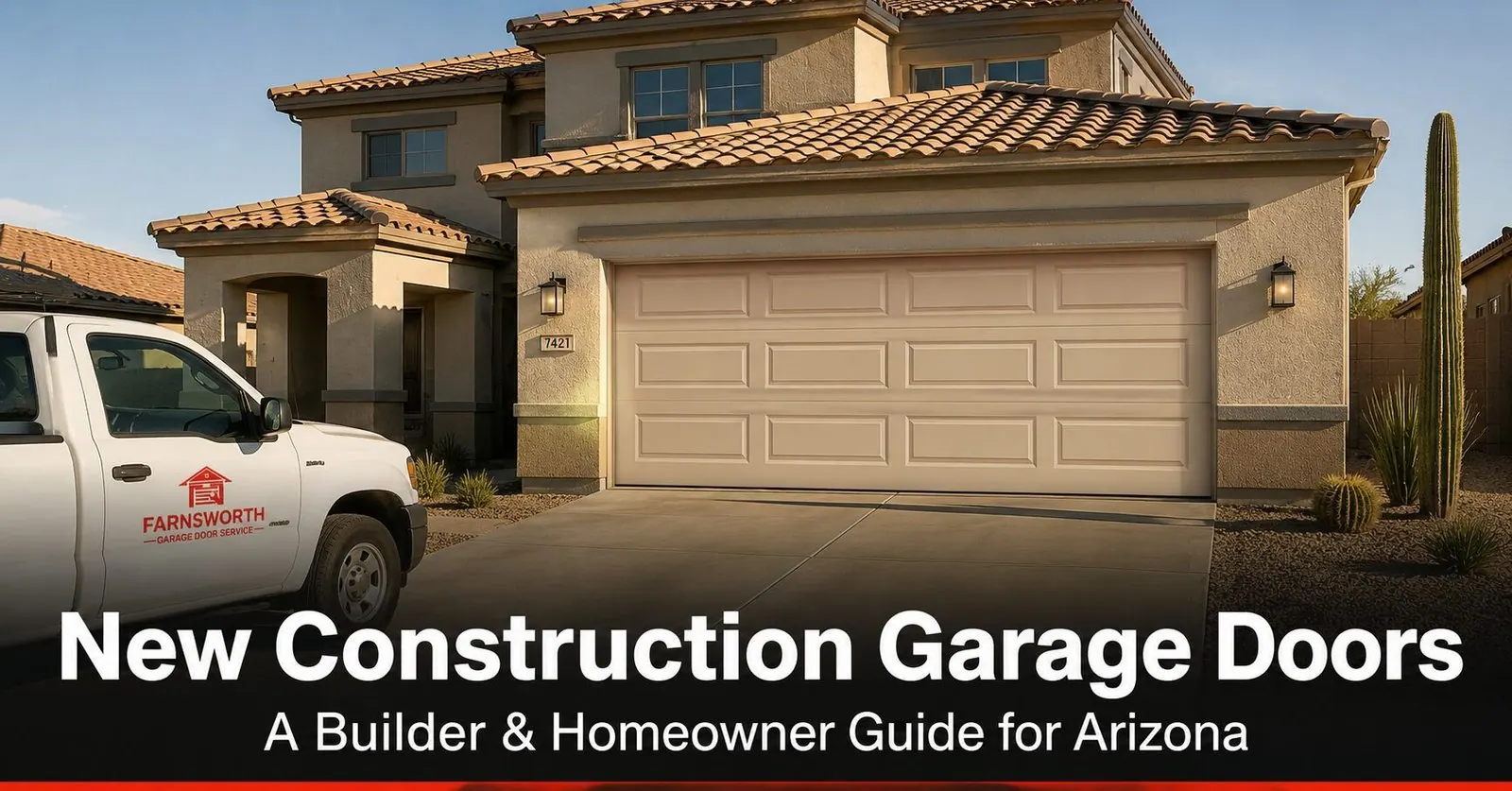
New-construction garage doors in Arizona are almost always builder-grade — solid, reliable doors chosen to hit a price point, not to maximize performance. That's fine, but it leaves a few things on the table that matter in our climate. Here's the short version:
- The door goes in over two phases — a rough-in during framing, then a finish-out once the home is nearly done.
- Get a first-year check. A new home settles, and the door's first Phoenix-area summer tells you whether the builder's finish-out was dialed in.
- The biggest upgrade in our heat is insulation — especially on an attached, west- or south-facing garage.
- Builders: the partner you want is on-time, communicates, and offers spec flexibility, so a door never holds up a certificate of occupancy.
Whether you just moved into a new build in Mesa, Queen Creek, or Gilbert — or you build them — this guide walks the whole picture, from rough opening to the upgrades worth making.
The Phoenix area is one of the fastest-growing housing markets in the country, and its eastern suburbs are at the center of it. Drive through Queen Creek, San Tan Valley, Gilbert, or Maricopa and you'll pass subdivision after subdivision of brand-new stucco homes — each one with a fresh garage door that nobody thought much about during the build. That door is the largest moving part of the house and one of its biggest single openings, yet on a new home it's usually the most overlooked. This guide fixes that. If you just bought a new build, you'll learn what you actually got, what to watch in the first year, and which upgrades are worth it in our desert. If you're a builder, you'll see what separates a garage door partner who keeps your timelines from one who blows them. Either way, we're writing from what we see in driveways across Mesa and the surrounding area every week.
What "Builder-Grade" Really Means
"Builder-grade" gets thrown around like an insult, but it isn't one. It simply means the door was specified to meet a builder's cost and quality target rather than to chase top performance. A builder is putting up dozens or hundreds of homes, and every component has a spec — a minimum standard the door has to meet so the home pencils out and passes inspection. The garage door spec on a typical Arizona build looks something like this: a standard sectional steel door, a basic insulation level to satisfy energy code, a half-horsepower chain or belt opener with photo-eye safety sensors, and a stock white or tan finish with no decorative hardware.
That's a perfectly good door. It will open and close for years. What it is not is optimized for the things that matter most in the desert — a high insulation tier, a quiet or smart opener, heavy-duty weather seals, or a higher-cycle spring. Those are usually left as upgrades, not included by default. So the honest way to think about a new-build door is this: you got a reliable baseline, and the question is whether the baseline fits how you'll use this garage for the next ten or twenty years.
How a New-Construction Garage Door Actually Gets Installed
Here's something most homeowners never see: your garage door went in over two separate visits, weeks or months apart, because the house was still being built around it. Understanding this two-phase process explains a lot — including why a brand-new door can still need a balance check in its first year.
| Phase | When it happens | What gets done |
|---|---|---|
| Phase 1 — Rough-in | During framing, before drywall | Framing crew leaves a finished rough opening sized to the door; the electrician runs 120V power to the ceiling for the opener and a wall outlet within reach of center. |
| Phase 2 — Finish-out | Near completion — after drywall, paint, and the concrete floor is poured | Installer hangs the sections, sets the vertical and horizontal tracks, winds the torsion spring, mounts and programs the opener, installs weather seals, balances the door, and runs the safety reverse test. |
The rough opening is the foundation of the whole job. If the framers size it correctly — level floor, plumb jambs, enough side room and headroom for the tracks and spring — the finish-out goes smoothly. If they don't, the installer has to compensate, and that's where a new door can end up slightly out of balance or running a little rough from day one. A good installer catches and corrects these issues during finish-out, but on a fast-moving build with a hard certificate-of-occupancy deadline, small things can slip through. None of this means your door is bad — it means the first tune-up is genuinely worthwhile, which we'll get to.
If you're building or doing a major addition and want the door done right from rough opening to final balance, that's exactly what our garage door installation service covers.
5 Things to Watch in Your First Arizona Year
The first year in a new home is when the door tells you the truth. The house settles, the seasons turn over once, and the door survives its first real desert summer. Keep an eye on these five things — not because anything is wrong, but because catching small issues early is what keeps a builder-grade door running like a premium one.
The first summer's heat
A new door's first July is a stress test. Thin builder-grade panels can flex visibly — installers call it "oil-canning" — under 150-degree surface temperatures, and a minimally insulated door lets that heat pour into the garage and the wall it shares with your living space. If your garage feels like an oven by mid-afternoon, the door is a big reason why. That's the cue to think about an insulation upgrade.
Settling and balance
New homes settle in their first year, and the garage opening can shift a hair as the slab and framing find their final position. If the door starts to feel heavier, pulls to one side, or doesn't hold its position when you stop it halfway, the balance has drifted. A balanced door is the single most important thing for the lifespan of your springs and opener — an unbalanced one wears both out early.
Dust on the rollers and seals
Desert dust is relentless, and it works its way into every moving part. Builder-grade rollers and hinges ship with minimal lubrication, and dry, gritty conditions chew through it fast. A door that's getting louder or rougher in its first months usually just needs cleaning and proper lubrication — but ignored, that grit accelerates wear.
The first monsoon
Arizona's summer storms drive rain, dust, and debris sideways into the bottom and side seals. Builder-grade weather seals are basic, and the first monsoon season shows whether they're actually keeping water and grit out. If you find a dust line or a puddle inside the door after a storm, the seals are the fix — an inexpensive one that protects everything behind them.
The opener's noise and habits
That basic half-horsepower chain opener is loud, and on an attached garage with a bedroom above or beside it, you'll notice. The first year is also when you learn the door's quirks — whether the safety sensors need realignment, whether the remote range is short, whether you wish you could check the door from your phone. None of these are emergencies, but they're worth noting before the door is "just how it is."
When the Builder's Door Needs Its First Service
The most common question we hear from new-build owners is some version of "it's brand new — why would it need service already?" The answer is that "new" and "dialed in" aren't the same thing. The door was installed fast, under deadline, by a crew that may have hung a dozen doors that week. It then went through its first settling and its first desert summer. A first-year service visit is simply the moment to confirm everything is right before small issues become real ones.
A good rule of thumb: have the door checked around the one-year mark, or sooner if you notice new noise, a heavier door, a pull to one side, or the opener straining. A first tune-up is quick and inexpensive, and it covers:
- Balance test — disconnect the opener and confirm the door holds its position by spring tension alone.
- Spring and cable inspection — check for early wear, proper tension, and correct sizing for the door's weight.
- Lubrication — rollers, hinges, springs, and bearings, with a product that holds up to dust and dry heat.
- Hardware check — tighten the bolts and brackets that a fast finish-out may have left a turn short.
- Safety sensor & reverse test — confirm the door reverses on contact and the photo-eyes are aligned.
- Seal & weatherstrip review — especially relevant after the first monsoon.
Think of it as the same logic as a new car's first oil change: the vehicle works fine, but the early check catches anything that needs attention while it's cheap to fix. Our garage door tune-up is built around exactly this, and it's a smart habit to repeat annually given what our climate does to a door.
Upgrades Worth Making on a New Build
A new home is the natural moment to decide whether the builder's baseline fits your life — ideally before the builder orders the door, when an upgrade is cheapest, but a new build is also a fine time to upgrade after move-in. Here are the changes that earn their keep in the Phoenix area, in rough order of how often we'd recommend them.
| Upgrade | What it does | Best for |
|---|---|---|
| Better insulation | Steps the door up from minimal to a polyurethane-insulated core, dramatically slowing heat transfer into the garage and the shared wall. | Attached garages and any door facing west or south — the highest-value upgrade in our heat. |
| Quieter opener | Swaps the loud chain drive for a belt-drive or wall-mount (jackshaft) unit that runs much quieter and frees up ceiling space. | Homes where a bedroom or living room sits above or beside the garage. |
| Smart control | Adds phone control, open/close alerts, and integration with the smart-home systems new AZ homes increasingly include. | Anyone who wants to confirm the door is closed from anywhere, or who forgets to shut it. |
| Higher-cycle springs | Replaces standard ~10,000-cycle springs with 25,000- or 50,000-cycle springs for far longer service life. | Busy households that use the garage as the main entrance several times a day. |
| Heavier weather seals | Upgrades the basic bottom and side seals to keep desert dust, monsoon water, and pests out more effectively. | Every Arizona garage — the cheapest upgrade with an outsized payoff. |
Of these, insulation is the one we point to most. On an attached, sun-facing garage it changes how the whole back of the house feels in summer and eases the load on your AC during the worst part of the afternoon. If you're choosing a door brand at the same time, our Clopay garage door options page is a good place to see insulated styles that suit Arizona homes.
For Builders: Choosing a Local Garage Door Partner
If you build homes in the Phoenix area, your garage door subcontractor affects something you care about a lot: whether a finished home is ready for its certificate of occupancy on schedule. A door that shows up late, fails a balance or safety check, or needs a callback can stall a closing. So the partner you want isn't just the lowest bid — it's the one who makes your timelines and your finished product predictable.
Here's what actually matters when you're evaluating a garage door installer for new construction:
- On-time, every time. They understand the two-phase timeline, schedule the finish-out only when the home is truly ready, and don't make the door the reason a closing slips.
- Proactive communication. Appointments confirmed ahead, a heads-up if anything changes, and one point of contact instead of a runaround.
- Spec flexibility. Entry, mid, and premium packages so you can match each community's price point — and offer buyers real upgrade options on insulation and openers.
- Licensed and insured in Arizona. Properly licensed, insured, and accountable for the work — no shortcuts that come back as warranty headaches.
- Built to last past the sale. Every door installed is a future service customer, so the right partner has every reason to do it right the first time — and to take care of your buyers after they move in.
A local, owner-run company in the Mesa and Phoenix area can often coordinate tighter than a national chain, because the people scheduling the work are the people accountable for it. We work with builders across the area on exactly this basis — and you can see where we cover on our service areas page.
Why Phoenix-Area Homeowners and Builders Call Farnsworth
Farnsworth Garage Door Service was founded by brothers Brigham and Riley Farnsworth. The Farnsworth name has 60+ years of family business across Mesa and the East Valley behind it — R&K, Farnsworth Wholesale, Farnsworth Realty — and we run this company the way our family has always run a business: tell the truth, put the price in writing, do the work right the first time.
- We work both sides of new construction — builders who need reliable, on-time installs, and homeowners who just moved in and want their door dialed in.
- We measure before we recommend. Your opening, sun exposure, and shared-wall layout decide the right door — not a one-size pitch.
- Clopay, Amarr, CHI, and Wayne Dalton across steel, faux-wood, and insulated lines — not locked into one brand.
- Everything in writing. Steel gauge, R-value, spring cycle rating, and price — before you decide.
- Same-day service is our standard, often within hours of your call.
- 5.0 stars on Google. Our neighbors keep us busy by telling theirs.
Just moved into a new build, or building them yourself? See our garage door installation page, book a first-year tune-up, or check where we work across the Phoenix area.
Frequently Asked Questions
What does "builder-grade garage door" mean?
A builder-grade garage door is a door specified to hit a builder's cost and quality target rather than to maximize performance. On a typical Arizona new build that usually means a standard sectional steel door, a basic insulation level, a half-horsepower chain or belt opener, and stock white or tan color with no decorative hardware or smart features. Builder-grade is not a defect — these are solid, reliable doors that pass inspection and work for years. It simply means the door was chosen to a price point, so the things that matter most in our climate, like a higher insulation tier, a quieter or smart opener, and heavier weather seals, are often left as upgrades rather than included by default.
How is a garage door installed in a new construction home?
New-construction garage doors go in over two visits because the home is still being built. In the rough-in phase, the framing crew leaves a finished rough opening sized to the door, and the electrician runs power to the ceiling for the opener. Once the home is far enough along — drywall, paint, and concrete floor poured — the door installer returns for the finish-out: hanging the sections, installing the tracks, winding the torsion spring, mounting and programming the opener, and setting the weather seals. The installer balances the door, runs the safety reverse test, and walks the timeline so it doesn't hold up the certificate of occupancy. As a homeowner you usually only see the finished result, but knowing it's a two-stage job explains why a brand-new door can still need a balance check and tune-up in its first year.
When does a new construction garage door need its first service?
A good rule of thumb in Arizona is to have your builder's door checked around the one-year mark, or sooner if you hear new noise, feel the door pull to one side, or notice it straining to open. The first year is when a new home settles, when the door survives its first brutal Phoenix-area summer, and when builder-grade hardware shows whether it was torqued and balanced correctly during a busy finish-out. A first-year tune-up — lubrication, balance check, spring and cable inspection, and a safety-sensor test — is inexpensive insurance that catches small issues while they're still small. It's also the moment to ask whether the seals and insulation the builder installed are right for your sun exposure.
Are new construction garage doors insulated for Arizona heat?
Sometimes, but usually at the minimum level. Many Arizona builders spec a basic insulated door to meet energy code, which is better than a bare single-skin door but well short of the polyurethane-insulated tier that actually moves the needle against 150-degree door surfaces. If your garage is attached and shares a wall with a bedroom or living room, or if the door faces west or south, upgrading to a higher insulation tier is one of the most worthwhile changes you can make on a new home. You can request it before the builder orders the door, or replace the door later — but it's far cheaper and simpler to spec the better door up front than to swap a barely-used one a year in.
How long do builder-grade garage door springs last?
Most builder-grade torsion springs are rated for about 10,000 cycles. A cycle is one full open and close, so an average family that uses the door three to five times a day reaches 10,000 cycles in roughly five to seven years. A busier household — kids, two cars, the garage as the main entrance — can get there in three or four. The spring isn't defective when it breaks; it simply hit the end of its rated life. If you want longer service intervals, ask about upgrading to a higher-cycle spring (25,000 or even 50,000 cycles) when the original eventually needs replacing, or at the time of a new install. In the desert, the spring also benefits from annual lubrication because dust and dry air are hard on it.
Should I upgrade my new home's garage door opener?
It depends on what the builder installed and how you live. Many new homes come with a basic half-horsepower chain-drive opener, which is functional but loud — and on an attached garage, that noise carries straight into the bedroom above or beside it. If quiet matters, a belt-drive or wall-mount (jackshaft) opener is a noticeable improvement. If you want to open and close from your phone, get alerts when the door is left up, or integrate with the smart-home system new Arizona homes increasingly ship with, a smart opener or add-on controller is worth considering. None of this is urgent — the builder's opener will work — but a new home is the natural moment to decide whether the default unit fits how you'll actually use the garage for the next decade.
Do garage door warranties transfer to the homeowner from the builder?
Usually the manufacturer's door and opener warranties stay with the home and pass to you as the new owner, while the installer's labor warranty and the builder's overall home warranty are separate. The catch is paperwork: warranty terms vary by manufacturer and many are tied to proper installation and maintenance. When you move into a new build, find the door and opener model numbers (often on a sticker inside the top section and on the opener motor), keep the documents the builder hands over, and note who installed it. If you can't find that information, a first-year service visit is a good time to document the door's specs and confirm what coverage you actually have.
We're a builder — how do we choose a local garage door installer in the Phoenix area?
Builders care about three things from a garage door partner: on-time delivery so a door never holds up the certificate of occupancy, consistent quality so finished homes pass inspection, and one reliable point of contact instead of a runaround. Look for an installer who understands the two-phase new-construction timeline, confirms appointments and communicates proactively about schedule, offers spec flexibility across entry, mid, and premium packages so you can match each home's price point, and is licensed and insured in Arizona. A local, owner-run company in the Mesa and Phoenix area can often coordinate tighter than a national chain — and because every door installed is a future service customer, the right partner has every reason to do it right the first time. Farnsworth works with builders across the area on exactly this basis.

New Build? Let's Get the Door Right.
Licensed, insured, locally owned. Whether you just moved into a new home and want a first-year check, or you build homes and need a garage door partner who keeps your timelines, we'll measure, recommend, and put it all in writing. Same-day service is our standard, often within hours of your call.