
How Often Should You Service a Garage Door in Arizona's Heat?
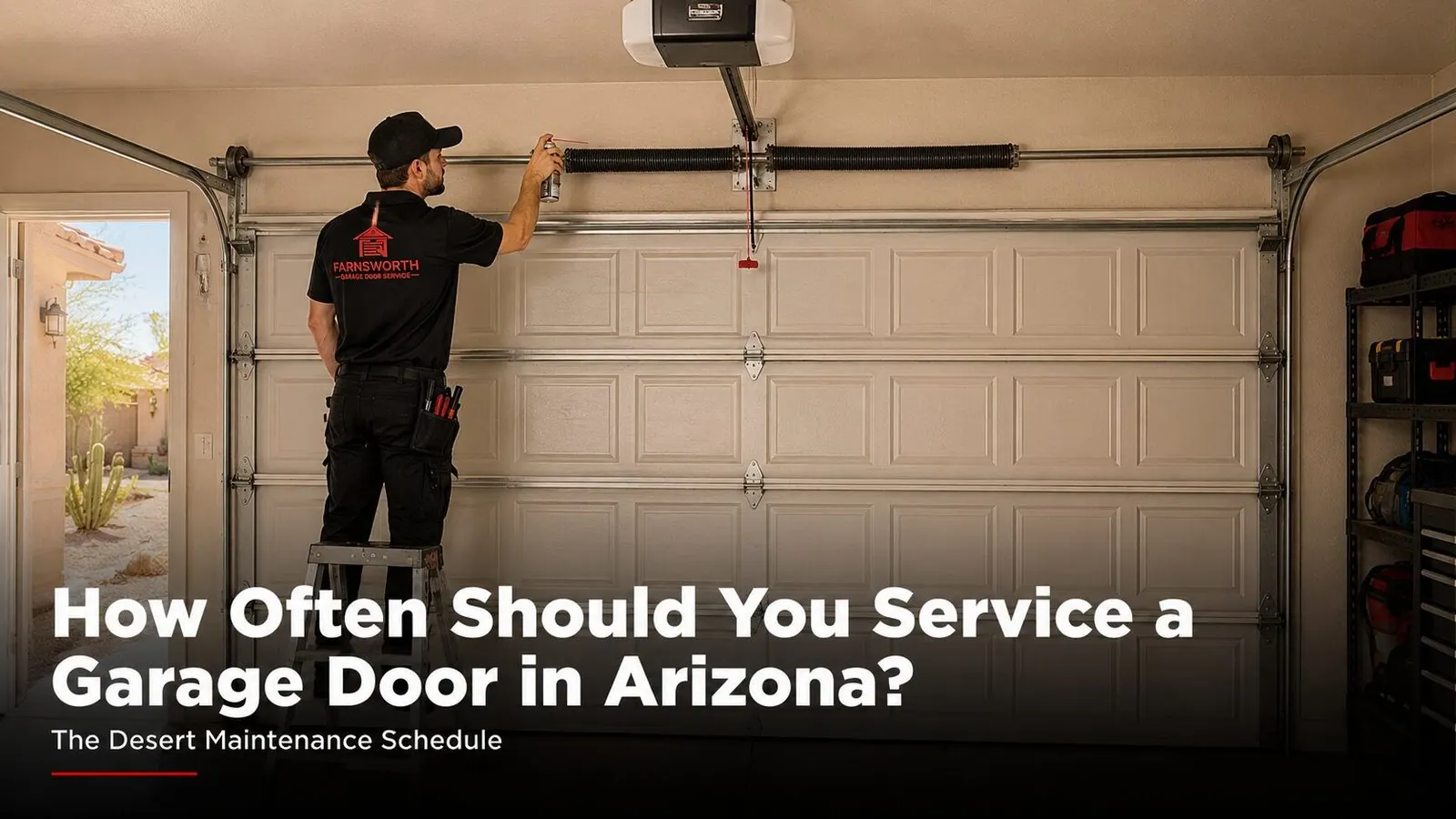
Once a year at minimum — twice a year for most Arizona doors that earn their keep. Schedule two visits (late spring and early fall) if any of these apply:
- The garage door is your home's main entrance (it is for most Valley families)
- It cycles 4+ times a day
- The garage faces west into the afternoon sun
- The door or opener is 10+ years old
In between, lubricate the springs, hinges, and roller bearings two to three times a year with a garage-door-rated lubricant — Arizona heat thins grease and desert dust soaks it up faster than the national advice assumes.
The standard national advice says a garage door needs professional service once a year. That advice was not written in a Mesa garage in July. Here, the door lives in a room that can pass 120°F by mid-afternoon, gets sandblasted by fine desert dust year-round, and takes a monsoon beating every summer — all while working as the real front door for most households. This guide covers the service schedule we actually recommend to neighbors across Mesa, Gilbert, and Queen Creek, what a proper tune-up includes, and the simple checks you can do yourself between visits.
Why Arizona Doors Age Faster Than the National Schedule
Three things separate a Phoenix-area garage door from one in a milder climate, and all three compress the maintenance calendar.
Heat works the metal. A closed garage here swings from comfortable at dawn to well over 120°F by late afternoon, every day, all summer. Steel springs expand and contract with each swing, adding fatigue on top of normal cycle wear, and the heat thins lubricant until parts that were greased in March are running dry by July. West-facing garages get the worst of it.
Dust never stops. Fine desert dust settles into spring coils, roller bearings, and hinge pivots, where it soaks up lubricant and acts like a mild abrasive. It's the reason a door that sounded smooth in spring can grind by fall — and why our lubrication advice runs more frequent than the national rule of thumb.
Monsoon season stress-tests everything. Wind loading flexes the door in its tracks, driven rain finds every tired seal, and power surges pick off aging opener logic boards. A door that goes into monsoon season already loose, dry, or out of balance comes out of it worse.
None of this means Arizona doors are doomed — the same door that fails early when neglected can reach its full rated life here with regular care. It just means "once a year, maybe" is a milder climate's schedule, not ours.
The Cycle Math: How Fast Your Door Is Actually Aging
Here's the number most homeowners never hear: in the trade, the service interval isn't really "once a year" — it's every 12 months or roughly 1,500 cycles, whichever comes first. A cycle is one full open-and-close, and once you count yours, the calendar advice suddenly gets personal.
Think through a normal Valley weekday: two cars out in the morning, two back in the evening — that's four cycles before you count the kids' bikes, the trash cans, the dog, or the Saturday projects. Standard torsion springs are rated around 10,000 cycles, and the math runs like this:
| Door cycles per day | Cycles per year | 10,000-cycle springs last about | Service cadence |
|---|---|---|---|
| 2 — light use, door is a backup entrance | ~730 | ~13 years | Once a year |
| 4 — typical two-car household | ~1,460 | ~7 years | Twice a year — you hit 1,500 cycles annually |
| 6 — door is the main entrance, kids coming and going | ~2,190 | ~4.5 years | Twice a year |
| 8+ — busy household or home business | ~2,900+ | ~3.5 years | Twice a year, plus quarterly lubrication |
Two things jump out of that table. First, the "average" Arizona family blows past the 1,500-cycle service interval every single year — which is why we tell most Mesa and Gilbert households that twice-a-year service isn't gold-plating, it's just matching the maintenance to the mileage. Second, spring lifespan is shorter than most people assume, and those estimates are before the desert's heat-fatigue discount. If your springs are on their fifth or sixth Arizona summer at family-level usage, the pre-failure years are exactly when balance checks and lubrication earn their keep — and when it's worth asking about high-cycle springs at your next visit.
What a Real Service Visit Includes
"Service" should mean more than a squirt of spray lube and a handshake. A professional garage door tune-up works through five stages:
Inspect. Springs (rust, cracks, uneven coil spacing), cables and drums (fraying, loose set screws), rollers, hinges, tracks, bottom brackets, weatherstripping, and the opener's drive system.
Lubricate. Springs, hinge pivots, roller bearings, and the lock with a garage-door-rated lubricant — never WD-40, and never inside the tracks, where lubricant just collects dust.
Adjust. Spring tension via a balance test, plus the opener's force settings and travel limits, which drift over time.
Safety-test. Photo-eye sensor alignment, the auto-reverse test, and the manual release.
Report. A written summary of what was checked, what was corrected, and anything worth watching before next time — so you're never guessing about the door's condition.
The balance test is the piece homeowners underestimate. The springs — not the opener — carry the door's weight, and when tension drifts, the opener quietly picks up the difference on every cycle. Catching that early is how a tune-up protects the most expensive components: the springs and the motor.
And what do these visits actually turn up? On Phoenix-area doors, the same handful of findings come back again and again: spring coils running bone-dry months after their last lubrication, opener force settings that drifted as the door got heavier, hinge and bracket bolts vibrated loose by thousands of cycles, bottom seals baked stiff and cracked by the concrete heat, and builder-grade springs on newer homes sized to the bare minimum for the door's weight. Every one of those is a small line item on a tune-up — and a much bigger one once it fails.
Your Schedule, by Situation
| Your situation | Professional service | Why |
|---|---|---|
| Light use, newer door (a few cycles a day) | Once a year | Annual visit keeps lubrication, balance, and safety systems on track. |
| Door is the main entrance / 4+ cycles a day | Twice a year (spring + fall) | Heavy use doubles cycle wear; most Valley families are in this row. |
| West-facing garage or door 10+ years old | Twice a year | Peak heat exposure and aging parts deserve a pre-summer and post-summer check. |
| Rental or frequently unoccupied property | Once a year + at each turnover | Tenants rarely report early warning signs; catch issues between occupants. |
| Snowbird home, empty all summer | Before you leave, check on return | A door that sits unused through the hottest months needs eyes on it both ends. |
A Year in the Life of an Arizona Garage Door
Most maintenance calendars are written for places with a real winter. Arizona's door year looks different — and it contains one surprise that catches almost every homeowner off guard.
- March–May: the prime tune-up window. Mild weather, and the last chance to get lubrication, balance, and opener settings squared away before the door's four hardest months.
- June: lubricate and prep for monsoon. Heat is already thinning whatever grease is on the springs, and monsoon wind, rain, and power surges are weeks away. Fresh lubricant, seal check, and a surge protector on the opener outlet.
- July–August: watch, don't wrench. Peak heat is when openers act up — thermal cutouts trip on long cycles, belts and chains expand, and surge-damaged boards show themselves. Pay attention to new noises and hesitation; this is the season problems announce themselves.
- September–October: the recovery visit. The best-kept secret in door maintenance here. A post-summer service catches what the heat did — dried coils, drifted settings, baked seals — while it's still minor. If you only book one visit a year, fall is a strong choice.
- November–February: broken-spring season. Here's the surprise: summer fatigues Arizona springs, but winter breaks them. Steel contracts on our cold desert mornings, and a spring that summer heat-cycled all year snaps on a 38°F January dawn — usually on the first cycle of the day, with the car inside. It's the busiest broken-spring stretch of our year, and it's exactly what the fall visit exists to prevent.
What You Can Do Between Visits
You don't need a technician for everything. Three habits keep an Arizona door healthy between professional visits:
Monthly: look and listen. Stand in the garage and run the door through a full cycle. New grinding, scraping, popping, jerky movement, or a door that hesitates is the machine asking for attention early, while the fix is still small.
Two to three times a year: lubricate. A garage-door-rated lubricant or white lithium grease on the springs, hinge pivot pins, and roller bearings. Wipe the excess so dust has less to cling to, and leave the track interiors dry.
Twice a year: safety checks. With the door closed, pull the red release cord and lift the door by hand to about waist height — a balanced door stays roughly where you leave it; a door that slams down or shoots up needs professional spring adjustment. Reconnect the opener, then test the photo-eyes by waving a broom through the beam while the door closes: it should reverse immediately.
When Not to Wait for the Calendar
A schedule is for healthy doors. Skip straight to a service call if you notice a door that's suddenly loud or shaking in the tracks, a door that hangs crooked or moves slower than it used to, fraying cables, a visible gap in a spring coil, or an opener that strains, hums, or reverses for no reason — that last one is often the door's balance or the opener asking for help. Every one of these costs less to fix this week than next month.
Can't remember the last time your door was serviced? That's the sign. Call or text (602) 935-9766.Why Neighbors Trust Farnsworth With Their Tune-Ups
Farnsworth Garage Door Service was founded by brothers Brigham and Riley Farnsworth. The Farnsworth name carries 60+ years of family business across Mesa and the East Valley — R&K, Farnsworth Wholesale, Farnsworth Realty — and we run this company the same way: tell the truth, put it in writing, fix it right the first time.
- A real inspection, not a drive-by. Every tune-up covers springs, cables, drums, rollers, hinges, tracks, seals, opener, and safety systems — and you get the findings in writing.
- Honest recommendations. If everything checks out, that's what the report says. We'd rather tell you your door is healthy than invent work.
- Desert-tuned advice. We service doors in Mesa, Gilbert, Chandler, Queen Creek, and across the Phoenix area — our schedule recommendations come from what Arizona heat and dust actually do to doors, not a national brochure.
- Same-day service is our standard, often within hours of your call, when something does need fixing.
- 5.0 stars on Google from homeowners who got straight answers and a door that runs quieter than it has in years.
Frequently Asked Questions
How often should a garage door be serviced in Arizona?
Once a year at minimum, and twice a year if the garage door is your home's main entrance, cycles four or more times a day, faces west into the afternoon sun, or is more than ten years old. Arizona's extreme garage heat, fine desert dust, and monsoon swings wear springs, rollers, and openers faster than the national once-a-year guidance assumes, so many Phoenix-area doors do best on a spring and early-fall schedule.
What does a professional garage door tune-up include?
A proper tune-up covers five things: a full inspection of springs, cables, drums, rollers, hinges, tracks, weatherstripping, and the opener; lubrication of springs, hinges, roller bearings, and the lock with a garage-door-rated lubricant; adjustment of spring tension, opener force, and travel limits; safety testing of the photo-eye sensors, auto-reverse, and manual release; and a written report of what was found, fixed, and worth watching. If a visit skips the balance test or the safety checks, it wasn't a real tune-up.
How often should I lubricate my garage door in Arizona?
Two to three times a year — more often than the twice-a-year rule of thumb used in milder climates, because summer heat thins lubricant and desert dust absorbs it. Use a garage-door-rated lubricant or white lithium grease on the springs, hinge pivots, and roller bearings, and skip WD-40, which is a solvent that strips grease rather than replacing it. Leave the inside of the tracks dry — lubricant there just collects dust and gums up the rollers.
Does regular service really make a garage door last longer?
Yes, measurably. Springs are rated in open-close cycles, and a dry, corroded spring works harder on every cycle — regular lubrication and balance adjustments are the difference between springs that fail early and springs that reach their full rated life. The same goes for the opener: a balanced door feels nearly weightless to the motor, while an out-of-balance door forces the opener to lift real weight on every cycle, which is one of the most common reasons openers die young in Arizona.
What time of year is best for garage door service in Arizona?
The two best windows are late spring, before the extreme heat arrives, and early fall, after the summer has done its damage. A pre-summer visit makes sure lubrication, balance, and the opener are ready for the hardest months, and it doubles as monsoon prep. A fall visit catches the wear that a brutal Arizona summer leaves behind — dried-out lubricant, drifted opener settings, and seals baked stiff. If you only service once a year, either window works; just keep it consistent.
What happens if I never service my garage door?
The door usually keeps working right up until it doesn't — and the failure is rarely convenient. Dry springs corrode and snap early, often trapping a car in the garage. An unbalanced door quietly overworks the opener until the motor or drive gear gives out. Loose hardware turns into wobbling rollers, then a door that jumps its tracks. Almost every emergency call we run in Mesa, Gilbert, and Queen Creek started as a small, inexpensive item that a routine service visit would have caught.
Does a newer garage door really need a tune-up?
Yes — the first year matters more than most homeowners expect, especially on new builds. Houses settle, and builder-grade doors often ship with entry-level hardware and springs sized to the bare minimum. A first-year service visit confirms the door is still balanced after settling, tightens hardware that vibrates loose in the first few thousand cycles, and catches installation shortcuts while the door is still young. From there, an annual schedule keeps the warranty conversation simple and the door out of trouble.
Why do garage door springs break in winter if summer does the damage?
Because heat and cold play different roles. Arizona's summer fatigues the steel — months of daily expansion-contraction cycles in a 120°F-plus garage work the metal and seed micro-cracks. Then a cold desert morning arrives, the steel contracts, and a spring that was quietly running out of cycles snaps — usually on the first opening of the day. November through February is the busiest broken-spring stretch of the Arizona year, which is why a fall service visit that inspects and lubricates the springs is the single best-timed appointment on the calendar.

Put Your Door on a Schedule — and Off Your Mind.
Licensed, insured, locally owned. One visit covers the full inspection, lubrication, balance adjustment, and safety tests — with everything documented in writing. Same-day service is our standard, often within hours of your call.