
Garage Door Lock and Security Upgrades Every Arizona Homeowner Should Consider
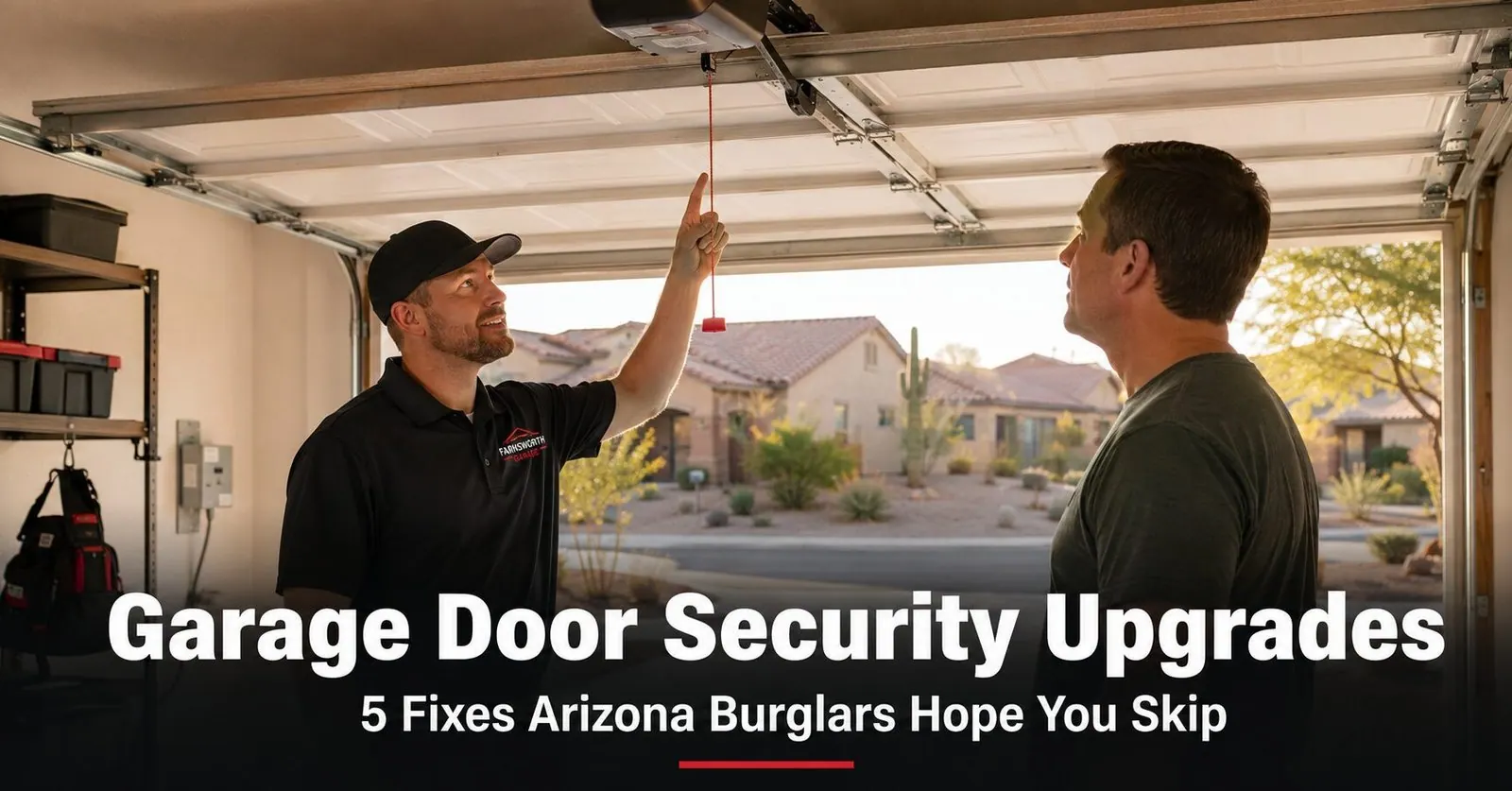
Five upgrades cover the vast majority of garage break-in risks:
- Guard the emergency release so it can't be "fished" from outside through the top gap.
- Modernize the opener — rolling-code security, a lockout-protected keypad, and the built-in vacation lock.
- Deadbolt the door into the house — the single most-skipped lock in the home.
- Reinforce weak points — damaged bottom panels and, for detached garages, a proper manual lock.
- Add smart monitoring so your phone knows the moment the door opens — or gets left open.
Most of these take a technician minutes to install, and several can be added during any regular service visit.
Homeowners across Mesa, Gilbert, and Queen Creek put real thought into front-door locks, cameras, and alarm systems — and then leave the biggest moving wall of the house on factory settings. Roughly 30% of burglars come in through the garage or the entry right beside it, and the most common tricks take under a minute. The good news: garage security is one of the cheapest problems in home protection to actually fix. Here are the upgrades we point out to neighbors on service calls, in the order we'd prioritize them.
Why Burglars Like the Garage
Three reasons. First, cover: once someone is inside a garage, the neighborhood can't see them anymore, and they can work on the interior door at their leisure. Second, that interior door is very often unlocked — most families treat the garage door as the lock. Third, the garage door itself has a built-in weakness that most homeowners have never heard of: the emergency release. Add in long Arizona summers when half the street is traveling — and whole snowbird neighborhoods in Fountain Hills and Gold Canyon that sit empty from May to October — and the garage becomes the natural first thing a burglar checks.
None of this is cause for alarm. Every one of these weaknesses has a specific, inexpensive fix.
Upgrade #1: Guard the Emergency Release
Every automatic garage door has a red cord hanging from the opener rail. Pull it, and the door disconnects from the opener so it can be lifted by hand — a life-safety feature for power outages. The problem is who else can pull it. In what's called a fishing attack, someone slides a stiff wire through the small gap at the top of the closed door, hooks that cord, pulls it, and lifts your door open. With the right tool it takes seconds, and it's one of the most common garage break-in methods experienced burglars use.
The fix is a release guard (often sold as a garage door defender or release shield) — a small bracket or shield that blocks the cord from being hooked from outside while leaving it fully usable from inside the garage. It's a quick install, and it closes the single most exploitable gap on the entire door.
Upgrade #2: Bring the Opener's Security Up to Date
Your opener is the electronic lock on the biggest door of your house, and opener security has come a long way.
Rolling code vs. fixed code. Openers made since the mid-1990s use rolling-code technology — LiftMaster's Security+, Genie's Intellicode, Overhead Door's CodeDodger — which generates a brand-new code from billions of possibilities every time you press the remote. Older fixed-code openers broadcast the same short code every time, and inexpensive "code grabber" devices can record and replay it. The tell: if your remote has a row of tiny DIP switches inside the battery cover, you're on fixed code, and the opener deserves replacement for security reasons alone. Our opener replacement service handles the whole swap, remotes and keypad included.
Keypad lockout. Some older wireless keypads will happily accept guess after guess, which makes them vulnerable to simple brute-force attempts. Modern keypads lock out after a few wrong entries. If yours is old enough that you're not sure, it's worth upgrading — and skip birthdays and street numbers when you pick the PIN.
Vacation lock. Most modern wall control panels include a lock button that disables every remote and keypad until you turn it back off. Heading out of town? One press, and a lost or copied remote is useless while you're gone. It's the most underused security feature already sitting in most Valley garages.
Upgrade #3: Deadbolt the Door Into the House
Here's the pattern most garage burglaries follow: get into the garage by any means, then walk through the interior door into the kitchen — because it was never locked. Security people call it the second-door problem, and it's everywhere. That door deserves the same hardware as your front door: a quality deadbolt and a reinforced strike plate with long screws that bite into the framing, not just the trim. It's a modest piece of hardware that turns "into the garage" from game-over into a dead end. If you do nothing else on this list tonight, start locking that door.
Upgrade #4: Manual Locks and Panel Reinforcement
Slide locks and manual locks. A side slide lock bars the door directly to the track — genuine physical security that no electronic trick defeats. They're the right answer for detached garages, storage garages, and doors without an opener. One important caution for automatic doors: if a remote gets pressed while a slide lock is engaged, the opener will try to drive a locked door, which can strip gears or bend the top section. Pair a slide lock with the opener's vacation lock, or ask us about wiring an interlock so the two can't fight each other.
Weak or damaged bottom panels. A dented, rusted, or water-damaged bottom section isn't just cosmetic — it's the spot someone can kick through to reach the release or an inside lock. If a panel is compromised, panel replacement or a steel reinforcement plate restores the door's strength without replacing the whole thing.
Light the approach. Homes with visible security measures are targeted far less often. A motion-activated light over the garage costs little and removes the darkness a burglar needs to work that top gap unseen.
Upgrade #5: Smart Monitoring and Alerts
Every upgrade so far hardens the door. Smart monitoring tells you what the door is doing when you're not looking at it — which matters, because the most common garage security failure isn't a break-in at all. It's the door somebody left standing open all afternoon.
A Wi-Fi-connected opener (or an add-on smart controller for an existing rolling-code opener) sends your phone a notification every time the door opens or closes, shows you its status from anywhere, and can auto-close the door if it's been open too long. Set a rule for alerts during overnight hours and you'll know about an unexpected opening the moment it happens. A camera covering the garage interior or driveway rounds out the picture, and a simple wireless sensor can tie the garage door into an existing alarm system so it's armed along with the rest of the house.
If your current opener is too old to add smart features — or predates rolling code entirely — one opener upgrade solves both problems at once.
Want a second set of eyes on your garage's weak points? Call or text (602) 935-9766 — we'll check them during any service visit.Every Vulnerability and Its Fix, at a Glance
| Vulnerability | How it's exploited | The fix |
|---|---|---|
| Emergency release cord | "Fished" through the top gap with a wire, then the door is lifted by hand | Release guard / garage door defender |
| Fixed-code opener (pre-mid-1990s) | Code grabber records and replays the remote signal | Replace with a rolling-code opener |
| Old keypad without lockout | PIN combinations guessed one after another | Modern keypad with attempt lockout; strong PIN |
| Unlocked garage-to-house door | Once in the garage, walk straight into the home | Deadbolt + reinforced strike plate, used every night |
| Damaged or weak bottom panel | Kicked through to reach the release or locks | Panel replacement or steel reinforcement |
| Remotes active while traveling | Lost or copied remote opens the door while you're away | Vacation lock on the wall console |
| No one watching the door | Door left open — or opened — with nobody the wiser | Smart alerts, auto-close, camera, alarm sensor |
A good way to knock out several of these at once: have them checked during a garage door tune-up. We're already inspecting the door's hardware — adding a security once-over takes minutes.
Why Neighbors Trust Farnsworth With Their Garage
Farnsworth Garage Door Service was founded by brothers Brigham and Riley Farnsworth. The Farnsworth name carries 60+ years of family business across Mesa and the East Valley — R&K, Farnsworth Wholesale, Farnsworth Realty — and we run this company the same way: tell the truth, put it in writing, fix it right the first time.
- Straight talk on what you actually need. Most homes need two or three of these upgrades, not all of them — we'll tell you which, and why.
- Security checks with every job. Ask on any repair or tune-up visit and we'll walk the door's weak points with you before we leave.
- Every major opener brand. LiftMaster, Chamberlain, Genie, Craftsman, Overhead Door — we can tell you in minutes whether yours has rolling code, vacation lock, and smart capability.
- 5.0 stars on Google from homeowners across Mesa, Gilbert, Chandler, Queen Creek, and the greater Phoenix area.
Frequently Asked Questions
Is the garage really a common break-in point?
Yes. Roughly 30% of burglars enter through the garage door or an entry point right next to it, and garage break-ins have been rising nationally for years. The garage is attractive because it offers cover once someone is inside, it often connects directly to the house through an unlocked interior door, and several of its weaknesses — like the emergency release cord — can be exploited in well under a minute by someone who knows what they're doing.
What is a fishing attack on a garage door?
A fishing attack is when someone slides a stiff wire or rod through the small gap at the top of a closed garage door, hooks the red emergency release cord, and pulls it. That disengages the door from the opener so it can be lifted by hand. It works because the release is deliberately easy to reach — it exists so you can open the door during a power outage. A release guard (sometimes sold as a garage door defender) blocks the maneuver without removing the safety function.
Does the zip-tie trick on the emergency release actually work?
Partially. A heavy zip tie through the release mechanism makes the cord harder to pull from outside, and it's better than nothing. But it only slows a fishing attack rather than stopping it, and if it's done wrong it can make the release hard to use in a real emergency — which defeats the reason the release exists. A purpose-built release guard is the proper fix; think of the zip tie as a temporary measure at best.
How do I know if my garage door opener has rolling code security?
Almost every opener manufactured after the mid-1990s uses rolling code technology — LiftMaster and Chamberlain call it Security+, Genie calls it Intellicode, Overhead Door calls it CodeDodger. The quickest check is your remote: if it has a row of tiny switches inside the battery cover, it's an old fixed-code system that can be copied by inexpensive interception devices, and the opener should be replaced on security grounds alone. No switches and a LEARN button on the motor unit generally means rolling code.
What is vacation lock on a garage door opener?
Vacation lock (sometimes just called lock mode) is a feature on most modern wall control panels that disables all remotes and keypads with the press of a button. While it's on, the door only operates from the wall button inside the garage. It's designed for exactly what the name suggests: flip it on before a trip so a lost, stolen, or copied remote can't open your door while you're away, then turn it off when you're home.
Can I use a manual slide lock with an automatic opener?
Only with care. A slide lock physically bars the door to the track, which is excellent security — but if anyone presses a remote while the lock is engaged, the opener will try to drive a locked door and can strip gears, bend the top section, or snap hardware. If you use one, pair it with the opener's vacation lock so remotes are disabled, or have a technician wire an interlock. For most homes, the opener's built-in electronic lock features are the safer everyday choice.
Are smart garage door alerts worth setting up?
For most households, yes. A Wi-Fi opener or add-on smart controller sends your phone a notification whenever the door opens or closes, lets you check its status from anywhere, and can auto-close the door if it's been left open. That covers the two most common real-world problems at once: the door someone forgot to close, and an opening you didn't expect. Many systems also tie into cameras and alarm sensors for a fuller picture of the garage.

Get a Garage Security Once-Over
Licensed, insured, locally owned. Whether it's a release guard, a modern opener, or just an honest read on where your garage stands, we'll walk the weak points with you and put every recommendation in writing — no pressure, no scare tactics. Same-day service is our standard, often within hours of your call.