
Hit Your Garage Door With Your Car? What to Do First, and What Insurance Covers
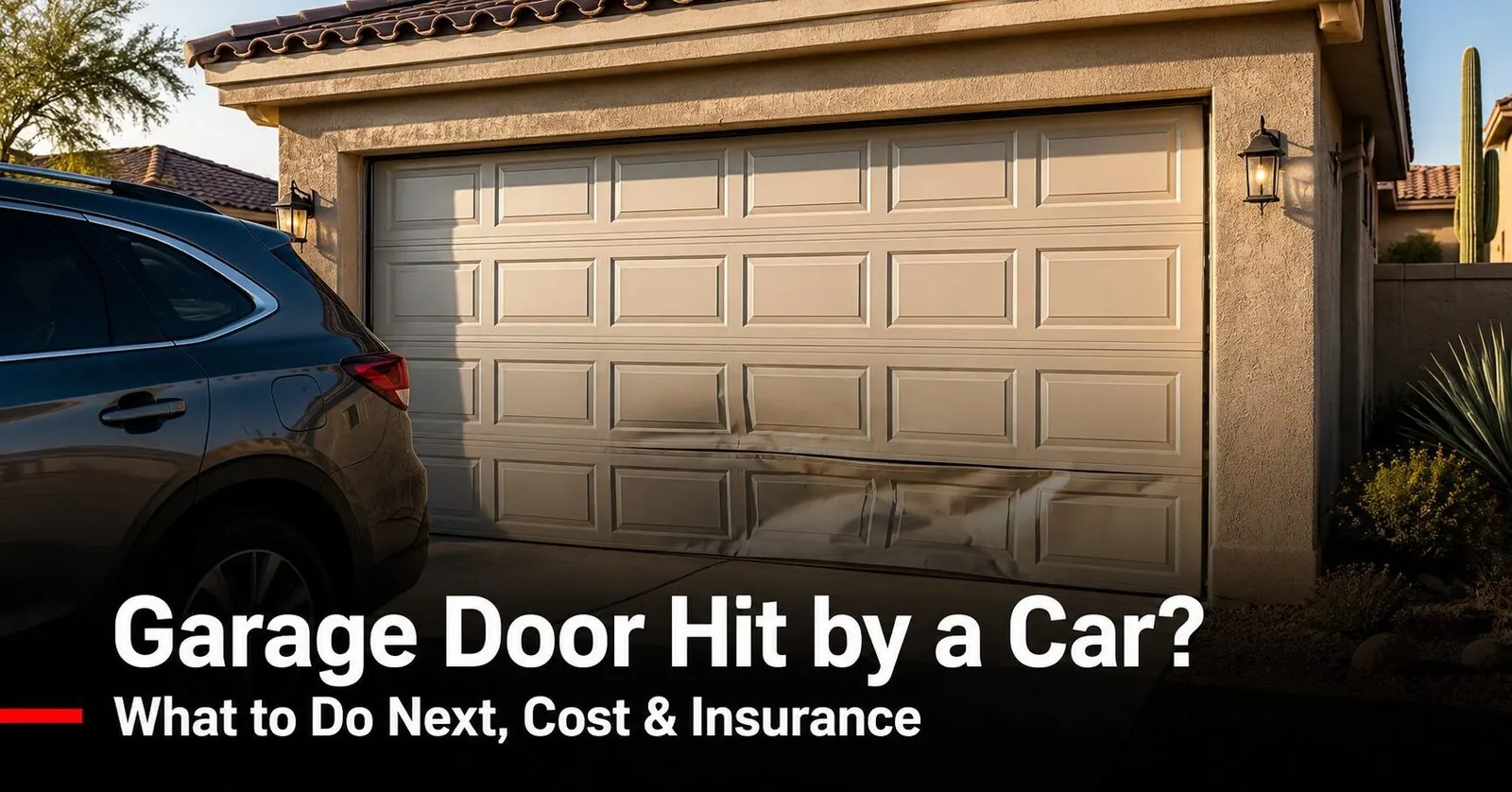
If a car hit your garage door, stop pressing the opener button — running a bent or off-track door is how a small dent becomes a big repair. Here's the short version of what to do next:
- Don't operate the door. Leave it as-is until it's checked. Cables and brackets are under high spring tension and can fail suddenly.
- Take photos from several angles before anything moves — you'll need them for the insurance claim.
- Get the other driver's info if it wasn't your own vehicle.
- Call a technician to assess the door, cables, track, rollers, and opener, and to give you a written quote.
- Then call your insurer. Backing into your own door is usually a homeowners claim for the door and an auto collision claim for the car. If someone else hit it, their auto insurance is usually first in line. Who pays, case by case.
Car trapped inside, or the door stuck open with night coming? Skip to getting a car out or securing a door that won't close, or call or text (602) 935-9766. You can text us a photo of the damage and we'll tell you what we see.
The rest of this guide walks through how bad the damage really is, what drives the cost, and how homeowners and auto insurance handle it here in Arizona.
It happens to good drivers all the time: a quick reverse out of the garage before the door is all the way up, a new teen driver who backs into the door from inside while it's still down, a delivery van that misjudged the turnaround. One bump and suddenly a panel is caved in, the door is sitting crooked, or it won't move at all. If you're standing in your driveway in Mesa, Gilbert, or Queen Creek looking at a dented door right now, take a breath — this is one of the most common calls we get, and it's almost always fixable. What matters most in the first few minutes is what you don't do. This guide covers the right next steps, how to read the damage, what actually determines the repair cost, and how to handle the insurance side so you're not paying out of pocket for something your policy should cover. For anything beyond a cosmetic scuff, our garage door repair team can assess it and tell you straight whether it's a repair or a replacement.
What to Do in the First 10 Minutes
The single biggest mistake after a collision is pressing the wall button or the remote to "see if it still works." A door that's been knocked off its track or had a cable snapped can be dragged into far worse shape by the opener — or come down hard. Here's the order to work through instead.
-
Get the car clear and leave the door alone
Put the vehicle in park and shut it off. Don't try to open or close the door, and don't pull the manual release just to test it yet — if the door is under odd tension, releasing it can let it drop. Just step back.
-
Photograph everything before it moves
Wide shots of the whole door, close-ups of each dent or crack, the tracks, any loose cable, and the vehicle. Timestamped photos are gold for an insurance claim, and they capture the scene before anyone shifts the car. They also help us: text a few to (602) 935-9766 and we can often tell you what to expect before anyone arrives.
-
Exchange information if another driver was involved
If it was a guest, a contractor, a delivery driver, or a neighbor, get their name, phone number, and auto insurance details. That's often the policy that ends up paying for the door.
-
Check whether the garage will still secure
If the door is stuck open and the garage connects to your house, you've got a security and heat problem — an open garage in an Arizona summer bakes everything inside and leaves the home exposed. Note whether it closes at all, but don't force it.
-
Call for an assessment
A technician can tell you in one visit whether it's a quick mechanical fix, a panel order, or a full replacement — and give you the written estimate your insurer will ask for. If the door won't close and the home can't be secured, ask about emergency garage door repair to make the opening safe.
Car Stuck Inside the Garage?
This one comes up more than you'd think. A driver backs into the door from inside while it's still down, the bottom sections fold, and now every car in the garage is trapped behind a door that won't open. It's stressful, especially when someone needs to get to work in the morning. Here's how to keep it from getting worse.
- Don't drive the car through it. Pushing a crumpled door with a bumper bends the tracks and can snap a cable under tension, and it damages the car.
- Don't pull the emergency release and try to heave it up. On a door that's off its track or has a broken cable, the springs may no longer be carrying the weight. A garage door can weigh well over 150 pounds, and a bent one can drop or swing sideways without warning.
- If the opener is still attached, unplug it so nobody hits the button out of habit.
- Take your photos, then call or text us. Depending on the damage, a technician can often free the door, lift it safely, or take a damaged section off so the cars can come out, and then secure the opening.
Door Stuck Open and Won't Close?
The other common version: you catch the bottom of the door on the way in, a couple of rollers pop out of the track, and now the door is stuck open with night coming. The instinct is to push it down by hand. Resist it if the rollers are out of the track, because a door that isn't guided by its tracks can bind halfway and fall crooked.
- Leave the opener off
Running it on an off-track door can pull the whole door out of the opening.
- Lock the door between the garage and the house
If the garage is attached, that's the door that keeps your home secure tonight, even if the garage itself is open.
- Move what you can't afford to lose
Bikes, tools, and anything valuable can go inside the house or into a locked car.
- Get it closed and secured
A technician can usually reset or temporarily secure the door, even when the real repair needs parts. See our emergency garage door repair page, or call or text (602) 935-9766.
An open garage in an Arizona summer also bakes everything inside it, so even a temporary close is worth it while you wait on panels or a new door.
How to Tell How Bad the Damage Really Is
The dent you can see is rarely the whole story. A garage door is a system — sections, tracks, rollers, hinges, cables, springs, and an opener all working together — and a hard enough hit sends force through all of it. The panel is just the part facing the driveway. Here's what a car impact commonly damages, and what each one looks like.
| Component | What a car hit does to it | What you'll notice |
|---|---|---|
| Panels (sections) | Dented, creased, or crushed; can bend the whole section out of plane | Visible dent or buckle; door looks wavy along that row |
| Tracks | Bent or knocked out of alignment so rollers can't run smoothly | Door binds, grinds, or sits crooked in the opening |
| Rollers & hinges | Popped out of the track, bent stems, cracked hinges | A section pulled loose from the track; rattling or a gap |
| Lift cables | Snapped or jumped off the drum when the door racked sideways | A cable hanging loose; one side of the door sagging lower |
| Bottom brackets | Bent — and these are under full cable/spring tension | Hard to spot, high-risk; leave this one for a tech |
| Opener arm & rail | Bent arm, cracked bracket, or a rail knocked out of line | Opener strains, clicks, or won't move the door evenly |
One quick, safe test tells you a lot: with the opener disconnected (only if the door is closed and clearly stable), see whether the door moves smoothly by hand. A door that's hard to lift, binds, or won't budge has a mechanical problem — bent track, broken cable, or off-track rollers — and shouldn't be run on the opener. If anything looks loaded with tension or you're not sure, skip the test and have it checked. Damaged cables and brackets tie directly into the door's spring and cable system, which carries enough force to cause injury when handled wrong.
Is It Safe to Use the Door?
Treat a door that's been hit as unsafe until a professional says otherwise. Here's why that's not an overreaction. The lift cables and bottom brackets on your door hold the same tension that the springs store to make a heavy door feel light. When a car bends a bracket or frays a cable, that tension is now riding on a weakened part — and it can let go without warning. Running the opener on a door that's off-track or missing a cable can pull the door down crooked, jam it hard enough to bend more parts, or strain the opener motor until it fails too.
If the only damage is a shallow cosmetic dent on a door that still opens, closes, and balances normally, it's usually fine to keep using until your repair appointment. When in doubt, the safe move is to stop using it — a door you can't operate for a day is a much smaller problem than a cable that fails while someone's standing under it.
Repair One Panel or Replace the Whole Door?
This is the question every homeowner asks, and the honest answer is "it depends on what we find." But the deciding factors are predictable, so you can get a feel for it before we even arrive.
When a single-panel repair makes sense
If the impact only damaged one section and the rest of the door, tracks, and hardware are sound, replacing that one panel is often the most cost-effective route (see our garage door panel replacement page) — as long as we can match it. Matching depends on your door's brand, model, color, and age. The brand and model are usually printed on a label inside the top section or along the edge of the door; snap a photo of it if you can find it, since it speeds everything up.
When replacing the whole door is the smarter call
A few situations tip the scale toward a full replacement: the hit crushed or creased multiple sections; the tracks, frame, and several rollers are bent; or the door is old enough that the matching panel is discontinued. That last one catches a lot of people — on a door more than roughly ten years old, the exact panel may no longer be made, and even when a similar panel exists, years of Arizona sun have faded the existing sections so a new panel won't color-match. At that point, patching it together costs real money and still leaves you with a mismatched, aging door.
Will a new door match the other doors on a 2- or 3-car garage?
If only one of several doors was hit, matching is the next question. When the same model and color are still made, a new door or section can look very close. The catch is the sun. Doors that have been in Arizona sun for years fade, so a brand-new door or panel can look brighter next to the old ones, even in the "same" color. Your options usually come down to three: match the model and color as closely as possible and accept a slight difference, replace the doors that face the street together so they match each other, or use the claim as the moment to update the whole front. Bring this up when you get the estimate, so the quote and the insurance claim cover the option you actually want. A photo of the label on the inside of the door (brand, model, and color) speeds this up a lot.
There's a silver lining worth knowing: a lot of the doors that get backed into around Mesa, Gilbert, and Chandler are thin, uninsulated, builder-grade units. If insurance is replacing the door anyway, that's the moment to step up to an insulated door that holds up to our heat — you can compare your new garage door installation options and turn an accident into an upgrade.
What Determines the Cost
We don't quote a flat price for "car hit my door" because no two impacts are the same — and a real number requires seeing the door in person. What we can do is be transparent about what moves the cost up or down, so the estimate makes sense when you get it.
- How many sections need replacing. One dented panel is a very different job from three crushed ones.
- Whether your panel is still made. An in-stock current panel is straightforward; a discontinued or custom panel has to be special-ordered to spec.
- Hardware damage. Bent tracks, broken cables, popped rollers, cracked hinges, and bent bottom brackets each add parts and labor.
- Opener damage. A bent arm or cracked bracket may be a simple part; a damaged rail or motor can mean opener repair or replacement.
- Door size, brand, and material. A two-car door, a premium brand, or a faux-wood or full-view door costs more to match than a basic single-car steel door.
- Repair vs. full replacement. Sometimes a replacement is close enough in price to a multi-panel repair that it's the better value.
Does Insurance Cover Backing Into Your Own Garage Door?
Usually, yes. If you back into your own attached garage door, the door is normally a homeowners claim under your dwelling coverage, and the damage to your car goes on your auto collision coverage. Each one has its own deductible, so a small repair may cost less than filing. If someone else hit the door, their auto insurance is usually the first place to go.
In general, a car hitting a garage door is one of the more straightforward claims out there. The wrinkle is figuring out which policy pays, because that depends on who was driving and what got damaged. Here's the general lay of the land.
| Situation | Policy that usually applies | Good to know |
|---|---|---|
| You hit your own attached garage door | Homeowners (dwelling) for the door; auto collision for your car | Both are subject to their own deductibles |
| You hit your own detached garage door | Homeowners (other-structures coverage) | Detached garages fall under a separate part of the policy |
| Your teen or another driver in your household hit it | Same as hitting it yourself: homeowners for the door, your auto policy for the car | Tell your agent who was driving; it can matter for your auto policy |
| Someone else's vehicle hit your door | Their auto liability coverage | You can also file with your own homeowners and let them recover from the driver |
| A delivery or service driver hit it | The company's commercial auto insurance | Get the company name, the vehicle or truck number, and the driver's name, and photograph the vehicle |
| A renter or tenant's car hit the door | Their auto liability; landlord's policy as backup | Document who was driving and get their insurer's info |
How to file a clean claim
Once you know roughly which policy applies, the process is simple if you keep it organized:
- Call your agent or carrier and describe exactly what happened and who was driving.
- Send the photos you took before anything moved.
- Provide the written repair estimate from your technician.
- Get the other driver's insurance info if a third party was involved.
- Weigh the deductible. If the repair is close to or below your deductible, it may not be worth filing — ask your agent before you open a claim.
Why Mesa-Area Homeowners Call Farnsworth After an Accident
Farnsworth Garage Door Service was founded by brothers Brigham and Riley Farnsworth. The Farnsworth name has 60+ years of family business across Mesa and the East Valley behind it — R&K, Farnsworth Wholesale, Farnsworth Realty — and we run this company the way our family has always run a business: tell the truth, put the price in writing, do the work right the first time.
- We assess the whole door, not just the dent. Panels, tracks, rollers, cables, brackets, and opener — so nothing damaged gets missed.
- Written estimates built for insurance. A clear, itemized quote your adjuster can work from.
- Repair or replace, explained straight. We lay out both paths and the trade-offs, then let you decide.
- We can make an open garage safe while special-order panels are on the way, so your home isn't left exposed.
- Start with a photo. Text a picture of the damage to (602) 935-9766 and we'll tell you what it looks like before we come out.
- Licensed and insured in Arizona (ROC #351810).
See our garage door repair services or check where we work across Mesa, Gilbert, Chandler and nearby cities.
Frequently Asked Questions
What should I do right after a car hits my garage door?
Stop using the opener. The most common way a minor hit turns into a major one is hitting the button to test it, which drags a bent door deeper into a bent track. Put the car in park, leave the door alone, and take clear photos of the damage from several angles before anything moves. If another person's vehicle caused it, exchange information and get their insurance details. Then look the door over from a safe distance for obvious problems: crushed panels, a door sitting crooked in the opening, a cable hanging loose, or a section pulled off the track. Call a technician to assess it rather than forcing it open or closed.
Is it safe to use my garage door after a car hit it?
Often it is not, and it is worth treating it as unsafe until a technician confirms otherwise. A car impact frequently snaps lift cables, bends the bottom brackets, knocks rollers out of the track, or twists the track itself. The bottom brackets and cables are under high spring tension, so a damaged one can fail suddenly. Running the opener on a door that is off-track or has a broken cable can pull the whole door down or jam it hard enough to bend more parts. If the door is visibly crooked, a cable is loose, or it binds when you try to move it by hand, leave it where it is and have it looked at before operating it.
Does insurance cover backing into your own garage door?
In most cases, yes, but which policy pays depends on who hit it and how your coverage is set up. If you backed your own car into the door, the structure damage is usually a homeowners insurance claim, while damage to your vehicle would fall under your auto collision coverage. If someone else's vehicle hit your door, their auto liability coverage is typically the first place the claim goes. An attached garage is normally covered under your dwelling coverage, and a detached garage under the other-structures portion of the policy. Every claim is subject to your deductible, so it is worth confirming the specifics with your own carrier before you file.
Will homeowners insurance or auto insurance pay for the damage?
As a general rule, the garage door and the building are property, so they go through homeowners insurance, while the vehicle goes through auto insurance. If you hit your own door, your homeowners policy typically handles the door and your auto collision coverage handles the car. If a guest, delivery driver, or neighbor hit your door, their auto liability coverage usually pays for the door, though you can also file with your homeowners insurer and let them pursue the at-fault driver. Because policies and deductibles vary, call your agent, describe what happened, and ask which coverage applies before assuming anything.
Can you replace just one panel of a garage door?
Sometimes. If only one section took the hit and the rest of the door is sound, a single-panel (single-section) replacement can be the most cost-effective fix, as long as we can source a matching panel. That depends on the door's brand, model, color, and age. The brand and model are usually printed on a label inside the top section or on the door's edge. Doors more than about ten years old are the tricky ones, because the exact panel may be discontinued and current colors may not match the sun-faded ones already on your door. When a match is not available or the impact damaged the frame, tracks, and multiple sections, replacing the full door is often the better long-term value.
What determines the cost to repair a garage door hit by a car?
The biggest factor is how much of the door took the impact. A hit that only dented one section and knocked the door off its track is a very different job from one that crushed multiple panels, bent both tracks, snapped cables, and damaged the opener arm. Cost is driven by how many panels need replacing, whether matching panels are still made for your door, whether tracks, rollers, cables, hinges, and bottom brackets are bent, and whether the opener took damage. Door brand and material, the size of the door, and how old it is all play a role too. The honest way to price it is an in-person assessment and a written quote, which is also exactly what your insurer will want for the claim.
How do I get my car out if the garage door is jammed shut?
Don't drive through it and don't pull the emergency release to force a damaged door up. When a door is off its track or a cable is broken, the springs may not be carrying its weight, and a bent door can drop or swing sideways. Unplug the opener, take photos, and call or text a technician. Depending on the damage, a technician can often free the door, lift it safely, or remove a damaged section so the cars can come out, then secure the opening until the repair is done.
Will a new garage door match my other garage doors?
It can come close when the same model and color are still made, but sun fading is the catch. Doors that have been in Arizona sun for years are usually lighter than a brand-new door in the same color, so a single new door can stand out next to the others. The usual options are matching as closely as possible, replacing the street-facing doors together so they match each other, or updating the whole front. Decide before the estimate is written so the quote and the insurance claim cover the option you want.
How long does it take to fix a garage door after a car accident?
It depends entirely on what was damaged. Resetting a door on its track, replacing bent rollers or snapped cables, and swapping a single in-stock panel are relatively quick mechanical fixes. The longer jobs are the ones that need special-order parts: a discontinued or custom panel has to be ordered to your door's exact spec, and a full door replacement is built and scheduled to fit your opening. If the door will not close and the garage cannot be secured, ask about emergency service so the opening can at least be made safe while any ordered parts are on the way.
Should I repair or replace my garage door after a car hits it?
Repair when the damage is contained: one or two dented sections on a newer door, a fixable track, and hardware that can be replaced piece by piece. Replace when the impact crushed several panels, the door is old enough that matching panels are discontinued, the frame or multiple tracks are bent, or the cost of patching it together approaches the cost of a new door. There is also a hidden upside to replacing after an accident: many older Arizona doors are thin, uninsulated builder-grade units, and an insurance-covered replacement is a chance to move up to an insulated door that handles our heat far better. A technician can lay out both paths so you can decide with full information.

Backed Into Your Garage Door? We'll Get It Sorted.
Licensed, insured, locally owned. We assess the whole door — panels, tracks, cables, and opener — and give you a clear written estimate your insurance can work from. Not sure how bad it is? Text us a photo first.