
Why Is My Garage Door Crooked or Tilted? Cable & Drum Diagnosis
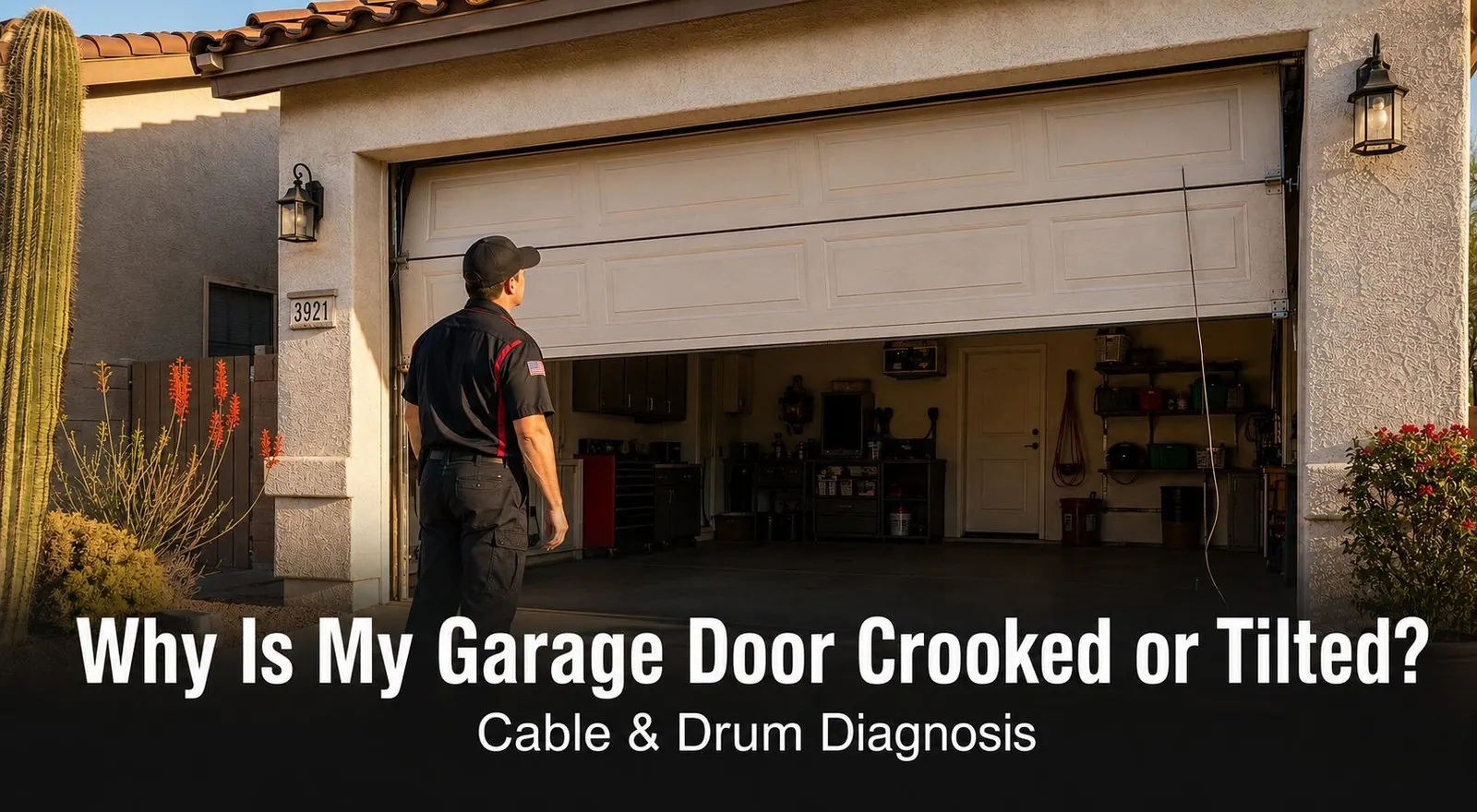
You glance at your garage door and something just looks off. One corner is riding higher than the other, the bottom rubber seal meets the floor at a slant, or the door visibly leans as it opens. Maybe you noticed a steel cable hanging loose at one side, or the door has started catching and tilting partway through its travel. It's an unsettling thing to see, because a door that's level one day and crooked the next clearly has something wrong inside it.
The good news: a crooked door points to a small set of specific causes, nearly all in one place — the cables and drums that keep each side rising and falling together. The not-so-good news: a tilted door is one you really shouldn't keep operating, because the parts involved are under serious tension and a partial failure can become a complete one fast. We get these calls from neighbors all over the East Valley, so here's how to read what your door is telling you.
First, Let's Clear Up the Spring Myth
When a door goes crooked, the first thing most homeowners reach for is "a spring must have broken." It's a reasonable guess — but on the vast majority of doors, it's the wrong one, and chasing it sends people in the wrong direction.
Here's why. On a two-spring torsion setup — the most common configuration on Arizona homes — both springs sit on a single shaft that runs straight across the top of the opening. That one shaft turns both cable drums at the same time, so both sides of the door always move together. When one of the two springs breaks, the shaft loses lifting power, but it's still one solid shaft connecting both sides. The result is a door that feels far too heavy and won't lift well — not a door that tilts. It sags or stops evenly, both corners together.
So if your door is genuinely crooked — one side clearly higher or lower than the other — the problem is almost never the spring. It's downstream, in the cable or drum on the low side. That's a different repair, and often a more time-sensitive one. (If your door instead feels heavy and won't lift but stays level, that's the spring story, and our guide to a broken garage door spring covers it.)
How a Healthy Door Stays Level
Two minutes on how the parts work makes every diagnosis below click into place. Picture the top of your door opening:
- The shaft is the long steel tube running across the top, with the spring (or springs) on it.
- The drums are the grooved wheels at each top corner. As the door opens, each drum winds up its cable like thread on a spool.
- The cables are the steel ropes that run from each drum down to a bracket at the bottom corner of the door. They carry the spring's lifting force to the door itself.
Because both drums are locked to the same shaft, they wind and unwind in perfect sync, so the two sides rise and fall together and the door stays square. A door goes crooked the instant one side stops keeping pace: a cable slips its groove, a cable lets go, or a drum loses its grip on the shaft. Now one corner is doing its own thing, and the door cocks to an angle.
6 Reasons a Garage Door Goes Crooked or Tilted
Nearly every crooked-door call we run traces back to one of these. The first four are cable-and-drum issues; the last two are track-related but show up as a tilt.
1. A cable slipped off the drum (the most common cause)
If the tension on a cable goes slack for even a moment — the door runs while something's binding it, a roller catches, or debris is in the way — the cable can hop out of its groove on the drum. Once it's off, that side has nothing holding it, so the door sags or tilts on the very next cycle. You'll often see loose, looping cable at one top corner while the other side looks normal.
2. A cable frayed through or snapped on one side
Cables wear out. Years of cycling, plus Arizona heat and grit, fray the steel strand by strand until it finally parts — or it rusts and breaks at the bottom bracket. The instant a cable breaks, that side of the door drops while the other side stays put, and the door hangs at a hard angle. This is the most dramatic version of a crooked door and the most dangerous.
3. A cable drum loosened or slipped on the shaft
Each drum is locked to the shaft by small set screws. If those work loose — from vibration, age, or a drum that was never torqued correctly — the drum can spin on the shaft instead of with it. That side then winds unevenly or not at all, the cable goes slack or wraps over itself, and the door tilts. You may hear a clunk or see one cable looser than the other.
4. A cable is wrapping over itself or riding unevenly
Sometimes the cable hasn't come off entirely but is winding over the top of itself on the drum, so one side packs higher than the other and the door climbs a little more crooked each cycle. This usually starts with a slightly loose drum or a stretched cable and gets worse the more you run it.
5. The door jumped off the track on one side
If a roller pops out of its vertical track — from a worn roller, a loose track bracket, a bump from a car, or a cable failure that let the door shift — that corner is no longer guided and drops or twists out of line. The door looks cocked, and you'll usually spot a roller sitting outside the rail or a section pushed away from the wall.
6. A bent track or binding section
A track that's been bent (often by a minor vehicle tap or a hard catch) or a track packed with hardened old grease and blown desert dust can make one side bind while the other moves freely. The door fights through that spot and leans as it goes. It can look like a cable problem but starts in the rail.
What You're Seeing — and What It Means
The exact way your door looks and sounds usually narrows the cause down quickly. Match what you're noticing to the most likely culprit and whether the door is safe to be near.
| What you're seeing | Most likely cause | Is it safe to use? |
|---|---|---|
| Loose, looping cable at one top corner; that side sags | Cable slipped off the drum | No — stop running it; re-seat needed |
| One side dropped hard; door at a sharp angle | Cable frayed through or snapped | No — unstable; stay clear, call a tech |
| Clunk noise; one cable looser; door drifts crooked over time | Drum loosened / slipped on shaft | No — gets worse each cycle |
| Door climbs more crooked a little more each time | Cable wrapping over itself on drum | No — stop cycling; can damage drum |
| Roller sitting outside the track; section pushed off the wall | Door off-track on one side | No — don't run opener; re-seat needed |
| Door binds and leans at the same spot every time | Bent track or debris in the rail | Inspect with opener off; clear loose debris |
Is It Safe to Keep Using a Crooked Door?
No — and this is the part we most want you to take to heart. A crooked door means one side has lost the support it's supposed to have, while the cables, drums, and shaft are still loaded with the tension that counterbalances a door weighing well over a hundred pounds. Running the opener now asks all that stored force to work through a setup that's already failing.
Cycle a tilted door anyway and a cable that was only partly off the drum comes fully off, a fraying cable finishes breaking, the door drags further off its track and bends panels, or it jams hard against the frame. Any of those turns a single cable or drum repair into a multi-part job — and if a cable lets go while the door is moving, it can drop or twist suddenly. If you need a car out in the meantime, leave that to a technician who can safely secure and move the door.
What to Do Right Now
If your door is sitting crooked as you read this, work through these in order.
- Stop operating the door. Don't keep hitting the button to "see if it'll straighten out" — every cycle makes a cable or drum problem worse.
- Unplug the opener. This keeps anyone in the house from running the door out of habit before it's fixed.
- Clear the area. Move cars, kids, and pets out from under and around the door. Assume the door could shift or drop until you know what failed.
- Look, don't touch. From a safe distance, check for a loose or hanging cable at a top corner, a roller sitting outside the track, or a section pushed off the wall. Note which side is low.
- Don't pull the manual release on a tilted door. The red cord disconnects the opener, and on a crooked door that can remove the last bit of control over a heavy, unbalanced door.
- Call for a diagnosis. Tell us which side is low and whether you saw a loose cable or heard a clunk or bang — that often pinpoints the problem before we arrive.
When you're ready, you can book a visit online or reach us by phone. If it turns out the door has come fully off its track, our off-track repair guide covers that, and our cable repair page explains what goes into setting both sides level again.
Why East Valley Homeowners Call Farnsworth for a Crooked Door
Farnsworth Garage Door Service was founded by brothers Brigham and Riley Farnsworth. The Farnsworth name carries 60+ years of business behind it across the East Valley — R&K, Farnsworth Wholesale, Farnsworth Realty — and we run this company the same way our family always has: find out what's actually wrong first, put the price in writing, then do the work right.
- We diagnose before we sell. A crooked door can be a re-seated cable or a full cable-and-drum job — we tell you which before quoting a dollar.
- Cables, drums, rollers, and springs on the truck. Most crooked-door causes get fixed in a single visit, not two.
- Same-day service is our standard, often within hours of your call.
- Written, itemized quote before any work begins. The price you agree to is the price on the invoice.
- 5.0 stars on Google. Our neighbors trust us — and tell their neighbors.
Crooked door, slack cable, or a door off its track? Explore our full repair services, our cable repair page, or see where we work across the East Valley.
Frequently Asked Questions
Why is my garage door crooked or sitting higher on one side?
A door that hangs higher on one side, drops at a corner, or binds at an angle almost always has a cable or drum problem on that side. The most common cause is a lift cable that slipped out of its drum groove, followed by a cable that frayed or snapped, or a cable drum that slipped on the shaft because its set screws worked loose. Any of those lets one side rise or fall independently of the other, so the door cocks to an angle. A door off its track on one side will also tilt. What it is almost never is a single broken spring — on a two-spring door both springs sit on the same shaft, so a spring break makes the whole door heavy, not crooked.
Can a broken spring make my garage door tilt or go crooked?
No — and this trips a lot of people up. On a two-spring torsion system, both springs ride on one shared shaft running across the top of the opening, and that single shaft turns both cable drums together. When one of the two springs breaks, the door doesn't tilt; it just loses lifting power and feels far too heavy for the opener, so it stops or sags evenly. A door that is visibly crooked, higher on one side, or hanging at an angle is telling you the problem is downstream of the springs — in a cable or a drum on that side. That's a different (and often more urgent) repair.
Is it safe to keep using a garage door that's crooked or off-balance?
No. A crooked door means one side is no longer being held the way it should be, and the cables and drums are full of stored tension. Running the opener can pull the door further off track, bend panels, fully unseat a cable that's only partly off the drum, or jam the door against the frame. If a cable has already broken on one side, the door can drop or twist suddenly. The safe move is to stop operating it, keep people and vehicles clear of the opening, and have it looked at before it gets worse. Forcing a crooked door is how a single cable repair turns into a multi-part job.
How did my garage door cable slip off the drum?
Cables jump the drum when the tension on them goes slack for a moment — long enough for the cable to escape its groove. That usually happens when the door is run while something is binding (an object under the door, a roller catching, ice or debris), when a drum set screw has loosened and the drum shifts, or when a cable has stretched or frayed enough to ride unevenly. Once a cable is off the drum, that side has no support, so the door sags or tilts on the next cycle. Re-seating the cable, checking the drum and set screws, and resetting tension is precise, high-tension work best handled by a technician.
What's the difference between a cable problem and a drum problem?
The cable is the steel rope that runs from the bottom of the door up to the drum; the drum is the grooved wheel at the top corner that the cable winds onto as the door opens. A cable problem is usually fraying, a break, or the cable slipping out of its groove. A drum problem is usually loose set screws letting the drum spin on the shaft, a drum that has shifted out of position, or a worn or cracked drum that no longer winds evenly. They're neighbors and they fail together: a slipped or broken cable often damages or loosens the drum, and a bad drum chews up cables. A technician inspects both as a pair and replaces cables in matched sets.
Can I fix a crooked garage door myself?
Clearing loose debris from a track or unplugging the opener so the door can't be run is fine. Re-seating a cable, winding a drum, or adjusting tension is not a DIY job. The cables and drums on a garage door carry the counterbalance load created by springs that can hold hundreds of pounds of stored energy, and a cable or winding bar that gets away from you can cause serious injury. A crooked door also usually has a root cause — a loose drum, a worn cable, or an off-track section — that has to be corrected, or the door will go crooked again. This is the kind of repair where the right tools and experience genuinely matter.
Why do garage door cables and drums fail more often in Arizona?
Our climate is hard on the parts that keep a door level. Summer heat bakes the factory lubricant on drums and bearings into a sticky varnish that makes the shaft drag and bind, which stresses cables. Blown desert dust packs into tracks and drum grooves, so cables ride rougher and wear faster. And the snowbird pattern — doors sitting unused for months, then put back into daily service — lets small problems like a loosening set screw or a fraying cable go unnoticed until the door suddenly hangs crooked. A yearly tune-up that cleans the tracks, checks the cables and drums, and re-lubricates the hardware heads most of this off before it becomes an emergency.

Door Hanging Crooked? Don't Run It — Let Us Take a Look.
Licensed, insured, locally owned. We diagnose cables, drums, tracks, and springs on-site and quote in writing before any work starts. Same-day service across the East Valley.