
Two-Car vs Two Single Garage Doors: Which Is Right for Your Home?
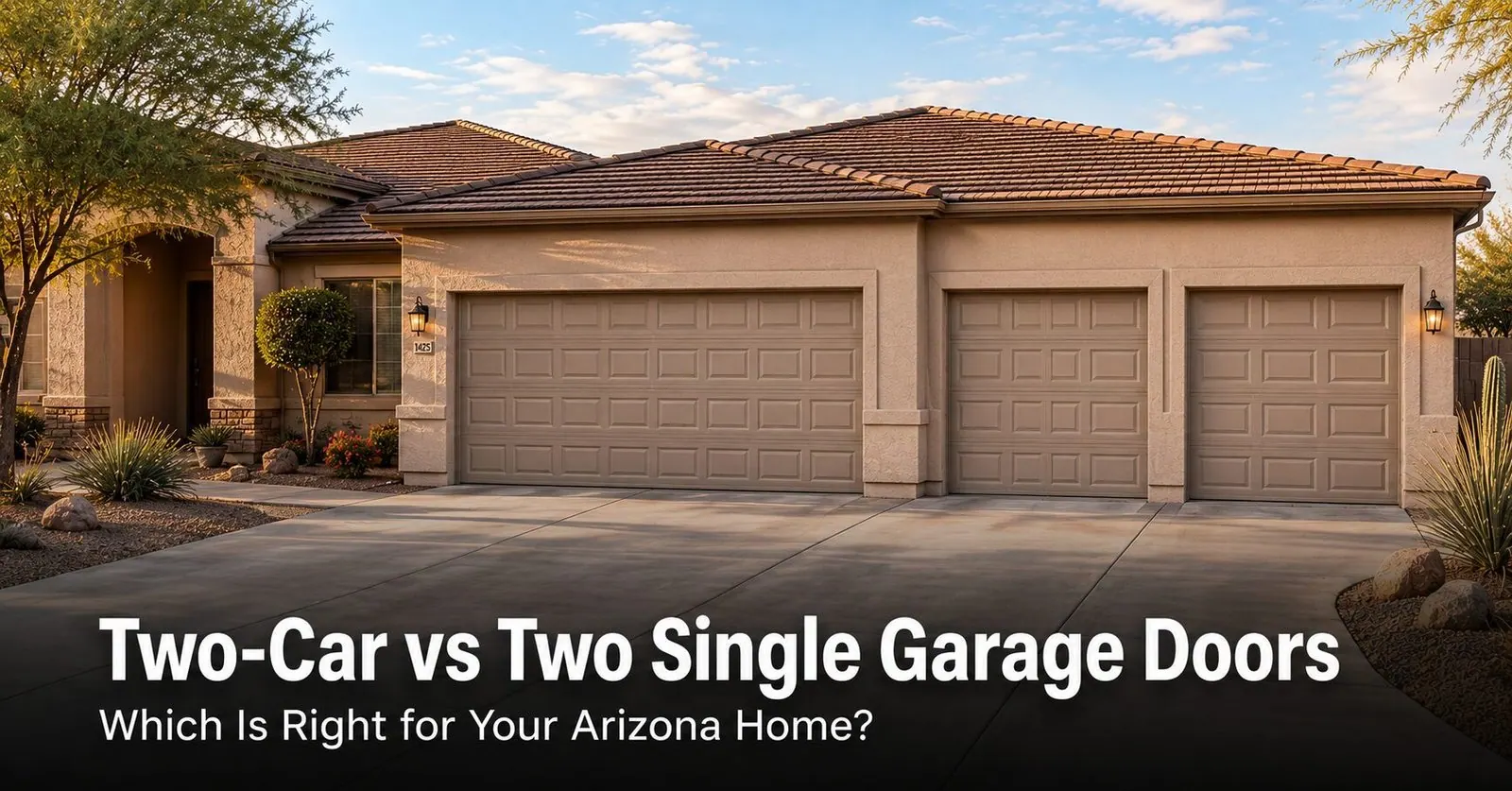
There's no universal winner — the right choice comes down to your vehicles, your home's framing, and what you value most:
- One wide two-car door gives you a clean drive-through with no center post, a lower upfront cost, one opener to maintain, and a modern look. Best for big trucks, boats, and trailers.
- Two single doors give you redundancy — if one bay goes down, the other still works — plus a traditional, symmetrical face and smaller, cheaper individual panel repairs. Best when you want a backup bay and like the classic look.
- The framing matters: two singles need a structural center post; a two-car door spans the whole opening. Switching from one to the other is a re-framing project, not a same-day swap.
Below: cost, structure, springs, openers, the Arizona angle, and how to decide.
It's one of the first questions homeowners ask us when they're building or replacing — should the garage have one big door or two smaller ones? Both are everywhere across the East Valley. Drive a newer Queen Creek subdivision and you'll see wide two-car doors on nearly every modern build; cruise an established Mesa or Chandler neighborhood and the two-single look is just as common. Neither is "better" in a vacuum. They're different tools, and the best one for you depends on what you park, how your home is framed, and what you'd rather not deal with on the morning a spring breaks. Here's how we walk our neighbors through it.
The Basic Difference — and the Center Post
A two-car door (also called a double door) is a single sectional door that spans the entire opening — most commonly 16 feet wide, sometimes 18 on larger garages. It gives you one uninterrupted drive-through with nothing in the middle.
Two single doors are two separate doors — usually 8 or 9 feet wide each — divided by a structural column between them. That column, the center post, isn't optional trim. It helps carry the load above the openings and gives each door its own set of jambs to anchor tracks to. This is the detail most homeowners overlook: the choice between one door and two is partly a framing decision baked into the house, not just a door you can re-order at will.
That's why going from two singles to one wide door — or the reverse — is a remodel. Removing a center post means re-framing the header so it can carry the longer span without that support. It's absolutely doable with the right crew, but it belongs in a renovation budget, not a same-day service call. If you're keeping the configuration you have, replacing like-for-like is simple. If you're building new, this is the moment to choose deliberately.
Two-Car vs Two Singles: Side by Side
Here's how the two configurations stack up on the things that actually matter day to day:
| Factor | One Two-Car Door | Two Single Doors |
|---|---|---|
| Drive-through space | One wide, clear opening — no post to steer around. Best for trucks, boats, trailers. | Two narrower openings with a post between. Tighter for oversized vehicles. |
| Upfront cost | Usually lower — one door, one spring system, one opener. | Usually higher — double the tracks and springs, often a second opener. |
| Redundancy | None — if a spring breaks, the whole opening is down. | Built in — if one door fails, the other still works. |
| Repair cost (per incident) | Larger, heavier panels cost more to match and replace. | Smaller individual panels are cheaper to repair. |
| Maintenance load | One door to tune up and lubricate. | Two of everything to keep serviced. |
| Curb appeal | Clean, modern, dominant on contemporary builds. | Traditional, symmetrical, suits carriage-house and ranch styles. |
What Each Really Costs
The honest answer is that upfront, a single two-car door is usually the more affordable way to cover a two-car opening. You're buying one door, one set of tracks, one spring system, and one opener — where two singles multiply most of that hardware and typically add a second opener. If first-day budget is the deciding factor, the wide door tends to win.
But cost has a second chapter that shows up years later: repairs. When a section gets backed into or a panel cracks, a two-car door means matching and swapping a larger, heavier section — more material, more labor. On a single door, that same damage is confined to a smaller, less expensive panel, and your other bay is untouched. So the configuration that costs less to install can cost a bit more per repair, and vice versa.
We don't publish flat prices here, because your real number depends on the door material and style, insulation level, opener choice, the condition of your existing framing, and whether anything structural has to change. What we do is measure on site and put both configurations in writing, side by side, so you're comparing real quotes for your opening rather than guessing from a brochure. If financing helps, we can walk through installation options together.
The Arizona Factors: Heat, Springs & Redundancy
Redundancy is worth more in a Phoenix summer
Here's a scenario we see constantly: it's 112 degrees, a torsion spring snaps overnight, and the door won't open in the morning. On a two-car door, that means the entire garage is sealed shut until it's repaired — both cars stuck inside. With two single doors, each bay has its own springs, so one broken spring leaves you a fully working second door to get to work. For a two-driver household, that backup bay can be worth the extra hardware all by itself. (And to be clear about the mechanics: a two-spring door shares one torsion shaft across the opening — when one of those springs breaks the door simply becomes too heavy to lift safely; it doesn't tilt or hang crooked. Either way, spring repair is a same-day job for a tech, not a DIY one.)
The wide door works harder — so it needs the right parts
A two-car door is heavier and spans a longer distance, which puts more demand on its hardware. Two things make a wide door reliable in our climate: correctly sized springs matched to the door's real weight, and struts — horizontal reinforcement bars across the inside of the top section that stop it from flexing. Struts matter most on wide doors and matter even more here, where monsoon gusts push on that big flat surface. A single door is lighter and shorter and asks less of its parts. Both last many years with regular service; the wide door simply has less margin if the springs are undersized or a strut was skipped at install — which is exactly why correct installation matters more on the bigger door.
Heat, dust, and two doors' worth of seals
Every opening you have is a place for East Valley dust and monsoon rain to get in. Two single doors mean two bottom seals, two sets of weatherstripping, and two doors' worth of seals to keep fresh — a little more upkeep, but also two chances to keep the garage tighter. Whichever way you go, sealing is what keeps the dust and heat where they belong: outside.
How to Decide
Lean toward one two-car door if:
- You park big. A dually, lifted truck, work van, boat, or trailer is far easier through one clear opening with no center post in the way.
- Upfront budget is the priority. One door, one opener, one spring system usually costs less to install.
- You want the modern look. A clean, wide door is the signature of contemporary East Valley builds — browse the new door options to see styles.
Lean toward two single doors if:
- You want a backup bay. Redundancy means a broken spring never strands every vehicle at once — a real comfort in summer.
- You like the traditional, symmetrical face. Two doors suit carriage-house and ranch styling and let the center post become an architectural feature.
- Your home is already framed for it. If the center post is there, replacing two singles like-for-like is the simplest path.
And if you're not sure? That's the most common answer, and it's exactly what a site visit is for. We'll look at your opening, your framing, and what you drive, then quote both configurations so the decision is made with real numbers in front of you — not a guess.
Why East Valley Homeowners Call Farnsworth
- Brothers-built and locally owned. Brigham and Riley Farnsworth founded this company, and the Farnsworth name has stood behind East Valley businesses for over sixty years.
- Straight comparisons, in writing. We quote both configurations side by side for your actual opening, so you choose with real numbers instead of a brochure guess.
- The whole system, sized right. Correct springs, the right struts on wide doors, and a balanced door before any opener goes on — that's what makes a door last in our heat.
- Same-day service is our standard, often within hours of your call.
- 5.0 stars on Google. Our neighbors keep us busy by telling theirs.
Planning a new door? Explore our new garage door options, learn about professional installation, or see where we work across the East Valley.
Frequently Asked Questions
Is it cheaper to have one big garage door or two single doors?
In most cases a single two-car door costs less to buy and install than two separate single doors. One door means one set of tracks, one spring system, and one opener, where two singles double most of that hardware and usually add a second opener. The flip side shows up later: if a panel gets dented or a section fails on a two-car door, you're matching and replacing a larger, heavier section, while a single door confines that repair to a smaller, less expensive panel. So the wide door tends to win on upfront cost and the pair of singles can win on the cost of an individual repair down the road. The right call depends on your opening, your vehicles, and how the front of the house is framed — we quote both side by side so you can compare real configurations.
Do two single garage doors need a center post?
Yes. Two single doors are separated by a structural column — usually a framed and often masonry-wrapped post — between the two openings. That post carries part of the load above and gives each door its own jambs to mount tracks to. A two-car door spans the whole opening with no post in the middle, which is why it gives you one clean, wide drive-through. If your home was built for two singles, switching to one wide door usually means removing that center support and re-framing the header to carry the longer span — a structural change, not just a door swap. It's doable, but it's a bigger project than ordering a different door.
Which is better for big trucks or a boat — a double door or two singles?
A single two-car door, almost always. A wide door gives you one uninterrupted opening with no center post to steer around, which makes backing in a dually, a lifted truck, a boat trailer, or a work van far less stressful. Two single doors force every vehicle through a narrower individual opening and put a column right where a wide mirror or trailer fender wants to be. If oversized vehicles are part of your life — common out in Queen Creek, San Tan Valley, and Gold Canyon — the clear span of a two-car door is the practical choice.
Are two single garage doors more reliable than one big door?
They offer redundancy, which is a real advantage in Arizona. With two separate doors, each has its own springs, cables, and opener. If a spring breaks on one bay — and a broken spring takes that door out of service until it's repaired — you still have a fully working second door to get a car out. On a two-car door, a broken spring means the whole opening is down. For a household that depends on getting to work in the morning, that redundancy can be worth the extra hardware. The trade is more parts to maintain: two doors mean two of everything to keep tuned up.
Does a wider two-car door wear out faster in Arizona?
Not faster, exactly, but a wide door works harder and benefits from a few extra parts. A two-car door is heavier and spans a longer distance, so it relies on properly sized springs and on horizontal reinforcement bars called struts to keep the top section from flexing — especially against monsoon wind gusts. A single door is lighter and shorter, so it puts less demand on its hardware. Both will last many years in our climate with regular service; the wide door simply has less margin for error if the springs are undersized or a strut is missing, which is why correct installation matters more on the larger door.
Can I replace two single doors with one two-car door (or the reverse)?
Sometimes, but it's a framing question before it's a door question. Going from two singles to one wide door means removing the center post and re-framing the header so it can carry the longer span without that support — structural work that may involve a permit. Going the other direction, from a two-car opening to two singles, means building a new center column and splitting the opening into two framed bays. Either change is possible with the right crew, but it's a remodel, not a same-day swap. If you simply want a different look, replacing like-for-like in the same configuration is far simpler and less expensive.
What are standard garage door sizes for single and double doors?
Single residential doors are most commonly 8 or 9 feet wide; two-car doors are usually 16 feet wide, with 18-foot versions on larger garages. Standard height is 7 feet, with 8-foot doors common on newer East Valley builds with taller garages. Those are typical numbers, not guarantees — actual sizing depends on your rough opening, and the width that matters for ordering is the smallest measurement across the opening, not the nominal label. We measure on site before recommending anything so the door fits the structure you actually have.
Which option looks better — one door or two?
It's a matter of taste and architecture, not right and wrong. A single wide door reads clean and modern and is the dominant look on contemporary Scottsdale and Gilbert builds, particularly in flush-panel or plank styles. Two single doors give a more traditional, symmetrical face that suits carriage-house and ranch styling and lets you frame the center post as an architectural feature. The best choice is the one that matches your home's lines — and on the largest surface on the front of the house, that cohesion is what neighbors and buyers actually notice.

Not Sure Which Configuration Fits Your Home?
Licensed, insured, locally owned. We'll measure your opening, look at what you drive and how the garage is framed, then quote one-door and two-door configurations side by side in writing — so you choose with real numbers instead of brochure guesses. Same-day service is our standard, often within hours of your call.