
Replace One Garage Door Panel or the Whole Door? How to Decide in Arizona
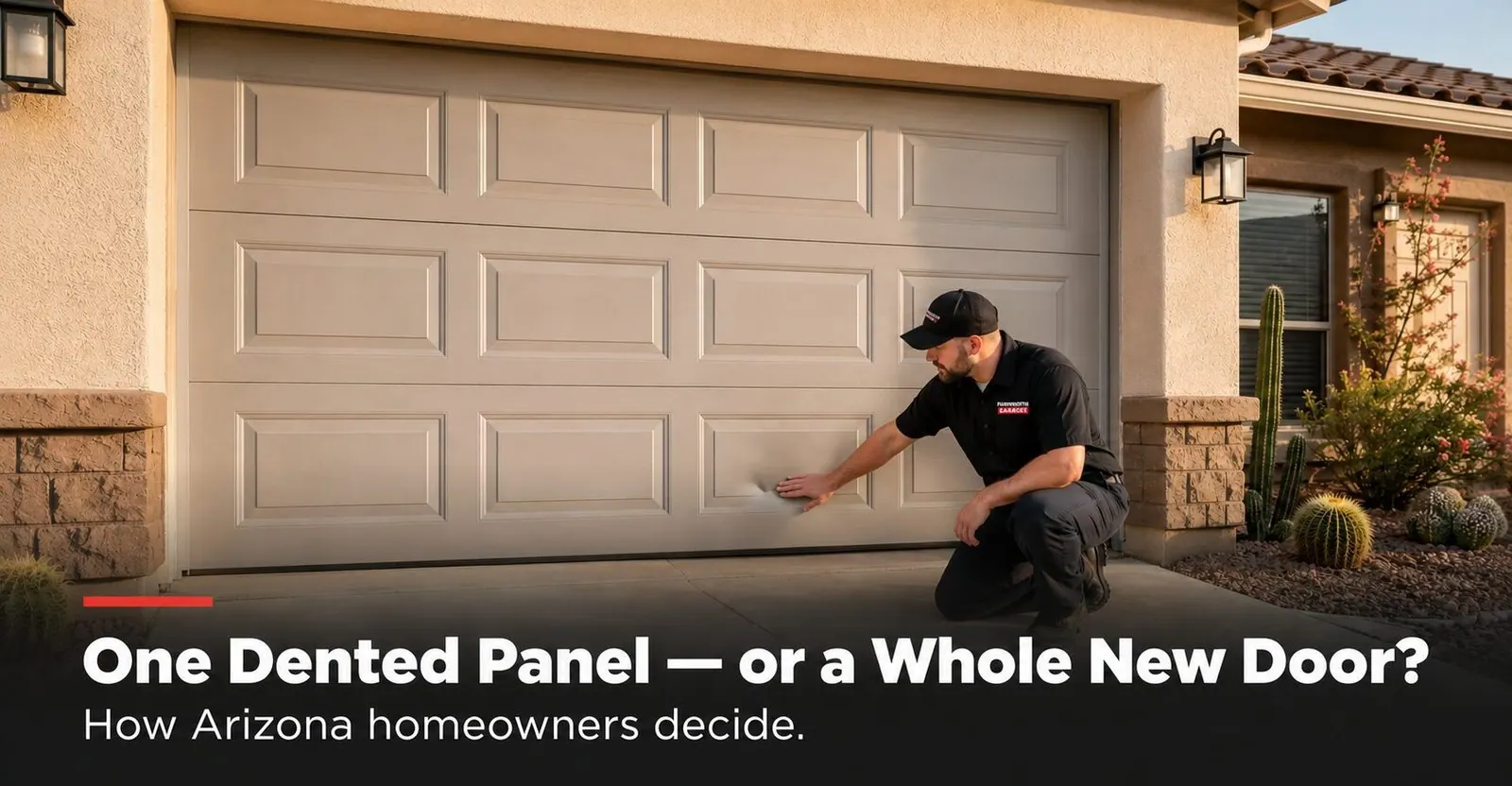
If one section of your garage door is dented or damaged, you often don't need a whole new door. A sectional door is built from separate panels, and a single one can usually be swapped on its own. Lean toward a single-panel replacement when:
- Only one section is damaged and the tracks, rollers, and brackets are straight.
- The panel can still be matched — your door's brand and model are recent enough that the exact section is available.
- The rest of the door is in good shape and not badly sun-faded.
Lean toward a full door replacement when the panel is discontinued, more than one section is damaged, the door is already near end of life, or a new panel would clash with sun-faded neighbors. Below: how to tell which situation is yours.
It usually happens in a hurry. Someone backs out a little too fast, a monsoon gust slams the door against a stray bike, or a delivery cart catches the bottom section just wrong. Now there's an ugly dent on the biggest surface on the front of your house, and the first question every East Valley homeowner asks us is the same: do I have to buy a whole new door for this? Most of the time, the honest answer is no — but “most of the time” has some real conditions attached, and a few of them are unique to living in Arizona. Here's how we walk our neighbors through the decision before anyone orders anything.
Why a Single Panel Can Come Out at All
The thing that surprises people is that a garage door isn't one solid slab. A standard residential door is built from four separate horizontal sections — panels — stacked on top of each other and connected at the seams by hinges. Rollers ride in the tracks on each side, and the whole stack lifts and folds overhead as a unit. Because the sections are bolted together rather than welded into one piece, a damaged section can be unbolted and lifted out while the sections above and below stay right where they are.
When we replace a single panel, the existing hardware comes along for the ride. The hinges and rollers transfer from the old section to the new one, and the new panel drops into the same spot in the track. The part homeowners don't see is the balance check at the end: your door's springs are tensioned to the door's exact weight, so we confirm the new section hasn't thrown that balance off before we call the job done. (More on why that matters in a moment.)
That modular design is good news for your wallet — but it only helps if the replacement section can actually be matched to the three or four sections staying on the door. That's where the decision really lives.
When Replacing One Panel Is the Right Call
A single-panel replacement is usually the smart, economical move when the damage is contained and the door is still young enough to match. We point homeowners toward it when:
- Only one section took the hit. A car backing into the door, a thrown ball, a dropped ladder — these typically dent one section, almost always the bottom one. If the damage stops at a single panel, you're a strong candidate.
- The tracks and hardware are straight. A dent is cosmetic; bent tracks, cracked rollers, or twisted brackets are structural. As long as the impact didn't knock the door off its tracks or warp the steel that guides it, the fix stays simple.
- Your door is recent enough to match. If the brand and model are still in production, we can order the exact section — same profile, same color from the factory. Newer doors are the easiest matches of all.
- The rest of the door is healthy. Good springs, sound sections, even color. Replacing one panel on an otherwise solid door gets you back to full strength without paying for parts you don't need.
If that's your situation, a panel swap is the right answer most of the time, and it's exactly the kind of garage door repair we handle on a routine service visit.
When the Whole Door Is the Smarter Buy
Sometimes the panel-only fix looks cheaper on paper but costs you more in the long run. A new door starts to make better sense in a handful of situations:
| If this is true… | …lean toward | Why |
|---|---|---|
| One section dented, door is newer, tracks straight | Single panel | Cheapest path that fully restores the door; exact match is easy on recent models. |
| The exact panel is discontinued | Usually whole door | A close substitute rarely matches profile and color cleanly; mismatched sections are obvious from the curb. |
| Two or more sections are damaged | Whole door | Once you're buying multiple sections plus labor, a new door is often the better value and resets the warranty. |
| Door is 12–15+ years old or near end of life | Whole door | New panel money is better rolled into a replacement that fixes age, fade, and worn hardware all at once. |
| The impact bent tracks or knocked the door off track | Inspect first | Structural damage has to be assessed before deciding — the panel may be the smallest part of the repair. |
The pattern is simple: a single, recent, cosmetic dent points to a panel; age, multiple sections, discontinued parts, or structural damage point to a new door. When a door has reached the end of its working life anyway, our guide on choosing a new garage door walks through what to look for so the replacement is right for your home and your elevation.
The Arizona Wrinkle: Faded Panels & Color Match
Here's the factor that catches people off guard, and it's one a garage door company in a milder climate would barely mention. Arizona sun fades garage doors. Slowly, evenly, and relentlessly, the finish on a steel door lightens over the years it spends facing a Phoenix afternoon. So even when the exact replacement panel is still made, a brand-new section out of the factory box arrives in the door's original color — which is now a shade or two brighter than the faded sections it's bolting in next to.
On a door that's only a few years old, that difference is usually too small to notice. On a door that's weathered five, ten, or more summers, a fresh panel can stand out like a patch. It's not a defect — it's the old sections that have changed, not the new one — but it's the kind of thing you want to know before the work happens, not after. We'll look at your door, tell you honestly whether a new panel will blend or show, and if it's going to show, talk through whether a paint match, a full replacement, or simply living with it is the right move for you.
Two more desert realities feed into this decision. Discontinued parts show up faster than you'd think — doors more than about a decade old frequently have sections the manufacturer no longer produces, which can force the question regardless of how minor the dent is. And monsoon and wind damage tends to be less contained than a tidy car dent; a section blown against an obstacle, or a door caught by a gust while partly open, can bend hardware and rack more than one panel at once. We check the whole system after any storm impact, not just the part that looks bad.
What Actually Affects the Cost
We don't quote panel work from a brochure, because two dented doors on the same street can land in very different places. These are the factors that move the number, and they're worth understanding before you compare any estimates:
- Panel availability. An in-production section from a common brand is the most affordable case. A specialty, premium, or discontinued panel costs more to source — and a single hard-to-find section can climb close enough to a new door that the new door wins.
- Brand, model, and construction. A basic single-layer steel section is one thing; an insulated, multi-layer, or carriage-style panel with an overlay is another. The same dent on a higher-end door is a higher-end panel.
- How many sections are involved. One panel is straightforward. The moment a second section enters the picture, the value math usually tips toward replacing the door.
- Hardware condition. If the impact bent rollers, hinges, brackets, or tracks, those get repaired alongside the panel — a dent that knocked the door off its tracks is a different job than a clean cosmetic ding.
- Spring re-balancing. A new section that weighs differently than the old one means the springs get re-checked and adjusted so the door stays balanced. It's a small step that protects your opener and hardware for years.
- Color match and finish. When a faded door needs a paint match to blend a new panel, that's added work — and sometimes the reason a full replacement turns out to be the cleaner value.
When we come out, we look at the whole door — not just the dent — and put both options in writing where it applies: what a single-panel replacement involves, and what a new door would run, side by side, so you can choose with real numbers instead of a guess. You can book a visit whenever it's convenient, and we'll bring the honest version of the tradeoff.
Why East Valley Homeowners Call Farnsworth
- Brothers-built and locally owned. Brigham and Riley Farnsworth founded this company, and the Farnsworth name has stood behind East Valley businesses for over sixty years.
- The honest version of the tradeoff. If a panel swap is all you need, we'll say so. If a new door is the better value, we'll show you why — both options in writing, side by side.
- We check the whole door, not just the dent. Tracks, rollers, brackets, and spring balance all get a look, so the fix addresses what actually got damaged.
- Same-day service is our standard, often within hours of your call.
- 5.0 stars on Google. Our neighbors keep us busy by telling theirs.
Dented door? Start with a garage door repair visit, explore new door options if it's time, or see where we work across the East Valley.
Frequently Asked Questions
Can you replace just one panel on a garage door?
Often, yes. A sectional garage door is built from separate horizontal sections — usually four — and a single damaged section can be unbolted and swapped while the rest of the door stays in place. The hardware (hinges and rollers) transfers to the new section, and the springs are re-checked so the door stays balanced. The catch is availability: the replacement panel has to be an exact match for your door's brand, model, profile, and color, and that match gets harder as a door ages. On a newer door, a single-panel swap is usually the right call. On an older or discontinued door, matching becomes the deciding factor.
Is it cheaper to replace a panel or the whole garage door?
A single-panel replacement is normally less than a full door, which is exactly why it's worth checking first. But it isn't automatic. A replacement section still has to be ordered from the manufacturer, color-matched, and installed, and a single specialty or discontinued panel can climb close enough to a new door that the new door becomes the better value — especially when the rest of the door is sun-faded or near end of life. We weigh the panel cost against the condition and age of the whole door before recommending one path, and we put both options in writing so you can compare them with real numbers instead of a guess.
How do I know if my garage door panel can be matched?
It comes down to the door's label. Look on the inside of the top section or along the edge stile for a sticker with the manufacturer, model or series name, model number, and manufacture date. That information lets us confirm with the manufacturer whether your exact panel is still produced. If there's no readable label, we match by visual profile — short panel, long panel, flush, or carriage style — plus steel gauge and color, then verify availability before ordering. Keeping the paperwork from your original install makes this much faster.
What happens if my garage door panel is discontinued?
Discontinued panels are common on doors more than about ten years old, and they change the math. When the original section can no longer be ordered, the options are a close-but-not-exact substitute panel (which rarely matches profile and color cleanly), sourcing a salvaged matching section if one can be found, or replacing the full door so every section matches and the warranty starts fresh. On a door that's already aged and faded, full replacement is frequently the more sensible long-term choice — but we'll lay out every option before you decide.
Will a new panel match the color of my faded Arizona door?
This is the honest conversation Arizona forces that milder climates don't. Even a perfect factory color match will read brighter than the sections around it, because years of intense desert sun gradually fade the original panels. On a door only a few years old the difference is usually minor. On a door that's baked through several Phoenix summers, a brand-new panel can stand out noticeably next to its neighbors. We'll tell you honestly whether the mismatch will be visible from the curb so it isn't a surprise after the work is done.
Does replacing a garage door panel affect the springs?
It can, and it's a detail DIY guides skip. Your door's torsion springs are tensioned to the exact weight of the door. A replacement section that weighs even a little more or less — a different insulation package, an added window, a heavier gauge — changes that balance. An out-of-balance door strains the opener and wears hardware early. Part of doing a panel replacement correctly is re-checking the door's balance and adjusting the springs if needed. Spring work stores serious energy and is not a homeowner job.
My car backed into the garage door and dented one panel — repair or replace?
A vehicle backing into the door is the single most common reason we replace one panel, and it usually damages the bottom section only. If the dent is cosmetic and the section's structure and the tracks are straight, a single-panel replacement is typically all you need. What pushes it toward a bigger repair is when the impact bent the rollers, brackets, or tracks, knocked the door off its tracks, or cracked more than one section. We check the whole system after an impact — not just the visible dent — so the fix addresses what actually got damaged.

Dented Panel? Let's Look Before You Buy a Whole Door.
Licensed, insured, locally owned. We'll inspect the panel, the tracks, and the spring balance, then lay out a single-panel fix and a full replacement side by side in writing — so you choose with real numbers, not a guess. Same-day service is our standard, often within hours of your call.