
Garage Door Won't Open in the Heat? Why It Happens in Arizona Summers
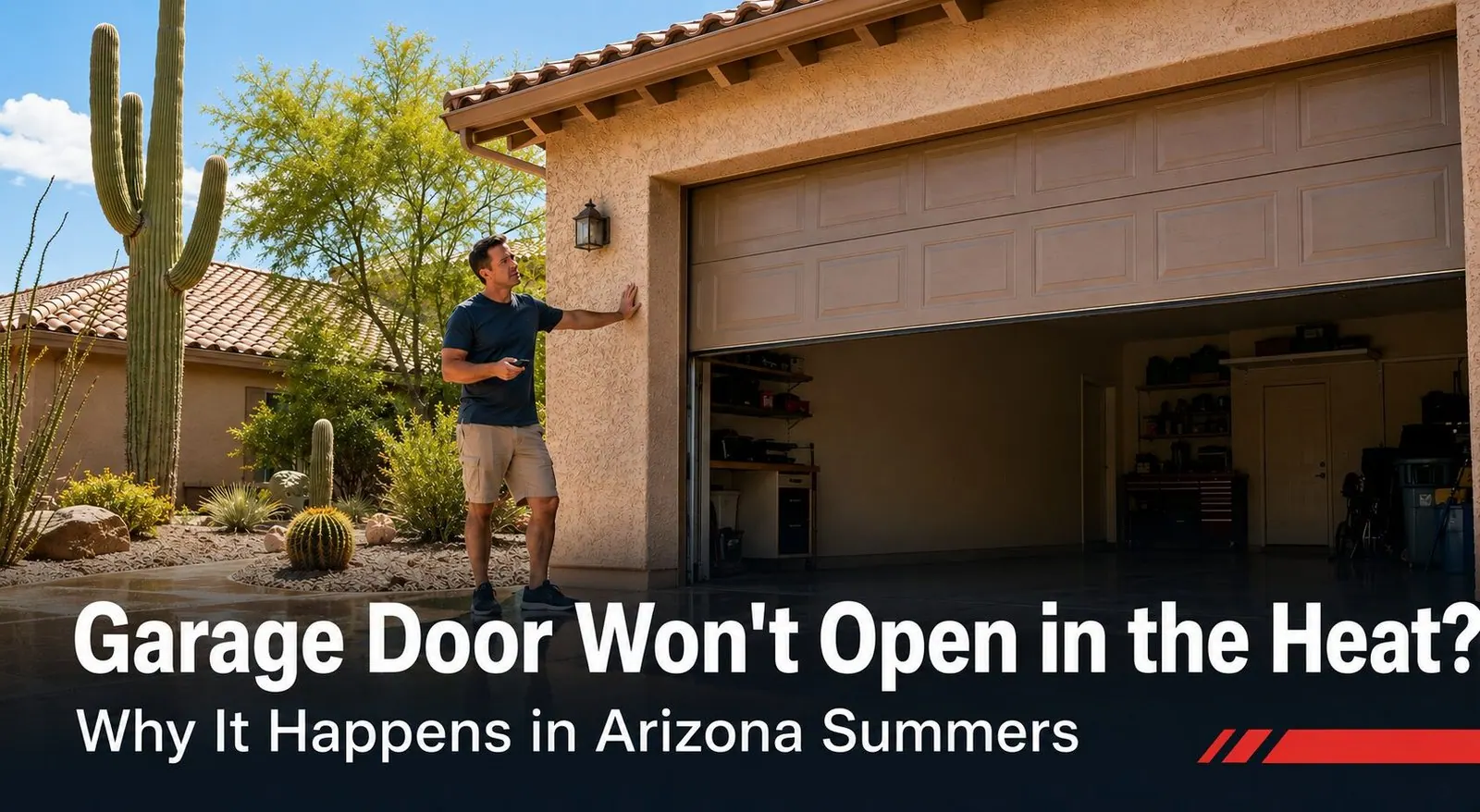
If your garage door works fine in the morning but won't open in the afternoon heat, you're not imagining it. An Arizona summer garage routinely hits 130–140°F by 3 p.m. — well above what most openers are rated to handle. The usual suspects:
- The opener motor hit its thermal cutoff and shut itself off until it cools.
- Old lubricant on the tracks and rollers turned to varnish, dragging the door down.
- Metal tracks and door sections expanded in the heat and started binding.
- Remote or keypad batteries lost voltage from sitting in a 160°F car.
- The opener's capacitor or logic board is aging out from years of summer heat cycles.
- Low afternoon sun is blinding the photo-eye sensors, blocking the signal.
If the opener is silent when you press the button, try the wall button to rule out the remote. If you hear the motor hum or strain but the door won't move, stop pressing — you'll burn out the motor. The fastest paths back to a working door are letting the unit cool for an hour, swapping batteries, and getting it professionally re-lubed before the next heat wave.
Here's a scene that plays out across the East Valley every July. You leave the house at 7 a.m. and the garage door behaves perfectly. You come home at 4 p.m., the asphalt is shimmering, the truck is baking in the driveway, and the door won't budge. You press the remote three more times, walk inside, hit the wall button — nothing. Sweat is running down your back. By 8 p.m. when the garage finally cools, the door opens like there was never a problem at all.
You're not losing your mind, and the door isn't possessed. It's heat. Phoenix-area garages get hotter than the inside of a parked car — we routinely measure 130 to 140°F on a ceiling thermometer in an uninsulated garage by mid-afternoon, and the door's hardware lives in that the entire summer. Every component — the motor, the lubricant, the metal, the electronics, the batteries, even the sensors — is being pushed beyond what it was designed for. So let's walk through what's actually breaking down when the temperature climbs, what you can sort out yourself, and when it's time to stop cycling the door and call us.
How Hot the Garage Actually Gets
This is the part most homeowners underestimate. The thermometer on the back porch reads 112°F, so it's reasonable to assume the garage is around the same temperature. It isn't. A typical East Valley garage stacks heat in a few brutal ways:
- The garage door itself becomes a radiator. A dark, non-insulated steel door in direct afternoon sun can hit 160°F on its outer skin. That heat radiates into the garage all afternoon, long after the sun has moved off.
- The roof and attic dump heat into the garage. Attic temperatures in Phoenix run 140–160°F. With nothing between the attic and the garage ceiling, that heat slides straight down.
- Hot air pools at the ceiling — right where your opener lives. Even when the floor is 105°F, the air at the motor head can be 20 to 30 degrees hotter.
- A west-facing garage gets the worst of it. The afternoon sun has hours to bake the door, the driveway, and the wall above it. North-facing garages run 10–15°F cooler at the same hour.
So when a manufacturer says the opener is rated for ambient temperatures up to 120°F, and your garage ceiling is sitting at 135°F for four hours every afternoon, the math is straightforward. Now layer on a door that's also expanding, lubricant that's gone tacky, and a remote battery that's been sitting in a car interior at 160°F all morning, and the surprise isn't that the door won't open today — it's that it ever worked at all.
7 Reasons Your Garage Door Quits When It's Hot
Nearly every "won't open in the heat" call traces back to one of these. They're roughly ordered from most to least common in Arizona summers.
1. The opener motor hit its thermal cutoff
Every modern opener has a thermal-protection switch inside the motor. When the windings get too hot — either from running a lot or just from sitting in a 140°F garage — the switch opens and the motor shuts down. You press the button, the LED might flash, but nothing moves. It feels broken. It isn't. It's protecting itself from cooking, and once the windings cool back down, it'll come right back to life.
2. The lubricant on the tracks and rollers has turned to varnish
This is the single most common Arizona-specific summer cause we run. White lithium grease, silicone spray, and old factory lube all break down under repeated heat cycling. Instead of staying slick, they oxidize into a sticky brown varnish that grabs the rollers and drags every cycle. In cool weather the door can muscle through it; on a 115°F afternoon, the same drag is enough to overwhelm the opener, which either reverses, hums and stalls, or trips its thermal cutoff trying.
3. Metal expansion is binding the door in its track
Steel expands with heat. Not by a lot — a 20-foot garage door section grows roughly a sixteenth of an inch over a 100°F swing — but track clearances are also small. If a track is slightly out of plumb, a roller is worn unevenly, or the door was installed tight to begin with, that little bit of expansion is enough to make the door scrape, grab, or jam at the same point every hot afternoon. The opener pushes into the resistance and gives up.
4. Your remote or keypad battery is dead (or close to it)
The most overlooked cause — and the cheapest fix. Garage door remotes live in cars that hit 160°F interior temperatures. Heat dramatically speeds up battery self-discharge. A CR2032 or 9-volt that should last a year often dies in two or three months of Phoenix summer. The remote still flashes its LED when you press it, so it feels alive, but it doesn't have enough voltage to actually transmit the radio signal across the driveway.
5. The capacitor in the opener is failing from heat cycling
Inside every opener motor is a starting capacitor — a small cylindrical component that gives the motor the kick it needs to start turning. Capacitors hate heat. After 8–12 Arizona summers, they swell, leak, or simply lose enough capacity that the motor hums when you press the button but can't start. You'll hear an audible hum from the unit and maybe a click, but the door doesn't move. Cooling doesn't help; this one is hardware.
6. Low afternoon sun is blinding the photo-eye sensors
The two small photo-eyes near the bottom of the tracks send an infrared beam across the opening. If the beam is broken — or fooled — the door won't close, and on some openers it'll also refuse to open. Arizona afternoon sun, low and intense, can hit the receiving eye directly and overwhelm it. The opener thinks something is in the path even though nothing is. This shows up like clockwork the same week every year as the sun angle changes.
7. A spring quietly let go in the heat
Torsion springs don't break because of heat — they break because they've reached the end of their cycle count. But Arizona summers are when the math catches up to a lot of springs, because households cycle their doors more (in and out of the AC, multiple kids' activities, snowbirds coming and going). A weak or recently broken spring leaves the opener trying to lift a 150–200 lb door it was never designed to handle. The motor strains, hums, or sometimes won't even attempt the lift.
What You're Seeing — and What It Means
Match what your door is actually doing to the most likely cause. This narrows the list before anyone touches the opener.
| What you're seeing | Most likely cause | Safe to DIY? |
|---|---|---|
| Total silence when you press the button; works again after sundown | Thermal cutoff or remote battery | Yes — let it cool, swap battery |
| Motor hums or clicks but door doesn't move | Capacitor failure or broken spring | No — stop pressing, call a tech |
| Door starts to move then reverses or stalls partway | Hardened lube, binding rollers, or weak springs | Inspect with opener off; service call for repair |
| Wall button works, remote doesn't (or works inconsistently) | Remote battery cooked by heat | Yes — replace battery |
| Door won't close in late afternoon; sensor LED flickering | Sun glare hitting photo-eye | Yes — shade test confirms it |
| Door is heavy or crooked when you lift it by hand | Spring or cable failure | No — counterbalance work, call a tech |
| Same problem every hot day, fine on cool mornings | Heat-aging opener or varnished lube | Inspect yourself; tune-up or replacement is the fix |
What You Can Safely Check Right Now
Work through these in order. The first three are quick, tool-free, and fix a real share of these calls on their own.
- Try the wall button. If the wall button works and the remote doesn't, you've found it — swap the remote battery and the keypad battery while you're at it. Don't forget the spare remote in the car.
- Ventilate the garage and wait an hour. If nothing happens when you press the button and the garage is over 110°F, the opener may be on a thermal timeout. Open the garage if you can, run a fan, and try again once the air has cooled.
- Listen carefully when you press the button. Silence = electronics or battery. A hum or click without motion = capacitor or spring. A strain followed by a reverse = mechanical drag or heavy door. The sound is your best clue.
- Look at the photo-eye LEDs. Both should glow solid. If one is flickering or off, that's the issue. Try shading the affected sensor with your hand to confirm whether sun glare is the cause.
- Test the door's balance by hand. With the door fully closed, pull the manual release rope, then lift the door by hand to about waist height and let go. Balanced doors stay put. Heavy ones — or ones that slam down — need spring service.
- Inspect the tracks for varnish or worn rollers. With the opener disconnected, look at the inside of the tracks where the rollers ride. A sticky brown coating, or rollers worn flat on one side, both point to a tune-up call.
How to Keep This From Happening Next Summer
Most heat-related door failures are predictable, which means they're preventable. A handful of small habits go a long way in this climate.
- Get a spring tune-up before May. Annual maintenance — clean the tracks, replace dried lube, check roller wear, tighten hardware, test balance — heads off the August failures we see most. Our tune-up service covers all of it.
- Replace remote and keypad batteries every spring. Don't wait for them to die. A $5 CR2032 pack swapped in April saves a triple-digit afternoon outside the keypad.
- Insulate the garage door if you haven't. A higher R-value door (or insulation panels on an existing steel door) drops garage temperatures 10–25°F at the hottest hours, which keeps the opener inside its happy range.
- Add an attic fan or garage exhaust vent. Even a small wall-mounted vent fan tied to a thermostat keeps ceiling temperatures from stacking and gives the opener a fighting chance.
- Watch the life expectancy on an old opener. In Phoenix, residential openers typically last 8–12 years instead of the manufacturer's 15–20. If yours is over a decade old and starting to act up on hot afternoons, a planned replacement is cheaper and less stressful than an emergency one.
When to Stop and Call a Tech
A lot of this you can knock out on your own — a new battery, a shaded sensor, an hour of cool-down time. Call us when:
- The motor hums or strains but the door won't move — capacitor, spring, or seized gear.
- The door feels heavy or crooked by hand — spring or cable, not an opener problem.
- The opener is silent and the wall button doesn't work either, even after cooling — electronics or logic board.
- You can see varnished tracks, worn rollers, or visible damage — a tune-up will keep the same call from happening again in two weeks.
- The problem repeats every hot afternoon — that's a system telling you it's at the end of its summer rope.
A technician can listen to the unit, test capacitor health, check the balance, clean and re-lube the tracks properly, and either fix the issue on the spot or recommend a planned replacement before the next 115°F day. When you're ready, book a visit online or call us, and explore our full repair services if the trouble runs deeper than a battery swap.
Why East Valley Homeowners Call Farnsworth When the Heat Stops Their Door
Farnsworth Garage Door Service was founded by brothers Brigham and Riley Farnsworth. The Farnsworth name carries 60+ years of business behind it across the East Valley — R&K, Farnsworth Wholesale, Farnsworth Realty — and we run this company the same way our family always has: find out what's actually wrong first, put the price in writing, then do the work right.
- We diagnose before we sell. A heat-failed door can be a battery, a re-lube, a capacitor, or a new opener — we tell you which before quoting a dollar.
- Capacitors, rollers, springs, sensors, and seals on the truck. Most summer failures get sorted in one visit, not two.
- We re-lube with the right product, not the easy one. No WD-40, no spray-on chain lube — correctly applied lithium or silicone where each part actually needs it.
- Same-day service is our standard, often within hours of your call — which matters most when it's 115°F and the door is stuck open.
- 5.0 stars on Google. Our neighbors trust us — and tell their neighbors.
Heat-stuck door, dying opener, or a unit ready for retirement? Explore our full repair services, our opener replacement page, or see where we work across the East Valley.
Frequently Asked Questions
Why does my garage door stop working when it's hot outside?
Arizona afternoons stack several problems on the same door at once. Garages can reach 130–140°F by 3 p.m., which is hotter than the inside of a parked car. At those temperatures the opener motor hits its thermal-protection limit and shuts off until it cools, the grease on tracks and rollers turns into a sticky varnish that drags the door down, metal tracks and door sections expand and bind, remote and keypad batteries lose voltage fast, capacitors inside the opener age out, and low afternoon sun blinds the photo-eye sensors. Any one of these can stop a door cold. By July you often have two or three working against you at the same time.
Can extreme heat actually damage a garage door opener?
Yes. Most residential openers are rated to operate up to roughly 120°F. Arizona garages routinely run hotter than that for several hours a day in the summer. Above its rated temperature an opener trips a thermal cutoff and stops responding until it cools, which is annoying but not damaging. What does cause damage is years of repeated heat cycling — capacitors dry out, plastic gear housings get brittle, logic boards age faster, and lubricants break down. That's why openers in Phoenix garages typically last 8–12 years instead of the 15–20 the manufacturer advertises, and why their summer years are when they finally quit.
Why does my garage door open fine in the morning but not in the afternoon?
This is the classic Arizona summer pattern, and it's almost always heat-related. The garage cools overnight and is still reasonable at 7 a.m., so the door cycles normally. By mid-afternoon the same garage is 40–60 degrees hotter, the opener motor is running near its thermal limit, the lubricant has thickened and gone sticky, the tracks have expanded slightly, and any sensor or remote with a marginal battery starts to fail. The door that opened twice this morning suddenly won't move at 4 p.m. Then the garage cools after sunset and the same door works again, which makes the problem feel ghostly. It isn't — it's temperature.
How hot does a garage get in Phoenix during the summer?
An uninsulated, west-facing garage on a 115°F day routinely hits 130–140°F by late afternoon, sometimes higher right under the opener at the ceiling, where heat collects. North-facing or insulated garages run cooler — closer to 105–115°F. The garage door itself, if it's a dark steel non-insulated panel in direct sun, can hit surface temperatures of 160°F or more, which radiates back into the garage and into the door's own hardware. Heat at the ceiling is the most punishing for openers because warm air rises and pools right where the motor lives.
Is it safe to keep trying to open the door when nothing's happening?
Mostly yes for a couple of attempts — but stop after that. If you press the button and the motor doesn't run at all, you're not stressing anything by trying once or twice. If you hear the motor try, strain, hum, or struggle, stop. That's the opener hitting either a stuck door, a broken spring, or its own thermal limit, and pushing through it can burn out the motor or stress the door. The right move is to listen, look, and then either let the system cool down for 30–60 minutes or have someone come look at it. Never bypass a thermal cutoff by repeated tries — it's there to protect a $400 motor from cooking itself.
Why does my remote work fine in winter but die every July?
Garage door remotes (and keypad batteries) live in some of the worst conditions on the property: clipped to a hot visor, baking in a car interior at 160°F, or mounted on the outside of a south-facing wall. Heat accelerates battery self-discharge dramatically — a CR2032 or 9-volt that should last a year can be dead in a couple of months of Phoenix summer. The remote works fine indoors when you test it because the battery has just enough voltage to flash an LED, but not enough to actually transmit the radio signal across the driveway. Replacing the battery is usually the first and cheapest summer fix, and it sometimes solves the whole problem.
When should I call a tech instead of waiting for it to cool down?
Wait it out (or check the simple stuff) when the opener clicks but doesn't move and the garage is over 110°F — give it an hour to cool and try again. Same for a remote that intermittently doesn't reach: swap the battery first. Call a technician when the door doesn't move at all and the opener is silent (capacitor or board), when you hear the motor humming or straining but the door doesn't budge (binding, broken spring, or seized gear), when the door is heavy or crooked when you lift it by hand (spring or cable issue — don't keep cycling it), or when the same problem comes back day after day even on cool mornings. A summer tune-up that re-lubes the right way, tightens hardware, tests capacitor health, and verifies the door's balance heads off most of the August-into-September failures we see.

Heat Got the Best of Your Garage Door? Let's Get It Moving Again.
Licensed, insured, locally owned. We diagnose openers, springs, sensors, and tracks on-site, re-lube with the right product, test capacitor health, and quote in writing before any work starts. Same-day service across the East Valley.