
Garage Door Won't Open After Power Outage: Manual Release Step-by-Step
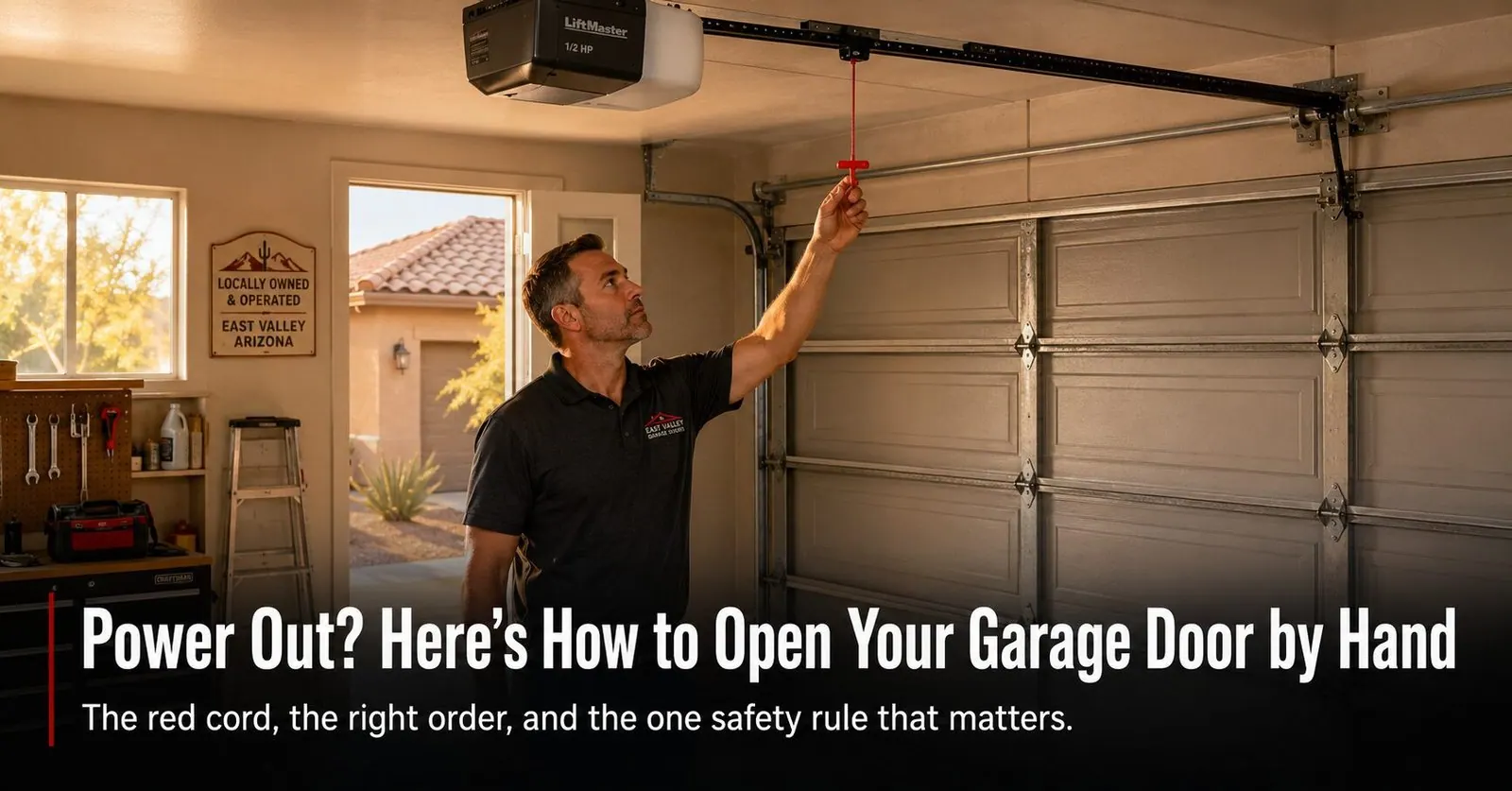
Your garage door isn't broken — the motor just has no power. Every modern opener has a red emergency release cord built in exactly for this. The short version:
- Close the door first if it's stuck open. Pulling the release with the door up can let it slam if a spring is weak or broken.
- Pull the red cord straight down to disengage the trolley from the rail.
- Lift the door by hand evenly with two hands until it stops at the top.
- Drive out, then pull the door back down by hand and lock the side latch if you have one.
When the power comes back, pull the cord back toward the door to reset the trolley, then run the opener once and you're back to automatic. If the door won't budge by hand even after pulling the release, stop — that almost always means a broken spring or cable, not an opener problem.
It usually happens during a monsoon. The wind comes through, the power blinks, and the garage door turns into a 200-pound paperweight between you and your car. Or it's the middle of a 115°F July afternoon, the grid hiccups for two hours, and you're trying to figure out how to get the kids to soccer practice without breaking anything.
The good news is that every garage door opener built in the last 35 years has a manual release cord built into it for exactly this reason. The bad news is that most homeowners have never used it, and there's one safety mistake that sends people to urgent care every year. Here's how to do it right, what to do if it doesn't work, and how to put everything back the way it was once the power comes back on.
Why the Door Is Stuck When the Power Is Out
Your garage door opener is a small electric motor that pulls a chain, belt, or threaded screw along a rail. That rail pulls a trolley, and the trolley pulls an arm attached to the top of the door. No electricity, no motor, no movement. The remote, the wall button, the keypad, and your phone app are all just sending the same signal to the same motor, so when one stops working in an outage, they all stop.
What people often forget is that the door itself isn't lifting on motor power. The torsion or extension springs above and to the sides of the door are doing the heavy lifting. The opener just guides the door up and down on those springs. That's why a properly balanced garage door can be lifted with one hand once you've disconnected the opener — and it's also why a door with a broken spring is dangerous to release.
How to Find Your Manual Release Cord
Walk into the garage and look up at the long rail running from the ceiling-mounted opener motor down to the top of the garage door. About one to two feet back from where the rail meets the door, you'll see a short cord hanging straight down with a red plastic T-handle on the end.
The cord is red on every brand we install — LiftMaster, Chamberlain, Genie, Craftsman, Linear, Sommer, Marantec. It's deliberately the most obvious thing in the garage so you can find it in the dark, which is exactly when you'll need it.
A few things to know about it:
- It hangs about 6–8 feet off the floor on most installs. Tall enough that a curious toddler can't reach it, low enough that an adult can.
- It's attached to the trolley — the small black or gray plastic block that slides along the rail. Pulling the cord moves a lever inside the trolley that decouples it from the chain or belt.
- If a previous homeowner removed the cord, you can still grab the metal lever on the trolley itself. You'll need a step stool.
- If you don't see any red cord at all, the opener may be very old (pre-1993) or a previous owner may have done something unusual. Call us and we'll talk you through it over the phone.
The Manual Release Procedure, Step-by-Step
Do these in order. The order matters, especially the first step.
- If the door is open, get everyone and everything out from under it. Before you touch anything, make sure nothing is parked or standing under the door — not the car bumper, not a kid, not a pet, not a trash bin. If something has to come out from under it, do that first, with the door still held up by the opener.
- Close the door first if you can. This is the single most important safety step. If your opener still has any power at all (battery backup, slow brownout), use the wall button to close the door before pulling the release. A closed door is in its safest position, with the springs at minimum tension and the door resting on the floor. Pulling the release on a door that's up means the springs are the only thing holding the door against gravity — if those springs are tired or broken, the door can slam down with several hundred pounds of force.
- Grab the red T-handle and pull straight down. A firm, deliberate pull — not a jerk. You'll feel a click or a clunk as the trolley releases from the rail. On some models you'll also hear the cord lock into a "released" position so it stays disengaged.
- Lift the door by hand with two hands, evenly. Get a hand on each side of the bottom panel. Lift smoothly. A healthy, balanced door should feel like it weighs 8 to 15 pounds because the springs are doing the work. If it feels like you're lifting a sandbag, stop — a spring is likely broken and you should not force it (see the next section).
- Lift until the door reaches the top of the track. The door should rest there on its own. If it drifts back down, the springs need adjustment and you should not leave anyone or anything under it.
- Drive in or out, then pull the door back down. Use two hands, lower it evenly, and let it close on the floor. If your door has a manual slide-lock or padlock on the side track, set it — this prevents anyone from lifting the door from outside while the opener is disabled.
What If the Door Won't Open by Hand Even After Pulling the Release?
If you've pulled the release, the trolley is clearly disconnected, and the door still feels like it weighs 200 pounds — that's not an opener problem. The door is now telling you that something on the door itself is broken, and the opener is no longer hiding it. The two usual suspects:
| What you'll see or hear | What it probably is | What to do |
|---|---|---|
| A loud bang earlier today, then a heavy door | Broken torsion spring (visible gap in the coil above the door) | Stop. Call us. Don't try to lift it — a 16-ft door without a spring weighs 150–250 lbs. |
| Door lifts unevenly — one side higher than the other | Cable off the drum or snapped on one side | Stop. Lower it carefully if you can. Call us. |
| Door binds, scrapes, won't move at all | Door off-track, bent track, or roller jumped | Don't force it — forcing a door off-track bends panels. |
| Door rises an inch then refuses to go higher | Side lock engaged, or roller jammed at a hinge | Check both side tracks for a manual slide-lock first. |
For more on the spring side of this, see our guide on spotting a broken garage door spring and the related repair on our spring repair page.
How to Reconnect the Opener Once the Power Is Back
This is the part most homeowners get wrong. Pulling the release down disconnects the trolley; pulling it back the other way re-engages it. The direction varies slightly by brand, but the principle is the same.
- Close the door fully by hand. The trolley can only re-engage when the door is in its closed position and the rail's traveler is aligned correctly. Lower the door carefully with two hands until it sits on the floor.
- Pull the red cord back toward the door. On most LiftMaster, Chamberlain, and Craftsman openers, pulling the cord back in the direction of the closed garage door re-arms the trolley. You should hear or feel a click as the lever returns to its engaged position. On some older Genie and Sommer models, you pull the cord straight back toward the opener motor instead — check the small sticker on the trolley if you're not sure.
- Press the wall button to run a normal open-close cycle. The opener will run, and when the trolley travels to its connection point on the rail, it'll automatically lock back in. You'll hear a slightly louder clunk than usual on the first cycle — that's the trolley reseating.
- Watch the first cycle all the way through. If the door drifts, the trolley grinds, the chain or belt jumps, or anything sounds wrong, stop the cycle with the wall button. Forcing a misaligned trolley can bend the rail or strip the chain drive sprocket — a $200 part on top of whatever else you're already dealing with.
Once the cycle completes cleanly, you're back to normal operation. Test the remote and the keypad to confirm everything paired back up — sometimes a power surge during the outage will require a quick re-program of the remotes, which is a separate fix covered in our opener replacement and service page.
The Arizona Angle: Monsoons, Surges, and Battery Backups
Power outages aren't random across the East Valley — they cluster around summer storms, and they have a few specific consequences for garage door openers worth knowing.
Monsoon power blips are when openers fry
It's not usually the outage itself that kills an opener. It's the surge when the grid comes back online. We get a wave of calls in late July and August from homes that lost power overnight, woke up with the AC running fine, and discovered the garage door wall button does nothing. The opener's logic board took a hit from the restoration surge, and now the door's still on the rail but the brain is gone.
A surge protector on the opener outlet is cheap insurance
Most garage door openers plug into a standard ceiling outlet with nothing between them and the grid. A quality surge strip plugged into that outlet costs less than $25 and protects a $400–$1,200 opener motor. A whole-house surge protector at the breaker panel protects everything including the opener, the AC, and the kitchen appliances — we recommend it for anyone living in Apache Junction, Gold Canyon, the outer ring of San Tan Valley, or any area where the grid takes a real beating from monsoon storms.
Battery backup is worth it if outages are a pattern
If you've used the manual release more than once in the last year, your next opener should have a built-in battery backup. Most LiftMaster Elite series openers (the 8500W jackshaft and the 87802 belt drive among them) include one standard. It runs the opener for about 20 cycles after power cuts — plenty for a typical monsoon outage. The battery is a sealed lead-acid pack inside the opener head and lasts 3–5 years before replacement. We carry replacement batteries on the truck.
Why East Valley Homeowners Call Farnsworth After an Outage
Farnsworth Garage Door Service was founded by brothers Brigham and Riley Farnsworth. The Farnsworth name has 60+ years of family business across the East Valley behind it — R&K, Farnsworth Wholesale, Farnsworth Realty — and we run this company the same way our family has always run a business: tell the truth about what's wrong, put the price in writing, do the work right the first time.
- We talk you through it on the phone first. If a release-cord pull is all you need, we'll walk you through it — no charge, no truck roll.
- We carry replacement boards, springs, and cables on the truck. Storm-fried board? Snapped spring discovered during manual release? Most calls get fixed in one visit.
- We install battery-backup openers for homeowners in monsoon-heavy parts of the East Valley who are tired of dealing with outages.
- We diagnose what's actually broken — sometimes it's the opener, sometimes it's a spring the outage exposed, and we'll tell you straight which one before quoting.
- Same-day service is our standard, often within hours of your call.
- 5.0 stars on Google. Our neighbors keep us busy by telling theirs.
If the door isn't behaving after a storm, see our full garage door repair services, our opener replacement page, or where we work across the East Valley.
Frequently Asked Questions
Why won't my garage door open after a power outage?
Your garage door opener runs on household electricity. When the power goes out, the motor has nothing driving it, so the remote, wall button, and keypad all stop working. Unless your opener has a battery backup (most LiftMaster Elite and newer Chamberlain units do; most older units do not), the door is stuck wherever it was. The door itself isn't broken — it's just disconnected from the only thing that was lifting it. The red emergency release cord is built into every modern opener exactly for this situation, and once you pull it, you can lift the door by hand and drive out.
Where is the manual release cord on a garage door opener?
Look up at the long rail that runs from the opener motor down to the garage door. About a foot or two back from where the rail meets the door, you'll see a red plastic handle on a short cord hanging straight down. That's the emergency release. It's red on every brand we install — LiftMaster, Chamberlain, Genie, Craftsman, Linear, Sommer. It's usually 6 to 8 feet off the ground. If a previous homeowner removed it, you can still pull the small metal trolley arm directly, but the cord is there to give you something to grab from the floor.
Is it safe to pull the manual release when the garage door is open?
No — and this is the most important safety point in this whole topic. Always close the door first if you can. If you pull the release while the door is up, the only thing holding the door against gravity is the torsion or extension spring above it. If that spring is healthy and the door is properly balanced, the door will hold. If the spring is broken, weak, or out of adjustment, the door can slam down with several hundred pounds of force. People have been seriously hurt this way. If the power is out and the door is stuck open, don't yank the cord — call us before you do anything else.
Do I need to do anything special to reconnect the opener after the power comes back on?
Yes, but it's simple. With the door fully closed, pull the red cord back toward the garage door (not down) until you hear or feel the trolley click into a ready position. Then press the wall button. The opener will run and the trolley will re-engage with the rail automatically when it lines up. On some older Genie and Craftsman models you reconnect by pulling the cord straight back toward the opener instead. If the door binds, drifts, or won't reconnect on the first cycle, stop and call us — forcing it can bend the trolley or strip the chain drive.
What if my garage door won't open manually even after pulling the release?
If you've pulled the release and the door still won't budge by hand, the problem isn't the opener — it's the door itself. The two most common causes are a broken torsion spring (the door now weighs 150 to 250 pounds with no spring to lift it) and a cable that has come off the drum or snapped. Both are easy to spot: a broken spring will have a visible gap in the coil above the door, and a broken cable will be hanging loose along the side. Don't try to force the door up. Both repairs need a tech with the right tools and replacement parts. Two-spring doors share one shaft, so even with one good spring left, the lift is wildly out of balance and unsafe to operate.
Does a battery backup on the garage door opener help during a power outage?
Yes, a lot. Most LiftMaster Elite series and several newer Chamberlain models include a built-in battery backup that runs the opener for roughly 20 cycles after the power cuts out. That's usually plenty for a typical Arizona monsoon outage. The battery is a sealed lead-acid pack in the opener head and lasts roughly 3 to 5 years before it needs replacement — often without you noticing, because nothing fails until the next outage. If you live in an area with regular monsoon power blips (parts of Apache Junction, Gold Canyon, and the outer East Valley get hit harder than central Mesa), a battery-backup opener is one of the smartest upgrades you can make.
Can a power surge from a monsoon storm damage my garage door opener?
Absolutely. We see this every monsoon season. A lightning-related surge or a hard power blink as the grid comes back online can fry the opener's logic board even when the door itself is sitting still. Symptoms after a storm: the lights work but the door won't move, the wall button does nothing, the remotes stop pairing, or the opener cycles erratically. If the door used to work fine before the storm and now nothing happens after power is restored, it's almost certainly a fried board. A whole-house surge protector at the panel is the best protection. A quality surge strip on the opener's outlet is the next best, and the cheapest insurance policy you can buy on a $400 to $1,200 opener.

Storm Knocked Out the Garage Door? We're an Hour Away.
Licensed, insured, locally owned. We'll talk you through a manual release on the phone for free — or come out same-day to fix what the outage exposed. Storm-fried boards, snapped springs, off-track doors, battery-backup upgrades. Quotes in writing before any work starts.