Garage Door Stuck Halfway: Is It Safe to Force It Down?
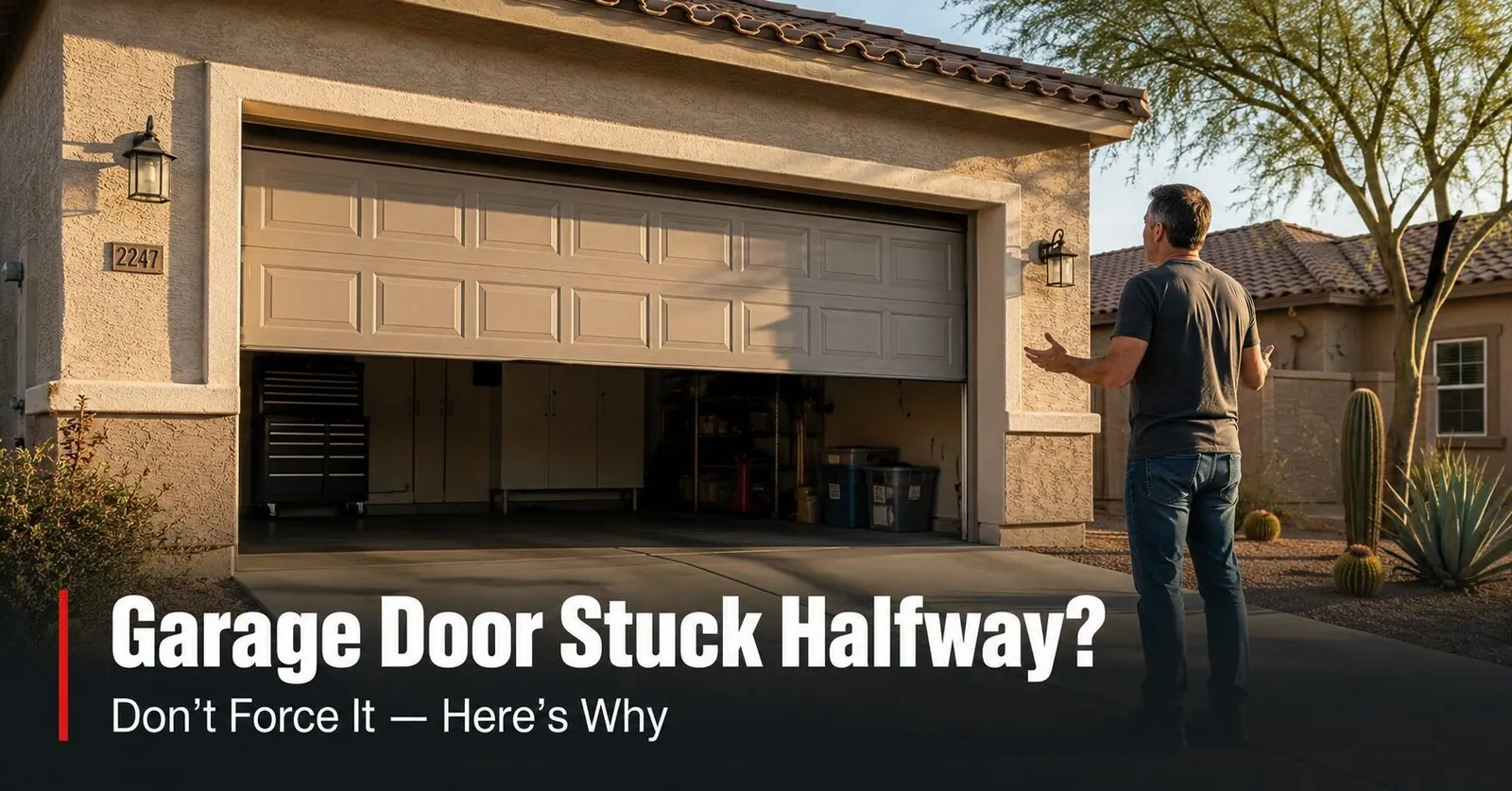
You hit the button, the door starts to move, and then it just… stops. Halfway up, halfway down, hanging there in the opening while the opener hums or sits silent. Your first instinct is to mash the button again or grab the bottom of the door and pull — and that's exactly the instinct we want to talk you out of for a minute.
A door that gets stuck partway isn't being stubborn. It's stuck because a part that's supposed to be doing its job has stopped doing it, and that part is almost always either the springs and cables that carry the door's weight or the track and rollers that guide it. Understanding which one will tell you whether the door is safe to be near at all. We get these calls from neighbors across the East Valley every week, so here's what's really going on and what to do about it.
The Short Answer: Should You Force It Down?
No. We know that's frustrating to hear when your car is trapped or your house is wide open, but forcing a stuck door is the one move that reliably turns a routine repair into an expensive one — and occasionally into an injury.
Here's why. Your garage door weighs well over a hundred pounds, and a double door can be far heavier. It doesn't feel that heavy day to day because the springs carry almost all of that weight, and the opener only has to nudge an already-balanced door. The moment a spring or cable fails, that weight has nowhere to go. Push the button and you're asking a small motor to hoist the full dead weight of the door — it strains, stalls, and you can burn it out. Pull the door by hand and you're now the only thing holding it up.
6 Reasons a Garage Door Gets Stuck Halfway
Most stuck-door calls trace back to one of these six. A couple are simple; a couple are jobs for a trained technician with the right tools.
1. A broken torsion spring (the most common cause)
The springs above your door — usually a single torsion spring or a pair on one shaft — store the energy that lifts the door. When one breaks, often with a loud bang like a gunshot, the opener is suddenly trying to lift the whole door alone. It may drag the door up a foot or two and stall, or the door may coast partway and stop.
One thing to clear up, because people worry about it: on a two-spring door, both springs sit on the same shaft across the top of the opening. So when one of the two breaks, the door doesn't tilt or hang crooked — it just becomes badly under-powered and stops or sags evenly. A door that's leaning to one side is a cable problem, not a spring one (that's next).
2. A frayed, broken, or slipped lift cable
The steel cables running down each side of the door translate the spring tension into lift. They fray over years of cycling and AZ heat, and they can snap or jump off the drum. When a cable lets go on one side, that side drops or stops while the other keeps tension — so the door catches, binds, and hangs lopsided partway through its travel.
3. The door has jumped off the track
If a roller pops out of its track — from a worn roller, a loose track bracket, a minor bump from a car, or a cable failure that let the door shift — the door binds at the height where the roller left the track and refuses to go any further. You'll often see a roller sitting outside the rail or a section pushed away from the wall.
4. Something is obstructing or binding the track
Sometimes the door stops at the same spot every time because something physical is in the way: a dent in the track, a bent roller stem causing a rhythmic bump, a bolt or piece of hardware that worked loose, or — very Arizona — a track packed with blown desert dust and hardened, varnished-up old grease. The door climbs to that point, hits resistance, and the opener gives up.
5. Opener travel or force limits are set wrong
Every opener has "limit" and "force" settings that tell it how far to travel and how hard to push before it decides something's wrong and stops. If those drift out of adjustment — common after a part swap, a power surge, or just age — the opener can stop the door short of fully open, or reverse and stop on the way down because it thinks it's hit an obstruction.
6. The opener overheated in the Arizona sun
Opener motors have a built-in thermal cutout that shuts them off before they cook. On a 110-degree afternoon, a motor that's already working harder than it should — usually because the door is slightly out of balance — can trip that cutout partway through a cycle and stop the door cold. Give it 15 minutes and it runs again, which is the tell-tale clue.
Where It Stops — and What That Tells You
The clue is often in where and how the door stops. Match what you're seeing to the most likely cause and whether it's safe to be near.
| What you're seeing | Most likely cause | Is it safe? |
|---|---|---|
| Loud bang, then door barely lifts or stalls low | Broken torsion spring | Stay clear — don't force or use manual release |
| Door hangs higher on one side / cable looks slack | Broken or slipped cable | Unstable — keep clear, call a tech |
| Door binds at the same height; section pushed out | Off-track / roller jumped | Don't run the opener; needs re-seating |
| Sticks at one exact spot, every time | Dent, debris, or bent roller in track | Inspect with opener off; clear loose debris |
| Moves freely by hand, but opener stops it short | Travel/force limits out of adjustment | Generally safe; needs opener adjustment |
| Only stops in the heat; runs again after cooling | Opener thermal cutout (often a balance issue) | Stop cycling it; have balance checked |
What to Do Right Now (and What Not to Do)
If your door is stuck in the opening as you read this, work through these steps in order.
- Stop pressing the button. Repeatedly hitting it while the opener strains can overheat or damage the motor and won't free a mechanical jam.
- Clear the area. Move cars, kids, and pets out from under the door. Assume it could move on its own until you know what's wrong.
- Look, don't touch. From a safe distance, check for a gap in the spring above the door, a loose or hanging cable, or a roller sitting outside the track. That visual tells you (and us) a lot.
- Don't pull the manual release while the door is up — unless you're sure the springs and cables are intact. The red cord disconnects the door from the opener, and if a spring or cable has failed, that's the only thing holding the door up. It can drop fast.
- If the door is stable and you must secure the opening, a technician can clamp it safely. Otherwise, leave it where it is.
- Call for a diagnosis. Tell us where it stopped and whether you heard a bang — that often pinpoints the problem before we arrive.
When you're ready, you can book a visit online or reach us by phone. If your door turned out to come off its track entirely, our guide on an off-track door walks through that repair, and if you heard that unmistakable bang, here's what a broken spring looks like up close.
Why East Valley Homeowners Call Farnsworth When the Door Gets Stuck
Farnsworth Garage Door Service was founded by brothers Brigham and Riley Farnsworth. The Farnsworth name carries 60+ years of business behind it across the East Valley — R&K, Farnsworth Wholesale, Farnsworth Realty — and we run this company the same way our family always has: find out what's actually wrong first, put the price in writing, then do the work right.
- We diagnose before we sell. A door stuck halfway can be a quick adjustment or a spring replacement — we tell you which before quoting a dollar.
- Springs, cables, rollers, and openers on the truck. Most stuck-door causes get fixed in one visit, not two.
- Same-day service is our standard, often within hours of your call.
- Written, itemized quote before any work begins. The price you agree to is the price on the invoice.
- 5.0 stars on Google. Our neighbors trust us — and tell their neighbors.
Stuck door, broken spring, or a door off its track? Explore our full repair services, our spring repair page, or see where we work across the East Valley.
Frequently Asked Questions
Is it safe to force a garage door down when it's stuck halfway?
No. A door that stops halfway is telling you something is wrong — usually a broken spring, a frayed or slipped cable, a roller that jumped the track, or an obstruction. Forcing it with the opener or by yanking on it can bend panels, pull more rollers out of the track, and turn a small repair into a big one. Worse, if a spring or cable has failed there's nothing counterbalancing the door's weight, so forcing it can let the door drop fast and hard. Stop, leave it where it is if it's stable, and have it looked at before you push or pull on it.
Why is my garage door stuck halfway open?
The most common causes are a broken torsion spring (the door suddenly feels far too heavy for the opener, which strains, moves it a little, and gives up), a frayed or slipped lift cable, a roller that has come out of the track, debris or a dent binding the door at a certain height, or opener travel and force limits that are set wrong. In an Arizona summer, an overheated opener motor can also cut out partway and stop the door until it cools. Where the door stops is a clue: a door that always sticks at the same height usually has a mechanical problem at that spot, while a door that strains anywhere points to a spring or balance issue.
My garage door stopped halfway and won't go up or down — what should I do?
First, keep people, pets, and vehicles out from under it. Don't repeatedly hit the button trying to force it — if the opener is straining you can overheat or damage it. Look (don't touch) for an obvious cause: a gap in the torsion spring above the door, a cable hanging loose, or a roller sitting outside the track. If the door looks like it's hanging at an angle or a heavy section is unsupported, treat it as unstable and stay clear. Then call a technician. A stuck door is almost always a quick diagnosis for a pro, and trying to wrestle it yourself usually adds damage.
Can a broken spring make a garage door stop halfway?
Yes — it's one of the most common reasons. Your springs do the heavy lifting; the opener is really just there to guide a door the springs have already balanced. When a spring breaks, the door's full weight lands on the opener, which isn't built to lift it. The opener may drag the door up a foot or two and then stall, or the door may coast partway and stop. On a two-spring door, both springs sit on the same shaft above the opening, so a single break doesn't make the door tilt — it just leaves it badly under-powered and prone to stopping or sagging. A loud bang followed by a door that won't lift is the classic broken-spring signature.
Should I pull the manual release if my door is stuck halfway open?
Be very careful here. The red manual-release cord disconnects the door from the opener so you can move it by hand — but it also removes the one thing holding a partially open door in place. If a spring or cable has failed and you pull the release while the door is up, the door can come crashing down because nothing is counterbalancing its weight. Only use the manual release if the door is already most of the way down, or if you've confirmed the springs and cables are intact and you can control the door's weight. If you're not sure, leave it connected and call a technician.
Why does my garage door get stuck halfway in the Arizona heat?
A few of our local conditions gang up on garage doors in summer. Opener motors have a built-in thermal cutout, and on a 110-degree afternoon a motor that's already working hard — often because the door is slightly out of balance — can overheat and shut off partway through a cycle, then run again once it cools. Heat also bakes the factory grease on rollers and hinges into a sticky varnish that drags, and blown desert dust packs into the tracks, so the door binds at the spot where the buildup is worst. If your door only acts up in the heat of the day and works fine in the cool morning, that's a strong hint to have the balance, lubrication, and tracks checked.
Will my garage door fall if it's stuck halfway?
If the springs and cables are intact, a halted door usually stays put. The danger comes when a spring or cable has failed, when the door is hanging at an angle, or when someone disconnects the opener with the manual release — any of those can let a heavy door drop without warning. Until you know what's wrong, the safe move is to assume it could fall: keep everyone clear of the opening, don't park a car under it, and don't pull the release. A technician can secure the door and tell you exactly what failed.
Door Stuck Halfway? Don't Force It — Let Us Take a Look.
Licensed, insured, locally owned. We diagnose springs, cables, tracks, and openers on-site and quote in writing before any work starts. Same-day service across the East Valley.