
Garage Door Bottom Seal Cracked or Worn? Why It Matters in AZ Dust & Monsoon
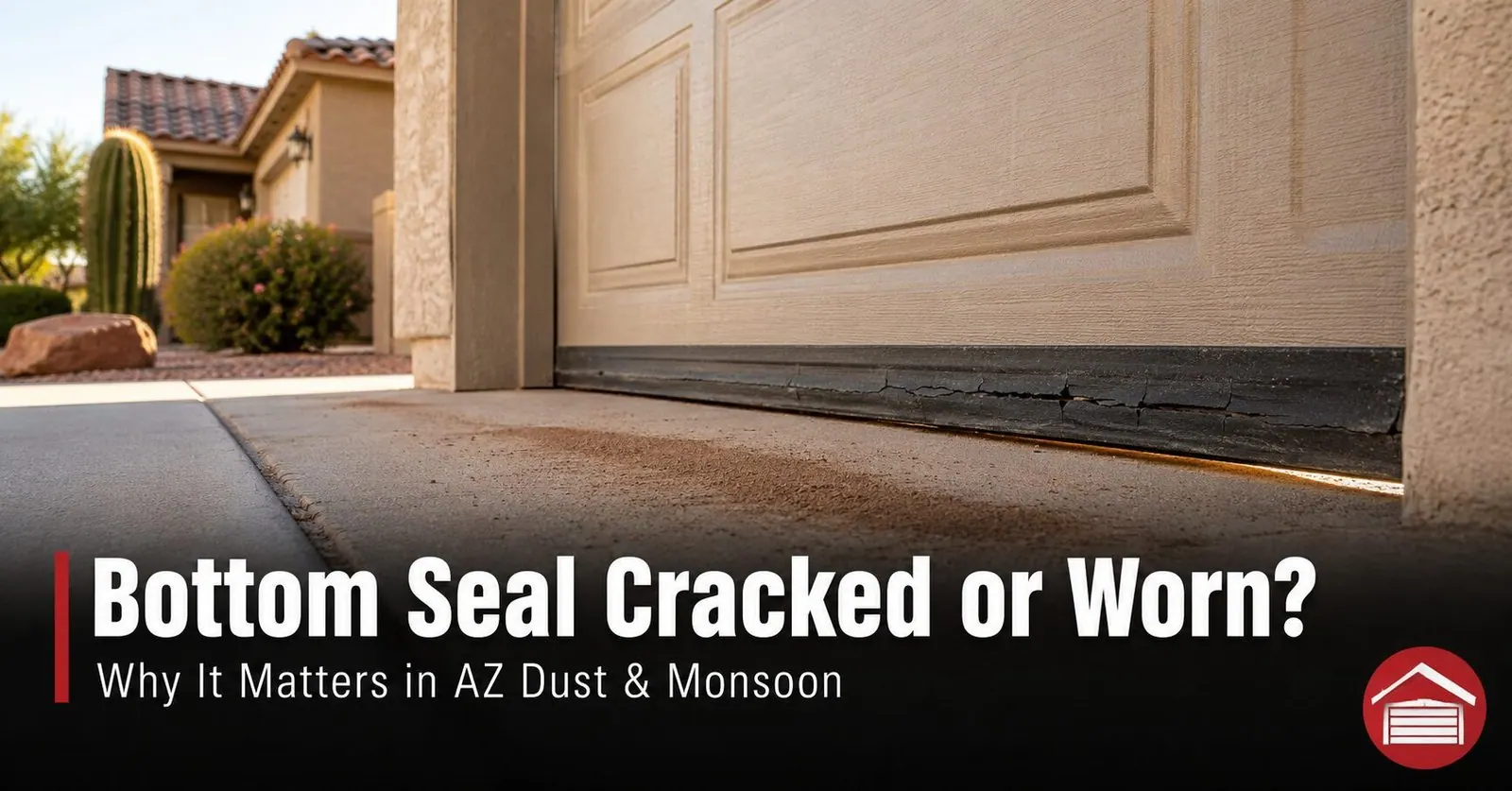
The rubber strip at the bottom of your garage door is the cheapest part of the whole system — and the part that does the most work in Arizona. It blocks dust, monsoon rain runoff, scorpions, hot air, and rodents from getting under the door, and it cushions the door against the concrete every time it closes. Three things tell you it's done:
- Visible damage — cracks, flattening, brittle edges, missing chunks, or a seal that has split end-to-end.
- Gaps you can see daylight through when the door is closed, especially at the corners.
- Dust, water, or critters showing up inside the garage when none did before.
In our climate a seal typically lasts 3–7 years for vinyl and 5–10 for higher-grade EPDM rubber before it cracks out from UV, heat cycles, and monsoon dust. Replacing one is one of the highest-ROI maintenance items on an Arizona garage door, and it's often the difference between a clean garage floor and a layer of fine red dust every morning during monsoon season.
Walk down any street in Mesa, Gilbert, or Queen Creek in late August and you can almost guess which homes need a new bottom seal without leaving the sidewalk. The clue isn't the door itself — it's the half-moon of brown dust on the concrete just inside the garage, baked there by monsoon dust storms that blew under the door at 3 a.m. while the homeowner slept. That dust got in because the rubber strip on the bottom of the door is cracked, flattened, brittle, or simply gone — and the same gap that lets the dust in is also leaking your AC, inviting scorpions, and quietly wearing the bottom panel of the door every time it closes.
The bottom seal is the unsung component of a garage door. It's the cheapest part of the system, it gets the worst treatment of any part, and almost no one thinks about it until a haboob blows through. Here's how to tell when yours is done, what's actually killing it in Arizona, and what to do about it.
What the Bottom Seal Actually Does
The bottom seal — sometimes called an astragal, T-rubber, or P-bulb depending on its shape — is the flexible rubber or vinyl strip on the underside of the lowest panel. It slides into an aluminum retainer track that's screwed to the bottom of the door, and it's designed to compress against the garage floor when the door closes. Quietly, it does five jobs at once:
- Seals out dust, dirt, leaves, and water from blowing or running under the door.
- Blocks pests — scorpions, crickets, mice, lizards — from squeezing through what would otherwise be an open invitation.
- Cushions the door against the concrete so the bottom panel doesn't crack or dent over thousands of cycles.
- Insulates — closing off the temperature exchange between a 140°F garage and a 75°F house.
- Conforms to small floor imperfections — a flexible seal hides the fact that no concrete slab is perfectly flat.
When it's working, you don't think about it. When it's done, every one of those jobs starts going wrong at the same time.
Why Arizona Is Especially Brutal on Bottom Seals
National-average lifespans for a bottom seal hover around 8–15 years. In the East Valley, we're seeing replacements at half that. Four climate-driven reasons:
- UV exposure. The bottom edge of a garage door sees direct, low-angle sun for hours every day. UV breaks down the polymer chains in rubber and vinyl — the same way it ages outdoor patio cushions and pool toys. Vinyl seals chalk and crack first; EPDM rubber lasts longer but still gives out faster here than in Ohio.
- Heat cycling. The seal sits between a 160°F concrete slab and a 140°F garage interior during summer afternoons, and a 50°F slab on winter mornings. Repeated expansion and contraction works hardness into the rubber until it stops springing back.
- Monsoon dust. Haboob-scale dust storms drive fine grit into the seal's contact face and into the retainer track itself. That grit becomes an abrasive every time the door closes. Over a couple of monsoon seasons it grinds the seal flat from the bottom up.
- Snowbird cycling patterns. Many homes here open and close the garage door dramatically more in winter (when residents are around) than in summer (when they're not), or vice versa for primary residents who spend the day in the AC. Uneven cycling means uneven wear, and the door often closes harder on one side than the other.
Plus, in the foothills around Apache Junction, Gold Canyon, and parts of San Tan Valley, scorpion populations make a worn seal a real safety issue, not just a comfort one. We get more "I keep finding scorpions in the garage" calls in those areas than anywhere else in our service area, and the first thing we check is always the bottom seal.
6 Signs Your Bottom Seal Needs Replacing
These are the patterns we see most often on East Valley service calls.
1. You can see daylight under the closed door
Walk into the garage in the middle of the day with the door fully closed and look at the floor along the bottom edge. If you can see a thin line of daylight at any point — usually the corners go first — that's the most direct evidence you can get. Even a quarter-inch gap is enough for dust, water, and pests.
2. The seal is visibly cracked, brittle, or chunked out
Look at the seal from outside with the door closed and from inside with it open. A healthy seal is uniformly flexible and roughly the same shape end-to-end. A failing seal shows hairline cracks running along the bulb, chunks broken out near the corners, a brittle edge that crumbles when you pinch it, or whole sections that have flattened into a hard strip instead of a soft tube.
3. Dust, sand, or water is showing up inside
The morning-after-monsoon dust line is the most obvious one. If you're sweeping fine brown grit off the garage floor in late summer, or finding small puddles after a heavy rain, the seal isn't doing its job. Same story for crickets, lizards, or scorpions appearing in a garage that used to be sealed.
4. A loud thud, slap, or pop when the door closes
A new bottom seal cushions the door against the concrete. A flattened or missing seal lets the bottom of the door slam straight onto the slab. You'll hear a sharper thud than usual, and over time that impact cracks the bottom panel, loosens the cable connections at the bottom brackets, and stresses the rollers.
5. The seal is the original one from when the home was built
Builders use the cheapest acceptable seal, often a basic vinyl strip. Builder-grade vinyl in the East Valley typically lasts 3–5 years before it starts to harden. If you bought the home new and it's now past that window — and the seal has never been changed — it's almost certainly done even if it still looks okay from a distance.
6. The retainer track itself is bent, corroded, or pulling away
The aluminum channel on the bottom of the door holds the seal. If something hit the bottom of the door — a kid's bike, a car bumper, a lawn mower — the retainer can bend out of shape. Once it's bent, no seal seats correctly, and the door no longer closes flat.
What You're Seeing — and What's Behind It
Match the symptom to the most likely cause before opening the toolbox or making the call.
| What you're seeing | Most likely cause | Fix |
|---|---|---|
| Dust line across the floor every morning | Worn or cracked seal across the full length | New bottom seal; consider threshold seal too |
| Daylight visible only at the corners | Door sagging, floor uneven, or bottom corners worn | Threshold seal + balance check + new bottom seal |
| Water under the door after a monsoon | Driveway slope toward the door + worn seal | New seal + threshold dam; consider exterior drainage |
| Scorpions or crickets appearing inside | Any gap large enough for a credit card | New rubber seal + threshold seal, both fresh |
| Loud thud or slap when the door closes | Seal flattened or missing; no cushion left | Replace seal promptly — protects the bottom panel |
| Seal looks fine but garage smells musty | Side jamb weather stripping is the bigger leak | Replace side and top weather stripping at the same time |
| Bottom panel of the door is cracking or dented | Years of impact without a working seal cushion | New seal first; panel replacement if structural damage |
DIY vs. Calling Us Out
Bottom seal replacement is one of the more DIY-friendly repairs on a garage door — with caveats.
A reasonable DIY job if…
- Your door has a standard aluminum T-end retainer that's in good shape.
- You can identify the seal profile (T-end with the right width) and order the right replacement length.
- You have a helper, dish soap or silicone spray as a lubricant, a screwdriver, and a flat-blade tool to coax the old seal out of the retainer.
- You're comfortable working on a ladder or with the door propped open carefully.
A service call if…
- The retainer track itself is bent, corroded, or needs replacement.
- The old seal is fused or glued into the retainer (very common after years of AZ heat) and a regular pull won't budge it.
- Your door uses a U-shape or older J-channel system rather than a modern T-retainer.
- You also need a threshold seal installed to seal an uneven slab.
- You're seeing dust, daylight, or critters at the corners specifically — that's often a balance, sagging, or cable issue, not just a seal.
- You'd rather bundle the seal swap into a full tune-up that also covers rollers, hinges, and lubrication.
How to Make the Next Seal Last Longer
You can't beat Arizona UV forever, but a few habits double the life of a new seal.
- Upgrade to an EPDM rubber seal on the replacement, not the cheapest vinyl. The price difference is small, the lifespan difference is real.
- Add a threshold seal bonded to the concrete to meet the door seal halfway. Two cheap parts seal far better together than one expensive part alone.
- Sweep the contact track after monsoon dust storms so grit isn't ground into the seal on the next cycle.
- Keep the bottom of the door clean. Dust caked on the bottom retainer abrades the new seal from above.
- Bundle it into an annual tune-up. Most worn seals are part of a broader pattern — dry rollers, loose hardware, dusty tracks. A real spring tune-up catches all of it in one visit. See our tune-up service.
- Replace the side and top weather stripping at the same time. It's the same rubber doing the same job around the door's perimeter, and it ages at the same rate.
Why East Valley Homeowners Call Farnsworth for Bottom Seal Work
Farnsworth Garage Door Service was founded by brothers Brigham and Riley Farnsworth. The Farnsworth name has 60+ years of business across the East Valley behind it — R&K, Farnsworth Wholesale, Farnsworth Realty — and we run this company the same way our family has always run a business: tell the truth about what's wrong, put the price in writing, do the work right the first time.
- We stock multiple seal profiles on the truck. Most calls get sorted in one visit, including the right retainer if yours is bent or corroded.
- We upgrade you to EPDM rubber by default. No charging extra for a part that should have been on the door from day one.
- We install threshold seals when they're needed, not just when they make the invoice bigger.
- We diagnose what's actually leaking — sometimes the bottom seal isn't the only problem, and we'll tell you that up front.
- Same-day service is our standard, often within hours of your call.
- 5.0 stars on Google. Our neighbors keep us busy by telling theirs.
If you're seeing dust, daylight, or critters under the door, see our weather stripping and bottom seal replacement page, our full repair services, or where we work across the East Valley.
Frequently Asked Questions
How long does a garage door bottom seal last in Arizona?
In most parts of the country a quality EPDM rubber bottom seal lasts 8 to 15 years. In Arizona, that window collapses to roughly 3 to 7 years for vinyl seals and 5 to 10 years for higher-grade rubber. UV exposure breaks down the polymer chains, repeated 115-degree heat cycles bake the flexibility out, monsoon dust embeds in the rubber, and the door slamming the seal against gritty concrete a few thousand times a year wears the contact face flat. If your home is more than five years old and the seal has never been replaced, it is almost certainly past its prime even if it still looks intact from a distance.
Can I replace a garage door bottom seal myself?
Sometimes yes. If your door has an aluminum retainer track on the bottom and the new seal slides straight in, it is a 30 to 45 minute job with a screwdriver, dish soap as lubricant, and a helper to feed the seal across. The catch is that the existing seal is often glued, kinked, or fused into the retainer with decades of dust and heat, and the retainer itself can be bent or corroded. If the retainer is damaged, missing, or your door uses a vinyl-only track or older U-channel system, the job gets harder fast and is usually a service call. A pro brings the right T-end size, the right length, the lubricant, and the experience to swap a stuck retainer without bending the bottom panel.
What size garage door bottom seal do I need?
Most modern residential garage doors use a T-end seal that slides into an aluminum retainer with two parallel channels. The most common T-end sizes are 1/4 inch and 5/16 inch, with width ranging from 3-1/2 inch to 5-1/2 inch depending on the gap you need to close. Older doors may use a P-bulb single T-end, a U-shape that wraps around the door bottom, or a J-channel. Measuring wrong is the most common DIY mistake. If you are not sure, pull a six-inch piece of the old seal out of the retainer, take a photo of the cross-section, and either match it at a hardware store or send it to us before ordering.
Why is dust still getting under my garage door after I replaced the seal?
Dust intrusion after a bottom seal replacement almost always traces to one of three things. First, the garage floor is uneven. Concrete slabs settle, crown, or wear unevenly over time, and a seal that closes flat in the middle can have a half-inch gap at the corners. The fix is a threshold seal bonded to the floor that meets the door seal halfway. Second, the seal size is wrong — a 3-inch wide seal cannot reach across a 1-inch gap. Third, the door itself is sitting crooked because of a cable, drum, or spring issue, which holds one corner up. If you replaced the seal and the dust line is still on the garage floor in the morning, the next thing to check is the door balance and the floor itself, not another seal.
Does a bottom seal really keep scorpions out?
A good seal makes a real difference, but it is not a silver bullet. Bark scorpions can squeeze through a gap as small as the width of a credit card, which means any opening between the door and the floor is a way in. A fresh, flexible seal that meets the concrete cleanly closes that pathway. Add a threshold seal bonded to the floor and you close the second pathway. Where homeowners run into trouble is the corners, where the seal often does not fully reach. We see far fewer scorpion calls in homes with a fresh bottom seal plus a threshold seal than in homes with one or neither, especially in Apache Junction, Gold Canyon, and parts of San Tan Valley where the foothill scorpion population is heaviest.
Will replacing my bottom seal lower my electric bill?
If your garage is attached to your house and the door between them is not sealed, then yes, a fresh bottom seal can meaningfully reduce how hard your HVAC is working. A worn seal with a 1/2-inch gap across a 16-foot opening is the equivalent of leaving an 8-inch by 16-inch window open all summer. Cooled house air leaks into the garage, heat from the garage migrates into the living space, and your air conditioner runs harder to keep up. We have had Mesa and Chandler homeowners report 5 to 10 percent drops in summer AC runtime after sealing the garage door properly, especially when combined with a threshold seal and weather stripping on the side jambs.
How much should a garage door bottom seal replacement cost in Arizona?
Pricing depends on the size of the door, the seal type and length, whether the retainer needs to be replaced or just the rubber, and whether you bundle it with other service. As a general framing, a straightforward T-end rubber swap on a standard 16-foot door is one of the most affordable repairs you can have done, often bundled into a tune-up visit. A full retainer replacement, a custom seal on an oversized door, or adding a threshold strip raises the total. We always quote in writing before any work starts, and we will give you the price up front so there are no surprises. Call or text us at (602) 935-9766 for a current quote — [FILL IN: Riley's standard seal-only price range and threshold-seal upsell price].

Dust, Daylight, or Scorpions Under Your Door? Let's Seal It Up.
Licensed, insured, locally owned. We carry multiple seal profiles on the truck, install threshold seals when they're called for, and quote in writing before any work starts. Same-day service across the East Valley.