Custom vs Stock Garage Doors: When to Splurge and When to Save
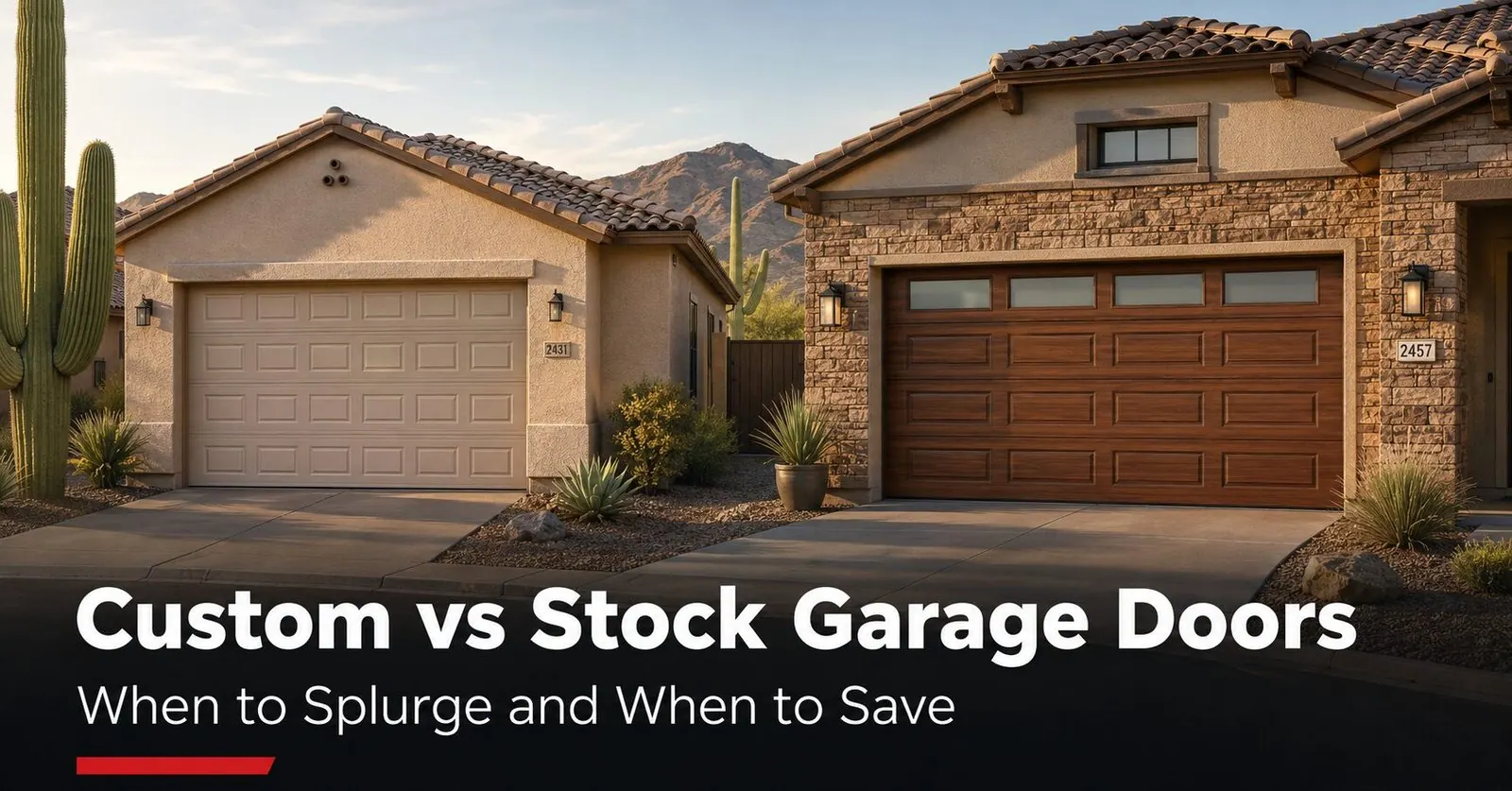
Neither is automatically the smart buy — it comes down to your opening, your home's style, and your timeline:
- Save with a stock door when you have a standard-size opening, want it sooner, or are replacing a builder-grade or rental-property door. Modern stock styles already look sharp, and the money goes further on insulation and hardware.
- Splurge on a custom door when your opening is an odd size, you're matching a distinctive architectural look, you want full-view glass or a real-wood finish, or the door is the centerpiece of the home's front.
- The middle path — semi-custom — is a stock door dressed up with windows, a designer color, upgraded insulation, and carriage hardware. For most East Valley homes, it's the sweet spot.
Below: what each term really means, lead times, the Arizona heat angle, and a situation-by-situation way to decide.
When a homeowner is shopping for a new door, "custom or stock?" is one of the first forks in the road — and it's one the brochures rarely explain honestly. Drive through a newer Queen Creek or Gilbert subdivision and nearly every home wears a stock door, because builders order them by the truckload. Roll up into the custom homes of Gold Canyon or north Scottsdale and you'll see real-wood and full-view glass doors that were built one at a time to match the house. Both have their place. The trick is knowing which problem you're actually solving — fit, looks, speed, or budget — so you don't overspend on a word or undershoot on a door you'll look at every single day. Here's how we walk our neighbors through it.
What "Stock" and "Custom" Actually Mean
A stock door is built to standard sizes and offered in a set menu of styles, colors, and insulation levels straight from the manufacturer's catalog. The common 16×7 two-car door and the 9×7 single you see on most East Valley homes are stock. Because those configurations are made in high volume — and often kept in regional inventory — they arrive faster and cost less. Stock doesn't mean basic, either: the major brands' stock lines run all the way up to premium insulated and designer-look models.
A custom door is built to order. That can mean a non-standard size for an unusual opening, a special color or finish, a premium material like real wood or full-view glass and aluminum, or a design that simply isn't on the standard menu. Custom gives you exactly the fit and look you want — but each one is produced individually, so it takes longer to make and costs more.
The most useful way to think about it: stock is about choosing from what's already designed; custom is about designing what you want. Most Arizona homes are genuinely well served by a quality stock door. Custom earns its keep in specific situations — and the rest of this guide is about spotting which one you're in.
Stock vs Custom: Side by Side
Here's how the two approaches compare on the things that actually shape your decision:
| Factor | Stock Door | Custom Door |
|---|---|---|
| Sizing | Standard widths and heights only (common 8, 9, 16 ft widths; 7–8 ft heights). | Built to your exact rough opening — ideal for odd or oversized openings. |
| Design choices | A set menu of styles, colors, windows, and insulation levels. | Open-ended — specialty materials, finishes, and one-off designs. |
| Lead time | Faster — produced in volume, often stocked regionally. | Longer — each door is made to order. |
| Cost | Lower for comparable construction grade. | Higher — you pay for the made-to-order fit and look. |
| Best fit | Standard openings, replacements, rentals, faster turnarounds. | Unusual openings, statement homes, specialty looks. |
| Replacement parts later | Common — panels and hardware are easy to match. | Can be harder to source if a section is damaged years on. |
One row worth lingering on is that last one. Down the road, if a section gets backed into, a stock door's panel is far easier to match and order. A discontinued custom panel can be a project. It's not a reason to avoid custom — just a real cost to weigh when a stock door would have served the same home.
When to Save: Go Stock
For a large share of East Valley homes, a stock door is the right call — not a compromise. Lean stock when:
Your opening is a standard size
If your garage was built to a common size — and most production homes in Mesa, Chandler, Gilbert, Queen Creek, and San Tan Valley were — a stock door drops right in. There's no fit benefit to paying for custom dimensions you don't need.
You need the door sooner
When a door is already broken, off-track, or storm-damaged, getting the garage secured and working again is the priority. Stock doors in common sizes move faster, which matters when your home's biggest opening is sitting exposed. If you're in that spot right now, our garage door repair team can get you stabilized while you decide on the replacement.
It's a rental or builder-grade replacement
For a rental property or a straightforward like-for-like swap, a durable stock door in a clean style does the job and keeps the budget where it belongs. Tempe landlords and property managers, especially, tend to get the best return from reliable stock doors.
You'd rather spend on performance than shape
On a standard opening, a modern stock door already looks great. The dollars often do more good going toward a higher insulation level — which pays off all summer in our heat — than toward a custom shape nobody will notice. Browse the new door options and you'll see how sharp current stock styles really are.
When to Splurge: Go Custom
Custom isn't about prestige — it's about solving something a catalog door can't. Lean custom when:
Your opening is an odd size
Older Phoenix and Mesa homes, additions, and some architect-designed builds have openings that don't match standard widths and heights. Forcing a stock door onto an opening it doesn't fit leads to gaps, poor sealing, and tracking trouble — a genuine problem in our dust and monsoon season. A made-to-measure door is the clean fix. (We measure the opening at three points and order to the smallest, because the tightest dimension is the one that has to fit.)
You're matching a distinctive home
On a custom or high-design home — common in Gold Canyon, north Scottsdale, and the Superstition foothills — the garage door is one of the largest surfaces on the front of the house. When the architecture is specific, a custom door that echoes the home's lines, materials, and color does something a stock door can't, and it shows.
You want full-view glass or real wood
Full-view aluminum-and-glass doors and authentic wood doors are signature looks, and they're almost always custom territory. If that's the statement you're after, this is where the splurge buys something real.
The door is the centerpiece
Some homeowners simply want the front of the house to turn heads, and the garage door is the canvas. When curb appeal is the goal and the budget supports it, a custom door delivers a result a menu can't. When you're ready, our installation team handles custom builds end to end.
The Middle Ground: Semi-Custom
Here's the option most homeowners actually land on, and it rarely gets named in the brochures: semi-custom. You start with a stock door in a standard size, then upgrade the handful of pieces that make the biggest visible difference.
That usually means some mix of: a higher insulation level for the heat, decorative window inserts, a designer or wood-grain color, and carriage-house hardware like handles and decorative hinges. The result reads as a premium door — but because the underlying door is still a standard size, you skip the cost and the longer lead time of a fully made-to-order build.
For the typical East Valley home with a standard opening, semi-custom is the sweet spot. It captures most of the curb-appeal jump for a fraction of the leap to true custom, and the parts stay easy to match later. If you like the idea of a stand-out door but your opening is ordinary, this is usually where we point people first.
The Arizona Heat Factor
Whichever way you lean, our climate should sit in the decision — because a few choices that look great in a showroom behave differently against a west-facing wall in July.
Dark and dramatic runs hot
Deep, dark custom colors are gorgeous and very on-trend, but dark surfaces soak up heat, and a west- or south-facing door takes the full force of the afternoon sun. It's still a workable choice here — just one to pair with good insulation and a heat-tolerant finish rather than pick on looks alone.
Full-view glass is stunning — and a heat path
Full-view glass-and-aluminum doors are one of the most striking custom looks going, but plain glazing lets radiant heat pour into the garage. If you love the look, insulated or tinted glass keeps the drama without turning the garage into an oven.
Insulation usually beats shape, dollar for dollar
In our heat, an insulated door keeps an attached garage meaningfully cooler and eases the load on the home's air conditioning — a benefit you feel every summer. On a standard opening, that's often where the next dollar does the most good, ahead of a custom shape. It's a recurring theme in how we advise: spend on what the Arizona sun actually rewards.
Lead time matters more in monsoon season
When a summer storm damages a door, a faster-arriving stock door gets your home closed up sooner — worth remembering if you're weighing a custom build during the stretch of the year when storms roll through.
Why East Valley Homeowners Call Farnsworth
- Brothers-built and locally owned. Brigham and Riley Farnsworth founded this company, and the Farnsworth name has stood behind East Valley businesses for over sixty years.
- Straight advice, not the priciest door. We'll tell you when a stock or semi-custom door serves your home just as well — and when custom is genuinely worth it.
- Measured and quoted on site. We measure your actual opening and put your real options in writing, so you choose with numbers instead of a brochure guess.
- Sized for our climate. Right insulation, right hardware, and a balanced door before any opener goes on — that's what makes a door last in the heat.
- Same-day service is our standard, often within hours of your call.
- 5.0 stars on Google. Our neighbors keep us busy by telling theirs.
Planning a new door? Explore our new garage door options, learn about professional installation, or see where we work across the East Valley.
Frequently Asked Questions
What is the difference between a stock and a custom garage door?
A stock door is built to standard sizes and offered in a set menu of styles, colors, and insulation levels straight from the manufacturer's catalog — think the common 16×7 two-car and 9×7 single doors you see across most East Valley neighborhoods. Because those configurations are made in volume and often kept in regional inventory, they arrive faster and cost less. A custom door is built to order: a non-standard size, a special color or finish, premium materials like real wood or full-view glass and aluminum, or a design that isn't on the standard menu. Custom gives you exactly the look and fit you want, but it takes longer to produce and costs more. Most Arizona homes are well served by a stock door; custom earns its place when the opening is unusual or the look really matters.
Are custom garage doors worth the extra cost?
They're worth it when they solve a real problem a stock door can't. If your opening is an odd size, if you're matching a distinctive architectural style on a Scottsdale or Gold Canyon custom home, if you want full-view glass or a real-wood look, or if the door is the centerpiece of the front of the house, a custom door delivers something a catalog door simply can't. Where custom is harder to justify is on a standard opening where a stock door in a modern style already looks great — there, the money is often better spent on insulation and quality hardware than on a custom shape. The honest test: are you paying for fit and a look you genuinely can't get otherwise, or just for the word "custom"? We're glad to lay both options side by side so the decision is clear.
How long does a custom garage door take to order in Arizona?
It varies by manufacturer, material, and how busy the factory is, but the pattern is consistent: stock doors in common sizes and colors move the fastest because they're produced in volume and often stocked regionally, while custom builds take meaningfully longer because each one is made to your spec. Special finishes, real wood, and full-view glass doors usually sit at the long end. That lead-time gap matters most when a door is already broken or storm-damaged and you need the garage secured quickly — in those situations a stock door gets your home closed up sooner. We don't promise specific timelines because they shift with supply, but we'll always tell you the realistic range for the exact door you're considering before you commit.
Can I get a custom size garage door for an odd opening?
Yes, and that's one of the best reasons to go custom. Older Phoenix and Mesa homes, additions, and some custom builds have openings that don't match standard 8, 9, or 16-foot widths or the usual 7- and 8-foot heights. Forcing a stock door onto an opening it doesn't fit leads to gaps, poor sealing, and tracking problems — a real issue in our dust and monsoon climate. A made-to-measure door is built to your actual rough opening so it fits cleanly and seals properly. We measure on site at three points across the opening and use the smallest dimension, because the width that matters for ordering is the tightest one, not the nominal label.
Do custom garage doors hold up in Arizona heat?
They can, but the material and finish matter more than whether the door is custom. Two things to watch in our climate: dark custom colors absorb a lot of heat and can run hot on a west-facing door, and full-view glass-and-aluminum doors look stunning but let radiant heat into the garage unless you choose insulated or tinted glazing. A custom door built in an insulated steel construction with a heat-tolerant finish holds up beautifully here. The mistake isn't choosing custom — it's choosing a finish or glazing for looks alone without thinking about a west-facing wall in July. We talk through orientation and material with every door so the choice looks great and survives the summer.
What is a semi-custom garage door?
A semi-custom door is the middle ground a lot of homeowners land on. You start with a stock door in a standard size, then upgrade the pieces that make the biggest visible difference — a higher insulation level, decorative window inserts, a designer color, carriage-house hardware, or a wood-grain finish. You get a noticeable step up in looks and performance without paying for a fully made-to-order shape or a non-standard size. For most East Valley homes with a standard opening, semi-custom is the sweet spot: it captures most of the curb-appeal upgrade for a fraction of the jump to a true custom build.
Is a stock garage door lower quality than a custom one?
No. Stock doesn't mean cheap or flimsy — it means standard size and a set menu of options. Major manufacturers build their stock lines in the same factories, with the same steel, insulation, and hardware as their custom work, all the way up to premium insulated and designer models. A well-built stock door from a quality line, installed correctly with the right springs and struts, will outlast a custom door that was installed poorly. Quality comes from the construction grade and the installation, not from whether the door was made to a standard size or a custom one. The right question isn't stock versus custom — it's which construction grade fits your home and how well it's put in.

Not Sure Whether to Go Custom or Stock?
Licensed, insured, locally owned. We'll measure your opening, look at your home's style and your timeline, then walk you through stock, semi-custom, and custom options in writing — with straight advice on where the money's worth it and where it isn't. Same-day service is our standard, often within hours of your call.