
Why Does My Garage Door Reverse Before It Closes? 7 Causes That Aren't the Sensors
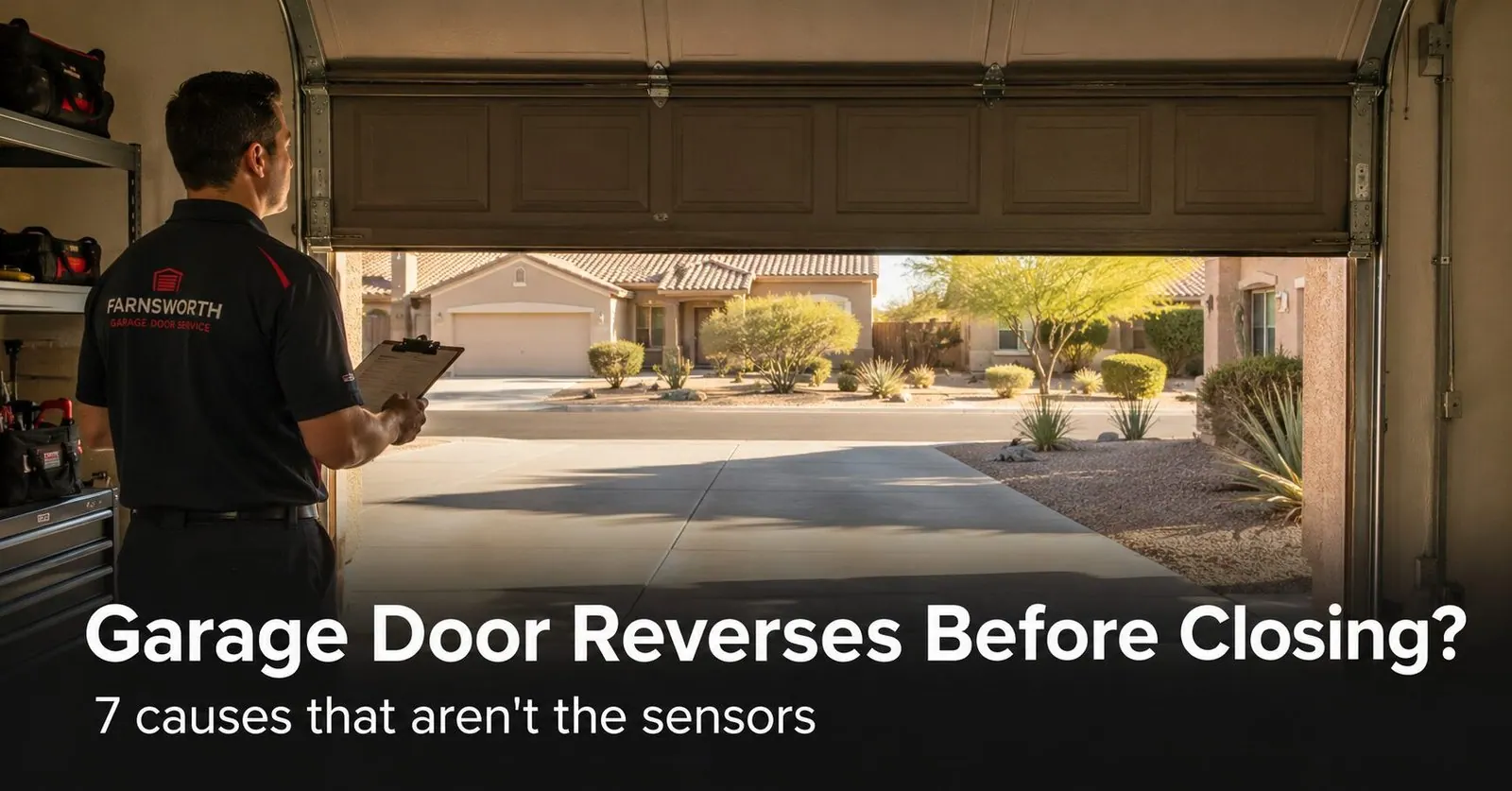
You press the wall button, the door starts to close, it gets within a foot of the ground, hesitates for a heartbeat, and then reverses back up. You check the safety sensor LEDs near the floor — both steady, both green. So it's not the sensors. What is it?
Every modern garage door opener has three independent safety systems, and most homeowners only know about one of them. The photo-eye sensors are the obvious one. The other two — the close travel limit and the down-force obstruction detector — are quieter, but they're what catches your door when something is binding, dragging, or out of adjustment. When either one trips, the opener does exactly what it's designed to do: stop the door, reverse it to the fully open position, and refuse to try again until you address whatever it saw.
The hardest part about diagnosing this from a homeowner's seat is that the door looks like it's working — until that final foot. This guide walks through the seven mechanical and opener-side causes we see across the East Valley, how to tell them apart, and the order to check them in before you call us.
The Two Safety Systems That Aren't the Sensors
If you've already confirmed the safety sensor LEDs are steady, the opener is using one of two other safeguards to reverse the door.
The close travel limit tells the opener exactly how far down the door should travel before the motor cuts off. It's a learned position, set when the opener was installed. How you adjust it depends on the age of your unit: older chain-drive openers use two small adjustment screws on the motor head labeled UP and DOWN, while newer openers (LiftMaster Security+ 2.0, current Chamberlain, Genie wall-mount and most models built in roughly the last decade) have no screws at all — the limits are set electronically with program or arrow buttons on the motor head's control panel. If that limit is set even half an inch past where the door actually meets the floor, the opener keeps driving down after the door has stopped — and reads the resistance as an obstruction.
The down-force obstruction detector watches motor current. When the door encounters anything that makes the motor work harder than expected — a dragging seal, a seized roller, a hinge that's lost its grease, a spring that's no longer carrying its share of the weight — the current spikes, the opener says "that's an obstruction," and reverses. Federal safety standards have required this since 1993, and it's been refined every model year since.
Both systems are doing their job correctly. They're just telling you something physical needs attention.
The 7 Causes We See Most Often
These are the calls we run across Mesa, Gilbert, Chandler, Queen Creek, and the rest of the East Valley. They're listed in roughly the order we check them on a diagnostic visit, fastest and cheapest first.
1. Close travel limit set too far
Number one by a long margin. The door reaches the floor, the opener keeps pushing, the motor binds for a fraction of a second, and the down-force circuit reads it as an obstruction. The tell is sound: you'll hear a small thud or a strained "umph" right before the door reverses. It's especially common after a new floor coating, a fresh garage floor pour, or any time the floor level has changed.
2. Down-force sensitivity set too aggressive
Some installers leave the down-force sensitivity dial near the low (most sensitive) end of its range, which is great for safety but unforgiving of any added friction. A door that's slightly out of tune, a roller that's lost a little grease, or a stiff cold-morning weather seal can all push the door past the sensitivity threshold and trigger a reverse — even though nothing is actually wrong.
3. Worn or seized rollers
A residential garage door has 10 rollers — two at the top of each panel. The nylon ones with sealed bearings glide quietly for 8–12 years in cooler climates. In Arizona, hot garage interiors dry out the bearings and crack the nylon faster — closer to 6–8 years on a builder-grade set. A roller with a flat spot or a stiff bearing forces the opener to pull more current right around the spot where the door's weight transfers to the curve of the track. That's exactly where the reverse happens.
4. Dragging or hardened bottom seal
The rubber astragal at the bottom of the door is supposed to compress against the floor and seal out dust and water. After a few Arizona summers, that rubber gets hard and brittle, and instead of compressing it grabs the concrete and drags. The opener reads the drag as resistance and reverses. Same thing happens if the concrete slab has a chipped edge or a small pebble caught right at the threshold.
5. Dry, stiff, or worn hinges
Each panel-to-panel hinge has a pivot point that needs a light coat of garage-door-specific lubricant once a year. When hinges dry out, they bind right as the door transitions from the vertical track into the horizontal curve — which is the same point where the door has to roll the last foot to the floor. The added resistance trips the down-force sensor.
6. Springs out of balance
A properly tuned torsion spring (or pair of springs) supports the entire weight of the door so the opener only has to overcome friction. When the springs lose tension — they're rated for a certain number of cycles, usually 10,000 on a builder-grade set, and Arizona's heat can shorten that — the door becomes heavier at the bottom of its travel. The opener works harder than it should, the down-force sensor trips, and the door reverses.
7. Cable beginning to slip on the drum
The lift cables wind onto a grooved drum at each end of the torsion shaft as the door opens, and unwind as it closes. When a cable starts to fray, get slack, or jump out of its groove, the door cants slightly, one side picks up more load than the other, and the opener's force sensor trips. You'll often see a small length of cable dangling near the bottom bracket or hear a snap or twang as the door moves. This is the most urgent of the seven — keep using the door this way and the cable can fail completely, dropping the door to one side and pulling it off track.
Quick-Reference Diagnostic Table
Match the symptom to the most likely culprit so you know where to start.
| What you notice | Most likely cause | First thing to check |
|---|---|---|
| Audible thud right before reverse | Close travel limit set too far | Back off the close (DOWN) limit — screw on older units, program/arrow buttons on newer ones |
| Reverses in the exact same spot every time | Worn roller, dry hinge, or kinked track section at that point | Watch the rollers and track at that spot during a close cycle |
| Only happens in summer or on hot afternoons | Heat-stiffened seal, expanded track, or springs near end of life | Lube all rollers and hinges; inspect the bottom seal for cracks |
| Door feels heavy when lifted by hand (opener disconnected) | Springs out of balance or losing tension | Call a tech — do not adjust torsion springs yourself |
| Door looks slightly crooked or tilted at the bottom | Cable beginning to slip on one drum | Stop using the door — visible cable slack is unsafe |
| Reverses right after a new garage floor coating or new seal | Close limit needs re-learning at the new floor height | Re-set the close travel limit |
| Reverses inconsistently — sometimes closes, sometimes doesn't | Sensitivity dial set too aggressive, or intermittent binding | Full lube + tune-up; then revisit the down-force adjustment |
A 4-Step Homeowner Checklist Before You Call
These four steps catch the easy causes safely. Stop and call us if anything looks worse than expected, or if you reach a step you're not comfortable with.
- Look for visible obstructions or debris at the threshold. Sweep the slab edge, check for chips, and look at the bottom seal for cracks or hardening.
- Watch a full close cycle from inside the garage. Note exactly where the door reverses, what the rollers and hinges look like at that point, and whether you hear any thud, scrape, or grinding sound.
- Lube the rollers, hinges, and springs with a garage-door-rated lithium or silicone spray. Wipe off any excess. Cycle the door twice and re-test.
- If the door still reverses, disconnect the opener at the red emergency release (with the door fully open) and lift the door by hand. If it feels heavy, the springs are the issue and that's our job from here.
When to Stop and Call a Tech
A few signs mean it's time to put the tools down and let us take it from here.
- Visible cable damage — fraying, slack, a strand coming off a drum. Cables are under high tension and can let go without warning.
- The door feels heavy when lifted by hand with the opener disconnected. That's a spring issue — and torsion springs are the part most likely to injure a homeowner.
- The door looks tilted or sits crooked against the floor. Almost always a cable, drum, or spring problem.
- Grinding, popping, or metal-on-metal noise during the last foot of travel. See our noise diagnostic guide — the sound usually tells us the part.
- You've adjusted the close limit and the down-force and it still reverses. The opener is telling you something mechanical is wrong, and the right move is to find it before it gets worse.
And please don't crank up the down-force setting to mask a reversing door. The sensitivity exists to stop a closing door from hitting a child, a pet, or a car. Disabling it is never the answer.
Why East Valley Homeowners Call Farnsworth for Reversing-Door Diagnostics
Farnsworth Garage Door Service was founded by brothers Brigham and Riley Farnsworth. The Farnsworth name has 60+ years of business behind it across the East Valley — R&K, Farnsworth Wholesale, Farnsworth Realty — and we run this company the same way: real diagnosis first, written quote second, work third.
- Diagnostic first. A reversing door is rarely one thing — we test the limits, force, sensors, balance, rollers, and cables before we tell you what it needs.
- Trucks stocked for same-visit fixes. Rollers, hinges, seals, cables, and the most common spring sizes ride with us, so most reverse-cause repairs finish on the first visit.
- Same-day service is our standard, often within hours of your call.
- Written, itemized quote before any work begins. The price you agree to is the price on the invoice.
- 5.0 stars on Google. Our neighbors trust us — and tell their neighbors.
Need a reversing door diagnosed? Book a repair visit, schedule a tune-up, or see where we work across the East Valley.
Frequently Asked Questions
Why does my garage door reverse just before it closes?
When the sensor LEDs are steady and the door still reverses, the opener is using its other safety systems — the close travel limit and the down-force obstruction sensor — and at least one of them thinks the door has hit something. The most common reasons are a close limit set too far (the door physically slams into the floor and bounces), a down-force sensitivity setting that's too aggressive, dragging rollers or a stiff hinge that adds friction the opener reads as an obstruction, a piece of debris or a chipped slab edge catching the bottom seal, springs that are out of balance, or a cable beginning to slip on its drum. Each one has a distinct tell.
How do I know if my garage door close limit is set wrong?
If the door is hitting the floor with an audible thud before the opener stops driving it down, the close limit is set too far. The opener interprets the impact as hitting an obstruction and reverses. How you adjust it depends on the opener's age. Older chain-drive units have two small adjustment screws on the motor head labeled UP and DOWN — backing off the DOWN screw a little at a time reduces the close limit. Newer openers (LiftMaster Security+ 2.0, current Chamberlain, Genie wall-mount, and most models from the last decade) have no screws; the limits are set electronically by pressing and holding the program or arrow buttons on the motor head and following the set sequence printed on the panel or in the manual. After any limit adjustment, re-run the force test by closing the door on a 2x4 laid flat under it to confirm the obstruction reverse still works.
Can a worn garage door roller cause the door to reverse?
Yes. The opener's down-force sensor watches how much current the motor is pulling. A roller with seized bearings, a flat spot, or a missing nylon wheel forces the motor to work harder for the last foot of travel — and the opener reads that extra current draw as an obstruction. The door usually reverses in the same spot every time, which is the giveaway. Replacing the worn roller (or the whole set on an older door) almost always solves it. In Arizona heat, nylon rollers dry out and crack faster than they do in cooler climates, so this is one of the more common causes we see in 8+ year old doors.
Why does my garage door reverse only in the summer?
Heat changes the door in three ways. The metal track expands and can pinch slightly tighter against the rollers. Old rubber weather seals soften and grab the concrete instead of sliding over it. And the steel torsion springs lose a small amount of lifting force at extreme temperatures — enough that a door already near the bottom of its spring life will go from acceptable to unbalanced. Any of these create the extra resistance the opener reads as an obstruction. If your door reverses only between June and September, the fix is usually a tune-up: lube the rollers and hinges, trim or replace the dragging seal, and check spring balance.
Is it safe to keep using my garage door if it reverses before closing?
Short-term, yes — the opener is doing exactly what it's supposed to do by reversing when it senses resistance. But the underlying cause is still there, and most of the causes get worse, not better. A roller that's adding friction today will eventually seize and pull the door off track. A cable that's beginning to slip on the drum will eventually jump off and let the door fall to one side. The safer move is to book a diagnostic visit while the door is still operable rather than waiting for a 2 a.m. emergency call.
Can I just increase the down-force setting to stop the reversing?
Please don't. The down-force setting exists to stop the door if a child, a pet, or a car bumper is in the way. Cranking it up to override a mechanical problem disables the very safety system that's flagging the problem in the first place. If the door has been reversing because of friction, debris, or balance issues, increasing force masks the symptom and increases the chance of someone or something getting hit by a door that won't stop. Fix the underlying cause instead.
How much does it cost to fix a garage door that reverses before closing?
Cost depends entirely on what's causing the reverse. A travel-limit or force-sensitivity adjustment during a tune-up visit is the least expensive. Replacing a worn roller set, a cracked bottom seal, or a frayed cable falls into mid-range repair territory. A full spring re-balance or a damaged track section costs more. We give every customer a written, itemized quote before any work begins — so the price you agree to is the price on the invoice. Call or text us at (602) 935-9766 for a same-day diagnostic visit.

Door Reversing Before It Closes? We'll Diagnose It Today.
Licensed, insured, locally owned. Written, itemized quote before any work starts. Same-day service across the East Valley.