
Phoenix Historic Neighborhoods: Garage Door Repair Tips for Pre-1990 Homes
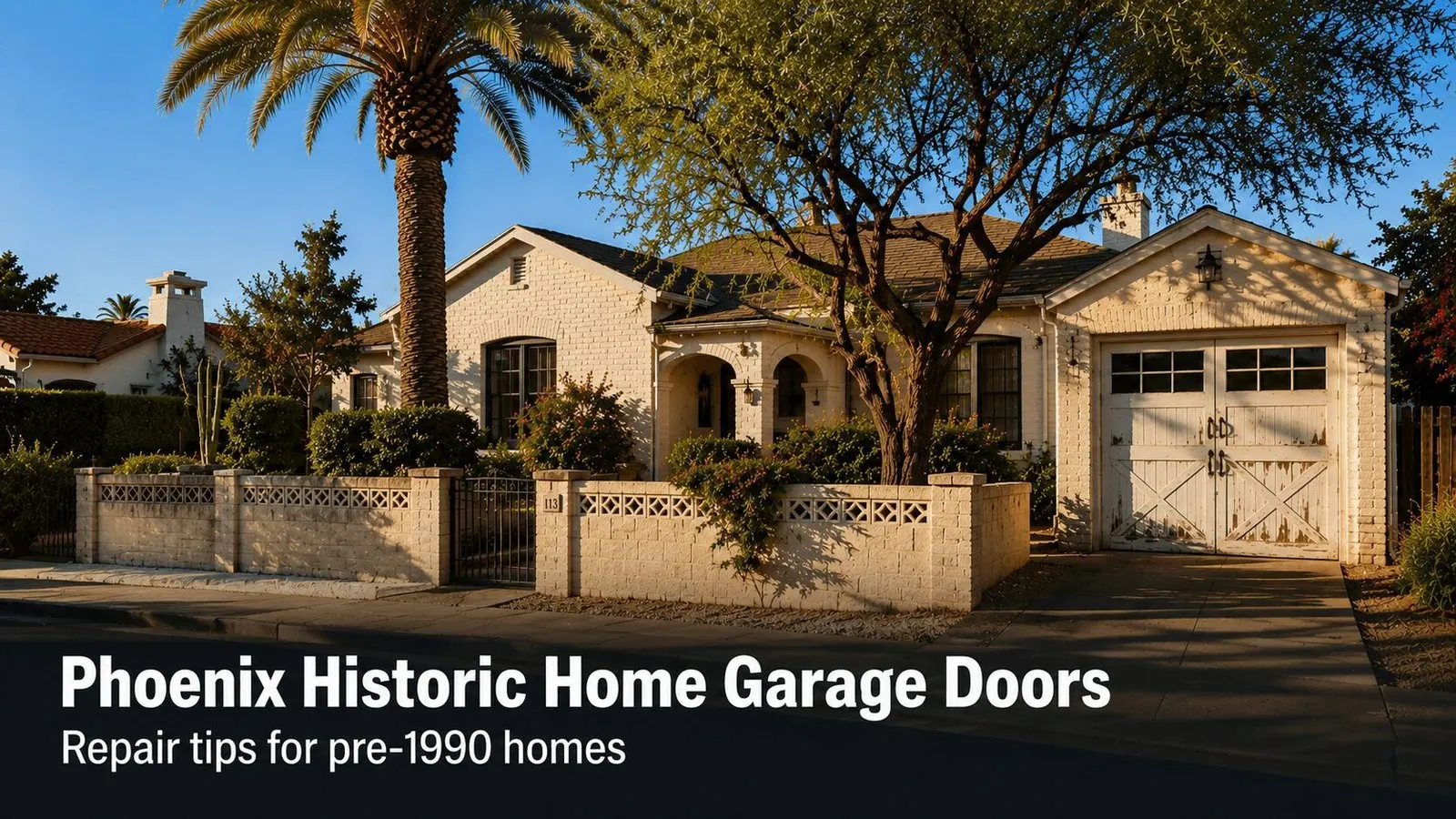
Walk down a block in Willo, Encanto-Palmcroft, or F.Q. Story and you'll see something you almost never see in a new build: garage doors that have been quietly working through Arizona summers for thirty, forty, even fifty years. A lot of them are still doing their job — they just need a different conversation than a tract home in Queen Creek does.
Historic-Phoenix garages are smaller, the doors are usually narrower, the springs are often the old extension type, and the opener is sometimes older than the homeowner. None of that makes the door a lost cause. It does mean a homeowner should know what's normal wear, what's a safety upgrade worth doing, and what's a sign it's time to modernize. We run garage door calls across Phoenix every week, including in the historic districts, and this is how we think through them.
Why Pre-1990 Phoenix Garage Doors Are Different
A few things about a historic-home garage are simply not the same as a modern build:
- Smaller openings. Single-car openings of 8 or 9 feet wide and 6'6 to 7 feet tall were the standard. Two-car homes often had two single doors rather than one wide opening. Cars were smaller; doors followed.
- Extension springs, not torsion. Pre-1990 doors were almost always built with extension springs that run along each track. Torsion springs above the opening — the modern standard — were less common in residential builds until the late 80s and through the 90s.
- Older opener tech. Federal law didn't require photo-eye safety sensors on garage door openers until 1993. Plenty of original openers still in service in historic Phoenix homes simply don't have them.
- Original wood and single-piece doors. Many pre-1980 homes had wood doors, and some had one-piece tilt-up doors that swing out and up as a single panel. Both can still work — they just age differently than modern sectional steel doors.
- Decades of Arizona sun. Even a sound door has lived through more direct desert sun than most cars on the road. Hardware loosens. Finishes chalk. Rollers and bearings dry out.
Pulling a modern part from a tract-home catalog and slapping it onto a historic-home door doesn't always work. The right call usually starts with looking at what's actually there.
6 Common Issues We See in Historic-Home Garages
These are the items that come up most often when we're out on a service call in Willo, Encanto, Coronado, Roosevelt, F.Q. Story, Garfield, and the surrounding historic neighborhoods. Most are fixable. A few are worth modernizing.
1. Extension springs without safety cables
Extension springs stretch along each side of the door, above the track. When they break — and they do, eventually — the spring and any loose hardware can fly across the garage. The fix is a thin steel safety cable threaded through each spring so a break stays contained. Many historic Phoenix doors were installed before safety cables were standard, and they're still in service today without them. Adding cables is an inexpensive, high-value upgrade.
2. Openers older than 1993 with no photo-eye sensors
Photo-eye sensors became a federal requirement on new openers starting in 1993. Older openers — including the screw-drive Genies and Sears Craftsman units that were popular in Phoenix in the 70s and 80s — often don't have them. That means there's no automatic reverse if a kid, a pet, or a car is in the way when the door is closing. On most older openers we can retrofit modern sensors; on the oldest, replacement is the cleaner answer. Either way, this is the single most important safety upgrade for a historic-home garage.
3. Original wood doors aged by the desert sun
A real wood door is beautiful on a historic Phoenix bungalow, and a well-built one can last decades. What it can't do is hide the sun. Over the years, wood doors check, split, lose their finish, and warp slightly — especially the bottom panel, which catches reflected heat off the driveway. The question is whether the door is structurally sound or just tired-looking. A sanded and refinished wood door can keep serving the home for years. A warped, delaminating one is a different conversation.
4. Tired single-piece tilt-up doors
One-piece tilt-up doors — the kind that swing out and up as a solid panel — were common in Phoenix homes built before the late 1970s. They're not unsafe in themselves, but they take up more driveway clearance, they're heavier to handle manually, and replacement parts are harder to source than they used to be. If yours still operates smoothly, there's no rush. If the springs are tired, the door is warped, or the opener is failing, this is usually the point where converting to a modern sectional door makes sense — and sectional doors can be installed in nearly any historic opening with the right track design.
5. Worn-out rollers, dried hardware, and dust-packed weather seal
This is the unglamorous list, but it's where a lot of historic-home garage doors get most of their improvement. Original steel rollers are noisy and rough; modern nylon rollers run quietly and last longer. Hinges and end bearings dry out and squeak. The bottom weather seal — the rubber strip along the floor — cracks and lets in blowing Phoenix dust and the occasional monsoon water. None of these are emergencies, but together they're the difference between a door that grinds and a door that runs smoothly.
6. Limited headroom and odd track configurations
Older Phoenix garages — especially detached ones common in pre-WWII neighborhoods like F.Q. Story and Coronado — sometimes have very little headroom between the top of the door and the ceiling or roof framing. Standard residential track doesn't always fit. The fix is low-headroom track, which uses a different drum and cable setup to run a sectional door in tight quarters. It's not a wall we hit often, but when we do, the answer is choosing the right track — not forcing a standard kit.
Old vs. Modern Garage Door Systems
Here's a quick side-by-side of what was standard in a pre-1990 Phoenix home and what's standard today. Knowing the difference makes it easier to decide where modernizing is worth doing.
| System | Pre-1990 standard | Modern standard |
|---|---|---|
| Springs | Extension springs along each track; often no safety cables. | Torsion springs on a shared shaft above the opening; safer, quieter, longer-lasting. |
| Door style | Wood, thin steel, or one-piece tilt-up. | Insulated sectional steel; faux-wood composite for historic curb appeal. |
| Opener | Older Genie screw-drive or Sears Craftsman; no photo-eye sensors pre-1993. | Belt-drive or DC-motor openers with photo-eyes, battery backup, and smart-home features. |
| Rollers | Original steel rollers — noisy and short-lived. | Nylon rollers — quiet, smooth, longer service life. |
| Weather seal | Basic rubber or none; cracks and dries out in AZ sun. | Heavier T-profile bottom seal designed for desert dust and monsoon rain. |
| Opening size | 8–9 ft wide × 6'6–7 ft tall single doors; sometimes two singles for two cars. | 16 ft wide × 7 ft tall single openings, or 18 ft for larger garages. |
Repair, Modernize, or Replace?
Historic Phoenix homes deserve a thoughtful answer here. Not every old door needs to be replaced — and not every old door is worth restoring. A simple way to think about it:
Repair
If the door panels are structurally sound, the tracks are straight, and the door looks right on the house, focus on wear items: springs and cables, rollers, weather seal, hinges, opener service. This is where most historic-home calls land — a focused tune-up that quiets the door and brings it back to safe, smooth operation without touching the panels.
Modernize
If the door is sound but the system around it is dated — old opener with no sensors, extension springs without cables, original steel rollers, no battery backup — modernize the system while keeping the door. New opener, sensors, fresh hardware, optional torsion conversion. The door still looks period-correct from the curb, but it runs quietly and safely. This is often the sweet spot for historic Phoenix homes.
Replace
If the panels are warped, delaminating, water-damaged at the bottom, or if a tilt-up door is on its last legs, replacement is the right call. A modern insulated sectional door — especially in a faux-wood finish — can match the historic look of the home while bringing the door system fully up to date. We work to keep the new door faithful to the home's period and architecture rather than fighting it.
When you're not sure which category your door is in, the right move is an on-site look. Same-day service is our standard, often within hours of your call, and we'll walk through what we see before recommending anything.
Why Phoenix Historic-Home Owners Call Farnsworth
Farnsworth Garage Door Service was founded by brothers Brigham and Riley Farnsworth. The Farnsworth name has 60+ years of East Valley business behind it — R&K, Farnsworth Wholesale, Farnsworth Realty — and we approach a historic-home call the way we'd want it handled on our own family's home: fix what's worn, modernize what's outdated, leave what's still doing its job.
- On-site look first. We inspect the actual door, springs, and opener before recommending anything — no upsell off a checklist.
- Honest, written quotes with itemized options. You see repair, modernize, and replace prices side by side.
- Old and new parts on the truck. Safety cables, nylon rollers, extension and torsion springs, modern opener sensor kits — the parts a historic-home door usually needs are stocked, so most service calls finish on the first visit.
- Same-day service is our standard, often within hours of your call.
- 5.0 stars on Google. Our neighbors trust us — and tell their neighbors.
Need a look at an older Phoenix garage door? Book a repair or service visit — or if you're thinking bigger, a new door consultation. A little routine maintenance goes a long way on a door that's already lasted forty years.
Frequently Asked Questions
Are pre-1990 garage doors in Phoenix still safe to use?
It depends on the door, the springs, and the opener — but in many historic Phoenix homes, the answer is "safe enough to use carefully, with a few specific upgrades worth doing." The most common safety gaps we see are extension springs without safety cables running through them, openers older than 1993 that don't have photo-eye sensors, and original wood doors that have aged in the desert sun. None of those make the door unusable today, but each is worth addressing. A short inspection will tell you which items on your specific door are wear items and which are real safety concerns.
Do older Phoenix garage doors need new safety sensors?
Photo-eye safety sensors became a federal requirement on new garage door openers starting in 1993. Plenty of pre-1990 Phoenix homes still run their original opener and have never had sensors — meaning the door has no automatic stop if a person, pet, or car is in the way when it's closing. We strongly recommend adding sensors any time we service one of these older openers, and on most older openers retrofitting sensors is straightforward. If the opener is too old to accept modern sensors, that's a strong reason to replace the opener itself.
What is an extension spring, and why is it different from torsion?
An extension spring runs horizontally along each track, above the door, and stretches as the door closes. There are typically two — one on each side — and they work independently. A torsion spring sits on a shaft above the opening and winds and unwinds to lift the door, and on a two-spring torsion setup both springs share one shaft and lift together. Most pre-1990 Phoenix homes were built with extension springs. They still work fine, but they're considered less safe than torsion because if one breaks, the spring and any loose hardware can fly. That's why modern extension-spring installs require safety cables threaded through each spring — and why we usually recommend conversion to torsion if a homeowner wants the safer, smoother setup.
Can I just replace the springs on my old extension-spring door?
Yes — extension springs are still made, and a like-for-like swap is straightforward. If you're keeping the extension-spring system, the most important safety item is making sure each spring has a safety cable running through it so a broken spring stays contained. The other option is converting the door to a torsion system, which moves the spring above the opening, gives you a quieter and smoother lift, and is the modern standard for residential doors. A technician can walk you through which makes more sense for your specific door and budget.
Does my old single-piece tilt-up garage door need to be replaced?
Not necessarily. Single-piece tilt-up doors — the kind that swings out and up as one solid panel — were common in Phoenix homes built before the late 1970s. They're not dangerous on their own, but they take up more driveway clearance when opening, they're heavier to operate manually, and parts are harder to source. If yours is structurally sound and the springs and hardware are in good shape, it can keep serving the home. If it's warped, the springs are tired, or the opener is failing, replacing it with a modern sectional door is usually the better long-term move — and modern sectional doors fit most historic-home openings with the right track design.
Why is my historic-home garage door narrower than modern doors?
Pre-1990 Phoenix homes — especially those in Willo, Encanto-Palmcroft, Coronado, F.Q. Story, and Roosevelt — were built when cars were smaller and garages were narrower. Single-car openings of 8 or 9 feet wide and 6'6 to 7 feet tall were standard, and many two-car homes had two single doors rather than one wide opening. That's not a problem — replacement doors are still made in those sizes, and we can match the existing opening without widening it. If you do want a wider opening, that's a structural change involving the header and framing and is worth a separate conversation.
Can Farnsworth modernize an older Phoenix garage door without replacing the whole thing?
Often yes. Many historic-home garage doors get a meaningful upgrade by replacing just the worn parts — new springs with safety cables (or a torsion conversion), new nylon rollers for quiet operation, a modern opener with photo-eye sensors and battery backup, fresh weather seal for the desert dust, and updated remotes or smart-home integration. The door panels themselves often stay. We approach historic-home calls in Phoenix this way by default — fix what's worn, modernize what's outdated, leave what's still doing its job — and walk through the options with you before anything is ordered.

Book a Historic-Home Garage Door Visit
We'll come out, look at the actual door, springs, and opener, and walk you through what's a wear item, what's a safety upgrade, and what's worth modernizing. Written, itemized quote before anything is ordered.