
Are Garage Door Springs Covered by Homeowners Insurance?
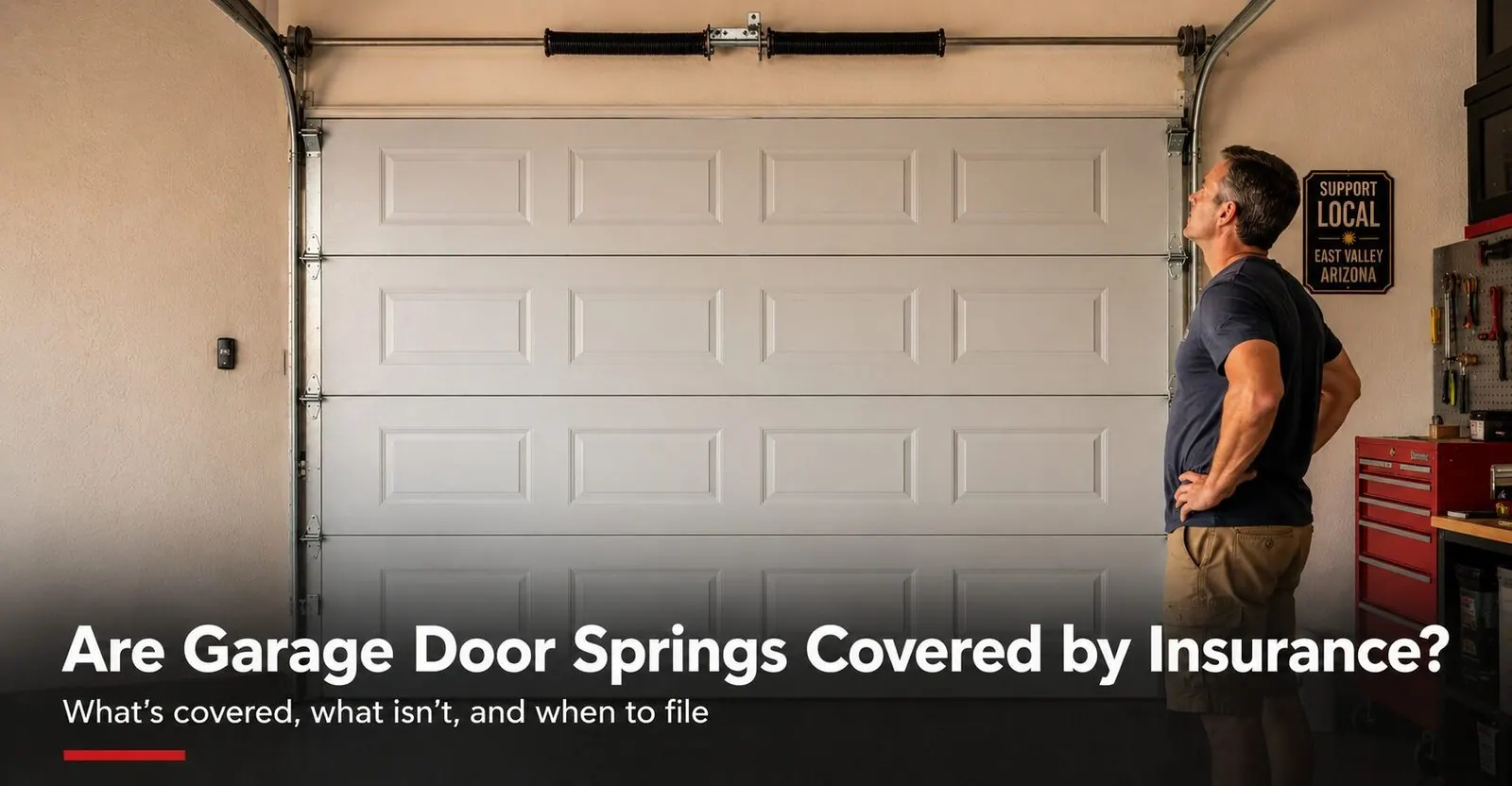
Usually, no. A garage door spring that breaks from normal use is treated as wear and tear, which standard homeowners policies specifically exclude. Springs are wear parts with a finite life, so an aging spring that finally snaps is considered maintenance, not a sudden accident. Here's the short version:
- Spring broke on its own from age or use: Almost never covered — that's wear and tear.
- Spring damaged by a covered event (car hit the door, fire, vandalism, storm): May be covered, because the cause is what your policy responds to.
- Even when there's an argument for coverage: A standard spring replacement is often smaller than your deductible, so a claim frequently isn't worth filing.
Policies differ, so always confirm with your own insurer. Below, we break down why springs get excluded, the situations where coverage actually kicks in, and how to decide whether to file at all.
It almost always happens at the worst moment: you're backing out for work, you hit the button, and the door barely moves — or you heard a loud bang from the garage the night before and now nothing works right. Once you spot the gap in the spring coils above the door, the next thought for a lot of East Valley homeowners is a fair one: I pay for homeowners insurance every month — will it cover this? It's a smart question to ask before you pay for any repair. The honest answer takes a minute to explain, because it depends less on the spring itself and more on what caused it to fail. Here's how coverage actually works, written from what we see on Mesa, Gilbert, and Queen Creek driveways every week.
The Short Answer: Cause Is Everything
Homeowners insurance is built to cover sudden, accidental losses — the unexpected stuff you couldn't have planned around. It is not built to cover the predictable end of a part's life. That single distinction explains almost every garage door spring question we get.
When an adjuster looks at a broken spring, the first thing they ask is why did it break? If the answer is "it's seven years old and it wore out," that's maintenance, and it falls under the wear-and-tear exclusion that's written into virtually every standard policy. If the answer is "a car backed through the door" or "there was a fire in the garage," then the spring is just one casualty of a larger covered event — and now it's part of a claim that might make sense.
So the part on your door is the same either way. What changes the coverage is the story behind the break.
Why a Worn-Out Spring Counts as Wear and Tear
To an insurer, a garage door spring is a consumable part, a lot like brake pads or tires on your car. It's engineered to wear out, and everyone — including the manufacturer — knows roughly when. Here's the math behind that:
Torsion springs are rated in cycles, where one cycle is a single open and close. A standard spring is rated for about 10,000 cycles. A typical household runs the door three to five times a day. Do the arithmetic and a standard spring reaches the end of its designed life in roughly seven years — sometimes sooner for a busy family that's in and out all day.
Because that failure is expected and gradual, insurers classify it as routine maintenance rather than an accident. You wouldn't expect a policy to buy you new tires when the tread wears down, and for the same reason it won't buy you a new spring when the coils give out from age.
If you want the full picture of how a spring fails and what it looks like, our guide on how to spot a broken garage door spring in Arizona walks through the warning signs in plain language.
When a Broken Spring Is Covered
Now the good news. There are real situations where your policy may step in — and they all share one trait: the spring was damaged by something sudden and accidental, not by age. When a covered peril damages your door, the spring usually comes along as part of the repair.
Events that commonly trigger coverage
- A vehicle hits the door — backing into it, or a guest who mistakes the gas for the brake
- Fire in or near the garage that damages the door and hardware
- Vandalism or an attempted break-in that bends or wrecks the door
- A falling tree or large branch coming down on the door
- Storm or wind damage — in some cases, monsoon-driven debris or a haboob's flying material
In each of these, the claim isn't really "my spring broke." It's "my garage door was damaged by a covered event," and the spring is one line on the repair. That's a different conversation with your insurer than an aging spring snapping on a quiet Tuesday.
Two important caveats. First, flood damage is generally excluded from standard homeowners policies and needs separate flood coverage. Second, coverage and exclusions vary by carrier and by the specific policy you bought, so the only way to know for certain is to read your policy or call your agent. Treat this article as a map, not the final word on your contract.
Covered vs. Not: Common Scenarios
Here's how the situations we hear about most tend to shake out. Your own policy is the final authority, but this is the general pattern.
| What happened | Typically covered? | Why |
|---|---|---|
| Old spring snapped on its own | No | Wear and tear — an excluded maintenance item |
| Car backed into the door | Often yes | Sudden accidental impact; door and spring repaired together |
| Garage fire damaged the door | Usually yes | Fire is a standard covered peril |
| Vandalism or break-in bent the door | Often yes | Vandalism is typically a covered peril |
| Tree limb fell on the door | Often yes | Falling-object damage is usually covered |
| Monsoon debris struck the door | Sometimes | Depends on wind/storm terms in your policy |
| Door wore out over many years | No | Gradual deterioration is excluded |
Should You Even File a Claim?
Here's the part a lot of articles skip: even when there's an argument for coverage, filing a claim often isn't the right move. A few things to weigh before you call your insurer.
Your deductible may swallow the whole repair
Most homeowners policies carry a deductible in the range of several hundred to a couple thousand dollars. A standard spring replacement is usually a smaller repair than that, which means even on a "covered" claim you'd pay the entire cost out of pocket and the insurer would pay nothing. In that case, filing accomplishes nothing except putting a claim on your record.
Small claims can cost you later
Insurers track your claims history, and a pattern of small claims can affect your premium or how a carrier views you at renewal. For a minor repair that lands under your deductible, many homeowners decide it's not worth touching the policy at all.
When a claim does make sense
Filing is worth it when the spring is part of a larger covered loss — a car that crashed through the door, fire damage, a tree that took out the whole assembly. When the total repair clearly exceeds your deductible, a claim can save you real money. The practical move is simple:
- Get the repair quoted in writing first. Know the actual number before you involve insurance.
- Compare it to your deductible. If the repair is smaller, a claim usually isn't worth it.
- Document the damage with photos if a covered event caused it — before anything gets removed.
- Then decide. For a clear covered event above your deductible, file. For a worn-out spring, just fix it.
None of this is financial or insurance advice, and we're garage door people, not agents — for anything specific to your coverage, your insurer or agent is the right call. What we can do is give you an honest written quote so you have a real number to work from.
Home Warranty vs. Homeowners Insurance
It's easy to mix these up, but they're different products. Homeowners insurance covers sudden, accidental losses to your property. A home warranty is a separate service contract built to cover mechanical breakdown of systems and appliances from normal use — which is exactly the kind of failure a worn-out spring is.
Some home warranty plans include the garage door opener and certain components, and a few include springs. If you have a warranty, that can be a far better route than a homeowners claim for a normal wear failure, since it's designed for breakdowns rather than accidents. The catches to read for:
- Coverage caps that limit how much the plan pays per repair
- Pre-existing condition exclusions if the spring was already failing
- Assigned-contractor rules that require you to use their network
- A trade-service fee you pay per visit regardless of the repair
Read the garage door section of your contract closely — it's often more limited than the headline coverage suggests. If your plan does cover springs and lets you choose your contractor, we're glad to work with that.
Keeping a Spring From Stranding Your Car
Since insurance rarely rescues you from a normal spring failure, the best protection is keeping the spring healthy and replacing it on your terms — not at 6 a.m. with your car trapped inside. A few habits go a long way, especially in our climate:
Lubricate the springs and hardware
A couple of times a year, a garage-door-rated lubricant on the springs, rollers, and hinges cuts the friction and dust grind that ages a spring early. It's the single cheapest thing you can do for spring life in the desert.
Keep the door balanced
A door that's out of balance forces the spring to fight the whole time, wearing it faster. If your door feels heavy or slams shut, the balance is off and the spring is working overtime.
Have the system inspected
During a routine garage door tune-up, a tech can spot a tired spring, gaps starting to form, and cable wear before any of it leaves you stranded. Catching it early turns an emergency into a scheduled visit.
Upgrade at replacement time
When a spring does need replacing, stepping up to a higher-cycle spring buys you more years before the next one. If your door is past the typical life of a standard spring, it's worth asking about.
Why East Valley Homeowners Call Farnsworth for Spring Repair
Farnsworth Garage Door Service was founded by brothers Brigham and Riley Farnsworth. The Farnsworth name has 60+ years of family business across the East Valley behind it — R&K, Farnsworth Wholesale, Farnsworth Realty — and we run this company the way our family has always run a business: tell the truth, put the price in writing, do the work right the first time.
- Honest written quotes on spring repairs — so you have a real number to compare against your deductible before you decide anything.
- We tell you straight whether a claim is even worth filing. If a repair lands under your deductible, we'll say so.
- Correctly sized, higher-cycle spring options for our climate — not just whatever's on the truck.
- Documentation help if a covered event damaged your door and you do need to file.
- Same-day service is our standard, often within hours of your call.
- 5.0 stars on Google. Our neighbors keep us busy by telling theirs.
Dealing with a broken spring? See our spring repair page, learn the warning signs in our broken spring guide, or check where we work across the East Valley.
Frequently Asked Questions
Does homeowners insurance cover a broken garage door spring?
In most cases, no. A garage door spring that breaks from normal use is treated by insurers as wear and tear, and wear-and-tear failures are specifically excluded from a standard homeowners policy. Springs are wear parts with a finite cycle life, so when one snaps after years of opening and closing, that's considered routine maintenance rather than sudden accidental damage. The exception is when the spring is damaged as part of a covered event, such as a car hitting the door, a fire, vandalism, or certain storm damage. In those situations the repair may fall under your policy because the cause, not the part, is what coverage hinges on. Always confirm with your own insurer, since policies differ.
Why is a worn-out garage door spring considered wear and tear?
Torsion springs are rated by cycles, where one cycle is a single open and close. A standard spring is rated for about 10,000 cycles. A typical household opens and closes the door three to five times a day, which works out to roughly seven years before that spring reaches the end of its designed life. Because the part is engineered to wear out and eventually fail, insurers classify a spring that breaks from age and use as a maintenance item, the same way they treat worn brake pads on a car. Homeowners policies are built to cover sudden, accidental losses, not the predictable end of a wear part's life.
When would homeowners insurance pay for garage door spring damage?
Coverage usually turns on what caused the damage. If a covered peril damages your door and the spring along with it, the spring can be part of the claim. Common examples include a vehicle backing into or through the door, a fire in the garage, vandalism or an attempted break-in, a falling tree or large branch, and in some cases wind or storm damage during a monsoon. The key is that the loss is sudden and accidental rather than gradual wear. If the only thing wrong is that an aging spring finally snapped on its own, that typically falls outside coverage.
Should I file an insurance claim for a broken garage door spring?
Often it isn't worth it, even when there's an argument for coverage. A standard spring replacement is usually a smaller repair than a typical homeowners deductible, which means you'd pay the full cost out of pocket anyway and still have a claim on your record. Filing small claims can also affect your premium or claims history. A claim makes more sense when the spring damage is part of a larger covered loss, like a car crashing into the door or fire damage, where the total repair clearly exceeds your deductible. Get the repair quoted in writing first, compare it to your deductible, and then decide.
Does a home warranty cover garage door springs?
A home warranty is different from homeowners insurance, and some home warranty plans do include the garage door opener and certain components, sometimes springs. Coverage varies widely by plan and provider, and many warranties cap what they'll pay, exclude pre-existing problems, or require you to use their assigned contractor. Read your specific contract closely, because the garage door section is often limited. If your plan does cover springs, that route can make more sense than a homeowners claim for a normal wear failure, since it's designed for exactly this kind of mechanical breakdown.
Does Arizona heat make garage door springs fail faster?
Arizona's climate is hard on springs in a few ways. Repeated heating and cooling as the garage swings from cool mornings to extreme afternoon temperatures speeds up metal fatigue, and fine desert dust works into the coils and accelerates wear, especially when the spring isn't lubricated. None of that changes how insurance treats the failure, since a spring that wears out faster because of the climate is still a wear-and-tear failure in the eyes of a policy. What it does mean is that Arizona springs often reach the end of their life sooner, which makes regular maintenance and timely replacement more important here than in milder places.
Is it safe to keep using my garage door after a spring breaks?
It's best not to. When a spring breaks, the counterbalance that makes the door feel weightless is gone, so the full weight of the door, often well over a hundred pounds, is no longer supported. Running the opener can strain or damage the motor, and a door that's only partly held can come down hard. On a two-spring door, both springs share a single shaft above the opening, so the door doesn't tilt to one side when one breaks. The safe move is to leave the door down, avoid using the opener, and have the spring replaced by a technician with the right winding bars and training.
How can I prevent a broken garage door spring?
You can't make a spring last forever, but you can get the most out of it and avoid being caught off guard. Lubricate the springs and hardware a couple of times a year with a garage-door-rated lubricant, keep the door balanced so the spring isn't fighting a misaligned door, and have the system inspected during routine maintenance so a tired spring is caught before it strands your car inside. If your door is approaching the end of a spring's typical life, upgrading to a higher-cycle spring at replacement time buys you more years. We're happy to look at the whole system and tell you honestly where your springs stand.

Broken Spring? Get an Honest Quote First.
Licensed, insured, locally owned. We'll give you a written quote on your spring repair so you have a real number to weigh against your deductible — and we'll tell you straight whether a claim is even worth filing. Same-day service is our standard, often within hours of your call.