
Apache Junction Garage Doors: Why Desert-Foothill Homes Wear Differently
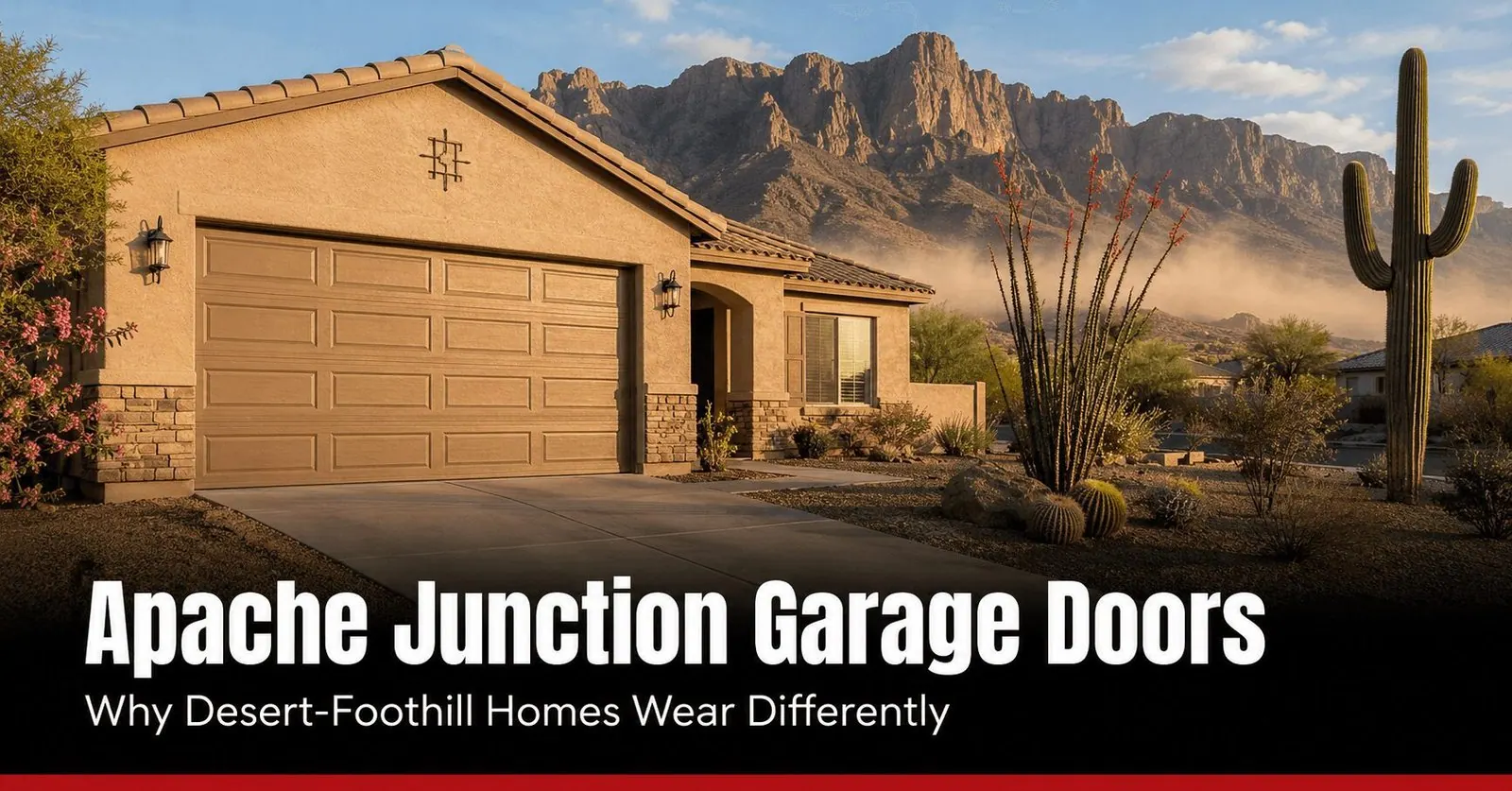
Apache Junction sits at the eastern edge of the East Valley, tucked right up against the Superstition Mountains where the suburbs end and the desert begins. That location does interesting things to garage doors. The neighborhoods west of the 60 have some of the oldest housing stock in the metro — a lot of homes built in the 1970s and 1980s, still on their first openers and original hardware. Monsoon storms barrel down out of the foothills and dump dust on doors that face open desert with nothing in front of them. And Apache Junction's mix of full-time retirees and seasonal snowbirds means many doors sit unused for half the year and then get cycled hard the other half. The wear patterns look different than what we see in Chandler, Gilbert, or even Mesa — and the maintenance schedule needs to look different too.
This is a field-tested look at the five things we find first on an Apache Junction garage door service call, plus what every Apache Junction homeowner can check this weekend.
Issue #1 — Aging Extension Springs in Pre-2000 Homes
The single most common thing we still find on original-construction Apache Junction doors
Extension springs are the long stretched springs that run parallel to the horizontal tracks on each side of the door — one on each side, anchored to the framing in back. They were the standard residential installation through the 1980s and into the early 1990s, and we still find them on a real share of original Apache Junction doors, especially in the neighborhoods west of Idaho Road and in the older mobile-home communities. They do work. But they store huge amounts of energy in a long, exposed coil — and when they fail (or when an old, undersized cable lets go), the spring can fly across the garage hard enough to put a hole in drywall. Even when intact, they age unevenly, run loud, and leave the door noticeably less balanced than a modern setup.
Most modern installations use torsion springs — wound springs mounted on a single shaft above the door opening. They're safer, quieter, hold tension more predictably, and last roughly twice as long as a comparable extension setup. We've converted many Apache Junction doors over the years and it's typically a half-day visit.
Issue #2 — Openers That Pre-Date Rolling-Code Security
Many Apache Junction homes still run the opener that came with the house
Two safety milestones matter for residential openers. Federal law required photo-eye sensors and auto-reverse on every new opener sold in the U.S. starting in 1993. Rolling-code remote security — the technology that scrambles your remote's signal every press so it can't be cloned — became standard in 1997. Any opener installed before those dates is missing safety features that today's families take for granted, and any opener missing rolling code can be cloned by an inexpensive code grabber sold openly online. We routinely find both on original-construction Apache Junction homes, including in well-kept properties where everything else has been updated.
Beyond safety, openers have a design life. Past about 15 years, the grease in the gear train hardens, limit switches drift, and the logic board starts behaving unpredictably in heat. A new opener with rolling-code remotes, photo-eye sensors, battery backup, and (if you want it) smart-home compatibility addresses all of it in one visit.
Issue #3 — Dust-Fouled Rollers, Bearings, and Tracks
The Superstition Foothills funnel dust right into your tracks
Apache Junction's biggest environmental tax on a garage door is dust. The Superstition Foothills act like a funnel: when summer storm cells collapse over the mountains, the outflow boundary sweeps down across Apache Junction and unloads sand and fine desert dust on everything in its path. That grit works into roller bearings, hinge pivots, and the inside of the horizontal tracks. Within a few seasons the door starts running rougher, the rollers wear flat where they should spin freely, and the opener has to push harder on every cycle — which shortens the opener's life right alongside the door's.
Plastic-bodied rollers are the worst offenders. They tend to be standard on builder-grade doors and they don't survive desert grit; they wear flat, develop chips, and eventually start binding in the track. Sealed nylon rollers with steel ball bearings are the upgrade we recommend on almost every Apache Junction door — they're quieter, smoother, and far more tolerant of dust.
Issue #4 — West-Facing Panels Baked by Direct Desert Sun
If your door faces west or south, the sun is doing real work on it
Apache Junction sits east of Phoenix proper, so a west-facing garage door catches direct desert sun from late morning until sundown for most of the year. Surface temperatures on a dark panel skin can reach 160°F in summer — hot enough to soften paint, dry out the rubber bumpers on hinges, and warp the panel skin on lower-gauge steel or composite doors. Once a panel starts warping, the seal at the top and bottom suffers, the door starts hitting the track unevenly, and the opener has to fight a door that no longer travels true. The damage is usually slow and accumulating, not catastrophic — but it's why a 20-year-old west-facing door in Apache Junction looks tired in ways a north-facing door of the same vintage doesn't.
If you're planning a replacement on a west- or south-facing opening, consider an insulated steel door (R-12 or higher) in a lighter color, with high-quality weatherstripping. The insulation slows panel-to-frame heat transfer, the lighter color keeps surface temperatures down, and the better weatherstripping holds its shape longer.
Issue #5 — Worn Bottom Seals and Dust Intrusion
The unsung hero — and the part that wears out first in Apache Junction
The bottom seal is the strip of flexible rubber that sits in a track on the bottom edge of the door and presses against the concrete slab when closed. Its job is to keep dust, rain runoff, and pests outside the garage. In Apache Junction it has a brutally hard life. Foothill wind drives fine grit between the seal and the slab, grinding the rubber down. Heat hardens it. Monsoon storms slam debris at it. By the time most Apache Junction seals are five years old, they're doing maybe a quarter of their original job — and that's when homeowners start noticing dust coating everything inside the garage, the occasional scorpion, and (during the right monsoon cell) actual water on the floor.
Bottom seals are inexpensive and quick to replace — usually 20 minutes on most door sizes. We also recommend checking the side weatherstripping at the same visit; it ages from the same exposure but tends to get missed.
The Apache Junction Wear-Pattern Checklist
One pass through the garage, fifteen minutes, no special tools needed. If you find any of these, call us before the wear turns into a failure.
| Check | What to look for | When to call a tech |
|---|---|---|
| Springs | Single torsion shaft above the door, no rust or coil gaps. | Extension springs without safety cables; visible gaps, rust, or stretching. |
| Opener age | Date sticker on motor head; photo-eye sensors near floor; battery backup. | Older than ~2010, missing photo eyes, no battery backup, or no rolling code. |
| Rollers and tracks | Smooth manual lift, rollers spinning freely, tracks clean. | Grinding noise, stiff manual lift, gritty residue inside the horizontal tracks. |
| Sun exposure | Panel skin flat and uncracked; paint not chalky; bumpers flexible. | Warped or bowed panels, faded chalky paint, dry-rotted bumpers. |
| Bottom seal | Rubber soft and intact, no daylight under closed door, no dust drift line inside. | Gaps, cracked rubber, water or dust entry after monsoon. |
| Cables | Tight, no fraying, seated cleanly on the cable drums. | Any visible fray, slack, or cable off the drum. Do not operate. |
| Snowbird idle pattern | Roller bearings still spin freely after summer; opener battery backup still holds. | Anything stiff, gritty, or balky on the first cycle back in October. |
For full-time residents we recommend a tune-up every 12–18 months. For snowbirds, schedule one in October when you arrive and one in April before you leave — that timing cleans grit out of the system before you fly out and catches anything that aged poorly while you were gone. We service all of Apache Junction including the neighborhoods west of Idaho Road, the foothill subdivisions east of the 60, and the older communities along Apache Trail.
Why Apache Junction Homeowners Call Farnsworth Garage
Farnsworth Garage Door Service was founded by brothers Brigham and Riley Farnsworth. The Farnsworth name has 60+ years of East Valley business behind it — R&K, Farnsworth Wholesale, Farnsworth Realty — and we treat every Apache Junction door call the way we'd treat work on a neighbor's house.
- Older-home expertise with extension-to-torsion conversions, pre-rolling-code opener replacements, and original-hardware retrofits done right.
- Snowbird-friendly scheduling with October arrival tune-ups and April pre-departure inspections.
- Same-day service is our standard for repair calls, often within hours of your call.
- Sealed nylon roller upgrades to keep dust from the foothills out of your bearings.
- Coverage across the East Valley: Apache Junction, Gold Canyon, Mesa, Chandler, Gilbert, Queen Creek, San Tan Valley, Scottsdale, Tempe, Phoenix, Fountain Hills, Guadalupe, and Maricopa.
Frequently Asked Questions
Why do garage doors fail faster in Apache Junction than in the rest of the East Valley?
Three reasons stack up. Apache Junction has the East Valley's oldest housing stock, so many doors are 25–45 years old running original springs, cables, and openers. The Superstition Foothills funnel wind, sand, and monsoon dust through neighborhoods that sit closer to open desert than most East Valley cities. And a heavy snowbird and retiree population means many doors sit unused for months and then get cycled hard — a pattern that punishes bearings, seals, and grease.
How old is too old for a garage door opener in Apache Junction?
If your opener pre-dates 1993 it has no photo-eye sensors. If it pre-dates 1997 it has no rolling-code remote security. Both are past replacement age. Even units installed in the 2000s typically cross their reliable design life around 15 years — hardened grease, drifted limit switches, and heat-sensitive logic boards start to show up.
Do Apache Junction homes still have extension springs?
Yes — more than any other East Valley city. Extension springs run parallel to the horizontal tracks on each side of the door and were the standard installation through the 1980s and into the 1990s. They work but they store enormous energy and can snap and fly across the garage when they fail. Modern torsion-spring conversions are safer, quieter, and last roughly twice as long.
What's the dust doing to my garage door?
Sand and fine desert dust act like grinding paste once they get into roller bearings, hinge pivots, and the track. The door runs rougher and louder, rollers wear flat, and the opener has to push harder on every cycle. Bottom seals also lose flexibility as grit grinds the rubber. Monsoon dust devils funneling out of the foothills make the problem worse in Apache Junction than almost anywhere else in the metro.
Should snowbirds run the garage door before they leave for the summer?
Yes. A five-minute check before you fly out is the best maintenance habit a snowbird can build. Lubricate the rollers, hinges, and springs; cycle the door fully three times so fresh grease redistributes; replace the opener's backup battery if it's older than three years. Sitting unused for four to six months in a 140-degree garage is hard on every moving part.
Are west-facing garage doors in Apache Junction worth replacing sooner?
Often, yes. A west- or south-facing door catches direct desert sun from late morning to sundown most of the year, and surface temperatures can crack 160°F on the panel skin in summer. That accelerates paint fade, weatherstripping degradation, and warping. If a west-facing door is sun-faded, chalky, or warped at the panel edges, it's worth pricing a replacement before it fails.

Schedule an Apache Junction Garage Door Inspection
Springs, opener, rollers, panels, and seals — one visit, walk the whole door. Same-day service is our standard for repair calls, often within hours of your call.