

Tempe Rental Properties: 5 Garage Door Issues Every Landlord Should Catch Before Tenants Move In
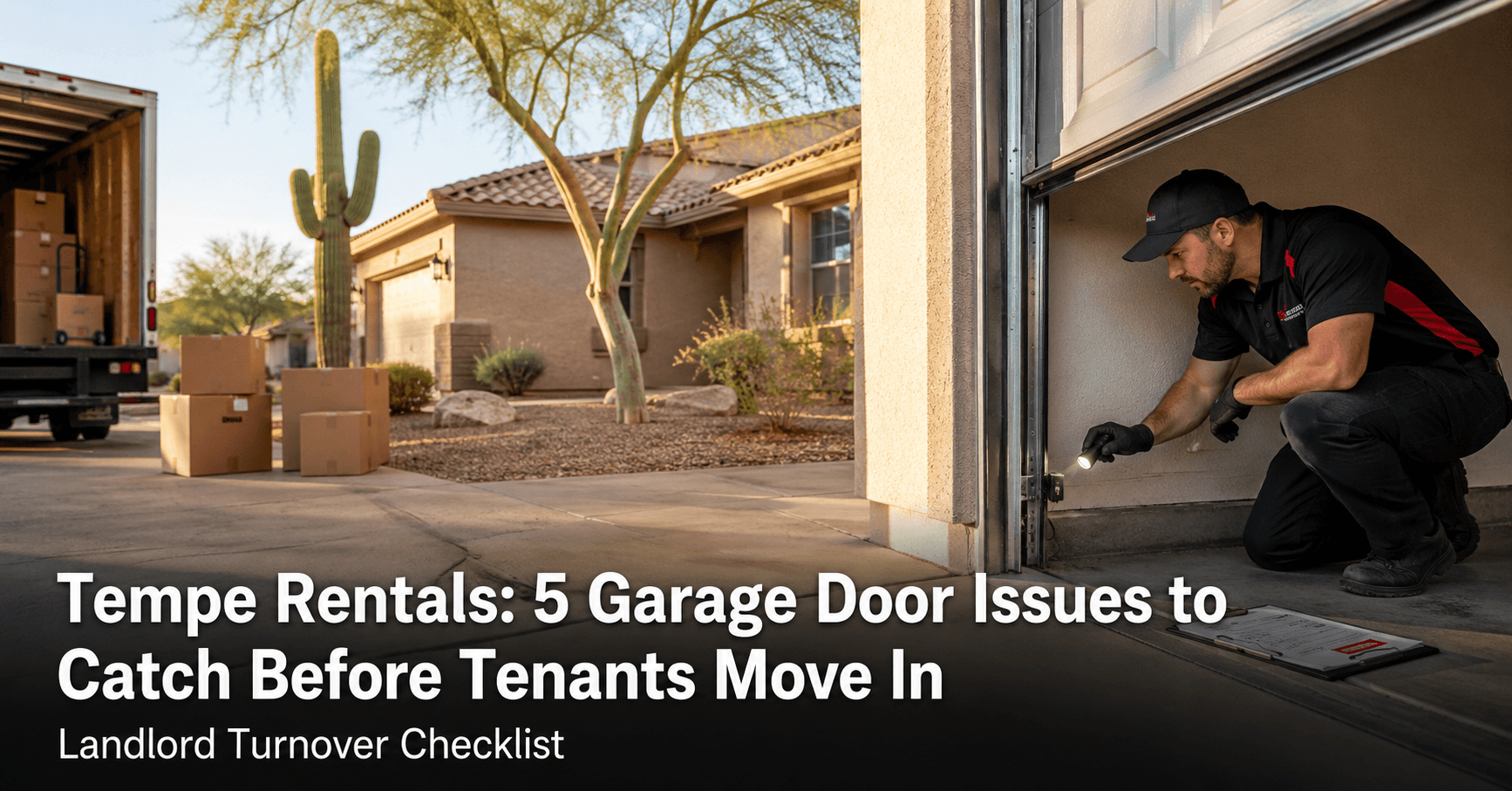
Tempe rentals work differently than owner-occupied homes. An owner cycles the garage door three or four times a day; a rental with roommates, ASU schedules, and delivery traffic can easily double or triple that. Add Arizona heat, monsoon dust, and the every-summer move-out, and you've got equipment aging faster than the lease term — and rarely on the walk-through checklist. Most landlord-tenant disagreements about the garage door trace to a problem that was already there at move-in but never documented.
Issue #1 — Photo-Eye Safety Sensors Knocked Out of Alignment
The most common Tempe turnover problem, by a wide margin
Every residential garage door opener built in the U.S. since 1993 has two photo-eye sensors near the floor that shoot an infrared beam across the opening. Break the beam, and the door refuses to close (or reverses mid-close). It's the single most important safety feature on the door — and the easiest thing for an outgoing tenant to knock out of alignment. A bike leaned against the wall, a recycling bin, a moving-day box pile — anything bumping a sensor more than half an inch takes the beam off-target. The door starts blinking, refusing to close, or closing only when someone holds the wall button. Most outgoing tenants don't mention it; most incoming tenants find out the first night. Working around the sensors by holding the button defeats auto-reverse — which is where the liability sits.
Issue #2 — Worn Torsion Springs Nearing End-of-Cycle
Rental cycle counts age springs faster than owner-occupied homes
A torsion spring is rated by cycles — one open + one close. A standard residential spring is rated for about 10,000 cycles, which is roughly seven years at three or four cycles a day. A Tempe rental with roommates and round-the-clock comings and goings can hit ten or twelve cycles daily, cutting that lifespan in half. The spring usually doesn't warn you — it snaps mid-motion, and you're left with a ~200-lb door, an opener too small to lift it, and a tenant who can't get to work. On a two-spring door, both springs wind on a single shaft above the door; when one breaks, the other is right behind it, so we replace them as a pair.
Issue #3 — Opener Wear, Dead Remotes, and Forgotten Keypad Codes
The most-missed turnover detail at almost every Tempe rental we visit
The opener is one of the most-used appliances in the unit and almost never gets handed over cleanly. The outgoing tenant takes the remotes (or loses them). The keypad code is whatever the last six tenants used. The battery backup has been dead for two summers. Three things matter at every turnover: (1) change the keypad code — treat it like a rekey; (2) wipe the opener's memory and program fresh remotes (most modern openers have a button on the back that erases all clickers), so an old roommate can't roll up six months later; (3) verify auto-reverse force, travel limits, and battery backup. For absentee or out-of-state landlords, a smart opener (LiftMaster with MyQ or similar) gives remote visibility, alerts, and tenant access without driving over.
Issue #4 — Cracked or Worn Bottom Seal: Dust, Monsoon Water, and Vermin
The unglamorous part — and the part tenants complain about
The bottom rubber seal sits in a track on the bottom edge of the door and presses against the slab when closed — keeping dust, runoff water, and pests outside. In Tempe it has a hard life: heat hardens the rubber, sand grits it down, monsoon storms blow debris at it, and every closing cycle compresses it against slab that hits 140°F by August. Most seals at a rental that haven't been changed in five years are doing a quarter of their original job. Tenants notice three ways: dust on everything by end of summer, a wet floor inside after monsoon, and the occasional scorpion or cricket in the garage — all reasons for an unhappy tenant at the first turnover.
Issue #5 — Panel Scuffs, Dents, and Hardware Damage from Move-Out
The "I didn't do that" conversation, in advance
Move-out day is when most damage shows up: a U-Haul ramp dragged across the bottom panel, a couch corner that caught a hinge, a backed-into door from unfamiliar wheels, a bent track from a stored mattress. It's almost always either disputed at deposit return or quietly missed and inherited by the next tenant. Panel damage matters beyond the cosmetic — a creased panel weakens door rigidity, putting load on the springs and opener; a bent hinge wears rollers unevenly; a kinked track is a future off-track event waiting for the wrong morning. The single best tool a landlord has is a dated pre-move-in photo set — three or four phone photos of the door, hardware, opener, and sensors. That sorts most "I didn't do that" arguments in one afternoon.
The Tempe Landlord Turnover Checklist
The same list in one place. Keep it with the make-ready checklist for each property; one pass per turnover.
| Check | What to look for | When to call a tech |
|---|---|---|
| Photo-eye sensors | Both LEDs solid. Door reverses on broom-handle test. | LED off or blinking; fails broom test; wires damaged. |
| Spring condition | Door stays put when lifted halfway with opener disconnected. | Sags, slams up, feels heavy; visible coil gaps or rust. |
| Cables and drums | Cables tight, no fraying, drums spinning evenly. | Any fray, slack cable, or cable off the drum. Do not operate. |
| Opener and remotes | Re-program remotes; reset keypad code; cycle door three times. | Over ~15 years old, no battery backup, slow or noisy lift. |
| Bottom seal | Rubber soft and intact, no daylight under closed door. | Gaps, cracked rubber, water or dust entry after monsoon. |
| Panels and hardware | No creases or dents. Hinges flush. Tracks straight. Strut intact. | Any creased panel, bent track, pulled hinge, or flat-spotted roller. |
| Documentation | Dated photo set of panels, opener, sensors, and tracks pre-move-in. | N/A — a tech can take these at the turnover visit. |
For landlords with multiple units, put garage door inspection on the same turnover trigger as carpet cleaning and paint touch-up. We can also block-schedule a portfolio walkthrough during the May–August turnover season — see preventative maintenance for what an annual plan covers.
Why Tempe Landlords Call Farnsworth Garage
Farnsworth Garage Door Service was founded by brothers Brigham and Riley Farnsworth. The Farnsworth name has 60+ years of East Valley business behind it — R&K, Farnsworth Wholesale, Farnsworth Realty — and we run rental-property service the way we'd run it on our own units.
- Turnover inspections tied to your make-ready schedule, plus dated photo documentation for the file.
- Multi-property service with block scheduling, centralized billing, and per-property service history.
- Same-day service is our standard for repair calls, often within hours of your call.
- Smart-opener upgrades with remote access and tenant onboarding for absentee owners.
- Coverage across the East Valley: Tempe, Mesa, Chandler, Gilbert, Scottsdale, Queen Creek, San Tan Valley, Apache Junction, Gold Canyon, Phoenix, Fountain Hills, Guadalupe, and Maricopa.
Frequently Asked Questions
How often should a Tempe rental property's garage door be serviced?
A full inspection between every tenant turnover plus one annual tune-up. Rentals see far more daily cycles than owner-occupied homes, which compresses the lifespan of springs, cables, rollers, and the opener.
Are landlords legally required to maintain garage door safety sensors?
Federal law (UL 325) requires every residential opener manufactured for U.S. sale since 1993 to have working photo-eye sensors and auto-reverse on contact. Arizona landlord-tenant law also imposes a duty to maintain habitable, safe conditions — a door that fails to reverse is the scenario insurers cite when claims go sideways.
What's the most common garage door problem at a Tempe tenant turnover?
Photo-eye sensors knocked out of alignment by a stored bike, recycling bin, or moving-day boxes. The door refuses to close, the outgoing tenant doesn't mention it, and the new tenant walks into a unit that won't lock up at night.
Can a worn garage door spring fail in the middle of a tenant's lease?
Yes. A residential torsion spring is rated for about 10,000 cycles — seven years at three or four cycles a day. Many rentals cycle six to twelve times daily, cutting that to three to five years. On a two-spring torsion door, both wind on a single shaft — when one snaps, the other is right behind it.
Should I install a smart garage door opener for my Tempe rental?
There's a real case for it, especially for absentee owners. A smart opener (LiftMaster with MyQ or similar) lets the landlord see when the door is open or closed, get left-open alerts, and grant or revoke tenant access remotely without reprogramming clickers.
Whose responsibility is it if a tenant damages the garage door?
It depends on the lease. Normal wear-and-tear (a worn bottom seal, a spring at end-of-life) is typically the landlord's. Tenant-caused damage — backing into the door, drilling into a panel — is typically the tenant's. A dated pre-move-in photo set is the best tool for sorting which is which.
Do you offer multi-property service for Tempe landlords and property managers?
Yes. We work with Tempe landlords and property managers owning anywhere from two units to a couple of dozen, scheduling turnover inspections, preventive maintenance, and on-call repair across the portfolio. Call (602) 935-9766 to set up a portfolio walkthrough.
Schedule a Tempe Rental Turnover Inspection
One trip per property between tenants — sensors, springs, opener, seals, panels, and dated photo documentation. Same-day service is our standard for repair calls, often within hours of your call.