

Queen Creek New Construction Garage Doors: 5 Issues to Watch After Year One
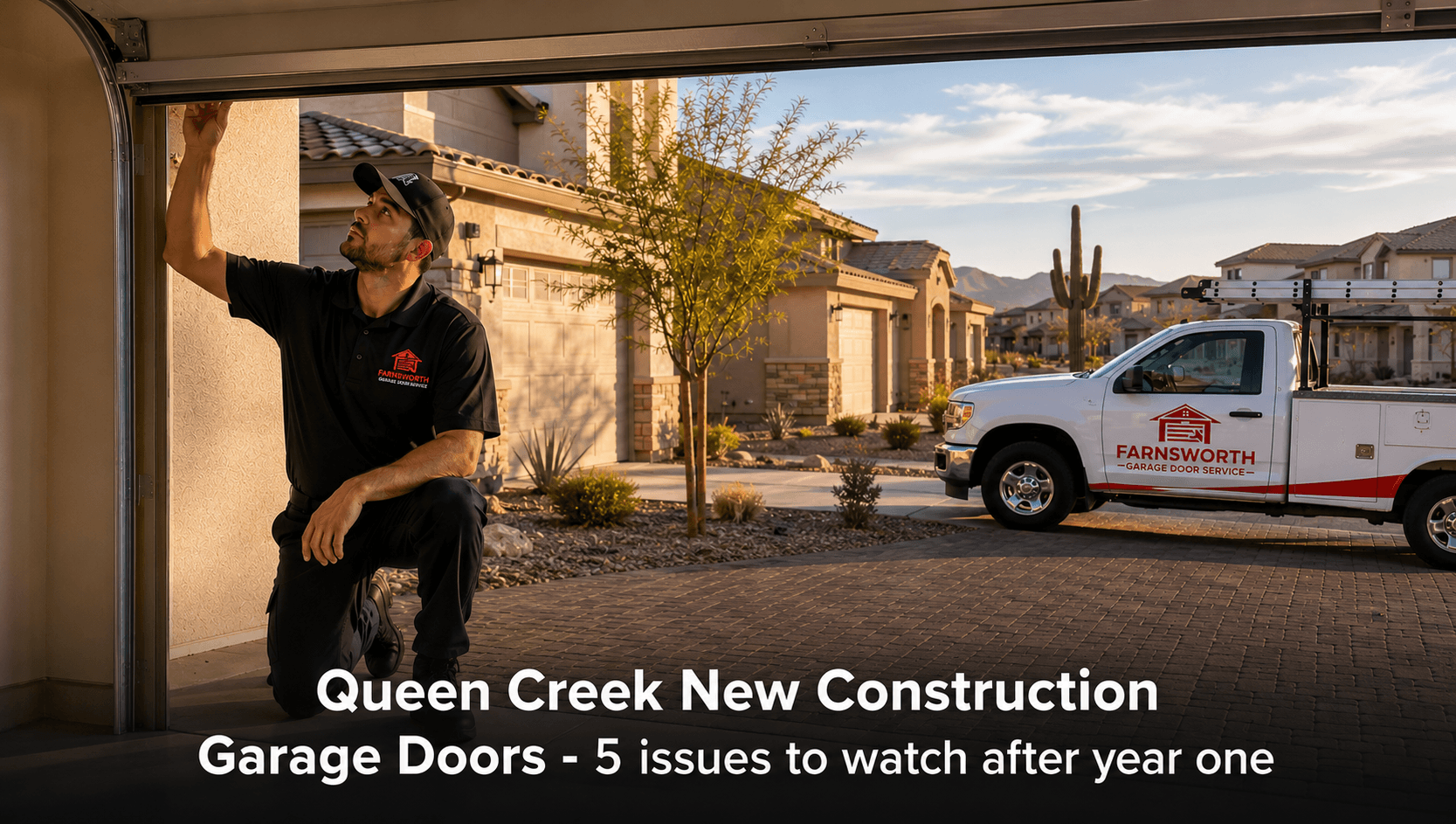
Queen Creek has been one of the fastest-growing cities in the East Valley for years — master-planned communities, custom builds between citrus orchards, stucco-and-tile rooftops as far as you can see. Almost every one of those homes has a garage door installed by the builder's preferred subcontractor on a tight schedule with parts spec'd to hit a price target. That doesn't make the door bad. But there's a real pattern to how builder-grade doors age, especially through the first Arizona summer.
We run calls across Queen Creek, San Tan Valley, Gilbert, and Mesa every week, and the year-one calls follow a clear playbook.
Issue #1 — Opener Limit Drift After the Home Settles
What's happening
Every new home settles. Foundation cures, framing dries out, and over the first six to nine months the rough opening shifts a fraction of an inch. Your opener was programmed with fixed travel limits the day it was installed — so as the frame moves, the door's true closed and open positions drift away from what the opener has stored.
The first sign is usually a door that thumps the concrete harder than it used to, or stops a half-inch short of fully closed. Sometimes the safety reverse trips at the bottom because the opener thinks it hit something. Owners assume the opener is failing. It's almost never the opener.
Issue #2 — Springs That Were Never Sized Correctly
What's happening
Builder-grade doors are sometimes shipped with a "close-enough" spring rather than one sized to your specific door's weight. If you upgraded to insulated panels, decorative hardware, or a window row at signing, the original spring may be a step under-spec'd. The door still works — but the spring is fighting harder than it should every cycle.
You'll feel it two ways: the door is heavy when you pull the red emergency release and lift it by hand (a balanced door should hold at chest height and lift with about 8–10 pounds of effort), and the opener strains audibly at the top and bottom of travel.
Issue #3 — Builder-Grade Rollers and Bearings Going Noisy
What's happening
If your year-old door has started popping, grinding, or sounding like a tractor, the culprit is almost always the rollers — the small wheels on each panel that ride the track. Builder-grade rollers are nylon-stem with unsealed bearings. Dust gets into the bearings, the nylon hardens in 110°F+ afternoons, and the rollers develop flat spots that knock against the track every cycle. End-bearings and hinge bolts wear on a similar timeline.
Not dangerous on day one — but the noise grows, the opener strains, and eventually a roller jumps the track.
Issue #4 — Weatherstrip Cracking From Arizona Sun
What's happening
The rubber seal at the bottom of your door — the bottom astragal — compresses against the concrete to keep dust, water, and critters out. Builder-grade seals handle a year or two in Arizona before they crack, harden, or pull loose at the corners. The perimeter weatherstrip ages on the same timeline.
You'll know it's gone when monsoon rain pools just inside the garage, fine dust shows up along the door line, or you see daylight under the door at the corners.
Issue #5 — Cable and Drum Balance Drifting
What's happening
Your door is held in balance by two steel cables wound onto drums at either end of the torsion shaft. If those drums weren't perfectly aligned at install — and on a tight new-construction schedule, "perfectly" sometimes means "close enough" — the cables feed slightly off-center. After a year of daily cycling plus monsoon-season wind gusts, the misalignment compounds.
The first symptoms are subtle: the door looks barely tilted as it travels, one cable goes slack at the bottom, or the door binds on one side. Ignore it and a cable can jump its drum, fray, or snap.
When to Schedule Your First Tune-Up
If you closed on a Queen Creek new build in the last 12–18 months and haven't had anyone touch the garage door yet, now is a great time. The sweet spot is months 9–14 — late enough that settling has happened and the weak points are showing, early enough to catch the five issues above before they turn into a failure, and ideally before the heart of summer. It's also worth checking your closing paperwork; a lot of builder labor warranties close around month 12.
A real tune-up isn't just a glance and a squirt of WD-40. Here's what we cover:
| Tune-Up Step | What it catches |
|---|---|
| Door balance test | Undersized or under-tensioned springs |
| Opener travel limit + safety reverse | Limit drift from frame settling |
| Roller, hinge, and bearing inspection | Builder-grade hardware wear |
| Cable and drum alignment check | Tension imbalance, off-center drums |
| Weatherstrip and bottom seal review | Heat-cracked rubber, monsoon water entry |
| Lubrication of springs, rollers, hinges, bearings | Dried-out factory lube, dust contamination |
If something looks worn, we'll show you what we found and give you a written quote before any extra work starts. Nothing surprise-billed at the end.
Why Queen Creek Neighbors Call Farnsworth
Farnsworth Garage Door Service was founded by brothers Brigham and Riley Farnsworth. The Farnsworth name has 60+ years of East Valley business behind it — R&K, Farnsworth Wholesale, Farnsworth Realty — and we run calls the way we'd want them run on our own homes.
- Same-day service is our standard, often within hours of your call.
- Honest written quotes before any work starts. No surprise add-ons.
- Local trucks, real stock — rollers, springs, weatherstrip, and bearings most Queen Creek doors need are on board, so first-visit fixes are routine.
- Coverage across the East Valley: Queen Creek, San Tan Valley, Gilbert, Mesa, Chandler, Tempe, Scottsdale, Apache Junction, Gold Canyon, Fountain Hills, Phoenix, Guadalupe, and Maricopa.
- 5.0 stars on Google. Our neighbors trust us — and tell their neighbors.
Frequently Asked Questions
How long should a builder-grade garage door last in Arizona?
The door panel itself usually has a long manufacturer warranty (often 5–10 years on the steel), but the moving parts — springs, rollers, cables, weatherstrip, and the opener — are spec'd to keep costs down and start showing their age in years 1–3. Arizona's heat, dust, and monsoon cycle compresses that timeline. Plan to lubricate and tune-up annually, and budget to upgrade rollers and weatherstrip in the first year or two.
Why does my new Queen Creek garage door already feel heavy?
Most often it's an undersized or under-tensioned spring. Builder-grade doors are sometimes shipped with a one-size-fits-most spring rather than one sized to your specific door's weight. If the spring is even slightly under-spec'd, the door feels heavy when lifted manually and the opener strains. A quick balance test — pull the red emergency release with the door halfway up; it should hold position — confirms whether the spring is doing its job.
Is my new garage door covered under the builder's warranty in year one?
Coverage varies by builder, but the typical pattern is panels and major components covered for several years, the opener for 3–5 years, and labor (tech visits, adjustments) only for the first 12 months. Limit drift, weatherstrip cracking, and roller wear are often classified as wear-and-tear rather than warranty defects. If something feels wrong, document it early and call your builder before the labor window closes.
When should I schedule my first garage door tune-up after moving in?
Around the 9–12 month mark — far enough out that settling has happened and the builder-grade weak points are showing, but before they cause a real failure. The tune-up covers limit adjustment, balance test, lubrication, weatherstrip inspection, roller and bearing check, and cable/drum alignment.
Why is my new garage door making popping or grinding noise already?
Almost always it's the rollers. Builder-grade nylon-stem rollers without sealed bearings start to flat-spot, scrape, and pop within the first year — especially in Arizona, where dust gets into the bearings and heat hardens the nylon. Upgrading to sealed ball-bearing nylon rollers makes the door dramatically quieter and adds years of life.
Do I really need to replace builder-grade rollers and weatherstrip?
You don't have to — but the parts that came with the door were chosen for the builder's price target. Sealed ball-bearing rollers cut noise, last 3–4× longer, and reduce strain on the opener. New EPDM weatherstrip seals out the dust and monsoon water that builder-grade rubber stops blocking after a year of Arizona sun. Both are cheap to swap during a regular maintenance call.
Do you service garage doors in Queen Creek and the surrounding new construction communities?
Yes — we run calls across Queen Creek every week, including newer master-planned communities and surrounding areas like San Tan Valley, Gilbert, Mesa, and Chandler. Year-one tune-ups, spring balance checks, opener limit adjustments, and roller/weatherstrip upgrades are all routine. Same-day service is our standard, often within hours of your call.
Year-One Tune-Up for Your Queen Creek Garage Door
Catch the five most common builder-grade issues before they turn into a Monday-morning surprise. Call or book online — written, itemized quote before any work begins.