
Why Your Garage Door Is So Loud (and What It's Trying to Tell You)
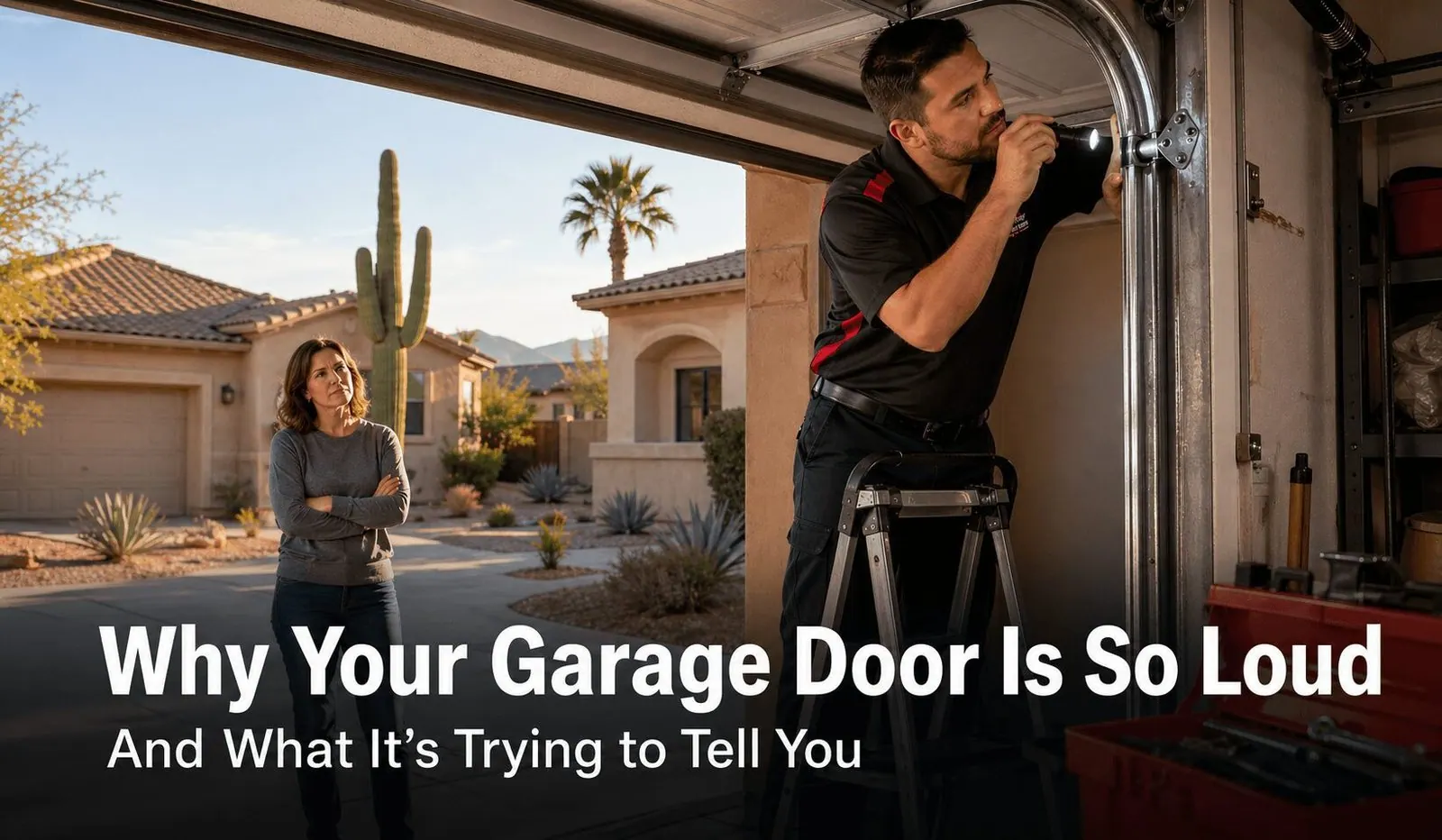
Your garage door is the largest moving part of your home, and it cycles up and down thousands of times a year. A little operational noise is normal. But when your door goes from quietly humming to grinding, squealing, rattling, or banging — that noise is information. It's telling you something is wearing out, working loose, or about to fail.
We get calls every day from homeowners in Mesa, Gilbert, Chandler, Scottsdale, and Phoenix who've been putting up with a noisy door for months, assuming it was normal. Often it is something simple — a 10-minute lubrication job. But sometimes it's an early warning of a part that's about to fail. Knowing the difference can save you a lot of money.
Below is a complete noise diagnosis guide: six sounds, six causes, and exactly what to do for each.
The Quick Noise Reference Chart
Use this table to quickly match what you're hearing to the most likely cause and whether it's a DIY fix or a call-a-tech situation.
| Sound | Most Likely Cause | DIY Fix? | Call a Tech? |
|---|---|---|---|
| Squeaking / chirping | Dry hinges, rollers, or brackets | Yes — lubricate | If it persists after lube |
| Grinding / scraping | Worn rollers or debris in tracks | Clean tracks + lubricate | Yes — if rollers are worn |
| Rattling / vibrating | Loose hardware (bolts, brackets) | Yes — tighten hardware | If door is misaligned |
| Banging / thudding | Loose opener chain or worn door stops | Check chain tension | Yes — for chain/stop adjustment |
| Popping / cracking | Spring fatigue or panel flex | No — springs are dangerous | Yes — spring inspection needed |
| Rumbling (motor running) | Worn motor bearings or unbalanced door | Balance test only | Yes — motor or balance issue |
1. Squeaking or Chirping
Dry hinges, rollers, or track guides — the most common garage door noise
Squeaking is the most common garage door complaint we hear, and it's usually the easiest fix. Moving metal parts — hinges, roller brackets, and the points where rollers contact the track — need lubrication to run quietly. Arizona's heat and dust accelerate dryness, so parts that might need lubrication once a year in a milder climate may need it every 3 months here.
The squeak will typically follow the door as it moves — you'll hear it at every hinge as each section bends through the curve into the horizontal track. That's a textbook lubrication problem.
Apply white lithium grease to every hinge pivot point and roller bracket. Use a garage door lubricant spray on the roller wheels themselves. Run the door twice to distribute. See the full lubrication guide below.
The squeaking comes back within days of lubrication — the rollers may be worn flat or cracked and need replacement. A set of nylon rollers is an inexpensive fix.
2. Grinding or Scraping
Metal-on-metal contact — worn rollers or debris in the tracks
Grinding is a step up from squeaking. It usually means something is making direct metal-on-metal contact rather than just moving dry. The two most common culprits are worn roller wheels that have lost their nylon coating and are now bare metal riding in the steel track, and debris — sand, pebbles, or built-up grime — packed into the tracks from Arizona's dusty conditions.
Open the garage door manually (pull the red emergency release cord) and run your hand along the inside of both tracks. If you feel grit or packed debris, that's your first fix. If the rollers look cracked, chipped, or the nylon is worn through to the metal, they need to be replaced.
Clean the tracks thoroughly with a rag and a mild cleaner. Remove all debris. Do NOT lubricate the inside of the tracks — only the rollers and hinges. Run the door and listen again.
Cleaning doesn't resolve it, or you can see that the roller wheels are worn, cracked, or missing their nylon coating. Roller replacement requires precise alignment — this is a quick professional job.
3. Rattling or Vibrating
Loose bolts, brackets, or panels — tighten everything that moves
A rattling garage door is usually a hardware problem: bolts and fasteners work themselves loose over thousands of cycles. The most common offenders are the bolts holding the hinge plates to the door panels, the roller bracket bolts, and the nuts holding the horizontal track brackets to the wall and ceiling.
Go around the door with a socket wrench and check every bolt you can see — hinges, roller brackets, track brackets, and the opener mounting hardware at the ceiling. Snug everything down. Don't overtighten, especially on the wood panels at the top and bottom of the door — just until firm.
A quarter-inch socket set and 30 minutes is all it takes. Work section by section from the bottom of the door to the opener. Tighten any bolt that has visible movement or wobble.
The door still rattles after tightening all hardware, or if it shakes unevenly or wobbles side to side during travel — that's a track alignment issue that needs professional adjustment.
4. Banging or Thudding
End-of-travel impact, loose opener chain, or worn door stops
A banging or thudding sound at the end of the door's travel — either fully open or fully closed — usually means the door is hitting the stops too hard, or the opener's travel limits are set wrong. The opener is telling the door to keep moving after it's already reached its endpoint, which slams it into the floor or the stop bolts at the top of the track.
A different type of bang — a slapping or clunking during travel — often comes from an opener chain that has too much sag. As the chain moves, it slaps against the rail. This is more common on older chain-drive openers and gets worse as the chain stretches over time.
If it's a chain-drive opener, check the chain tension — there should be about ½ inch of sag at the midpoint of the rail. Your opener manual will show how to adjust tension. For end-of-travel banging, check the limit adjustment screws (usually on the side of the opener motor unit).
You're not comfortable adjusting the opener limits or chain tension, or if the banging is happening mid-travel rather than at the endpoints — that often points to a broken cable or pulley problem.
5. Popping or Cracking
Spring fatigue or panel stress — don't ignore this one
A popping or cracking sound at the start of movement is often the spring system releasing tension, or door panels flexing under load. A single occasional pop — especially on a cold morning — may be harmless thermal expansion. But repeated popping, or popping that's getting louder or more frequent, is a warning sign that warrants a professional eye.
Torsion springs have a finite lifespan — typically 10,000 cycles, which works out to about 7–10 years of daily use. As they near end of life, they develop micro-fractures that can cause popping sounds before a full break. A broken torsion spring is one of the most common (and dangerous) garage door failures — it happens suddenly and leaves the door inoperable.
There is no safe DIY fix for spring issues. Springs are under hundreds of pounds of rotational tension. Even lubricating the spring coil (which can reduce popping) should be done carefully with a spray lubricant — never touch the spring hardware itself.
Popping is recurring or getting worse. If your door is 7+ years old and you're hearing new spring-area noises, a proactive inspection is worth it — catching a fatigued spring before it breaks is far better than an emergency call.
6. Rumbling While the Motor Runs
Worn motor bearings or an unbalanced door fighting the opener
A low rumbling or growling sound coming from the opener motor unit while it's running often means the motor bearings are worn. This is more common on openers that are 10+ years old and is usually a sign the opener is nearing end of life.
Rumbling can also come from the door itself being out of balance — if the springs are losing tension, the door becomes heavier than the opener expects, and the motor has to work harder, generating more heat and vibration. An unbalanced door can burn out an opener motor years ahead of schedule.
Pull the red emergency release cord and lift the door manually to about waist height. Let go. A balanced door should stay in place or move very slightly. If it drops rapidly, the springs are losing tension — that needs a tech.
The door fails the balance test, the rumbling is getting worse, or the opener is 10+ years old. A worn opener running an unbalanced door is a ticking clock — address it before it strands you.
How to Lubricate Your Garage Door the Right Way
Lubrication is the one maintenance task every homeowner can safely do, and it prevents the majority of noise complaints before they start. In Arizona, we recommend doing this quarterly — the heat and dust break down lubricant faster than in cooler climates. The whole job takes about 10 minutes.
What to buy
White lithium grease (spray can, ~$8–10) for hinges, brackets, and the torsion spring coil. WD-40 Specialist Garage Door Lubricant or a similar dedicated garage door spray for roller wheels. These are available at any hardware store. Do not use standard WD-40, 3-in-1 oil, or motor oil — they attract dirt and gum up the works.
Step-by-step lubrication
- Close the door and disconnect the opener by pulling the red emergency release cord. You'll be moving the door manually.
- Clean the tracks with a damp rag. Remove any debris, dirt, or built-up grease. Do NOT apply lubricant inside the tracks — only the parts that ride in them.
- Lubricate the hinges — spray a small amount of white lithium grease into each hinge pivot point where the sections bend. Wipe off any excess.
- Lubricate the rollers — apply garage door lubricant spray to the roller wheel bearings (the point where the wheel meets the stem). Avoid getting lubricant on the wheel itself if it rides in a track.
- Lubricate the torsion spring — apply a light coat of white lithium grease along the full length of the spring coil. This reduces friction and extends spring life. Do not touch the spring hardware (end cones, winding cones) — only the coil itself.
- Lubricate the roller brackets — a small amount on each bracket where it contacts the track.
- Reconnect the opener, run the door 2–3 cycles to distribute the lubricant, and wipe any excess from the floor and door surfaces.
| Part | Product to Use | How Often | Common Mistake |
|---|---|---|---|
| Hinges | White lithium grease | Every 3 months | Using WD-40 — evaporates fast, attracts dirt |
| Rollers | Garage door lubricant spray | Every 3 months | Over-applying — attracts debris, reduces grip |
| Torsion spring | White lithium grease (coil only) | Every 6 months | Touching end cones or winding bars — dangerous |
| Roller brackets | White lithium grease | Every 6 months | Skipping — brackets squeak too |
| Tracks (inside) | Nothing — keep dry | Clean only | Lubricating the track — causes slipping and debris buildup |
When It's Time to Call Farnsworth
We're a local East Valley operation — not a national chain. When you call us about a noisy door, you get a straight diagnosis, not an upsell.
- Same-day service on most repairs: Roller replacement, spring repair, tune-up service, and opener repair are all typically done in a single visit.
- Honest diagnosis: If lubrication would solve your problem, we'll tell you that — even if it means we leave without a paid repair job. We'd rather earn your trust than a single invoice.
- Fully stocked trucks: We carry the most common parts for East Valley homes, so we rarely need a second visit.
- East Valley local: We serve Mesa, Gilbert, Chandler, Scottsdale, Tempe, Queen Creek, San Tan Valley, Phoenix, Fountain Hills, Apache Junction, Gold Canyon, Guadalupe, and Maricopa.
- 5.0 stars on Google: Our neighbors trust us — check our reviews and see why.
Frequently Asked Questions
Why is my garage door suddenly so loud?
A sudden increase in noise usually means something has changed — a spring is fatigued, a roller has cracked, a hinge has worn dry, or hardware has worked loose. If the noise appeared overnight, inspect the door visually before running it again. A sudden loud bang followed by a very heavy door almost always means a broken torsion spring — stop operating the door and call a professional immediately.
Can I lubricate my garage door myself?
Yes — lubrication is one of the few garage door tasks that is genuinely safe for homeowners. Use white lithium grease on hinges and brackets, and a dedicated garage door lubricant spray on roller wheels and the spring coil. Never use WD-40 — it evaporates quickly, attracts dirt, and makes the problem worse over time. Do not lubricate the inside of the tracks themselves — only the parts that ride in them.
What does a grinding noise on a garage door mean?
Grinding almost always means metal-on-metal contact. The most common causes are worn nylon rollers that have cracked or lost their coating, or debris packed into the tracks. Start by cleaning the tracks thoroughly. If grinding persists after cleaning and lubricating, the rollers likely need replacement — a quick, inexpensive professional fix that makes a dramatic difference in noise and operation.
Is a rattling garage door dangerous?
Rattling by itself is usually not dangerous — it typically means loose hardware. Tighten all visible bolts on hinges, roller brackets, and track mounting hardware with a socket wrench. However, if the rattling is accompanied by the door wobbling side-to-side or moving unevenly, that could indicate a track alignment issue that warrants a professional inspection.
What causes a garage door to pop or crack when opening?
Popping or cracking at the start of movement usually comes from the spring system releasing tension, or door panels flexing under load. A single occasional pop may be normal thermal expansion. Repeated or worsening popping — especially on a door that's 7+ years old — can indicate spring fatigue. Have a technician inspect the springs before one of them fails completely.
How often should I lubricate my garage door?
Quarterly is ideal for Arizona homeowners — once each season. Our heat, UV, and dust break down lubricants faster than in milder climates. If your door starts squeaking between scheduled lubrications, that's your signal to reapply early. The full job (hinges, rollers, spring coil, brackets) takes about 10 minutes and prevents the majority of noise issues before they start.
Do you service noisy garage doors in Gilbert, Chandler, and Scottsdale?
Yes — Farnsworth Garage Door Service diagnoses and repairs noisy garage doors throughout the East Valley and greater Phoenix area, including Gilbert, Chandler, Scottsdale, Mesa, Tempe, Queen Creek, San Tan Valley, Phoenix, Fountain Hills, Apache Junction, Gold Canyon, Guadalupe, and Maricopa. Most noise-related repairs are completed same-day.

Still Hearing That Noise?
Our East Valley technicians diagnose noisy doors every day — usually fixed same visit. Call or book online for a fast, honest assessment.