
Garage Door Won't Open? 7 Fast Fixes Before You Call a Repair Tech in Mesa & the East Valley
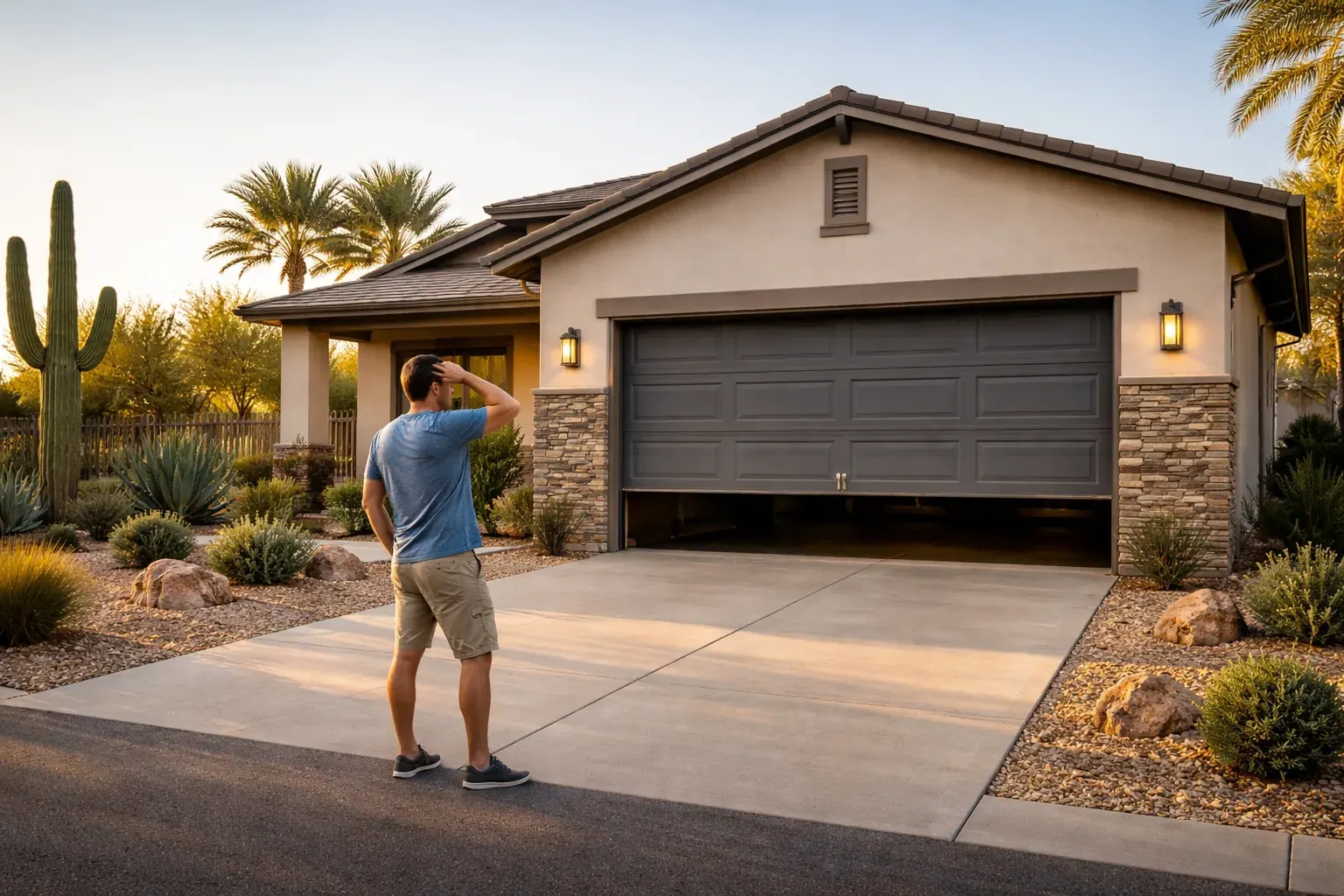
It's one of the most frustrating moments in homeownership: you press the button, the opener hums, and nothing happens. Or worse — you hear a loud bang from inside the garage and suddenly the door won't budge. If you're in Mesa, Gilbert, Chandler, Queen Creek, Phoenix, or anywhere in the East Valley, you're not alone. Garage doors are the largest moving part of your home, and they take a beating from Arizona's extreme heat, dust, and daily use.
The good news: a surprising number of "broken" garage doors can be fixed in a few minutes without a service call. The bad news: a few of the issues on this list are genuinely dangerous and should never be tackled as a DIY project. This guide walks you through the 7 fastest checks in the order a professional technician would run them — so you can either solve the problem yourself or know exactly what to tell us when you call.
- Check the remote and wall button batteries
- Look for a disengaged emergency release cord
- Inspect the safety sensors (photo eyes)
- Check your power and GFCI outlet
- Look for an engaged manual lock
- Inspect the torsion springs for a break
- Check for a burned-out opener or stripped gear
- When to stop and call a professional
- FAQ: garage door repair in the East Valley
1. Check the Remote and Wall Button Batteries
It sounds obvious, but this is the #1 reason our technicians get called to a home only to solve the problem in 60 seconds. If only the remote stopped working — and the wall button still opens the door — you almost certainly have a dead remote battery.
How to check it
- Step 1: Try the wall button inside the garage. If it works, skip to step 3.
- Step 2: Slide open the back of your remote and replace the battery. Most use a CR2032 or a 3V lithium coin cell.
- Step 3: If the wall button also does nothing, move on to Fix #4 — you likely have a power issue.
Arizona tip: The extreme summer heat inside a parked car drains remote batteries fast. If you had to replace the battery less than a year ago, consider keeping a spare in your kitchen drawer.
2. Look for a Disengaged Emergency Release Cord
Every garage door opener has a red cord hanging from the trolley — the part of the rail that physically pulls the door up and down. That cord is the emergency release. If someone pulled it (kids love to), the opener motor is running perfectly but the door is no longer attached to it.
How to fix it
- Close the door fully by hand (only if the springs are intact — see Fix #6 first if you're not sure).
- Pull the red cord toward the door (away from the motor) to re-engage the trolley. You should hear or feel a click.
- Press the opener button. When the trolley passes over, it should snap back into place on the carriage.
If you don't feel the re-engagement click, the carriage may be broken — that's a repair we see often in older LiftMaster and Genie units. If your remote or keypad is also acting up, that's often a related symptom.
3. Inspect the Safety Sensors (Photo Eyes)
This is the #1 cause of "my garage door won't close" calls in the East Valley — and it often looks like the door won't open because it goes up an inch and reverses. Federal law requires every residential garage door opener made after 1993 to have a pair of photo-eye sensors mounted about 6 inches off the ground on either side of the door. If they're misaligned, dirty, or blocked, the opener will refuse to operate.
Quick checks
Are the LEDs lit?
Both sensors should have a solid light. If one is off or blinking, they're misaligned. Loosen the wing nut and gently twist until both lights turn solid.
Are they dirty?
Arizona dust settles on the lenses. Wipe each eye with a clean microfiber cloth — no glass cleaner, no water.
Is anything blocking them?
A broom, a pool noodle, a stray Amazon box, even a spiderweb between the sensors can trigger a false block.
Sun glare?
In Phoenix, afternoon sun can wash out the receiver eye. Shade it with your hand and test — if that fixes it, the sensor needs to be repositioned.
4. Check Your Power and GFCI Outlet
If the opener is completely dead — no lights, no hum, no clicks — the problem is almost always electrical, not mechanical.
- Check the outlet: Most garage ceiling outlets are on a GFCI circuit and can trip during monsoon storms. Test the outlet by plugging in a lamp or phone charger.
- Reset GFCI outlets: There may be a tripped GFCI in the garage, a nearby bathroom, or the exterior wall. Press every "RESET" button you can find.
- Check the breaker: Look in your main electrical panel for a tripped breaker labeled "garage" or "outlets."
- Opener unplugged: More common than you'd think — especially if someone recently worked on the ceiling, insulation, or holiday lights.
5. Look for an Engaged Manual Lock
Many older garage doors in Mesa, Tempe, and Phoenix have a manual slide lock built into the track — a metal bar that slides into the horizontal rail to physically lock the door. If it's engaged and you hit the opener button, the motor will strain, the door will shake, and nothing will open.
Walk inside your garage and look at both sides of the door near the middle hinge. If you see a horizontal metal bar sitting inside the track, slide it out. Problem solved. While you're there, take a quick look at the rollers — if they look worn, cracked, or wobbly, that's worth mentioning on your next service call.
Note: Some LiftMaster wall consoles also have a "lockout" or "vacation" mode button that disables the remotes. If you were recently out of town, check the wall console for a lock icon and hold the button for a few seconds to disable it.
6. Inspect the Torsion Springs for a Break
This is where DIY stops and professional repair begins. If your door makes a loud bang (many homeowners describe it as sounding like a gunshot) and then won't open — you have a broken torsion spring. Don't try to fix this yourself. Torsion springs are under hundreds of pounds of rotational force and cause some of the most serious injuries in home repair.
How to tell if a spring is broken
Look at the long metal spring mounted on a shaft above the door (not the opener rail). If you see a clear 2–3 inch gap in the coil, the spring is broken. Other signs:
- Loud bang: You heard it happen — a broken spring sounds like a firecracker going off in the garage.
- Opener strains but door doesn't move: The motor is trying to lift the entire weight of the door without spring assistance.
- Door opens 6 inches and stops: The opener's force sensor is correctly refusing to lift a dangerously heavy door.
- Door is crooked or jammed at an angle: This may be an off-track garage door — do not try to operate it.
- Door feels extremely heavy: A properly balanced door should feel like about 10 pounds when lifted by hand. A door with a broken spring can feel like 200+ pounds.
7. Check for a Burned-Out Opener or Stripped Gear
If you've worked through everything above and the opener is powered but something is clearly wrong, the most likely suspects are the opener's internal gear assembly or logic board. In Arizona, heat is brutal on openers — the attic space above a garage in Phoenix can exceed 150°F in July, which dramatically shortens the life of plastic gears and capacitors.
Signs of an opener problem
- Motor hums but nothing moves: Classic symptom of a stripped main drive gear on Chamberlain and LiftMaster units. This usually means an opener motor repair or replacement.
- Clicking with no movement: Could be a bad capacitor or logic board — common in openers 8+ years old.
- Intermittent operation: Works sometimes, doesn't work others. Usually a heat-related logic board failure.
- Burning smell: Unplug the opener immediately. This is a fire risk, not a repair to delay.
DIY vs. Professional Repair: What's Safe to Fix Yourself
Here's a quick reference for what you should handle on your own versus when to call Farnsworth:
| Issue | DIY Safe? | Call a Pro? |
|---|---|---|
| Dead remote battery | Yes | No |
| Dirty or misaligned sensors | Yes | No |
| Tripped GFCI outlet | Yes | No |
| Disengaged emergency release | Yes | No |
| Engaged manual lock | Yes | No |
| Broken torsion spring | Never | Yes |
| Broken cables or drums | Never | Yes |
| Bent or damaged panel | Never | Yes |
| Opener gear/logic board | Risky | Yes |
| Burning smell from opener | Unplug it | Yes — urgent |
Why East Valley Homeowners Call Farnsworth
When the door really does need a technician, you have choices — big national chains, or a local family-owned operation like ours. Whether it's a quick repair, a seasonal tune-up, or a full new garage door installation, here's what makes us different:
- Local and family-owned: We live and work in the East Valley. Your neighbors are our customers.
- Same-day service: Most repairs scheduled before noon are completed the same day across Mesa, Gilbert, Chandler, Queen Creek, and Phoenix.
- Upfront pricing: We give you a real number before we start — no high-pressure upsells, no "while we're here" surprises.
- Licensed and insured: Fully licensed Arizona contractors with liability coverage for your peace of mind.
- 5.0 stars on Google: Built one happy neighbor at a time.
Frequently Asked Questions
Why won't my garage door open all of a sudden?
The most common causes are a broken torsion spring, a disengaged emergency release, dead remote batteries, misaligned photo-eye sensors, a tripped GFCI outlet, or an engaged manual lock. In Phoenix and the East Valley, heat-related opener failures and worn springs are especially common because of our extreme summer temperatures. Work through the 7 checks above in order — if none of them solve the problem, call a licensed technician.
Is it safe to force open a stuck garage door?
No. A typical residential garage door weighs between 150 and 300 pounds and is held in balance by springs under extreme tension. Forcing it can break cables, bend tracks, damage the opener, or cause serious injury. If the door won't open freely after the basic checks, stop and call a professional.
How do I know if my garage door spring is broken?
Look at the long torsion spring mounted on the shaft above the door. If you see a visible 2 to 3 inch gap in the coil, the spring is broken. Other telltale signs: you heard a loud bang, the opener strains but the door doesn't move, the door opens only a few inches before stopping, or the door feels extremely heavy when lifted by hand.
Can I open my garage door manually if the power is out?
Yes — as long as the springs are intact. Pull the red emergency release cord to disengage the opener, then lift the door by hand. If the door feels extremely heavy or won't stay up on its own, the spring is broken and the door should not be operated until it's repaired.
How long does it take to fix a garage door that won't open?
Most repairs are completed in 60–90 minutes on site. Spring replacement, cable repair, sensor realignment, opener gear replacement, and even weather stripping and seal replacement can typically be done in a single visit. Our trucks are stocked with the most common parts used on East Valley homes so we rarely have to come back a second time.
How much does it cost to fix a garage door in Phoenix?
It depends on the cause. Simple fixes like sensor realignment and remote reprogramming are low-cost. Torsion spring replacement, cable repair, and opener replacement are larger investments but are still far less expensive than replacing the whole door. We provide free, upfront quotes before any work begins. Call (602) 935-9766 for a quote.
Do you offer emergency garage door service in the East Valley?
Yes. Farnsworth offers same-day and emergency garage door repair across Apache Junction, Chandler, Fountain Hills, Gilbert, Gold Canyon, Maricopa, Mesa, Phoenix, Queen Creek, San Tan Valley, Scottsdale, and Tempe. If your car is trapped inside or your home is unsecured, call us right away — we prioritize emergencies. You can also contact us online for non-urgent requests.
Garage Door Still Won't Open?
Skip the guesswork. Our licensed East Valley technicians can usually be at your door the same day with a fully stocked truck. Free quotes, upfront pricing, no pressure.
Call (602) 935-9766 Book Online