

Is My Garage Door Off-Track? Signs, Causes, and Why Not to Force It
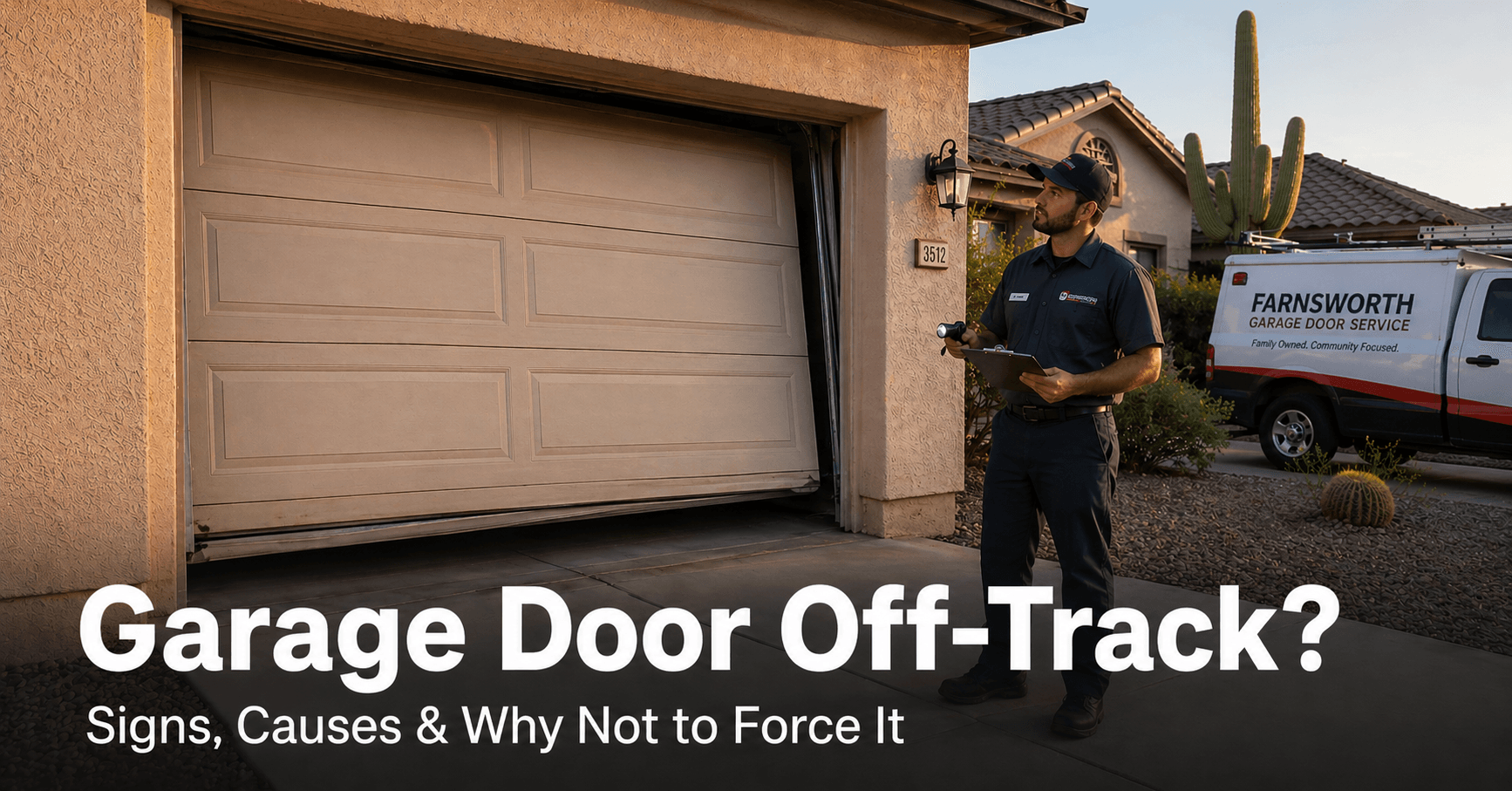
An off-track garage door is one of those problems that looks dramatic and feels alarming — and for good reason. One minute everything is fine; the next, the door is leaning at a weird angle, scraping the frame, refusing to close all the way, or hanging halfway up like it's frozen. Most homeowners we talk to in Mesa, Gilbert, Chandler, and Queen Creek have the same first reaction: can I just push it back into place?
Please don't. We've written this guide so our neighbors in the East Valley can identify exactly what's happening, understand why it happened, and know what's safe to do (and what absolutely isn't) while they wait for a technician. The door will come back. The fix is straightforward when it's done in the right order. But the wrong move in the next ten minutes is the difference between a one-hour repair and a six-hour, panel-replacement-and-emergency-room kind of day.
- What "off-track" actually means
- 7 signs your garage door is off-track
- The 6 most common causes
- Why you should never push it back into place yourself
- What a professional repair actually involves
- How to prevent it from happening again
- FAQ: off-track doors in the East Valley
What "Off-Track" Actually Means
Your garage door rides up and down inside two vertical metal channels — one on each side of the opening — that bend backward at the top and run along the ceiling. Those channels are the tracks. Tucked into hinges along the edge of every panel are small wheels called rollers, and those rollers ride inside the tracks. When the system is working, the door glides smoothly because every roller stays in its channel.
An off-track door is one where one or more of those rollers has popped out. Sometimes it's a single roller in the bottom corner; sometimes a whole side of the door has come loose; sometimes the door is wedged at an angle with the bottom skewed several inches out of square. None of these are versions of the same problem with the same fix. They all start, however, with the same root question: why did the rollers leave the track in the first place?
That root cause matters because if you just shove the rollers back in without addressing what made them jump in the first place, the door will go off-track again — usually within days, sometimes within minutes. A real fix always starts with the diagnosis, not the re-tracking.
7 Signs Your Garage Door Is Off-Track
Some signs are obvious; some sneak up on you. If you spot any of the following, treat it as an off-track until a technician confirms otherwise.
Door is visibly crooked
One side sits higher than the other when closed, or the door looks tilted in the opening. This is the most common visual cue.
Big gap between door and frame
You can see daylight on one side that wasn't there yesterday. Often paired with a noticeable gap between the door and the weather seal.
Scraping or rubbing on the wall
A scraping sound that wasn't there before, paint or stucco scuffed near the edge of the opening, or a fresh paint smear on the door panel.
Door stuck partway open
The door froze mid-cycle and now the opener can't move it in either direction. The motor may strain, click, or just give up.
Visible roller outside the track
You can see a roller hanging out in the air rather than inside the metal channel — usually near a corner or in the curved transition section.
Loud bang followed by sag
You heard a loud noise and now the door is hanging unevenly. That bang was likely a cable or roller giving way.
Bent track or visible damage
You can see a section of the metal track that's bent, twisted, or pulled away from the wall. Often happens after a vehicle bumps the door.
The 6 Most Common Causes of an Off-Track Garage Door
Every off-track door has a story, but they all tend to fall into one of these six categories. Knowing which one you're looking at helps you communicate the problem when you call us — and it helps you understand what the real fix involves.
1. Broken cable
The lift cables on the sides of your door work with the springs to carry the door's weight. When one snaps — usually from age, rust, or wear — that side of the door drops without warning, the door twists, and rollers can pop out in a single motion. Broken cables are the #1 cause of off-track calls we take in the East Valley, and cable repair always has to happen before the door is re-seated.
2. Broken or worn-out roller
The cheap plastic rollers builders install in new construction crack, lose their wheels, or seize on their stems — often within a few years in our heat. When a roller fails mid-cycle, the door loses support at that point and surrounding rollers can be yanked out too. Upgrading to sealed nylon rollers during a tune-up is one of the cheapest ways to prevent this from ever happening again.
3. Vehicle impact
You'd be surprised how often we hear "I barely tapped it." Even a slow bump from a backing-up SUV can dent the bottom panel, bend the lower track, or knock rollers out of alignment. Sometimes the damage is invisible at first and the door operates fine for a few days before the bent track finally fails. If a vehicle has touched your door recently, assume it's part of the problem.
4. Bent or loose track
The tracks are bolted to your garage framing with lag screws and bracket hardware. Over years of vibration, those mounting points loosen, the track drifts out of plumb, and the channel can develop dents or kinks. Once a track shifts more than about a quarter inch, the rollers start binding — and one cycle is all it takes to push them out.
5. Failed bottom bracket or hinge
The bottom brackets anchor the lift cables on each side of the door. If a bracket separates from the panel — usually from rust or the wrong screw being used during a previous repair — the cable goes slack and the door drops on that side. Worn or broken hinges between panels can cause the same kind of cascade. Safety note: bottom brackets are under spring tension. Never loosen the bolts on a bottom bracket yourself.
6. Forcing the door against an obstruction
If something is in the way — a kid's bike, a trash can, a broom — the safety reverse should kick in. But when sensors are misaligned or the obstruction is small enough to be missed, the door can keep pushing. Once it binds against the object, rollers can pop out on the way back up. Same goes for trying to operate a door with a broken spring; the unbalanced lift pulls the door sideways out of alignment.
Why You Should Never Try to Force It Back Into Place
We get it. Off-track doors look like they should be a simple "lift here, push there" fix. The reality is harder, and the consequences of a wrong move are bigger than people expect.
The door is heavier than it looks.
A standard residential single-car door weighs 130 to 180 pounds. An insulated double-car door can weigh well over 250 pounds. The reason it normally feels light is that the springs are doing 95% of the work. When the door is off-track, that balance is broken — and the moment you take hold of it, you may be holding far more weight than you expected.
The door is unsupported and unbalanced.
Once a roller is out, that section of the door is floating and the remaining rollers are taking uneven load. If you yank or pry to "get it back in," you can jerk the rest of the rollers out, snap a still-intact cable, or trigger the whole door to fall. We've taken calls from neighbors who tried this and ended up with a broken hand, a smashed car hood, or both.
The opener cannot help — it'll only make it worse.
If you reach for the wall button or remote hoping the opener will pull it back, please don't. The opener will strain against the misaligned door, bend the rail, strip the gear, or rip the trolley assembly clean off. Now you have an off-track door and a broken opener. And if the root cause (broken cable, broken roller, bent track) hasn't been fixed first, the door will go off-track again the next time you operate it — sometimes more violently than the first.
What a Professional Off-Track Repair Actually Involves
Here's what happens when one of our technicians arrives in the driveway. Knowing the sequence makes the bill make sense and helps you understand why "just pop it back in" isn't really a thing.
- Stabilize the door. Before anyone touches a roller, the door is locked in place with vise-grip clamps on the tracks or 2x4 bracing in the opening.
- Cut power to the opener. Unplugged at the ceiling outlet so no remote, keypad, or wall button can accidentally fire mid-repair.
- Diagnose the root cause. Inspect every cable end, every roller, every hinge, the bottom brackets, and both tracks for plumb. We figure out what failed and why before new parts come off the truck.
- Fix the underlying problem. Replace the broken cable, roller, hinge, or bracket. Track sections bent more than about a half inch get replaced rather than straightened.
- Re-seat the door. Open a small section of track at the affected area and guide each roller back into the channel one at a time.
- Check plumb and alignment. Vertical sections checked with a level; horizontal sections should slope very slightly back toward the wall — that backward pitch is what helps the door stay on track in normal use.
- Tighten everything. Track bolts, hinge bolts, roller brackets, bottom brackets — snug but not over-tight, since over-tightening creates pressure points.
- Manual cycle test. With the opener disconnected, run the door through its full travel by hand. Every roller should stay in its channel.
- Balance check. Lift the door to waist height and let go. A properly balanced door floats. Drift up or down means the spring needs adjustment.
- Reconnect the opener and run it. Two or three full cycles to confirm everything is behaving.
Most off-track repairs in the East Valley take 1 to 3 hours. Our trucks carry the most common cables, rollers, hinges, brackets, and replacement track sections, so the vast majority of these jobs are one-visit fixes.
What's Safe to Do Yourself vs. When to Call Us
A short reference for the most common situations homeowners ask us about:
| Situation | Safe to handle yourself? | Call a pro? |
|---|---|---|
| Pulling the red release cord (door already at the floor) | Yes | No |
| Taking photos of the damage from a safe distance | Yes | No |
| Clearing obstructions from the floor track area | Yes | No |
| Pushing or pulling the door back into the track | Never | Yes |
| Operating the opener with the door visibly off-track | Never | Yes |
| Loosening bolts on the bottom bracket | Never | Yes — danger |
| Replacing or splicing a broken cable | Never | Yes |
| Bending the track back into shape | Risky | Yes |
| Driving a vehicle into or out of the garage | Not until repaired | Yes |
Why East Valley Doors Go Off-Track More Than You'd Think
Our climate is hard on garage doors in ways most homeowners don't think about until something fails. Three things happen here that compound off-track risk:
- Heat fatigues hardware. South-facing garage doors in Phoenix, Scottsdale, and Apache Junction can hit surface temperatures of 130 to 160°F in July. Plastic rollers go brittle, lubricants break down, and steel components expand and contract every day. Builder-grade hardware that might last 12 years in a milder climate often gives out in 6 to 8 here.
- Monsoon dust gets into everything. The fine dust from haboobs settles into roller bearings, into hinge knuckles, into the gap between the rollers and tracks. Over time it grinds rollers down and binds the action. We see noticeably more off-track calls in the weeks following dust storms.
- New construction means builder-grade everything. The newer master-planned communities in Queen Creek, San Tan Valley, and Maricopa are full of doors installed with the cheapest 10,000-cycle springs and basic plastic rollers. Those parts often start failing right around year 5 to 7 — exactly when most homeowners are still thinking of the door as "new."
None of this means your door is doomed. It means a little proactive maintenance — especially upgraded rollers and a yearly tune-up — buys you decades of trouble-free operation in the East Valley climate.
How to Prevent It From Happening Again
Once a door goes off-track, the conversation with your tech naturally turns to "how do we keep this from happening again?" The answer is rarely complicated. A handful of small habits and one annual visit prevent the vast majority of off-track failures.
- Schedule an annual tune-up. A proper tune-up tightens hardware, inspects cables and rollers for wear, lubricates moving parts, and verifies spring balance and track plumb. Most off-track failures are years in the making — a yearly inspection catches them long before they happen.
- Replace builder-grade rollers. If your door still has the original plastic rollers, swap them out next time we're there. Sealed nylon 13-ball-bearing rollers cost very little, run dramatically quieter, and last many times longer.
- Lubricate the right parts. A few minutes a quarter with a quality garage door lubricant (not WD-40) on the springs, hinge pins, and roller bearings keeps everything moving. Skip the tracks themselves — the rollers are supposed to roll, not slide.
- Watch for warning signs. Doors warn you before they fail: new squeaks, a hesitation at the same point in every cycle, a door that closes harder on one side, a single visibly wobbly roller. Calling at that stage costs far less than calling for an off-track.
- Be careful with vehicles. Even a soft tap can bend a track or skew a panel without leaving a mark. If a vehicle has touched your door, get it inspected before operating it.
Why East Valley Homeowners Call Farnsworth
Farnsworth Garage Door Service is a family-owned company run by brothers Brigham and Riley Farnsworth right here in the East Valley. Off-track calls are some of the most common — and most stressful — service requests we take, and we've built our process around getting customers back to normal as fast and as safely as possible.
- Same-day service across the East Valley: Most off-track repairs called in before noon are completed the same day in Mesa, Gilbert, Chandler, Tempe, Queen Creek, Scottsdale, Apache Junction, and Phoenix.
- Fully stocked trucks: Common cables, rollers, hinges, brackets, and replacement track sections are on the truck — most jobs are finished in one visit.
- Upfront pricing: A real number before we start work, never a moving target. No high-pressure upsells.
- Licensed and insured Arizona contractors: Liability coverage for your peace of mind.
- 5.0 stars on Google: Earned one neighbor at a time across the East Valley.
Frequently Asked Questions
What does it mean when a garage door is off-track?
An off-track garage door is one where the rollers have come out of the metal tracks that guide the door up and down. The door may sit crooked, lean to one side, scrape the wall, jam mid-cycle, or stop working entirely. It is almost always caused by an underlying problem — a broken cable, a broken roller, a bent track, or impact damage — and it should not be operated again until a technician has corrected the root cause.
Can I push my garage door back onto the track myself?
We strongly recommend you do not. Even a single-car residential garage door weighs 130 to 180 pounds, and an insulated double door can weigh well over 250 pounds. When the rollers leave the track, the door is no longer evenly supported. Forcing it back can cause the door to fall, can snap remaining cables under load, and can bend the track further. A professional off-track repair always starts by securing the door before anyone touches it.
Will my homeowners insurance cover an off-track garage door?
It depends on the cause. If your door went off-track because a vehicle hit it, a tree limb fell on it during a monsoon, or another covered event damaged it, your homeowners policy may cover the repair minus your deductible. Wear-and-tear failures, like a broken cable or worn roller, are not typically covered. Always check with your insurer and document the damage with photos before any repair work begins.
How long does it take to fix an off-track garage door?
Most off-track repairs in the East Valley take 1 to 3 hours on site. A simple repair — replacing one or two broken rollers and re-seating the door — can be done in about an hour. More involved repairs, like replacing a broken cable, straightening a section of track, or installing a new bottom bracket, take longer. We carry the most common parts on the truck, so most repairs are completed in a single visit.
Is an off-track garage door dangerous?
Yes. An off-track door is unsupported, unstable, and still under tension from springs and remaining cables. It can fall suddenly, especially if someone tries to lift it, force it, or operate the opener. Children and pets should be kept away from the door until repair is complete, and you should not park a vehicle underneath an off-track door under any circumstances.
How do I prevent my garage door from going off-track?
Annual maintenance is the single best prevention. Tightening hardware, inspecting cables and rollers for wear, lubricating moving parts, checking track alignment, and replacing rollers before they fail dramatically reduces the chance of an off-track event. Doors in the East Valley take an extra beating from heat, dust, and monsoon storms, so a once-a-year tune-up is well worth scheduling.
Should I replace the whole door if it has gone off-track?
Usually no. Off-track repair is almost always a hardware fix, not a panel replacement. Unless the door panels themselves were severely bent or impacted, the same door can be re-tracked, re-rollered, and put back in service. If the panels were structurally damaged in the same incident, our technician will let you know whether panel replacement or full door replacement makes more sense for your situation.
Garage Door Off-Track? We'll Get It Fixed Today.
Same-day off-track repair across the East Valley. Free quotes, upfront pricing, no high-pressure upsells. Just a clean fix from a local family-owned team.