

How Long Does a Garage Door Last in Arizona? (And When to Replace vs. Repair)
If you've ever stood in your driveway watching your garage door creak its way up the rails and thought, "How long is this thing actually supposed to last?" — you're asking the right question. In Arizona, the answer is more complicated than it would be in Ohio or Oregon. Our heat, our sun, our dust storms, and our temperature swings all wear out garage doors faster than the national averages you'll see online.
We've worked on doors all over the East Valley — Mesa, Gilbert, Chandler, Queen Creek, Scottsdale, Tempe, San Tan Valley, and beyond — and we see the same patterns over and over. Doors that get a little attention every year last decades. Doors that get ignored until something breaks rarely make it past 15.
This guide breaks down exactly how long the door, and each of its parts, should last in Arizona — plus how to tell when it's time to repair, replace, or just keep it tuned up. No sales pitch, just what we'd tell a neighbor.
Why Arizona Is Harder on Garage Doors Than Most Places
The factory-quoted lifespan of a garage door usually assumes a temperate climate. In the Phoenix metro, three things conspire to chip years off that estimate:
1. Extreme UV exposure
Arizona gets 300+ days of sun a year, and the UV index regularly hits 11+ during summer months. Paint fades, plastic weather seals get brittle, and sealants on wood doors break down two to three times faster than they would in a milder climate. A south- or west-facing garage door takes the brunt of it — we routinely see paint chalking and surface oxidation on steel doors after just 8–10 years on those exposures.
2. Surface temperatures over 150°F
Air temperatures in summer can sit at 110–115°F for weeks. The actual surface temperature of a dark, sun-facing garage door can reach 150–160°F. That kind of heat slowly distorts panel sections, breaks down adhesives in insulated doors, and bakes the grease out of rollers, hinges, and torsion springs. Inside an uninsulated garage, opener motors and circuit boards run hotter all summer, which shortens their service life.
3. Monsoon dust and grit
Haboobs and microbursts in late summer push fine desert dust into every part of the door system. Dust embeds in hinge pins, packs into roller bearings, and contaminates lubricants. Within months, a perfectly lubricated door can start grinding because the grease is now half abrasive paste. Add the occasional driving rain and you also get rust at panel seams and the bottom track.
The good news: none of this is fatal. East Valley homeowners who invest in an insulated door, do a yearly tune-up, and refresh seals before they fail routinely get 25+ years out of their door. Homeowners who skip maintenance often lose 5–10 years off the lifespan.
Lifespan by Garage Door Material (Arizona Reality, Not National Averages)
Material choice has more impact on Arizona lifespan than just about anything else. Here's what we actually see in the field:
Insulated steel (polyurethane core)
The longest-lasting option for Arizona homes. The polyurethane foam bonds directly to the steel skins, which gives the panels structural rigidity and resists the heat-related warping that plagues uninsulated panels. Modern paint systems with primer + topcoat hold up well against UV. With a yearly tune-up, these doors regularly hit the 25–30 year mark, and we've seen well-cared-for examples push past 35.
Insulated steel (polystyrene core)
The "good but not best" option. Polystyrene foam is loose-fit inside the panels rather than bonded, so the panels are slightly less rigid than polyurethane construction. The R-value is lower (typically R-6 to R-10 vs. R-13 to R-18 for polyurethane). They still outlast uninsulated doors handily, just not as long as the premium tier.
Uninsulated single-layer steel
The shortest-lived steel option. Without an inner layer, a single-skin steel door is prone to surface denting, oil-canning (visible waviness from heat expansion), and faster fading. In a south- or west-facing exposure, we've seen these doors look noticeably tired within 8–10 years. They're still functional well past that, but the curb-appeal life is short.
Wood and wood-composite
Beautiful but high-maintenance in Arizona. Real wood doors need re-sealing or re-staining every 2–3 years to survive UV exposure and the swing between dry desert air and monsoon humidity. Without that care, you'll see cracking, splitting, and warping inside 7–10 years. With it, a quality wood door can last 25 years or more. Wood-composite doors (engineered overlay over a steel or insulated core) split the difference: real wood look, much less maintenance, 18–25 year typical life.
Aluminum and full-view (glass) doors
Common in modern Arizona builds because of their clean look. Aluminum doesn't rust, which is a plus, but it's softer than steel and dents more easily. The big lifespan limiter is the seals around the glass panels — they break down in UV and need to be inspected every couple years to prevent water and dust intrusion. Plan on a tune-up every 12–18 months for these.
Vinyl / fiberglass
Less common in the East Valley. Vinyl handles humidity well and won't dent or rust, but it gets brittle under sustained UV, especially in darker colors. Fiberglass can yellow and crack in sun. We tend to recommend insulated steel over these options for Arizona-specific durability reasons.
If you're in the market for a new door and want to go deep on materials, our guide on new garage door installation walks through what we recommend for East Valley homes specifically.
Lifespan of Springs, Openers, Cables, and Other Parts
The door panels themselves are usually the longest-lived component. The hardware that makes the door work wears out on its own schedule:
| Component | Typical Arizona Lifespan | What Wears It Out |
|---|---|---|
| Standard torsion spring (10,000-cycle) | 7–10 years | Cycle count (each open + close = 1 cycle), rust from monsoon humidity, lack of lubrication |
| High-cycle torsion spring (25,000+ cycle) | 18–25 years | Same factors but with much more headroom |
| Garage door opener (DC motor) | 12–15 years | Heat in uninsulated garages, dust in motor housing, capacitor failure |
| Garage door opener (AC chain-drive) | 10–12 years | Older tech, fewer thermal protections, runs harder against heavy doors |
| Steel rollers | 5–8 years | Bearing wear, dust contamination, lack of lubrication |
| Nylon rollers (sealed bearing) | 10–15 years | Time and cycle count — much quieter and longer-lived than steel |
| Cables | 8–15 years | Frayed strands at the bottom bracket, rust, sudden snap when a spring breaks |
| Cable drums | 15–25 years | Usually outlast the cables themselves; aluminum drums can crack with age |
| Hinges | 15–25 years | Rust at hinge pins, crack at section joints if a door is slammed |
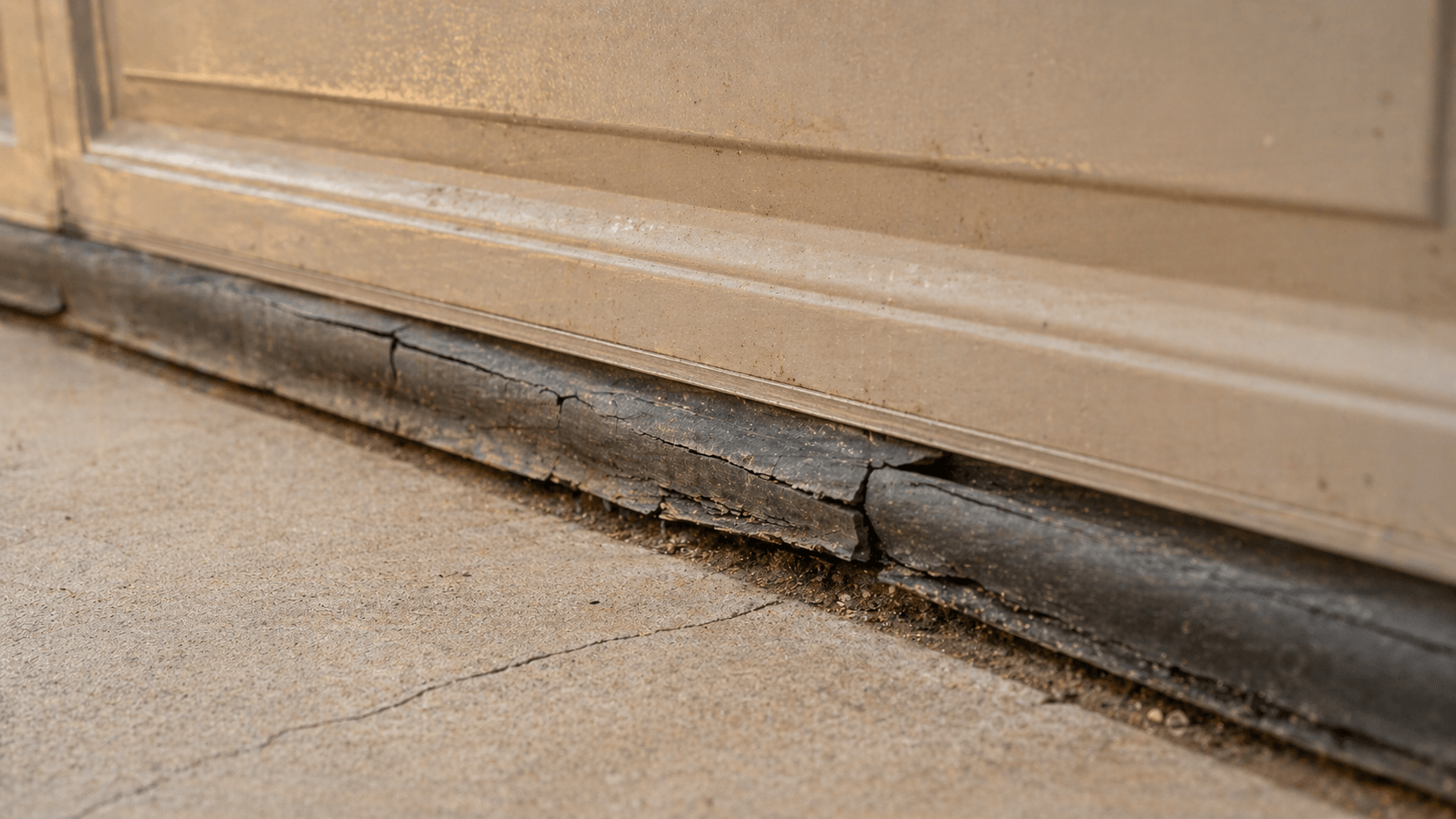
| Bottom weather seal (astragal) | 3–5 years | UV exposure, monsoon dust grinding under the door, daily compression cycles |
| Side / top jamb seal | 5–8 years | UV brittleness; usually the most overlooked maintenance item |
| Remotes / keypads | 5–10 years | Battery contacts, button wear, sun exposure on keypad housing |
| Safety photo-eye sensors | 10–15 years | Wire damage from string trimmers, dust on the lens, alignment drift |
Translation: by year 8–10, even on a healthy door, you should expect to start replacing some of these — usually springs, weather seal, and rollers — well before the door panels themselves are anywhere near end-of-life. That's normal, expected, and not a sign the door is "going bad."
Signs Your Garage Door Is Reaching the End of Its Life
Most aging garage doors don't fail dramatically — they degrade quietly until one day they don't open. Here's what to watch for:
- Visible panel fading or oil-canning: Faded, chalky paint on the sun-facing side. Wavy or rippled panels (oil-canning) caused by heat expansion. Cosmetic at first, but a sign the panel structure is fatiguing.
- Increasing noise on operation: Grinding, popping, or scraping sounds that are getting worse rather than going away after lubrication. Often points to bearings or rollers near the end.
- Slower or labored opening: The opener struggles, the door pauses partway up, or you can hear the motor working harder than it used to. Usually a spring tension issue or a door that's no longer balanced.
- Door won't stay halfway open: A balanced door should hold its position when raised manually 3–4 feet. If it slams down or shoots up, the springs are out of balance — one of the clearest signs they're nearing failure.
- Frequent track adjustments needed: Repeated off-track issues or scraping at the same spot suggests the panels themselves are losing their square shape.
- Daylight visible around the seal: If you can see a strip of light under the door when it's closed, your bottom seal is gone — and probably has been for a while. Replace it before monsoon dust gets through.
- Multiple components failing within months of each other: A spring, then a cable, then a roller, all within a year? That's an aging system, not bad luck.
For a deeper diagnostic walkthrough, our noisy garage door guide and 8 signs it's beyond repair post both cover specific symptoms in more detail.
Repair vs. Replace: A Decision Guide for Arizona Homeowners
Here's the framework we use on-site when a customer asks, "Should I just fix it, or is it time?" None of these are absolute, but together they make the call pretty clear.
| Situation | Repair | Replace |
|---|---|---|
| Door under 10 years old, single component failed | Repair | Not needed |
| Door 10–15 years old, occasional service calls | Repair + tune-up | Premature |
| Door 15–20 years old, multiple repairs in past 2 years | Short-term only | Strong case |
| Door 20+ years old, anything failing | Diminishing returns | Recommended |
| Repair cost > 50% of new door + install | Poor long-term value | Better investment |
| Vehicle impact damage (panels & tracks bent) | Rarely worth it | Almost always |
| Uninsulated door on attached AZ garage | Won't fix the heat | Worth considering |
| Cosmetic fade only, otherwise fine | Repaint or maintain | Optional / curb-appeal |
One nuance specific to Arizona: even when a door is technically repairable, an old uninsulated door attached to your living space is costing you money every summer in HVAC load. We've had customers replace functional 18-year-old single-layer doors with insulated steel and report meaningful drops in their July electric bills. If your door is also in the "borderline" category functionally, the energy math often tips the decision toward replacement.
How to Make Your Garage Door Last Longer in Arizona
The biggest difference between a 15-year door and a 30-year door isn't usually the brand or price tag — it's whether the homeowner stays ahead of small problems. Here's what we recommend for East Valley homes:
Lubricate moving parts
Use a silicone or lithium-based garage door lubricant on rollers, hinges, springs, and the opener rail. Skip WD-40 — it's a degreaser and dries out fast. In Arizona, lube goes in spring (before summer heat) and fall (after monsoon dust).
Get a professional tune-up
A real garage door tune-up includes a balance test, hardware tightening, spring inspection, cable check, sensor alignment, and lubrication. Doors that get this every year easily outlast doors that don't.
Replace the bottom seal
The astragal seal is cheap and easy to swap. Replacing it before it fully fails keeps dust and rain out of your garage and prevents track corrosion. Don't wait until you can see daylight under the door.
Repaint sun-faced doors
For steel doors on south or west exposures, plan on a fresh coat of exterior-grade paint every 8–12 years. It's far cheaper than a full door replacement and keeps panels protected from UV-driven oxidation.
Listen for new sounds
A door that's developed a new grinding, popping, or rattling sound is telling you something. Catching a worn roller at $20 is much cheaper than catching a snapped cable at $250 — plus the panel damage when it falls.
Upgrade to high-cycle springs
If you're already replacing standard springs, the upgrade to 25,000-cycle springs is usually a small percentage more and can double or triple the spring's lifespan. For households that use the door 5+ times a day, it pays for itself.
Why East Valley Homeowners Trust Farnsworth
We're a small, local operation — not a national chain. That means you get a straight answer based on what your door actually needs, not a sales script.
- Honest repair vs. replace assessment: If a $200 fix gets you another five years, we'll tell you. We'd rather earn your trust than push a replacement that doesn't make sense.
- Tune-ups that actually do something: Our tune-up service isn't a 10-minute glance — it's a full inspection of the door, springs, cables, opener, and sensors, with everything tightened, lubed, and balanced.
- Serving the entire East Valley: We cover Mesa, Gilbert, Chandler, Queen Creek, San Tan Valley, Scottsdale, Tempe, Phoenix, Apache Junction, Gold Canyon, Fountain Hills, Maricopa, and Guadalupe.
- 5.0 stars on Google: Our reputation comes from the work, not the marketing. Read what your neighbors have to say.
- 24/7 emergency service: Door stuck, spring snapped, or won't close at 11 PM? We answer the phone.
Frequently Asked Questions
How long does a garage door last in Arizona?
Most residential garage doors in Arizona last 15 to 25 years. Insulated steel doors with quality finishes routinely hit the high end, while uninsulated single-layer steel and unsealed wood doors often fall to the low end because Arizona's UV, heat, and monsoon dust accelerate fading, warping, and seal failure. With a yearly tune-up, the high end can stretch to 30 years or more.
Why do garage doors wear out faster in Arizona than in other states?
Three big reasons: extreme UV exposure that fades and breaks down paint and plastic seals; surface temperatures that can hit 150–160°F on a south-facing door, baking out lubricants and stressing components; and monsoon dust that infiltrates rollers, hinges, and weather seals. The day-to-night temperature swing in summer also expands and contracts panels and hardware repeatedly, which accelerates fatigue.
How long do garage door springs last?
Standard torsion springs are rated for around 10,000 cycles, which translates to roughly 7–10 years for a typical household using the door 3–5 times a day. High-cycle springs (25,000+ cycles) can last 18–25 years. In Arizona, heat doesn't dramatically shorten spring life — but rust from monsoon humidity and dust contamination can if the door isn't lubricated regularly.
How long does a garage door opener last?
Most modern garage door openers last 12–15 years. DC motor models with battery backup tend to last longer than older AC chain-drive units. Heat is the main enemy — openers in uninsulated Arizona garages run hotter every summer, which shortens motor and circuit board life. Keeping the garage cooler, lubricating the rail, and replacing batteries on schedule can stretch opener life to 18–20 years.
When should I repair vs. replace my garage door?
Repair if the door is under 15 years old, the issue is a single component (spring, cable, roller, panel), and the repair cost is well below 50% of replacement. Replace if the door is 20+ years old with recurring problems, multiple systems are failing within a couple years of each other, repair cost exceeds 50% of a new door, or the door has structural damage from a vehicle or storm. When the call is borderline, an on-site assessment from a tech you trust is the best tiebreaker.
Can regular maintenance really make my garage door last longer?
Yes — significantly. Doors that get an annual tune-up routinely last 5–10 years longer than doors that are run until something breaks. The biggest wins are lubricating rollers, hinges, and springs twice a year, replacing cracked weather seals before water gets in, catching early-stage cable wear before a snap takes the door out of service, and tightening fasteners that work loose with heat cycling.
Does Farnsworth service garage doors throughout the East Valley?
Yes — Farnsworth Garage Door Service repairs, replaces, and maintains garage doors across the entire East Valley and greater Phoenix metro, including Mesa, Gilbert, Chandler, Queen Creek, San Tan Valley, Tempe, Scottsdale, Apache Junction, Gold Canyon, Fountain Hills, Maricopa, Guadalupe, and Phoenix.
Want a Door That Actually Lasts?
Whether it's a tune-up, a repair, or a full replacement — we'll give you the honest answer for your home and your budget.