

Garage Door Won't Close? 9 Causes — and When to Call a Mesa Tech
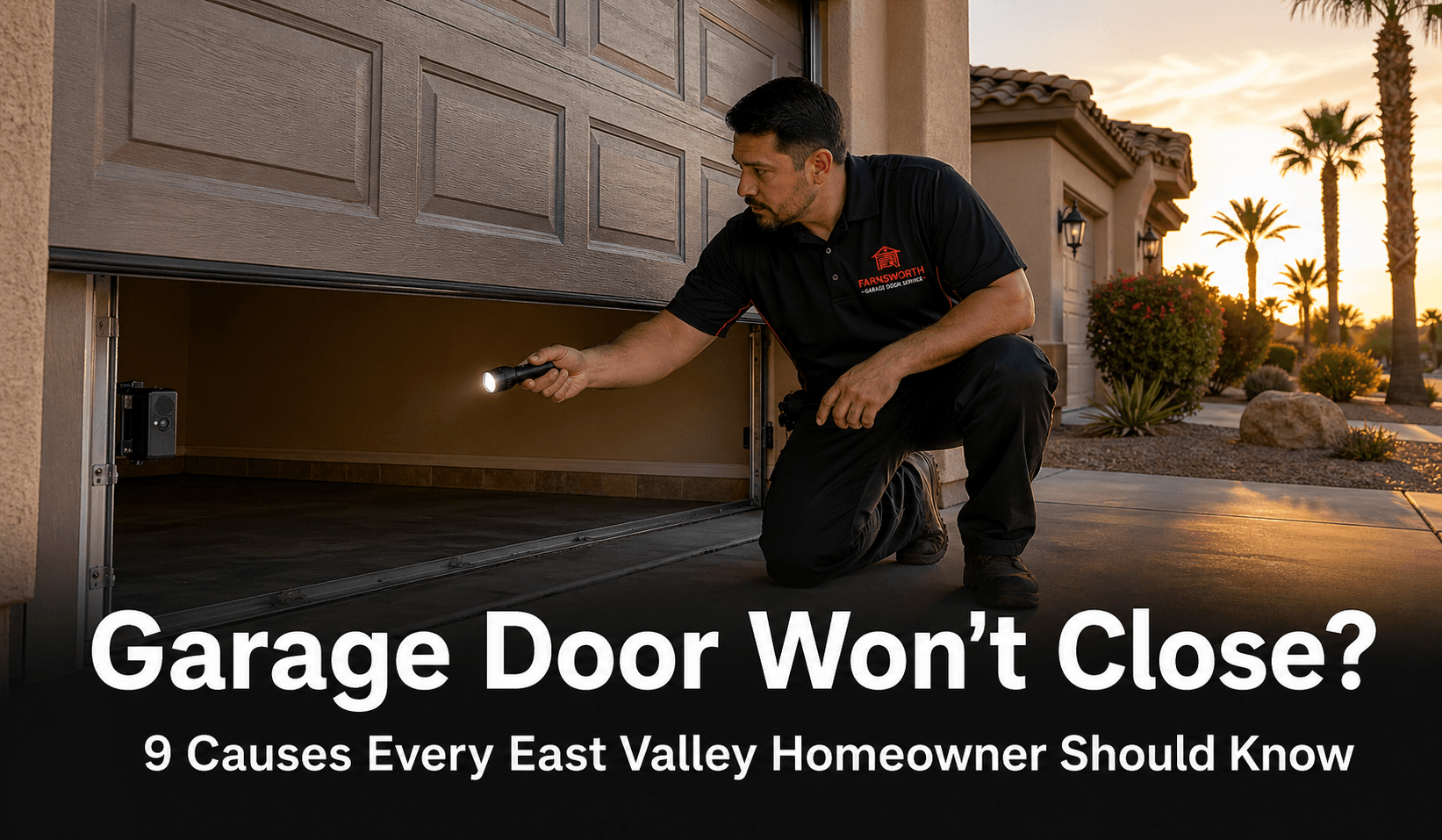
It's the opposite of the problem most people worry about — the door opens fine, but when you tap the button to close it, nothing happens. Or it starts down, jerks back up, or stops an inch from the floor and reverses every time. If you're watching this happen in Mesa, Gilbert, Chandler, Queen Creek, or anywhere across the East Valley, you're in good company — it's one of the top three calls our team takes every week.
The encouraging part: the cause is almost always something simple. Every residential garage door opener built since 1993 has a safety reversal system, and in most "won't close" calls, that system is working too well. The 9 causes below are listed roughly from most to least common. Work through them in order — and we'll flag the points where the right move is to stop and let a pro take it.
- Misaligned photo-eye sensors
- Wall console "lock" mode
- Track obstruction
- Close-limit out of adjustment
- Damaged sensor wire
- Worn rollers or binding track
- Frayed cables
- Off-track door
- Failing opener
- DIY vs. pro reference + FAQ
1. Misaligned or Dirty Photo-Eye Safety Sensors
If you take one thing from this article: at least 7 out of 10 "won't close" calls we run end up being the photo-eye sensors. They're the small black or amber boxes mounted about 6 inches off the ground on each side of the door. They beam an invisible signal across the opening — and if anything breaks that beam, or the sensors aren't pointed at each other perfectly, your opener will refuse to close.
How to diagnose it in 60 seconds
Look at the LEDs
Both sensor LEDs should glow solid. If one is off, blinking, or flickering, the pair is misaligned.
Wipe the lenses
East Valley dust is brutal. A thin film of grit can break the beam. Use a clean dry microfiber cloth.
Realign them
Loosen the wing nut, gently pivot until both LEDs are solid, then retighten. Don't over-tighten.
Watch for sun glare
Low-angle Phoenix sun can wash out the receiver eye. Shade it with your hand and try again.
One more clue: if your opener's overhead light blinks 10 times when you press the wall button, that's the universal "sensor fault" signal across LiftMaster, Chamberlain, and modern Genie units.
2. Wall Console "Lock" or "Vacation" Mode
This one fools homeowners constantly — even handy ones. Most modern wall consoles have a small Lock button or padlock icon. Hold it for a few seconds and the opener will refuse to close from the remote or keypad, even though the wall button still works. From outside, the door looks "stuck open."
Find the wall console near your interior garage entry door, look for the lock icon, and hold the button for 2–3 seconds until the LED changes or you hear a beep. We see it most often after houseguests or pest control visits.
3. An Obstruction on the Track or Under the Door
The opener has two jobs: lift, and refuse to close on anything that shouldn't be there. The "refuse" half is doing its job when something — a broom, a cat toy, a bag of mulch leaning against the inside of the door, even a stiff spider web stretched across the photo-eye beam — gets in the way.
Walk the opening. Look at the floor, look up at the side tracks for leaves or paint chips, and run a finger along the bottom rubber seal for stuck pebbles. If the door reverses about an inch off the floor, you've almost certainly found something. While you're there, glance at the rollers — cracked or wobbly ones are worth flagging on your next service call.
4. The Close-Limit Switch Is Out of Adjustment
Every opener has two limit switches: one for fully open, one for fully closed. If the close-limit is set even a quarter-inch too far, the opener thinks the door has already hit the floor and reverses to "protect" what it thinks is an obstruction.
How to spot a close-limit problem
- The door reverses just before hitting the floor every single time.
- The opener's overhead light flashes after the reverse (often 5 flashes for a force/limit fault).
- The sensors are clean and aligned — both LEDs solid.
- Nothing is on the floor in the doorway.
On most LiftMaster and Chamberlain units the close-limit is a small dial on the back of the motor head; Genie uses a "limit set" button procedure. Adjusting these is doable, but it's also easy to make the problem worse — and on belt-drive units the trolley can over-travel and damage the rail. We generally recommend leaving this one to a tech.
5. A Damaged or Pinched Sensor Wire
The thin pair of wires running from each photo-eye to the opener can be nicked by a weed trimmer, chewed by mice, pinched by a staple, or cooked brittle by Arizona attic heat. When the wire is cut or shorted, the sensors lose power and the door refuses to close. Telltale signs: one sensor LED is completely off while the other glows solid, you see exposed copper or staples biting into the wire, or wiggling the wire makes the LED flicker. Tracing a short is tedious — our techs carry replacement sensor sets, so this is typically a quick visit.
6. Worn Rollers, Hinges, or a Binding Track
If your door starts down, slows or grinds halfway, then reverses, the opener may be reading the extra friction as an obstruction. With the door closed, look at the rollers (cracked, wobbly?), hinges (bent or rusted?), and tracks (straight, no dents from a bumper?). A binding door is usually also loud — listen for grinding, popping, or scraping sounds you may have been ignoring. A routine tune-up resolves about 80% of binding issues by replacing rollers, lubricating tracks, and resetting hinge alignment.
7. Stretched or Frayed Cables
The lift cables run from the bottom corners of the door to the drums on the torsion shaft, carrying the door's entire weight. After years in heat-stressed Arizona garages they fray, stretch, or slip off the drum — and when they do, the door sits unevenly and the opener reads the imbalance as an obstruction. Visual signs: the door looks crooked when open, a cable hangs slack, or daylight peeks through a corner when the door is closed.
8. An Off-Track Door
Sometimes a "won't close" call is really an off-track call in disguise. If a roller has popped out of the vertical track — usually after a snapped cable, a bumper tap, or a broken hinge — the door sits crooked, the opener senses the binding, and refuses to continue. From the driveway, it just looks "stuck."
Signs of an off-track door: a visible gap between a roller and the track, one side of the door sitting higher than the other, or a loud bang or scraping sound right before the trouble started.
9. A Failing Opener Logic Board or Motor
If you've worked through everything above and the door still won't close, the opener itself is the suspect. Arizona heat is murder on these units — Phoenix garage attics routinely top 150°F in July, which cooks capacitors and plastic gears far faster than in cooler climates. Most East Valley openers last 8–12 years; we've seen plenty die at 6.
Symptoms of an opener-side problem
- Motor hums but trolley doesn't move: stripped main drive gear.
- Random reversals with no pattern: usually a heat-stressed logic board.
- Door closes, then immediately reopens: stuck close-limit or failing board.
- Burning smell: unplug the opener immediately — fire risk.
If your opener is over 8 years old and acting up, a full replacement is often a better value than chasing repairs.
DIY vs. Professional Repair
| Issue | DIY Safe? | Call a Pro? |
|---|---|---|
| Misaligned or dirty sensors | Yes | Only if needed |
| Wall console lock mode | Yes | No |
| Track obstruction | Yes | No |
| Close-limit adjustment | Risky | Recommended |
| Damaged sensor wire | Maybe | Usually |
| Worn rollers / binding track | Limited | Tune-up |
| Frayed cables | Never | Yes |
| Off-track door | Never | Urgent |
| Opener logic board | No | Yes |
| Burning smell | Unplug it | Urgent |
Why East Valley Homeowners Call Farnsworth
- Local and family-owned: we live and work in the East Valley. Your neighbors are our customers.
- Same-day service: most repairs scheduled before noon are completed the same day across Mesa, Gilbert, Chandler, Queen Creek, Tempe, and Phoenix.
- Upfront pricing: a real number before we start — no high-pressure upsells.
- Licensed and insured Arizona contractors.
- 5.0 stars on Google: built one happy neighbor at a time.
Frequently Asked Questions
Why won't my garage door close all the way?
The most common cause is a misaligned or dirty pair of safety photo-eye sensors near the bottom of the tracks. Other frequent culprits: a close-limit out of adjustment, the wall console set to lock mode, an obstruction on the track, a damaged sensor wire, worn cables, or an off-track door. Start by checking that both sensor LEDs glow solid and nothing is in the door's path.
Why does my garage door go down a few inches and then go back up?
The opener's safety system has detected a problem. Most common causes: blocked or misaligned photo-eyes, a too-sensitive close-force setting, a worn roller catching on the track, or an actual obstruction. Check the sensors first — both LEDs should be solid — and clear anything from the door path. If it persists, the close-limit may need adjustment.
How do I reset my garage door safety sensors?
Loosen the wing nut on each sensor bracket, gently pivot until both LEDs glow solid, then retighten. Wipe each lens with a clean dry microfiber cloth. If the LEDs still won't stay solid, you likely have a damaged wire or failed sensor — call a technician.
Is it safe to leave my garage door open overnight if it won't close?
No. A door that won't close leaves your home unsecured and lets in dust, pests, and monsoon rain. If same-day service isn't available, disengage the opener with the red emergency cord and lower the door manually — but only if the springs are intact and the door isn't off-track.
How much does it cost to fix a garage door that won't close in Mesa?
It depends on the cause. Sensor realignment and wall-console resets are quick, low-cost fixes. Replacing sensors or adjusting the close-limit is mid-range. Spring replacement, opener replacement, or off-track repair are bigger investments but routine for our team. Farnsworth provides free, upfront quotes — call (602) 935-9766.
Do you offer same-day garage door repair in the East Valley?
Yes. Farnsworth offers same-day and emergency garage door repair across Apache Junction, Chandler, Fountain Hills, Gilbert, Gold Canyon, Maricopa, Mesa, Phoenix, Queen Creek, San Tan Valley, Scottsdale, and Tempe. If your door is stuck open and your home is unsecured, call right away — we prioritize those calls.
Garage Door Still Won't Close?
Don't sleep with your home wide open. Our licensed East Valley technicians can usually be at your door the same day with a fully stocked truck. Free quotes, upfront pricing, no pressure.
Call (602) 935-9766 Book Online