

Broken Garage Door Spring? How to Spot It and What It Costs to Fix in Arizona
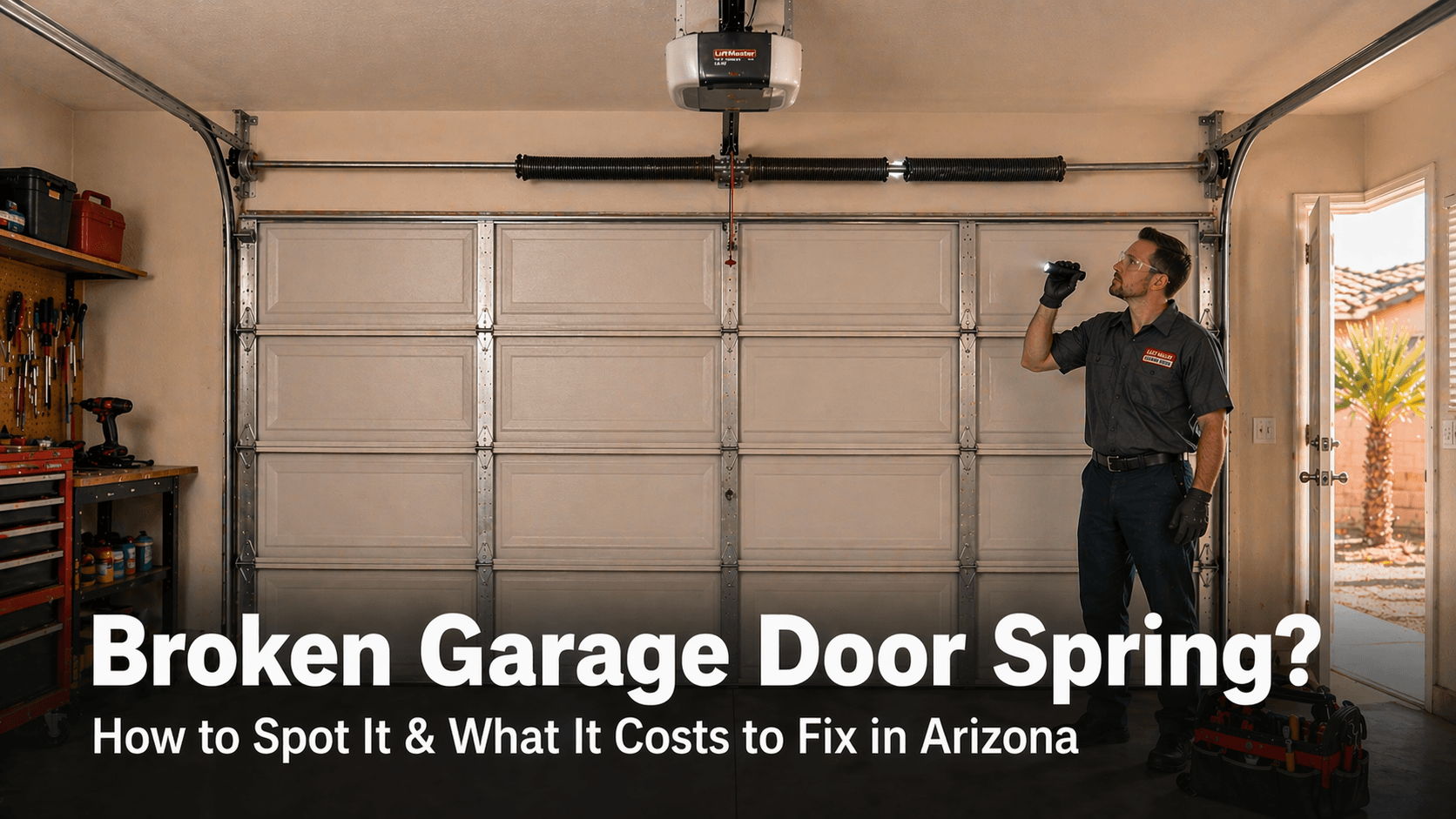
We get calls about broken springs every week. It's the number-one service call in residential garage door repair — not just in Arizona, but across the country — because every single spring has a finite lifespan and every door eventually wears through it. The good news is that a broken spring is almost always a clean, self-contained problem. It breaks, we replace it, the door works again. The bad news is that it doesn't give you much warning, and when it happens, your car is usually stuck inside.
We wrote this guide to help our neighbors in Mesa, Gilbert, Chandler, Queen Creek, Scottsdale, Tempe, and the rest of the East Valley know what they're dealing with when a spring snaps — and what a fair repair looks like. No scare tactics, no pricing pressure, no hard upsell. Just what you actually need to know.
7 Signs Your Garage Door Spring Is Broken
Most of the time a broken spring is obvious the moment it happens — you hear it. But not always. Sometimes the spring fails quietly overnight and you just wake up to a door that won't behave. Look for any of these seven signs:
1. You heard a loud bang — like a gunshot in the garage
Torsion springs are under tremendous rotational tension. When one snaps, the stored energy releases all at once with a sharp, startling crack. People commonly describe it as a gunshot, a 2×4 dropping onto concrete, or a bowling ball hitting the floor. If you heard that sound and your door stopped working right after, the spring is almost certainly the culprit.
2. The opener runs but the door barely moves
This is the classic post-break symptom. You press the wall button or remote, the opener motor runs normally, the belt or chain engages — but the door only jerks up an inch or two and stops. That's the opener trying to do the spring's job and failing. An opener is designed to guide a counterbalanced door. It is not designed to lift a 150–200-pound door by itself.
3. You can see a visible gap in the spring coils
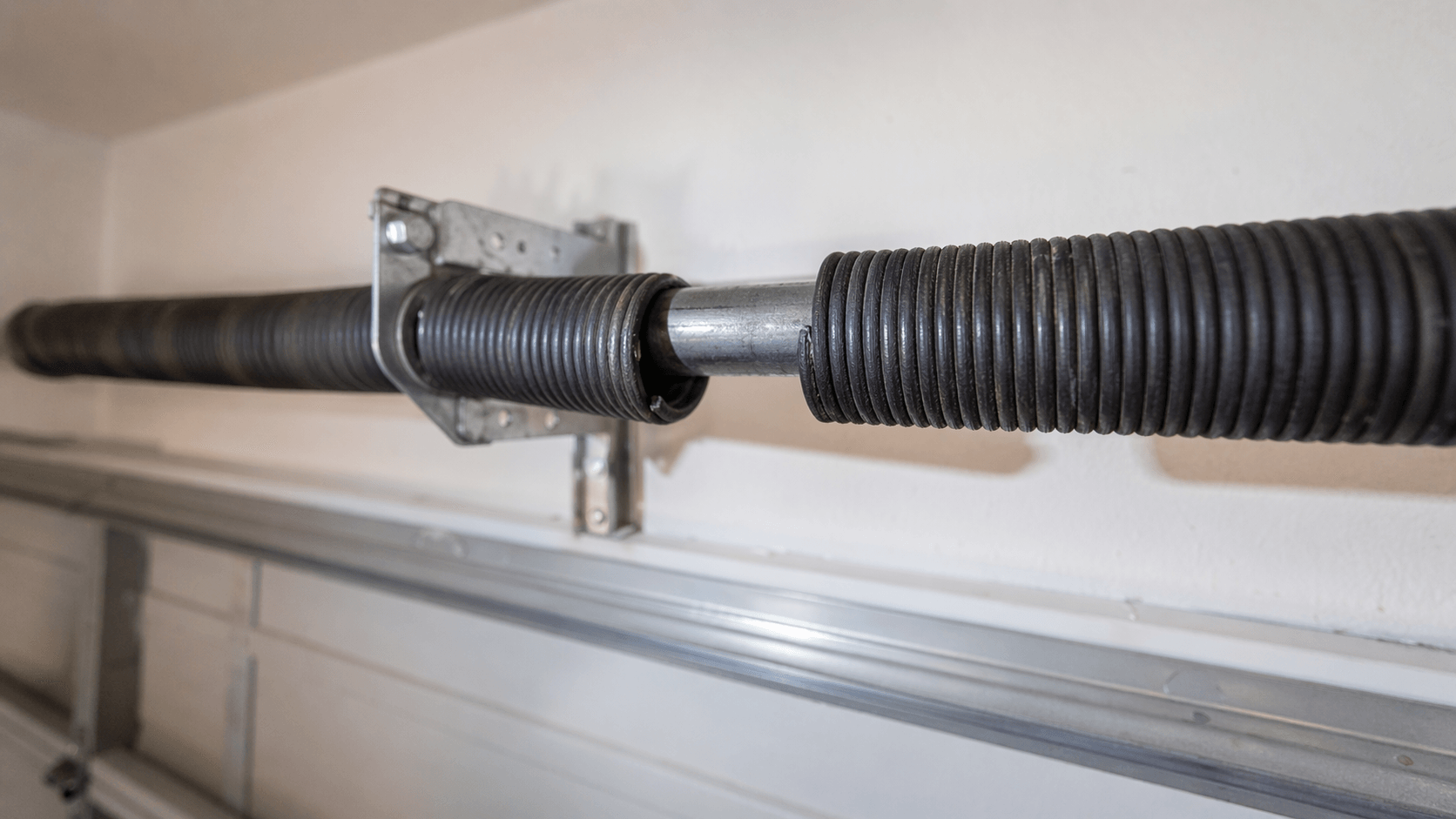
Go into the garage and look at the torsion spring — the tightly wound steel coil mounted horizontally on the shaft above the door. A healthy spring is one continuous coil with no breaks. If you see a 2-inch gap where the coil has clearly separated into two pieces, that's a broken spring, plain and simple. You may also see this on a two-spring system where only one has snapped (the other spring is still intact).
4. The door is extremely heavy when you try to lift it manually
A properly counterbalanced garage door should be light enough to lift with two hands — roughly 8–10 pounds of lifting effort even though the door itself weighs 150+ pounds. If you pull the red emergency release cord and the door feels like a lead weight, the spring has failed. Do not try to force it up to get your car out. Call a professional.
5. The door has been getting slower or harder to open for weeks
Springs don't always fail in one sudden snap — sometimes they warn you first. If the door has felt sluggish lately, if the opener sounds like it's straining, or if you've noticed the door stops for a second mid-travel before continuing, the spring is losing tension and nearing end of life. Catching this before a full break is a huge win — a planned repair is much less stressful than a "car trapped in the garage" emergency call.
6. The door opens a few inches then slams shut
Some modern openers have force sensors that detect when the door is too heavy and automatically reverse to prevent damage. If the opener starts lifting, realizes the load is all wrong, and lets the door drop — that's a sign the counterbalance system (spring + cables) has failed.
7. A loose cable is hanging off to the side
When a spring breaks, it often takes the cable with it — or the cable slips off the drum because the shaft is no longer under tension. If you see a steel cable dangling loosely next to the door or coiled on the floor, that's a clear sign the counterbalance system is out. Do not try to re-route the cable yourself — winding and tensioning is precision work.
Why Garage Door Springs Break
Springs don't break because of bad luck. They break because they have a finite lifespan measured in cycles, and every spring eventually reaches the end of it. Understanding why makes the repair a lot less stressful.
The cycle rating — the number most homeowners don't know about
Every torsion spring is rated for a specific number of cycles, where one cycle equals one full open-and-close. A standard residential spring is rated at roughly 10,000 cycles. That sounds like a lot until you do the math:
- 3 cycles per day: ~9 years of life
- 4 cycles per day: ~6.8 years of life
- 5 cycles per day: ~5.5 years of life
- 7 cycles per day (families using the garage as the main entry): ~4 years of life
So when a 7-year-old spring snaps on a busy family's door, that's not an unusual failure — that's the spring hitting its rated end-of-life right on schedule.
What accelerates spring failure in Arizona
A few factors speed up the natural cycle-fatigue process in our climate:
- Heat cycling: Arizona garages can swing from 50°F at night in winter to 140°F in summer afternoons. Steel expands and contracts with temperature, and repeated thermal cycling fatigues the metal faster than in milder climates.
- Lack of lubrication: Dust and heat dry out spring lubrication faster here than almost anywhere else. A dry spring experiences more friction at every cycle, and that wear is cumulative.
- Undersized original springs: Builder-grade springs are often sized for the cheapest rating that technically meets the door weight. Once insulated panels, hurricane-rated glass, or decorative hardware get added, the original spring can be under-spec'd.
- Rust and humidity: Monsoon-season humidity, plus dust storms depositing fine particulates into coil gaps, creates micro-pitting on the steel that weakens it over time.
Torsion Springs vs. Extension Springs — What You Actually Have
There are two types of garage door springs. Modern residential doors almost always use torsion springs. Older Arizona homes (roughly pre-1995) sometimes still have extension springs. Knowing which you have matters for repair and replacement.
| Feature | Torsion Spring | Extension Spring |
|---|---|---|
| Location | Mounted on a steel shaft directly above the door opening | Mounted along the horizontal tracks, running parallel to the ceiling |
| How it works | Twists around a shaft to store energy — rotational tension | Stretches and contracts to store energy — linear tension |
| Lifespan | Typically 10,000 cycles (high-cycle upgrades available) | Typically 5,000–10,000 cycles; wears unevenly |
| Safety | Safer when installed correctly | Requires safety cables by code |
| Door balance | Smooth, even lift through travel | Can feel jerky or uneven, especially on wider doors |
| Noise | Quieter | Typically louder; more moving parts |
| Modern code | Standard for new installs | Legacy — often converted to torsion |
If your home still has extension springs, a broken one is a great opportunity to convert to a modern torsion system. The torsion setup is quieter, safer, easier to balance, and lasts longer. Farnsworth handles extension-to-torsion conversions routinely across the East Valley.
What Does Garage Door Spring Replacement Cost in Arizona?
We don't publish fixed pricing because every job is different — and frankly, any company that quotes you a firm number over the phone before seeing the door is either guessing or planning to surprise you later. That said, here's a transparent look at what actually drives the cost of a spring replacement in the Phoenix metro, so you know what to ask about when you call for a quote.
What affects the price
1. One spring or two
Most modern residential doors use a two-spring system. When one breaks, we strongly recommend replacing both at the same time — both springs have gone through the same cycles, and the second is statistically very close to its own breaking point. Replacing both at once is only marginally more than doing one, and it prevents a second service call in a few months.
2. Spring size and wire diameter
Springs are sized to the weight of your specific door — a 9×7 uninsulated steel door weighs around 90–110 lbs, a 16×7 insulated door can run 140–180 lbs, and a solid wood door can exceed 250 lbs. Heavier doors need larger-diameter wire, which costs more per spring. Wire diameter runs from around .207 inches on the light end to .295+ on heavy doors.
3. Cycle rating (standard vs. high-cycle)
Standard springs are rated at 10,000 cycles. High-cycle springs are available at 20,000, 25,000, 50,000, and even 100,000 cycles. These cost 15–30% more up front but can double or triple the lifespan of the repair. For busy households, it's a smart upgrade that pays back in fewer service calls.
4. The condition of surrounding hardware
When a spring snaps, it often damages the cables. Old drums, bearings, and the center bracket may also be due for replacement at the same time. A tech who's already inside the system can swap these parts at marginal cost — and skipping them means you'll be paying for another service call soon. We'll always tell you what is and isn't necessary; nothing is pushed.
5. Extension-to-torsion conversion
If you have old extension springs and want to convert to a modern torsion system, that's a bigger job — new shaft, new drums, new brackets — and costs more than a like-for-like spring swap. But it's often the right long-term call for a 20+ year old door.
What to expect from a fair quote
Any reputable East Valley garage door company should be able to give you a written quote on site, before work begins, that clearly lists:
- How many springs are being replaced
- The cycle rating of the new spring(s)
- Whether cables and other wear parts are included or separate
- Labor and trip charges broken out
- Warranty on parts and workmanship
If a company won't put that in writing, or refuses to quote before "inspecting" the door, that's a red flag. Our Farnsworth spring quotes are always written, itemized, and given before we turn a wrench.
Why DIY Spring Replacement Is a Very Bad Idea
We're big believers in DIY when it's safe. Lubricating your door, tightening hardware, programming a remote — those are homeowner jobs, and we've written guides for them. Spring replacement is not one of those jobs. It's one of the most dangerous home repair tasks in residential construction, and the injury rate on amateur spring replacements is serious enough that every major garage door manufacturer explicitly warns against it in the owner's manual.
What's actually happening inside a torsion spring
A typical residential torsion spring is wound with 7–8 full turns of stored rotational tension. That tension is roughly equivalent to a 150-pound person standing on a 12-inch lever arm — constantly, for years. If that energy releases suddenly and unexpectedly (for example, if a winding bar slips out of the cone), it releases all at once, with enough force to break bones, take out an eye, or worse. This is not a scare tactic. It's physics.
The sizing problem almost nobody talks about
Even if you safely removed and installed a spring, you have to get the size right. A correct replacement requires four precise measurements:
- Wire diameter — measured using the 20-coil method (count 20 coils, measure the total length in inches, divide by 20). Off by 0.01 inches and the spring is the wrong strength.
- Inside diameter — the inner opening of the coil (commonly 1-3/4", 2", 2-1/4"), which determines what size shaft it fits.
- Spring length — the compressed coil body only, not including the end cones.
- Wind direction — right-wound springs mount on the left, left-wound on the right. A two-spring system requires one of each.
Get any of these wrong and you either burn out your opener in six months, leave the door dangerously unbalanced, or install a spring that immediately snaps. Home improvement stores don't carry the full range of wire diameters anyway — pros order from wholesale spring suppliers with tight cross-reference catalogs.
The economics don't work out either
The tools alone — proper winding bars, a vice-grip C-clamp set, a torque-rated socket wrench, and accurate calipers — cost more than a professional replacement. Then you still need to measure correctly, source the right parts, and tension the spring safely. Professional labor is a fraction of what you'd spend to do it once yourself — and you'd have the insurance, warranty, and peace of mind on top.
What to Do Right Now If Your Spring Just Broke
If your spring snapped in the last hour, here's exactly what we'd tell a neighbor over the phone:
- Stop operating the door. Don't keep pressing the opener button hoping it'll go. You'll burn out the motor, break a cable, or damage the panels.
- Don't try to lift the door manually. A 150-pound door with no counterbalance can fall quickly and seriously injure anyone standing under it — especially kids or pets.
- If your car is inside, leave it. A tech can open the door safely when they arrive. Trying to muscle the door up yourself risks injury and often makes the repair worse.
- Lock the door lever or engage the manual lock if you have one, so no one can try the opener from another remote.
- Call a local, licensed garage door company (that's us — (602) 935-9766). A spring call is typically 60–90 minutes on site and most are handled same-day.
- Document anything unusual — if you heard the bang at a specific time, or see visible damage to panels or cables, mention it when you call. It helps us bring the right parts on the truck.
How Long Will a New Spring Last?
A new, properly sized spring installed by a qualified tech should last close to its rated cycle life. Here's a realistic expectation based on the cycle rating you choose:
| Cycle Rating | Avg. Life at 3 Cycles/Day | Avg. Life at 5 Cycles/Day | Best For |
|---|---|---|---|
| 10,000 (standard) | ~9 years | ~5.5 years | Light-use households, budget repairs |
| 20,000 (high-cycle) | ~18 years | ~11 years | Average households, smart long-term pick |
| 25,000 (heavy-duty) | ~22 years | ~13 years | Families that use the garage as the main entry |
| 50,000+ (commercial-grade) | ~45 years | ~27 years | Heavy-use doors, commercial applications |
A simple way to stretch spring life: lubricate quarterly. A light coat of white lithium grease along the spring coil reduces friction and noticeably slows cycle fatigue. It takes 10 minutes and can add a year or two to the spring's life.
Why Neighbors Call Farnsworth for Broken Spring Repair
We're a small, local East Valley operation — not a national chain and not a franchise. When you call, you get us.
- Same-day service: Spring replacement is our most common call, and trucks are stocked with the most common sizes for East Valley homes.
- Honest written quotes: Every spring job gets an itemized quote before any work starts. No bait-and-switch, no surprise add-ons.
- We replace springs in pairs when it's warranted — and we tell you when it isn't. If only one spring needs replacing and the other has plenty of life left, we'll say so.
- High-cycle upgrades available: If you'd rather pay 20% more once and forget about springs for a decade-plus, we'll explain the cycle-rating options and let you choose.
- Local coverage across the East Valley: Mesa, Gilbert, Chandler, Tempe, Scottsdale, Queen Creek, San Tan Valley, Apache Junction, Gold Canyon, Fountain Hills, Phoenix, Guadalupe, and Maricopa.
- 5.0 stars on Google: Our neighbors trust us — and tell their neighbors.
Frequently Asked Questions
How do I know if my garage door spring is broken?
The three biggest giveaways are: (1) you heard a loud bang from the garage — like a gunshot or a 2×4 dropping onto concrete; (2) the opener motor runs but the door barely moves or only opens a few inches; and (3) the door feels extremely heavy if you try to lift it manually. Go into the garage and look at the torsion spring above the door. If you see a visible 2-inch gap in the coils where it has separated, that's a broken spring. Stop using the door and call a professional.
How much does it cost to replace a garage door spring in Arizona?
Cost varies based on spring size, wire diameter, cycle rating, whether it's a single- or two-spring system, and the condition of surrounding hardware. Single-spring replacements are the lowest cost; replacing both springs on a two-spring system (which we recommend when one fails) is the most common residential job. Any quote you get should specify how many springs are being replaced, the cycle rating, and whether cables and wear parts are included. Farnsworth provides a written itemized quote on every call before any work begins.
Can I replace a broken garage door spring myself?
We strongly recommend against it. A torsion spring stores hundreds of pounds of rotational energy — enough to cause serious injury if it releases unexpectedly during a repair. Beyond the danger, sizing a replacement spring requires precise measurement of wire diameter, inside diameter, length, and wind direction, plus accurate door-weight calculations. The wrong spring will burn out your opener or leave the door dangerously unbalanced. The cost of a professional replacement is small relative to the specialized tools, correct parts, and risk involved.
Should I replace both springs if only one is broken?
Yes — on a two-spring system, you should replace both at once. Both springs have gone through the same number of cycles, so if one has failed, the other is very close behind. Replacing just the broken one almost always means paying for a second service call in a few months, and an unbalanced spring pair strains the opener. Replacing both together costs only marginally more and solves the problem for years.
How long does a spring replacement take?
A straightforward residential torsion spring replacement typically takes 60–90 minutes on site — including measurement, removal, installation, proper tensioning, a balance test, and lubricating the full system. Older systems with worn cables, drums, or bearings, or extension-to-torsion conversions, take longer. Farnsworth carries the most common spring sizes on every truck, so most East Valley spring calls are completed in a single visit.
Why do garage door springs break in the cold?
Arizona winter mornings are cold enough (40–55°F) that steel contracts slightly and becomes more brittle. Combined with the loss of elasticity in dry, dusty spring lubricant, the first cycle of a cold morning is often when an aging spring finally gives out. It's not that the cold caused the failure — the spring was already near end-of-life — but the temperature change is often the trigger.
Do you service broken garage door springs in Mesa, Gilbert, Chandler, and the East Valley?
Yes — Farnsworth Garage Door Service handles broken spring calls across Mesa, Gilbert, Chandler, Tempe, Scottsdale, Queen Creek, San Tan Valley, Apache Junction, Gold Canyon, Fountain Hills, Phoenix, Guadalupe, and Maricopa. Spring breaks are one of the most common service calls we run, and trucks are stocked so most jobs are handled same-day.
Broken Spring? Let's Get You Back in the Garage.
Most East Valley spring replacements are completed same-day. Call or book online for a fast, honest quote — written and itemized before any work begins.